Strong Campbell Interest Inventory: Expert Guide 2026

A student sits across from you with a course calendar open on their phone, or an adult arrives saying they're tired of “guessing” at the next move. They don't need a pep talk. They need a clear read on what kind of work fits, what doesn't, and how far to trust the result.
The Strong Campbell Interest Inventory has stayed relevant because it answers that narrower question well. It is built to map preferences to occupational themes, then turn that pattern into counselling conversation, not a verdict. Used properly, it helps a school counsellor, rehabilitation clinician, or career coach narrow the field before anyone starts talking about training, aptitude, or job search strategy.
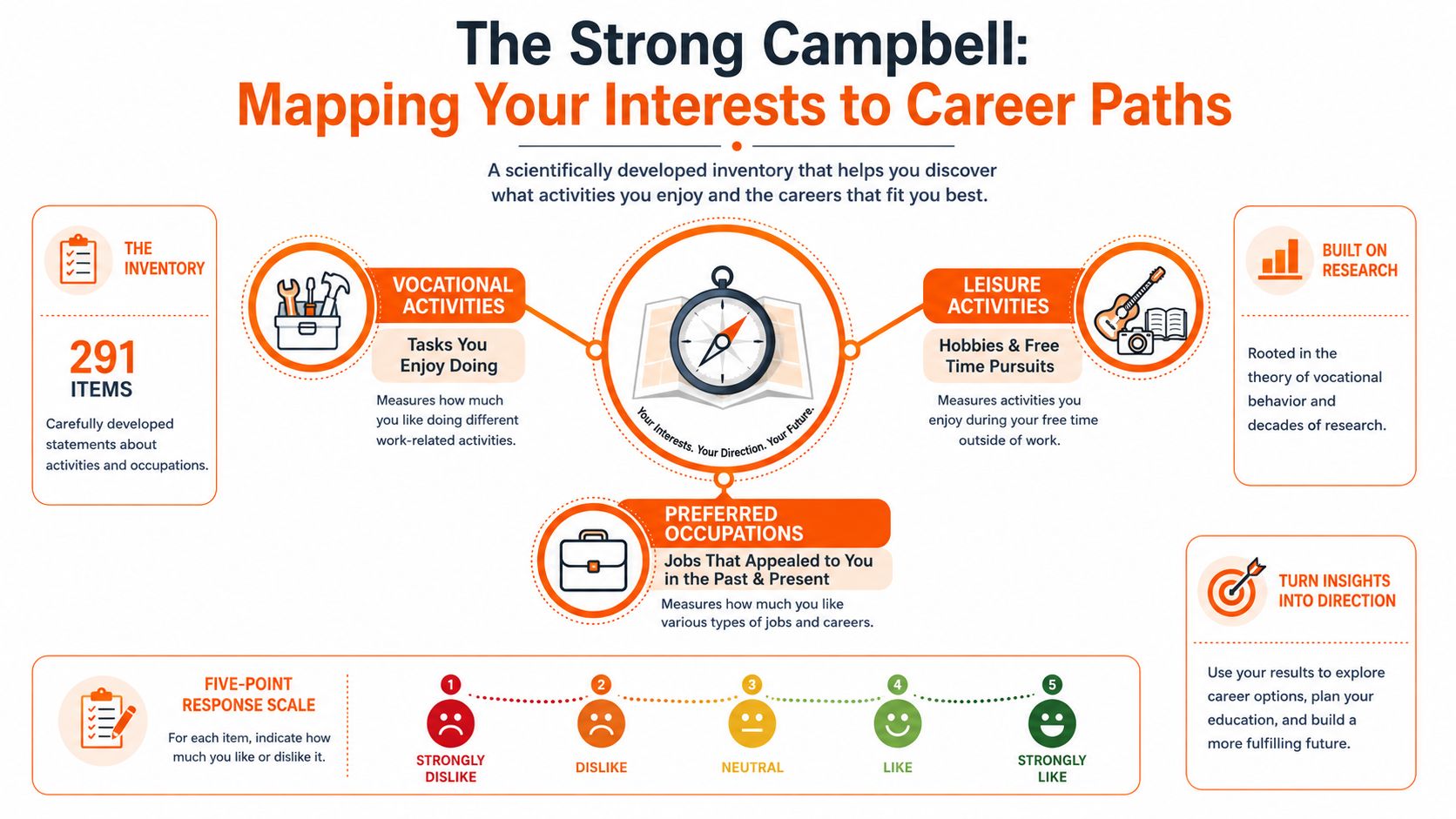
What the Strong Campbell Interest Inventory Actually Measures
A Grade 11 student often shows up thinking they need to choose a university stream before they've even named what kind of work energises them. An adult in career transition can be in a similar spot, only with a mortgage, a resignation letter, and less patience for vague advice. In both cases, the Strong is useful because it starts with preference, not performance.
Practical rule: if the client wants a single answer about who they are, the Strong will frustrate them. If they want a map of where their interests fit, it can be a strong starting point.
The Strong Campbell Interest Inventory became a major vocational-interest tool in the 1980s, and by the time Strong materials were widely used in counselling services, it was described as one of the four most widely used interest inventories in high school and college counselling, alongside Kuder and related instruments. A California university dissertation analysing SCII and CAI results also found statistically significant sex-based differences in RIASEC distributions at the .01 level. For the SCII, males were more likely to fall in the Artistic theme, while females were more likely to fall in the Realistic and Conventional themes, which is one reason a good interpreter watches the pattern instead of forcing a stereotype. University of the Pacific dissertation on SCII and CAI results
The practical distinction matters. Interests tell you what someone is drawn to. Aptitudes tell you what they can do well. Personality describes how they tend to operate across situations. A strong profile may point a student toward engineering support work, design, healthcare, teaching, business, or trades exploration, but it does not measure academic readiness, processing speed, or attention on its own. For that, I pair it with cognitive screening, and I keep a separate conversation about skill development.
For readers who want a cleaner grounding in testing logic, the overview at what is cognitive assessment is a useful companion. It helps distinguish a vocational-interest profile from an objective cognitive profile, which is where many counselling mistakes begin. I also see people cross-reference interest patterns with resources like INTJ salary insights, then forget that type descriptions are not the same thing as test data.
The phrase I use at the desk is simple.
The Strong tells you what looks attractive, not what is guaranteed to succeed.
That framing keeps the rest of the process honest.
How the Test Is Structured and What the Scales Mean
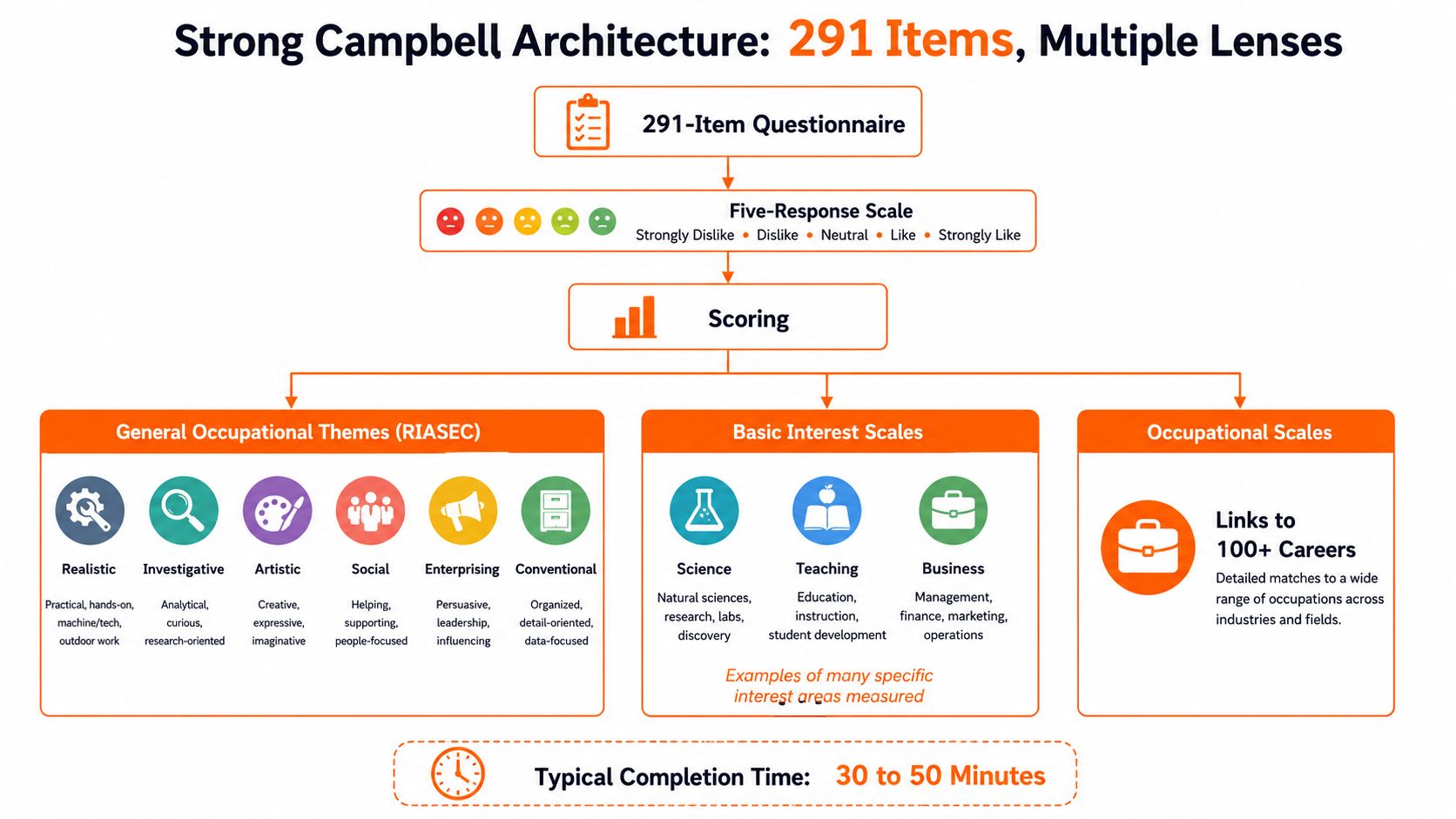
A client usually meets the Strong Interest Inventory as a 291-item questionnaire with a five-response format that takes about 30 to 50 minutes to complete. That structure matters because it separates a formal vocational profile from a casual “what jobs do you like” survey. The inventory is built around Holland's six RIASEC themes, Realistic, Investigative, Artistic, Social, Enterprising, Conventional, and it turns item responses into an occupational-fit profile rather than a diagnostic label. Strong Interest Inventory overview
The profile works like a matching screen
A matching screen does not judge character, skill, or dependability. It checks responses against stored patterns and shows where there is overlap. The Strong uses that same logic. It compares a client's answers with profiles from people satisfied in different occupations, then reports where the similarities and gaps sit.
That is why the output is a profile, not a single score. A client may show a stronger pull toward Investigative and Social work, but the interpretation lives in the pattern, not in one number. At the counselling desk, that pattern can point toward nursing, psychology, public health, research support, or technical training, depending on the rest of the case. The same result can also help an adult client see that the problem is not low ability, it is a poor environment fit.
The scales are layered on purpose
The first layer is the General Occupational Themes. Under that sit Basic Interest Scales, which split the broad themes into narrower preferences. Below that are Occupational Scales, which connect those preferences to named careers. That layered design lets a clinician move from broad inclination to concrete options without jumping straight to a job title.
The Strong Campbell Interest Inventory is most helpful when a client says something broad like "I like helping people." It sharpens that statement into something more usable, showing whether the preference lines up with teaching, social service, counselling, health care, or other structured paths. It still does not decide the final answer, because interest data does not settle training, fit, or labour-market access on its own.
For a related testing model that many clients confuse with interest work, the discussion at personality assessment inventory provides a clearer contrast. The Strong is not a personality inventory. It is a vocational fit tool, and that narrower purpose is exactly why interpretation matters.
Administration, Scoring, and What Reliability Numbers Tell You
The Strong is usually administered on paper or online, then scored into a report that a qualified interpreter reviews with the client. That interpreter should not treat the output as a self-explanatory printout. The report is only useful when someone can explain what is stable, what is noisy, and what needs follow-up.
The reliability numbers are why the Strong has remained credible in practice. A U.S. Department of Justice and NCJRS abstract on police selection reported a 30-day test-retest median correlation of .88, which indicates very high short-term stability in that sample. Broader history on the SCII also reports median test-retest correlations of r = .91 over a 2-week interval, r = .70 to .78 over 2 to 5 years, and .64 to .72 after 20+ years. Those figures tell a useful story: interests are stable enough to support long-term counselling, but they are not frozen for life. NCJRS abstract on Strong-Campbell use in police selection
How to read those numbers at the desk
A high correlation over a short interval means the tool is not wobbling from one administration to the next. A lower long-range correlation does not mean the test is broken. It means life, work, education, illness, family demands, and experience do change the shape of a person's interests over time.
That's why I caution clients against treating a teenage profile as a permanent sentence. A 17-year-old who leans toward hospital work may still become a data analyst, and an adult who once loved field-based work may now want a desk role for practical reasons. The Strong can follow those shifts, but it should not be used to police them.
Clinical point: confidence intervals and standard error of measurement matter because no scale is perfectly exact. Small differences between adjacent scales are often less meaningful than the overall cluster.
A good scorer explains that before any career decision gets made. The question is not whether the client got a “good” or “bad” score. The question is whether the pattern is stable enough, distinct enough, and useful enough to inform the next step.
For a broader look at score stability in assessment work, the discussion at test-retest reliability is a practical companion.
SCII Test-Retest Reliability at a Glance | ||
|---|---|---|
Interval | Median Correlation | Clinical Implication |
30 days | .88 | Strong short-term stability for applied use |
2 weeks | .91 | Very high immediate consistency |
2 to 5 years | .70 to .78 | Useful for long-range counselling, with expected life change |
20+ years | .64 to .72 | Interests remain informative, but adult roles and context matter |
How the Strong Campbell Interest Inventory Compares With Related Tools
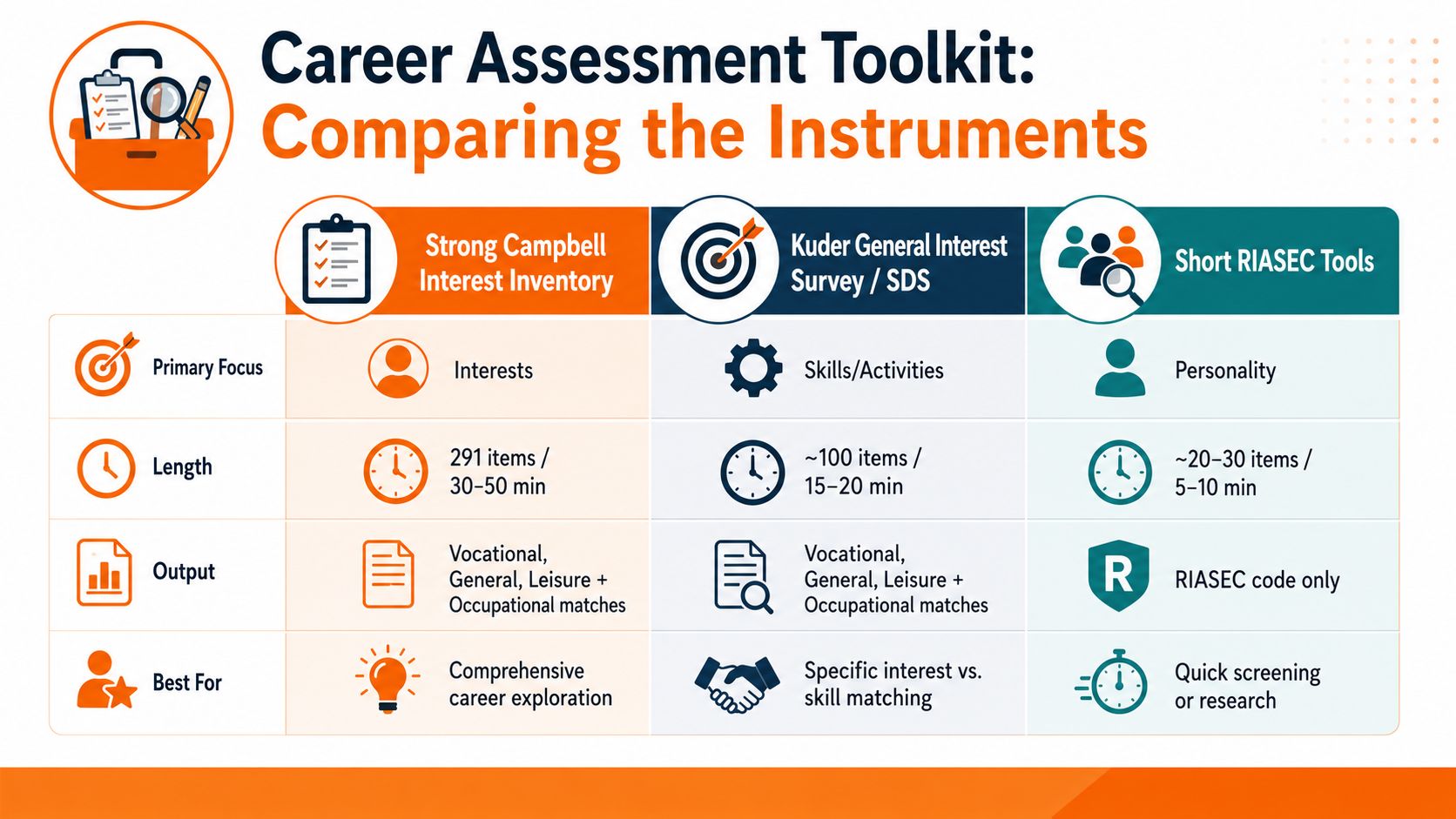
A Grade 11 counsellor choosing between the Strong and the Kuder is not choosing “better” versus “worse.” The choice depends on whether the student needs a broad vocational map or a faster read on a narrower question. The same logic applies when an adult client is being screened after an injury, a layoff, or a return-to-work referral.
The Strong's advantage is depth. Its occupation-matching scales and layered interest structure give concrete suggestions that are easier to discuss than a single Holland code. Shorter RIASEC tools can be helpful when time is tight, but they rarely give the same counselling richness. career finder quiz from HiredBySkill can be useful for clients who want a quick starting point before a fuller interview, as long as they understand that a quiz is not a replacement for formal interpretation.
Picking the right tool for the question
A school counsellor working with a Grade 11 student who says “I like science” could start with the Strong if the family wants a more complete exploration of careers and training paths. The same student might do well with a shorter RIASEC tool if the issue is triage, for example deciding whether to explore science, business, or arts before the next appointment.
A rehabilitation counsellor faces a different trade-off. If the client needs a broader picture of interest fit after an injury or cognitive change, the Strong can be more helpful than a brief screener. If the immediate question is whether the person has the processing capacity for a fast-paced role, an aptitude battery or cognitive screen belongs in the workflow alongside the interest measure.
What each tool does well
Strong Campbell Interest Inventory: best when the client needs thorough career exploration and concrete occupational suggestions.
Kuder or SDS-style tools: best when you need quicker interest language or a shorter administration.
Short RIASEC tools: best for screening, research, or low-burden first-pass conversations.
The comparison is practical, not ideological. I've seen Strong profiles open up excellent conversations with adults who thought they were “too late” to change direction. I've also seen shorter tools do the job when the client only needed a first filter and a next step.
The key is to match the instrument to the decision. If the decision is high stakes, a richer profile usually earns its place.
Integrating Strong Results Into a Modern Clinical Workflow
A teenager comes in for career counselling, but the intake form also mentions attention concerns, unfinished schoolwork, and a history of “shutting down” under time pressure. If you only run the Strong, you may get an accurate interest profile and still miss the reason the student is struggling to act on it. If you only run a cognitive screener, you may know how they process information and still miss what kind of work interests them.
That is why I pair the Strong with objective cognitive data. A digital assessment can profile attention, memory, executive function, processing speed, and eye-hand coordination, then the Strong can show where the student's interests land. Together, they answer a more useful counselling question: does the student's preferred field match motivation and cognitive load, or does the path need more support before it is realistic?
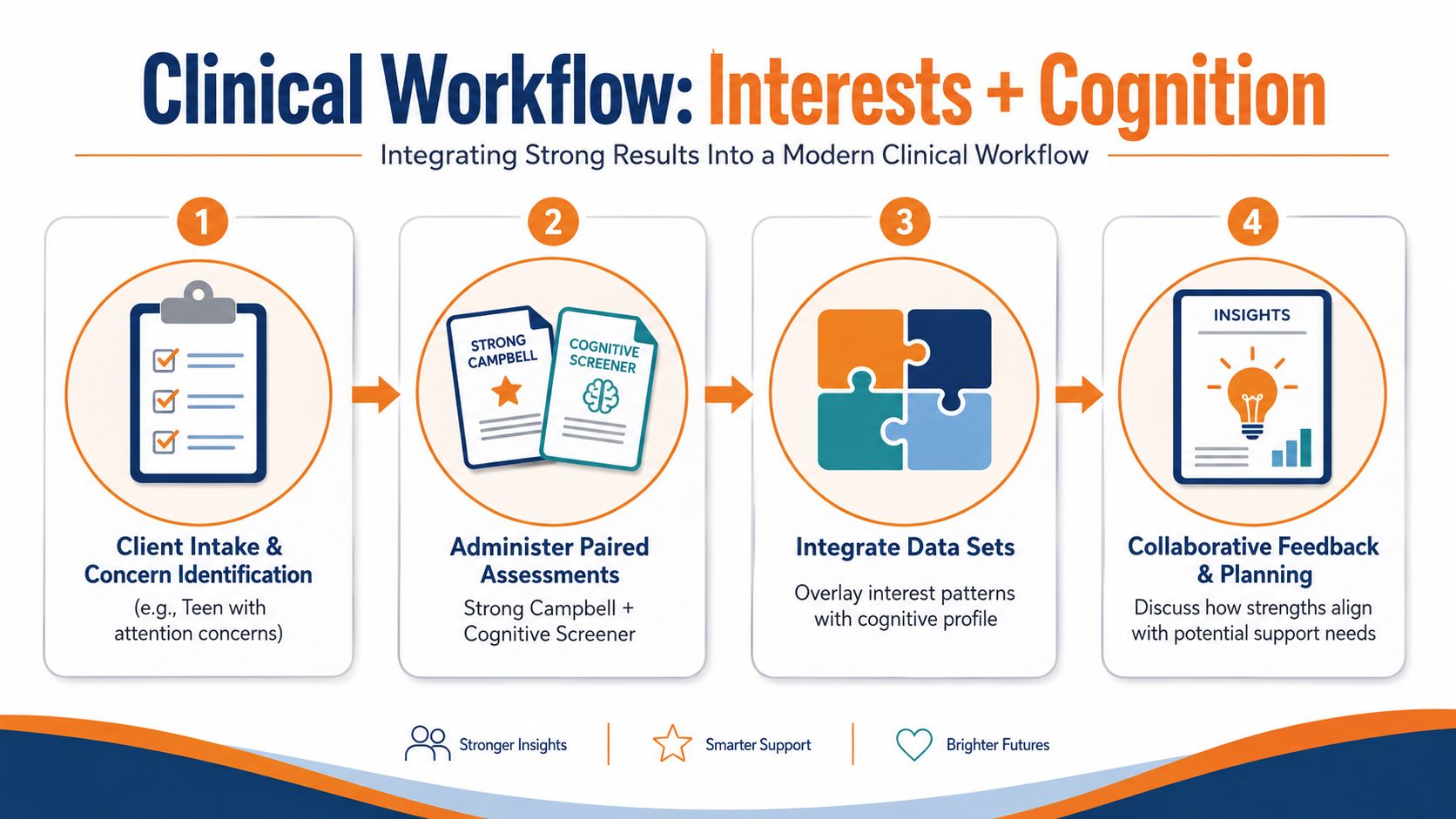
A workflow that holds up in practice
Client intake and concern identification. The referral question should be explicit. “Career uncertainty” is different from “career uncertainty plus suspected attention problems.”
Administer paired assessments. The Strong gives interest data. A digital cognitive screen gives objective performance data.
Integrate the two profiles. Look for fit, friction, and any mismatch between aspiration and capacity.
Give collaborative feedback. Talk about supports, not just pathways.
That fourth step is where clinicians often keep a client from a bad decision. A student may love fast technical environments, but if the cognitive screen suggests weaknesses in processing speed or sustained attention, the conversation changes. The goal is not to close the door. The goal is to decide whether the client needs accommodations, a slower entry path, or a full referral.
I use the same logic when a client's interests point to work that demands sustained precision, rapid switching, or complex multi-step memory. If the interest profile and the cognitive profile line up, the plan is often straightforward. If they clash, further evaluation is warranted rather than a blind push into training.
For teams that need continuity of care across visits, the workflow should make follow-up easy to maintain, not awkward. One assessment seldom tells the whole story, and the handoff between appointments matters as much as the test result.
I also keep the Strong in the same conversation as the executive coaching tools list when a client's goals include leadership, self-management, or workplace performance. The interests still matter, but they sit beside the practical question of whether the person can sustain the demands of the role. A platform like Orange Neurosciences can provide a rapid cognitive profile to sit beside interest data, which is more clinically useful than either result in isolation. The combined picture is what guides referral decisions.
Common Misconceptions and Honest Limitations
A Strong profile can be useful at the desk, and it can still be misread. The most common mistake is treating it as a verdict. The next mistake is assuming it predicts job success on its own. A third is assuming the occupational lists will keep up with hybrid roles, portfolio careers, and reskilling paths across Canada. They do not, at least not cleanly.
The figure people often want to avoid is still the one that matters. An independent review found that measured interests predict career choice with an estimated overall hit rate of 50.3%, while the Strong specifically had an estimated hit rate of 53.8% with 41,061 participants across 61 studies. That level of prediction is useful for sorting options, not for declaring an outcome. I treat the Strong as a decision aid, and nothing more final than that. Independent review of interest prediction and Strong hit rate
What that means in real counselling
If a client's profile points to several plausible pathways, the Strong helps narrow the field. It does not tell me whether the person will finish a diploma, cope with a noisy office, or stay satisfied after a few months on the job. For that, I look at interview material, work samples, and cognitive data together with the interest results.
The California dissertation findings matter here as well. The study reported statistically significant sex-based differences in RIASEC distributions at the .01 level, with males more likely to fall in the Artistic theme, and females more likely to fall in the Realistic and Conventional themes. That does not make the inventory unusable. It means interpreters need to watch how the profile is being read, especially when family expectations or cultural assumptions are already in the room. University of the Pacific dissertation on SCII and CAI results
The labour market problem is real as well. In Canada, clients often ask whether the Strong still maps to healthcare, technology, trades, or nonlinear adult retraining. The answer is yes, but only if the clinician translates older occupational labels into current pathways instead of taking the report at face value. A profile that once pointed to “office work” may now point to project coordination, health administration, or digital operations.
Honest limit: the Strong is strongest when used as a structured conversation starter. It is weakest when treated like a crystal ball.
That is the line I use with families, students, and employers alike.
That is also why I like pairing the Strong with objective cognitive data. A digital assessment can profile attention, memory, executive function, processing speed, and eye-hand coordination, then the Strong can show where the student's interests land. The practical advantage is simple. Interest data answers what kind of work fits. Cognitive screening helps show whether the person can handle the demands of that work, with supports or referral when needed.
I also use the language of assessment carefully. Some clients hear “test” and expect a pass or fail. Others assume “interest inventory” means a soft, low-stakes conversation. The language of assessment matters because the Strong sits between those two expectations. It gives structure to a career conversation, but it does not replace clinical judgment, and it does not replace evidence from other measures.
The same caution applies in digital workflows. A cleaner reporting dashboard does not make the interpretation more accurate by itself. It only makes it easier to combine the Strong with interview notes, cognitive screening, and referral decisions without losing track of the trade-offs.
Best Practices for Interpretation, Ethics, and Canadian Use
Canadian clients often ask the same practical questions. Does the Strong have Canadian standardisation and local norms? Can it be used with bilingual, immigrant, or Indigenous clients? What if the client's language or educational background doesn't match the population the test was built on? Those are not side issues. They are the core of responsible interpretation.
Canadian occupational testing guidance expects assessors to use instruments with appropriate norms and documented validity for the population being tested, especially when results can shape education or employment decisions. If you do not have local norms, you need to say so plainly and interpret with caution. That caution matters more, not less, when the client's background differs from the reference group.
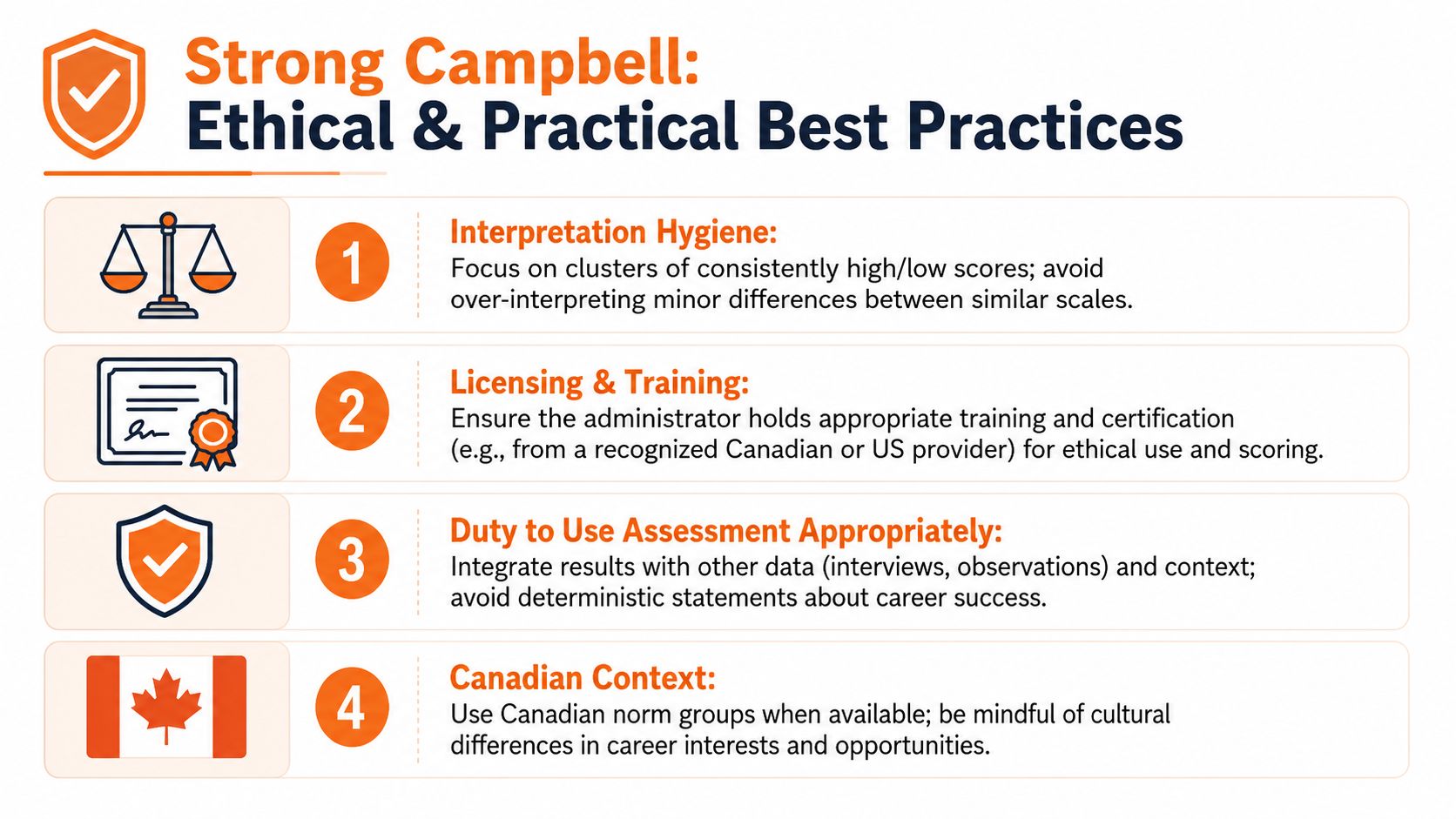
A desk-ready checklist
Interpretation hygiene: focus on clusters of consistently high or low scales, not tiny gaps between adjacent scores.
Licensing and training: only people with appropriate training should score and explain the instrument.
Appropriate use: combine results with interview data, observations, and context before making recommendations.
Canadian context: be cautious when norms are U.S.-based and the client's language, culture, or opportunity set is different.
For clinicians who want a language lens before they start debriefing, the language of assessment is worth a quick look. The words used in feedback can either support reflection or create unnecessary certainty.
How I handle the common Canadian questions
I do not oversell the test as locally normed when I can't verify that for the specific administration context. I also do not treat bilingual or immigrant clients as if one set of occupational preferences should mean the same thing across every cultural frame. Interest expression is shaped by opportunity, family story, and familiarity with work, not just by preference in the abstract.
When the profile looks clean but the client's functioning is uncertain, I bring in digital cognitive data. That gives me a second source of evidence before I recommend a path, a support plan, or a referral. When a platform shows objective issues in attention, memory, processing speed, or executive function, the next step may be further evaluation rather than more career brainstorming.
The Strong is still valuable in Canadian practice. It just needs a clinician who respects context enough to use it well.
Frequently Asked Questions About the Strong Campbell Interest Inventory
Does the Strong Campbell Interest Inventory have Canadian standardisation and local norms? Public-facing explanations often leave that question vague, so interpret carefully and check whether the version you're using has norms that fit your client's population. If it doesn't, use the profile as a counselling aid rather than a standalone decision rule.
Is it only useful for students? No. Adults reskilling later in life often benefit just as much, because the Strong helps clarify what kind of work still fits after layoffs, health changes, or burnout.
How should clinicians interpret it with digital cognitive screening? Use the Strong for interest fit and a digital screener for attention, memory, executive function, processing speed, and eye-hand coordination. If the interest path is attractive but the cognitive profile raises concerns, the plan usually needs support or referral, not blind encouragement.
When does a Strong result suggest neuropsychological referral? When the profile and the client's functioning don't match, or when attention, memory, or processing concerns are already interfering with school or work, a fuller evaluation is usually the right next step.
Orange Neurosciences gives clinicians a workflow-ready cognitive profile that sits beside interest data instead of replacing it. If you want to pair vocational insight with objective measures of attention, memory, executive function, processing speed, and eye-hand coordination, visit Orange Neurosciences and see how a faster cognitive read can support better counselling decisions.
Orange Neurosciences' Cognitive Skills Assessments (CSA) are intended as an aid for assessing the cognitive well-being of an individual. In a clinical setting, the CSA results (when interpreted by a qualified healthcare provider) may be used as an aid in determining whether further cognitive evaluation is needed. Orange Neurosciences' brain training programs are designed to promote and encourage overall cognitive health. Orange Neurosciences does not offer any medical diagnosis or treatment of any medical disease or condition. Orange Neurosciences products may also be used for research purposes for any range of cognition-related assessments. If used for research purposes, all use of the product must comply with the appropriate human subjects' procedures as they exist within the researcher's institution and will be the researcher's responsibility. All such human subject protections shall be under the provisions of all applicable sections of the Code of Federal Regulations.


© 2026 by Orange Neurosciences Corporation