Risks of AI in Healthcare and Safer Adoption

It's Tuesday morning. A developmental paediatrician, a care-home nurse, and a school psychologist each open an AI-generated cognitive profile before their next appointment. The report looks clearer than their hurried notes, and someone asks whether its flagged score should determine the referral, classroom plan, or conversation with the family.
Why a Clean Score Can Still Harm Care
The familiar risks of AI in healthcare don't always involve a dramatic technical failure. Often, a clinician accepts a plausible result without checking what the task measured, whose performance established the benchmark, or whether the patient could use the device comfortably.
A polished profile can make that shortcut feel reasonable. Coloured bands and precise scores suggest certainty, even when the underlying interpretation needs context.
If you lead a clinic, you're the person who must decide whether staff should accept, override, or refuse an output. That decision needs more than confidence in the software.
An automated cognitive profile is decision support, not a medical diagnosis or a treatment.
Say a patient completes a memory task while struggling to hear the instructions. The score may accurately describe their performance during that session, but it doesn't establish why they struggled. Treating the result as evidence of a cognitive disorder skips the clinical work between measurement and diagnosis.

Make the decision boundary visible
Before staff open a report, agree on what it can change. A screening flag might justify a closer conversation, while a referral requires review of symptoms, function, history, and assessment conditions.
Understanding sensitivity and specificity helps teams distinguish a tool that detects possible concerns from one that reliably rules them out. Neither measure turns an automated profile into a diagnosis.
Keep the following table beside any procurement proposal or clinical review. Use it to ask for evidence and assign responsibility, rather than accepting reassuring language about accuracy or security.
Eight Risks and the First Control for Each
Healthcare AI risks and the first control
Risk | What fails in practice | Who is harmed first | First control |
|---|---|---|---|
Clinical safety | A wrong or over-trusted score changes a referral or the chart | Patients with atypical presentations | Show uncertainty and require clinician sign-off |
Bias and equity | False positives or negatives differ by group | Indigenous, racialized, rural, multilingual, paediatric, and disability groups | Report subgroup sensitivity, specificity, and calibration |
Data quality and shift | Labels or populations no longer match live care | People whose records differ from training data | Prospective validation and drift checks |
Privacy and consent | Sensitive traits are inferred or data are reused | Patients and families in repeat cognitive testing | Purpose limits, meaningful consent, and minimisation |
Cybersecurity | Breach, re-identification, or model inversion | Identifiable patients and the organisation | Encryption, role-based access, audit logs, and retention limits |
Transparency | A black-box result is treated as fact | Clinicians who cannot explain the decision | Plain-language disclosure and recorded overrides |
Liability after change | The model updates with no named owner | Clinics left with a wrong recommendation | Model inventory, versions, and a clinical owner |
Workflow and automation bias | Speed encourages rubber-stamping | Busy clinics, schools, and care homes | A human review before the result changes care |
Read each row as a purchasing condition. For example, a vendor's promise to protect patient information doesn't answer the bias-and-equity row. You need evidence about performance in the people your service will assess.
The same distinction applies to clinical safety. A tool can run reliably, preserve the chart, and produce an inappropriate recommendation for a patient outside its validated population.
Why safety-only governance misses people
A Canadian public-health AI policy scan found that 85.7% of reviewed organisational policies addressed data privacy and security, 86% addressed privacy more broadly, 86% addressed transparency, and approximately 64% addressed fairness and bias. Ethical governance appeared in 71%, and bias- or equity-mitigation objectives appeared in 71.4%, yet 86% used a safety-based rather than explicitly equity-based approach.
These findings describe reviewed policies, not the performance of every Canadian healthcare organisation. They nevertheless expose an important procurement problem: a safety checklist can be complete while questions about unequal outcomes remain unanswered.
Public Health Ontario's review similarly identifies algorithmic bias, unrepresentative datasets, privacy concerns, and limited transparency as recurring health-equity concerns. A rural patient shouldn't receive less reliable interpretation because their language, connectivity conditions, or clinical setting were poorly represented during development.
During a pilot, add an evidence field and an owner beside each table row. An answer such as “the clinician will check” isn't sufficient unless someone specifies what they'll check, where they'll document it, and what happens when the result fails review.
For any cognitive tool that could influence referral, educational placement, treatment priority, or service denial, make human review and subgroup evaluation mandatory adoption conditions.
When One Accuracy Number Hides Unequal Error
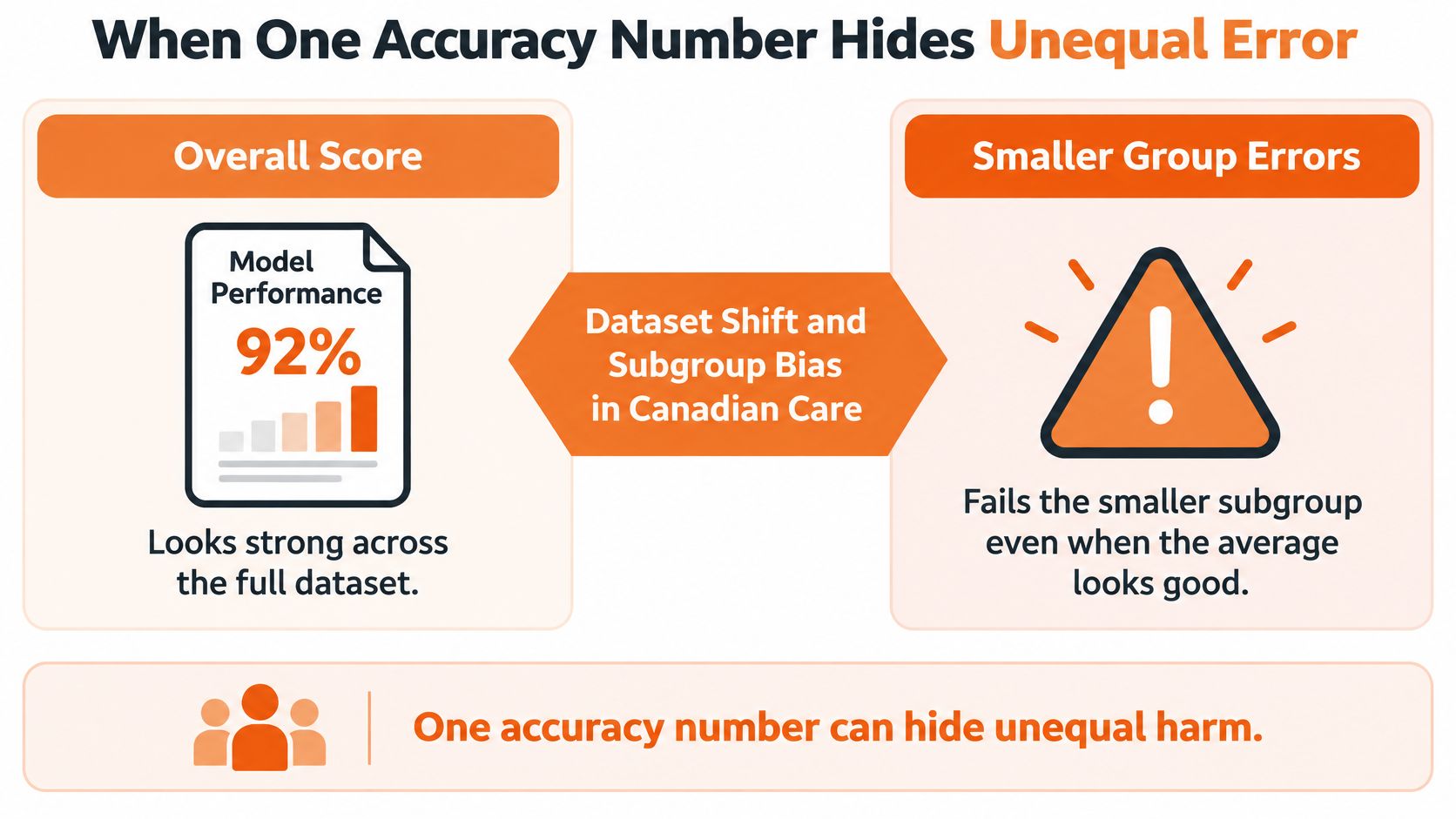
A class average can look respectable while a smaller group of students fails. An overall AI performance score can conceal a similar problem: the model performs well for the largest group but makes consequential errors for people who are less represented.
Subgroup bias means performance differs across groups. Dataset shift means the patients, records, devices, or conditions encountered in practice differ from those used during development.
Canada's Pan-Canadian AI for Health guiding principles call for equity, culturally appropriate care, bias reduction, and evaluation against evidence-based benchmarks throughout the AI lifecycle. For a clinic, those principles should become questions that a vendor can answer with validation evidence.
Ask what happens within each group
Ask for subgroup-stratified sensitivity, specificity, and calibration, alongside missing-data analysis. Calibration asks whether a reported likelihood agrees with what occurs; missing-data analysis checks whose information disappears before the model produces its answer.
Look beyond translated instructions. Language-specific measurement invariance asks whether the assessment measures the same underlying ability across languages, rather than changing meaning with the wording. A guide to the language of assessment can help your team frame that discussion.
Require prospective validation in Canadian populations resembling your intended service. Historical records alone may reproduce differences in access to assessment or subjective clinical labels, rather than provide an independent standard.
Test the conditions your patients encounter
Consider a hypothetical processing-speed task developed mainly with urban English-speaking participants. A rural multilingual elder uses an unfamiliar tablet, pauses to interpret instructions, and receives a concerning result.
The practical question isn't whether the software calculated the task score correctly. It's whether the score supports the proposed interpretation for that person under those conditions.
Adoption rule: Missing subgroup evidence is an uncertainty to resolve, not evidence that performance is equal.
After deployment, compare performance across the populations you serve and investigate changes in missingness, unexpected results, and clinician overrides. Treat monitoring for inappropriate uses and undisclosed biased outcomes, incident logging, and periodic independent audits as operating requirements in your governance plan.
A clinician must review consequential results before they affect care or access. A single accuracy percentage is not an adoption criterion.
Where Cognitive Data Travels After the Visit
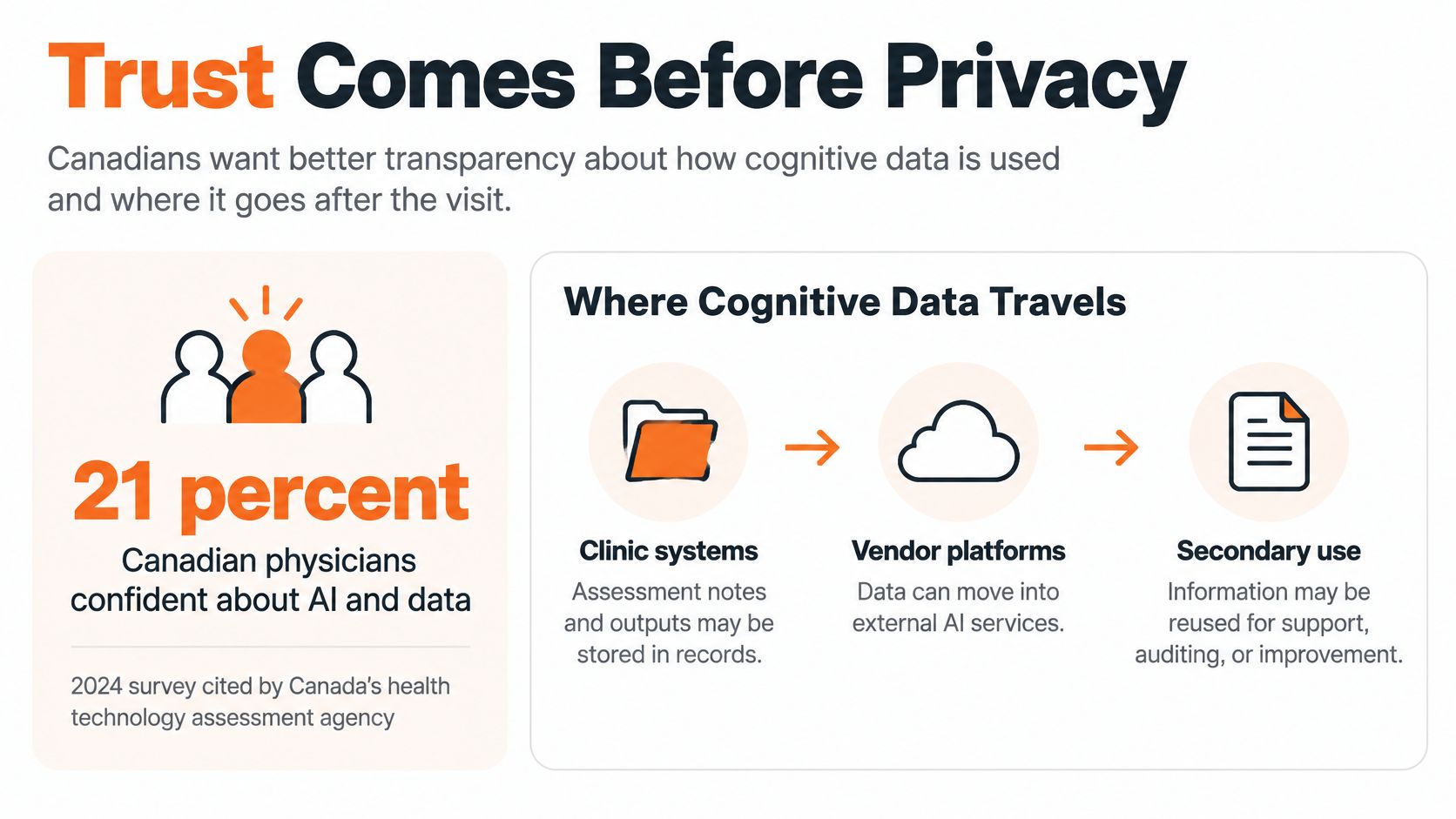
Trust is already fragile: a 2024 survey cited in Canada's Drug Agency's health technology watch list found that only 21% of Canadian physicians were confident about AI and patient confidentiality, while 79% were not confident or were unsure. The watch list also reports at least 14 major cyberattacks affecting hospitals, laboratories, and health networks from 2015 to 2023.
Those concerns extend beyond whether a patient agrees to an assessment. A cognitive record can travel through systems the patient never sees, leaving copies that outlast the clinical encounter.
Follow the record beyond the report
Start with task responses, identifying details, and device information collected during assessment. Trace their transfer to the vendor, storage in the clinical record, appearance in support logs, access by subprocessors, and any cross-border processing.
Then ask what happens when the original purpose ends. Does deleting the patient account remove source files, derived profiles, and support copies, and how are retained backups handled?
Secondary use changes the purpose of the information. Scores collected to track therapy might later support model training, marketing segmentation, or an insurance-related inquiry. Don't assume that permission for the original assessment authorises those uses.
Canadian federal and provincial privacy duties differ; the absence of a dedicated healthcare-AI training-data regime doesn't remove existing obligations. The Canadian privacy authorities' AI principles emphasise a valid legal basis, meaningful consent where applicable, minimisation, safeguards, and appropriate privacy-and-ethics review.
Turn the map into contract questions
Require a documented answer for each control:
Collect less: Identify which fields are necessary and exclude unrelated chart content.
Protect access: Require encryption in transit and at rest, role-based permissions, tenant isolation, and audit logs.
Limit retention: Specify deletion processes, retention periods, breach notification, and restrictions on unrelated reuse.
Verify governance: For datasets drawn from First Nations communities, use the OCAP principles of ownership, control, access, and possession to examine applicable community agreements before validation or training.
For vendors serving US organisations, PatientNotes' HIPAA compliance checklist for BAAs offers useful contract questions, but a US agreement doesn't establish Canadian compliance. Compare contractual promises with the service's published privacy policy.
Native-language delivery can improve access, but it doesn't establish appropriate Indigenous data governance or reliable operation with limited connectivity. Map every flow before the first patient sits down.
Who Owns a Wrong Result After the Model Changes
If next month's model differs from the one your clinic validated, who answers for a bad cognitive recommendation? A general statement that AI supports decisions doesn't assign the work of investigating, correcting, and preventing that error.
The Chambers Canada healthcare AI legal overview describes Health Canada's February 2025 guidance for machine-learning-enabled medical devices, including algorithm-change protocols, transparency, and cybersecurity, and notes that the proposed Artificial Intelligence and Data Act lapsed when Parliament was prorogued in January 2025. That legal picture makes a documented division of operational responsibility especially important; it isn't permission to leave responsibility unassigned.

Divide the work before an incident
Who does what when cognitive AI is wrong
Who | Before go-live | After a model change | Must not do |
|---|---|---|---|
Clinician | Check history, function, language, and access | Override, record the reason, and report the case | Treat the score as a diagnosis |
Vendor | Disclose limits, retention, and subprocessors | Notify material change and drift | Reuse data for a new purpose without authority |
Institution | Name an owner and keep an inventory | Audit logs, incidents, and reassessment triggers | Assume the vendor absorbed the legal duty |
This is an operational allocation, not a final determination of legal liability. Contracts, professional duties, applicable laws, and the circumstances of an incident still matter.
For example, a vendor might change scoring while the institution continues displaying old reference information. The clinician needs a route to flag the inconsistency, but shouldn't have to discover an undisclosed update through patient encounters.
Separate patient change from software change
Longitudinal cognitive care adds another complication. An apparent improvement could reflect patient progress, familiarity with the task, altered assessment conditions, or a scoring update.
Your review of test–retest reliability should therefore include the model version attached to each report. If the scoring method changes, ask whether earlier and later profiles remain comparable before presenting the difference as clinical progress.
A technically correct task score can still support an incorrect interpretation when age, education, disability, device, language, or setting differs from development conditions. For AI-enabled medical devices whose malfunction could compromise safety, the evidence and post-market surveillance expectations may need to be stronger.
Before approving an update, require written answers to these questions:
Validated use: What population, setting, outcome, and version were evaluated?
Drift review: Who decides whether a performance change requires suspension or reassessment?
Patient explanation: How will patients learn that AI contributed to their assessment?
Correction trail: Where will overrides, reasons, and corrected reports remain accessible?
Three Ways Cognitive AI Goes Wrong in Practice
These hypothetical scenes show how an ordinary handoff can turn a useful tool into a source of harm. None requires the software to stop working.
A screening result becomes a family diagnosis
At a care-team meeting, someone describes a resident's repeated memory and attention results as dementia. The family hears a diagnosis that the assessment never established, and staff begin interpreting everyday behaviour through that label.
A 2025 JMIR qualitative study interviewed 195 Canadians from Ontario, Newfoundland and Labrador, Manitoba, and Saskatchewan about AI deriving social-determinants-of-health information from electronic medical records; participants identified inaccurate inferences, negative effects on care, privacy and security breaches, misuse, discrimination, and weaker patient–provider relationships.
That study wasn't a cognitive-tool validation trial. Its relevance is the harm people anticipated when systems infer sensitive characteristics they never explicitly offered for algorithmic analysis.
Repeated cognitive assessments can describe memory, attention, executive function, development, and functional change. Misinterpreting or repurposing that detail can expose a person to stigma, inappropriate referrals, or consequences for insurance and employment.
Screening identifies a possible concern. Assessment investigates abilities and context. Diagnosis is a clinical judgement. They are different acts.
A visit summary becomes an eligibility ranking
A rehabilitation service introduces an AI scribe to prepare visit notes. Later, a manager starts using generated summaries to rank patients for therapy access, although nobody assessed the system for that purpose.
This is function creep: the organisation has moved from documentation to an eligibility decision. The person whose needs were poorly captured in a summary may lose access without knowing how the decision was made.
British Columbia's privacy regulator's AI-scribe guidance warns about consent, accuracy, security, cross-border disclosure, human oversight, and function creep. The health organisation remains responsible for its obligations when an external company processes the information.
A low score becomes a barrier to care
A rural Indigenous elder completes a multilingual screening tool tested mainly in an urban sample. Unfamiliar device gestures, language differences, and missing cultural context produce an implausibly low result.
The clinician accepts it without resolving the mismatch, and the family leaves with an inaccurate impression of the elder's abilities. The harm occurs at the decision point, when an unexplained result becomes an authoritative description of a person.
For a purchasing team, these scenes are useful acceptance tests. Ask prospective vendors to demonstrate how their workflow would prevent each handoff from becoming an unsupported decision.
Clear These Checks Before You Adopt
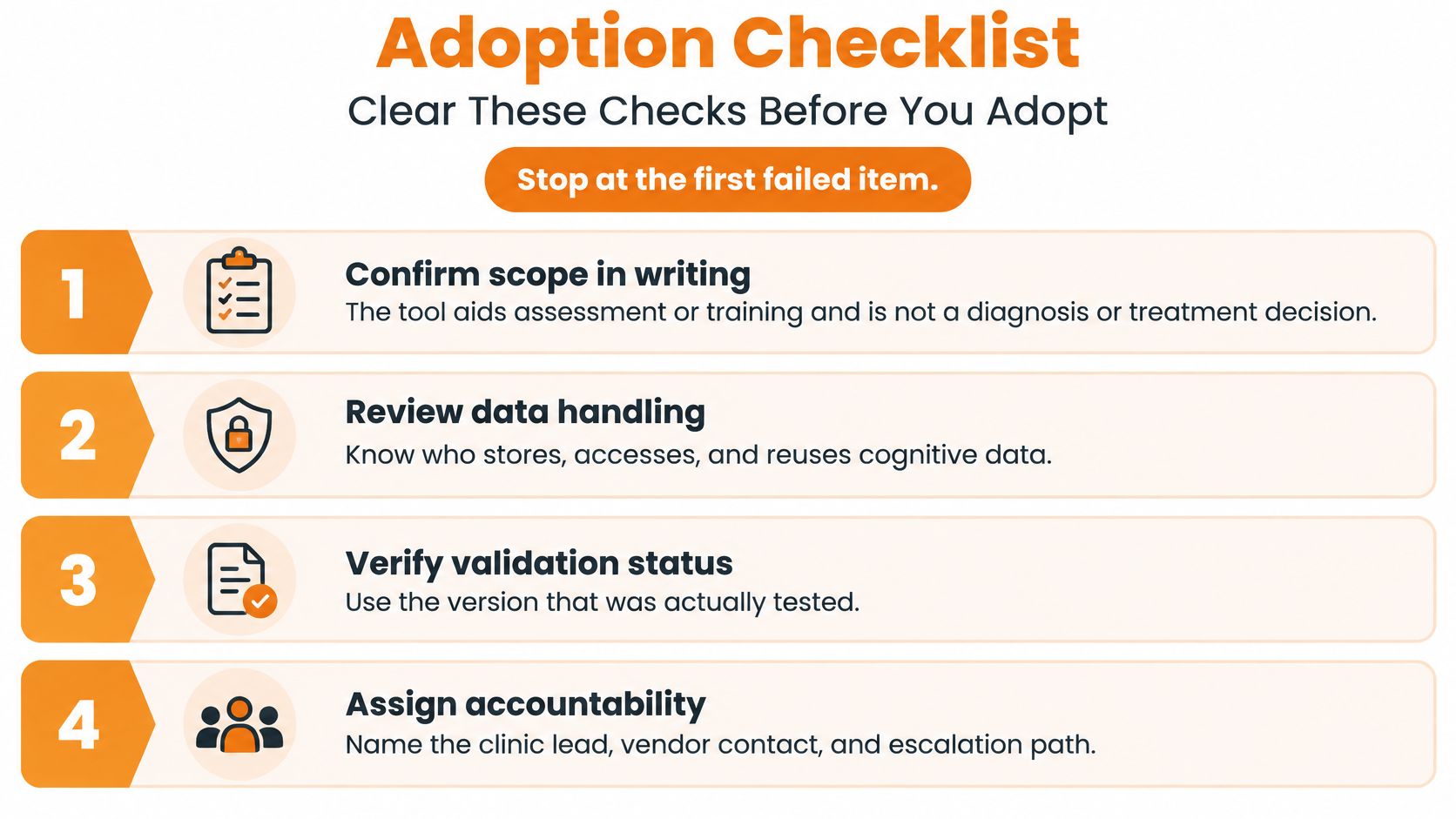
Use this as a stop-at-the-first-failed-item checklist. A missing answer should delay the pilot, not become a task to finish after patient information has entered the system.
The College of Physicians and Surgeons of British Columbia's AI guidance calls for secure storage, access, and transmission, a valid legal basis before personal data leaves the clinical environment, and critical review of AI recommendations through an equity, diversity, and inclusion lens. Turn those expectations into observable checkpoints rather than a signed acknowledgement that staff have read a policy.
Require evidence before patient use
Confirm scope in writing. Record the permitted assessment or training uses and the decisions the tool must not make. For the cognitive decision-support tools considered here, the checkpoint is explicit non-diagnostic scope, not language suggesting autonomous treatment.
Demand relevant validation. Match evidence to your patients' languages, ages, disabilities, devices, and settings. Obtain a clear statement identifying populations missing from validation.
Approve the data-flow map. Identify storage locations, borders, subprocessors, retention, deletion, and breach-notification arrangements. Reject undisclosed training reuse.
Verify security controls. Obtain evidence of encryption, role-based access, and audit logging. Ask someone responsible for information security to assess the evidence, rather than accepting a sales assurance.
Register the accountable people and version. Use the responsibilities in Who does what when cognitive AI is wrong to identify the clinical owner, vendor contact, approved model version, and drift reviewer.
Make patient choice workable. Test the explanation with someone outside the implementation team. Confirm that declining AI has a clear, practical alternative and that consent decisions reach the staff using the system.
Test the clinical review checkpoint. Before a result influences care, confirm data completeness, language and accessibility conditions, unexpected scores, and population mismatch. Run a sample case through the actual workflow.
Rehearse an override. Enter an implausible result into a test environment and verify that staff can reject it, preserve the reason, and report the case without overwriting the source record.
Choose a bounded pilot
Use a comparison of cognitive assessment tools to define the task you're buying for, not just the features available. A platform may cover attention, memory, executive function, and related skills, yet still need a carefully limited initial use.
Start with an agreed population, purpose, and escalation route. Judge the pilot by whether clinicians can explain and challenge its outputs, patients understand their choices, and the organisation can trace every consequential result to its approved version.
Orange Neurosciences offers AI-supported cognitive assessment and training tools for clinics, rehabilitation services, care homes, and schools, including native-language delivery within an explicit non-diagnostic scope. Visit Orange Neurosciences to review the platform before a pilot, and bring this checklist to your discussion about validation, cognitive-data handling, and responsibility when a model changes.

Orange Neurosciences' Cognitive Skills Assessments (CSA) are intended as an aid for assessing the cognitive well-being of an individual. In a clinical setting, the CSA results (when interpreted by a qualified healthcare provider) may be used as an aid in determining whether further cognitive evaluation is needed. Orange Neurosciences' brain training programs are designed to promote and encourage overall cognitive health. Orange Neurosciences does not offer any medical diagnosis or treatment of any medical disease or condition. Orange Neurosciences products may also be used for research purposes for any range of cognition-related assessments. If used for research purposes, all use of the product must comply with the appropriate human subjects' procedures as they exist within the researcher's institution and will be the researcher's responsibility. All such human subject protections shall be under the provisions of all applicable sections of the Code of Federal Regulations.


© 2026 by Orange Neurosciences Corporation