Your Guide to the Cognitive Skills Definition and How They Work
Feb 25, 2026
When you hear the term cognitive skills, what comes to mind? In the simplest sense, these are the core mental abilities your brain uses every single day to think, learn, remember, reason, and pay attention. They’re the fundamental building blocks for how you process information and navigate the world, working together seamlessly behind the scenes in almost every task you perform.
What Are Cognitive Skills and Why Do They Matter?
Think of your cognitive skills as the internal toolkit that powers your mind. Just like a carpenter needs a hammer, saw, and measuring tape to build something, your brain needs its own set of tools to function effectively. These tools aren't physical, of course, but are the mental processes that allow you to tackle everything from the simplest chores to the most complex challenges.
Every day, you rely on this toolkit without a second thought. Driving to work while listening to a podcast? That’s your divided attention at work. Recalling the steps to a recipe you made last week? You're accessing your long-term memory. Planning your family's weekly schedule? That requires your executive functions—your brain's very own project manager. Each skill plays a distinct role, yet they collaborate constantly to create a smooth, functional experience.
The Building Blocks of Thought and Action
Getting a handle on the basic definition is the first step, but seeing how these skills pop up in real life is what truly matters. These abilities aren't just abstract academic concepts; they're the machinery behind your daily performance and overall mental sharpness. For a deeper dive, check out our guide on the mental acuity definition to see how these skills contribute to quick, clear thinking.
These skills are absolutely crucial because they directly influence:
Learning and Education: Strong cognitive skills are the bedrock of academic success, whether it's a child learning to read or an adult mastering a new professional certification.
Professional Performance: Your ability to focus, solve problems, and manage time effectively at work is tied directly to the strength of your cognitive functions.
Social Interactions: Following conversations, remembering names, and reading social cues all depend on a well-oiled cognitive toolkit.
To really appreciate why these skills are so important, it's helpful to understand the bigger picture of cognitive development in early childhood. The patterns established early in life often set the stage for our cognitive health and abilities later on.
To make this a bit more concrete, let's break down the core skills in your brain's toolkit.
Your Brain's Toolkit A Quick-Start Guide
This table is a handy summary of the core cognitive skills, what they help you do, and where you see them in action every day. Think of it as a quick-start guide to understanding the powerhouse between your ears.
Cognitive Skill | Core Function | Everyday Example |
|---|---|---|
Attention | Focusing mental resources on a task | Reading a book while ignoring background noise |
Memory | Storing and retrieving information | Recalling a friend's birthday or your grocery list |
Executive Function | Planning, organizing, and managing tasks | Creating a budget and sticking to it |
Perception | Interpreting sensory information | Recognizing a familiar face in a crowd |
Processing Speed | How quickly you can take in and use information | Quickly reacting to a traffic light changing colour |
Visuomotor | Coordinating vision with motor skills | Catching a ball or typing on a keyboard |
By seeing these skills laid out, it becomes clearer how interconnected they are and how vital each one is for navigating our daily lives smoothly.
How Different Professions Lean on Different Skills
Interestingly, the demand for specific cognitive skills can vary a great deal from one profession to another. For example, a study of Canadian educators revealed some intriguing patterns. When benchmarked against other professions, teachers outperformed those in general programs and health but fell behind those in science and computing.
This highlights a nuanced landscape where teaching roles demand strong foundational cognitive abilities but may not require the same level of technical, STEM-oriented skills. It’s a perfect example of why precise cognitive assessments are so valuable—they show us the specific strengths needed for different roles.
Ultimately, a clear definition of cognitive skills reveals that these abilities aren't just about "being smart." They represent a unique profile of specific strengths and weaknesses that determine how efficiently and effectively you process the world around you.
By understanding this profile, you can pinpoint areas for improvement and take targeted steps to strengthen your mental toolkit. This is exactly where we come in. Explore our site to discover how Orange Neurosciences supports this journey through precise assessment and targeted training.
Taking a Closer Look at Core Cognitive Abilities
Let's move past a simple definition and see how these mental tools actually work in our day-to-day lives. Picture your brain as an orchestra. Each cognitive skill is like an instrument, and when they all play together in harmony, the result is smooth, effortless thought and action.
We're going to spotlight six of these essential "instruments" to see what they do and why they matter.
Attention: The Brain's Spotlight
Attention is your brain’s ability to zero in on specific information while tuning out everything else. It’s not just one thing, but a whole system with different jobs.
Sustained Attention: This is your focus stamina—the ability to concentrate on one thing for a long time. Think of a programmer hunting for a bug in lines of code for hours, or a student cramming for a final exam.
Divided Attention: This is classic multitasking. It’s what you’re doing when you’re stirring a pot on the stove while helping your kid with their math homework.
Selective Attention: This is your brain's filter. It’s the magic that lets you have a deep conversation in a bustling restaurant, completely ignoring the chatter and clatter all around you.
If your attention isn't working well, every other cognitive skill takes a hit. It’s the gatekeeper that decides what information even gets a chance to be processed.
Memory: The Mind's Filing Cabinet
Memory is the incredible process of locking in, storing, and later pulling out information. It operates on different timelines, from thoughts that last only a few seconds to knowledge you'll keep for a lifetime.
Think about learning a new recipe. First, you use your short-term memory to keep the steps in mind while you grab the ingredients. After you’ve made it a few times, that information starts moving into your long-term memory, becoming a skill you can pull up weeks or even years later.
All the while, your working memory is busy juggling this information, allowing you to do things like mentally double the ingredient amounts if you're cooking for a bigger crowd. If you're looking to sharpen this specific skill, our guide offers some practical tips on how to improve working memory.
Executive Functions: Your Inner CEO
If your brain has a project manager, it's this sophisticated set of skills. Executive functions are the high-level abilities that let you plan, organize, and follow through on complex tasks. They're what you use to manage your life and work toward your goals.
Executive functions include crucial skills like inhibition (stopping yourself from saying the first thing that pops into your head), cognitive flexibility (switching gears between different tasks or ideas), and emotional regulation. They’re fundamental for everything from making a monthly budget to navigating tricky social situations.
A perfect real-world example is planning a holiday. You have to research destinations (planning), book flights and hotels in the right order (organizing), and figure out a new plan if a flight gets cancelled (flexibility). These skills are the command-and-control centre of your mind.
This concept map shows how foundational skills like attention, memory, and planning are all managed by the brain.
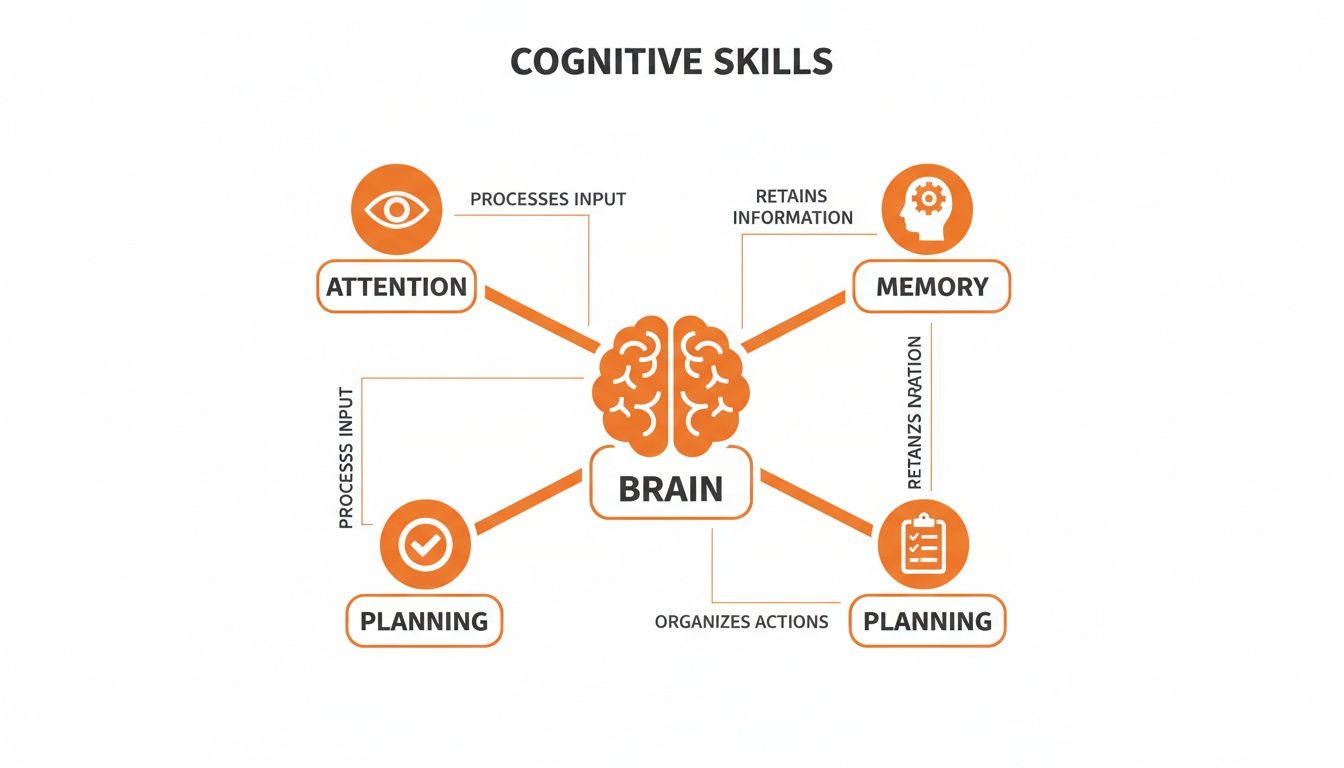
While each skill is unique, this visual makes it clear that they're all deeply interconnected, stemming from the brain's core processing power.
Perception: Making Sense of Your World
Perception is the amazing process of taking in raw data from your senses and turning it into something meaningful. It's how your brain translates the signals from your eyes, ears, and skin into a rich experience of the world around you. This all happens so fast, we rarely even notice it.
Imagine walking into a party and immediately spotting a friend across the room. Your brain didn't just see a random collection of facial features; it rapidly processed visual cues—the shape of their eyes, their unique smile—and matched it all against your memories to make an instant ID. Perception is also what allows you to catch the sarcastic tone in someone’s voice or recognize the comforting smell of home.
Processing Speed: Your Mental Bandwidth
Processing speed is exactly what it sounds like: how fast you can take in information, make sense of it, and react. Think of it like your brain's internet connection. A faster connection means you can perform mental tasks more smoothly and efficiently.
Someone with a quick processing speed can learn the rules of a new board game on the fly, keep up with a fast-paced conversation, or make split-second decisions when it counts. It’s a skill that supports almost everything else your brain does.
Visuomotor Coordination: The Eye–Hand Partnership
Finally, visuomotor coordination—often just called eye–hand coordination—is the skill that lets you sync up what you see with what you do. It’s the seamless partnership between your visual system and your physical movements.
This skill is absolutely essential for countless daily activities that require a bit of precision.
Typing an email: Your eyes track the words on the screen while your fingers fly across the keyboard to hit the right keys.
Catching a ball: Your brain instantly calculates its path and speed, guiding your hand to the exact right spot.
Threading a needle: This is a masterclass in aligning precise visual input with delicate motor control.
Each of these core cognitive skills is constantly working with the others. They aren't isolated talents but a deeply interconnected network. Understanding how each one works is the first step toward recognizing your own cognitive profile—both your strengths and the areas where you might need a little extra support.
How Our Minds Change As We Age
Our cognitive skills aren't set in stone. They're constantly in motion, shifting and adapting as we journey through the different stages of life. Think of it as a natural evolution, where certain abilities step into the spotlight when we need them most to tackle new challenges and make sense of the world around us.
Understanding this progression helps us appreciate our own mental toolkit—and the abilities of our loved ones, from our kids to our grandparents.
From the moment we’re born, our brains kick off a period of incredible growth. Early childhood is all about laying down the foundations. When you see a toddler learning to stack blocks, you're watching a masterclass in visuomotor coordination and problem-solving unfold in real-time.
As kids get a bit older, their attention spans stretch, letting them follow along with stories or focus on a lesson in class. Their memories start to blossom, helping them learn the alphabet, recognize familiar faces, and build a rich vocabulary. These early years are crucial for building the mental architecture that will support everything that comes next.
The Teen Brain and Taking Control
When we hit adolescence, the brain goes through another major overhaul. This time, the focus shifts to developing more sophisticated executive functions. The prefrontal cortex—often called the brain's "CEO"—is maturing, which leads to huge leaps in our ability to plan, control impulses, and think abstractly.
This is why teenagers start getting better at managing complex school projects, thinking about what they want to do after graduation, and considering the consequences of their actions. Their ability to juggle multiple tasks and manage their emotions sharpens, getting them ready for the independence of adulthood.
Hitting Our Stride and Navigating Life's Demands
In young and middle adulthood, our cognitive skills are typically at their peak. We use this fully developed toolkit to build careers, raise families, and make some of the biggest decisions of our lives. The ability to reason, solve problems, and process information efficiently is absolutely critical during this demanding phase.
Interestingly, how these skills translate into real-world success isn't always a straight line. Research from the Higher Education Quality Council of Ontario, for example, shows some interesting dynamics in how cognitive skills impact wages in Canada. While higher earners generally get a bigger financial payoff from their skills, women’s abilities tend to yield higher returns at lower earning levels, while men's skills give them a greater advantage at the top. It’s a clear reminder of how external factors can shape the economic value of our cognitive profile.
Staying Sharp in Later Life
As we get older, it's completely normal to notice some shifts in our cognitive abilities. You might find it takes a little longer to pull up a name from memory or get the hang of a new piece of technology. This is often just a normal part of aging, not necessarily a red flag for a serious problem. While our processing speed might slow down a bit, other skills—especially those built on a lifetime of knowledge and experience—can stay strong or even get better.
The most important thing to remember is that the brain keeps its amazing ability to adapt and change throughout our entire lives. This is a concept known as neuroplasticity. By staying mentally active, socially connected, and physically healthy, we can actively support our cognitive health for years and years.
Many people wonder where the line is between normal aging and more significant changes. If you're curious to learn more, our detailed guide on what is cognitive decline offers clear explanations and helpful context.
Ultimately, seeing our cognitive abilities as part of a lifelong journey helps us appreciate how our brains are always evolving. From the foundational learning of childhood to the wisdom that comes with experience, our minds are constantly adapting. Recognizing these patterns empowers us to support our brain health at every age. For anyone looking to get a precise understanding of their own cognitive profile, a tailored assessment can offer invaluable insights. Explore the tools and resources we have at Orange Neurosciences to see how we can help you on your path to lifelong cognitive wellness.
We've all been there—misplacing our keys, fumbling for the right word. These moments are completely normal, a part of the beautiful mess of being human.
But what happens when these occasional slip-ups start to feel less like isolated incidents and more like a frustrating pattern? That's when it might be time to pay a little closer attention.
Recognizing the signs of cognitive challenges isn’t about self-diagnosing or panicking over every forgotten name. It's about empowering yourself. It’s about understanding what might be happening under the hood, whether it's due to high stress, a past brain injury, ADHD, or simply the natural changes that come with aging.
From Simple Lapses to Noticeable Patterns
The real tell isn't a single event. It’s the pattern. Forgetting one appointment is one thing; consistently missing them week after week is another story.
Here’s what these patterns can look like in everyday life, broken down by the core skill that’s being taxed.
Attention Challenges: Does a conversation in a busy café feel impossible to follow? A practical example is finding yourself constantly asking people to repeat what they said or losing your train of thought right in the middle of a sentence.
Memory Difficulties: This goes deeper than just forgetting names. It’s about asking the same question multiple times, even after you’ve heard the answer, or suddenly needing detailed notes for tasks you used to do automatically, like making your morning coffee.
Executive Function Struggles: Think of these skills as your brain's "CEO." When the CEO is struggling, you might feel completely overwhelmed by simple, step-by-step tasks, like following a recipe or paying your monthly bills. Kicking off a new project or even making a simple decision can feel like climbing a mountain.
This is where a clear cognitive skills definition becomes so helpful. It allows us to connect a real-world challenge—like struggling to plan a project—to the underlying mental engine of executive functions. Once you can name it, you can start to understand it.
Common Signs to Watch For
A simple checklist can help you spot a potential pattern. While this is far from a diagnosis, noticing a consistent cluster of these signs might mean it's a good time to chat with a professional.
Trouble staying focused on one thing for an extended period.
Frequently misplacing important items like your wallet, phone, or glasses.
Struggling to pivot or adapt when a routine is suddenly disrupted.
Feeling more impulsive or having a harder time reining in your immediate reactions.
Finding it tough to learn new skills or follow multi-step instructions.
Recognizing these signs isn't about finding flaws. It's about being an informed, compassionate advocate for yourself or someone you care about. These struggles are often invisible to the outside world, and simply identifying them is a powerful first step.
If you suspect executive functions might be the source of the trouble, getting more specific information is key. Our guide offers details on what's involved in getting a test for executive dysfunction and what to expect.
The ultimate goal is to move from a place of uncertainty to one of clarity. By understanding these signs, you can take the next step with confidence—whether that’s talking to a doctor, exploring a professional assessment, or making lifestyle changes that support your brain health. At Orange Neurosciences, we're here to provide the tools to get you that objective clarity.
How Professionals Assess Cognitive Skills Today
When it comes to understanding cognitive skills, a professional assessment gives us an objective look at a person’s mental strengths and where they might be struggling. But the old-school methods? They can be incredibly slow and sometimes leave too much room for interpretation.
Think about the traditional paper-and-pencil tests or long, clinician-led interviews. These often take hours to complete and even longer to score by hand. It’s a process where subtle but important details about skills like executive function or processing speed can easily get missed. For clients, this can mean long waits between appointments just to get the results.
Thankfully, modern digital platforms have stepped in to change the game. By using rapid, game-based tasks, they make the whole process more engaging and efficient. AI-powered assessments, for example, can generate a complete cognitive profile in under 30 minutes, giving clinicians and educators the timely insights they need to act fast.
Comparing Traditional and Digital Assessment
The difference between the old way and the new way is stark. Let's break it down.
Feature | Traditional Assessment | Digital Assessment |
|---|---|---|
Duration | 1–2 hours per domain | <30 minutes total |
Scoring | Manual, subjective | Automated, objective |
Engagement | Passive tasks | Interactive game-based tasks |
Accessibility | Limited by location | Remote and scalable |
It’s pretty clear why modern tools are becoming the standard. They deliver faster, more reliable results that create a natural bridge to targeted, effective support.
Key Benefits Of Digital Assessments
Digital assessments aren’t just about speed; they blend quick results with a much better user experience, improving both the data quality and the client’s comfort level. This frees up clinicians to focus on what truly matters: interpreting the results and planning the next steps.
Less Administrative Burden: Automated scoring completely removes the need for manual calculations, saving clinicians hours of tedious work.
Enhanced Engagement: Who wouldn't prefer a fun, game-like challenge over a dry test? This approach boosts motivation and helps lower test anxiety, leading to more accurate results.
Scalability: With remote access, assessments can be delivered to people anywhere, making it possible to support diverse communities and multiple locations at once.
These advantages show why modern cognitive assessment is no longer a niche tool but a core practice in clinics, schools, and workplaces.
A Look at the Digital Assessment Workflow
So, how does it actually work in practice? The process is surprisingly straightforward and efficient.
Clinician Setup: A professional starts by entering basic demographic and referral information into a secure platform.
Interactive Tasks: The user then dives into a series of brief, engaging challenges that feel more like games. The difficulty adapts in real-time based on their performance.
Automated Analysis: Behind the scenes, powerful algorithms analyze every response, measuring things like accuracy and reaction time to build a detailed cognitive profile.
Report Delivery: A comprehensive, easy-to-read report is generated in minutes, providing the data-driven insights needed for effective planning.
This streamlined flow ensures both speed and depth, making sure every cognitive skill is thoroughly evaluated. But it’s also about making sure everyone gets a fair shot.
For a practical example, a school psychologist recently worked with a student who was having trouble paying attention in class. Using a digital platform, the student completed all the assessment tasks in a single 30-minute session. The very next day, the psychologist had the results and was able to work with the teacher to implement new classroom strategies. That’s the kind of actionable impact we’re talking about.
This speed and objectivity are especially crucial for underserved populations. Research shows that male immigrants educated outside Canada, for instance, can face numeracy and literacy gaps of 13–17% compared to native-born men, with even wider gaps for females. These disparities can significantly impact their success in the job market. Rapid, objective cognitive profiling can pinpoint these challenges and guide the right kind of support to help close that gap. Learn more about these findings.
“A rapid, objective cognitive profile helps diverse populations get the support they need sooner.” — A clinician using Orange Neurosciences
Using Orange Neurosciences In Practice
The dashboard is where clinicians can see everything in one place—monitoring a client’s progress and accessing their metrics in real time.
As you can see, each cognitive domain is laid out with clear score bars. This makes it incredibly easy to spot strengths and identify areas that might need a bit more focus.
Actionable Insight: When you share these results with clients or their families, use these clear visuals. It helps everyone understand the findings and gets them on board with any follow-up training. Always remember to frame the scores within the context of the individual's unique story and next steps.
By bringing this AI-driven approach into their practice, professionals can slash assessment times, make smarter decisions, and present information in a way that truly connects.
To dive deeper into the methods and importance of cognitive evaluation, check out our comprehensive guide on what is cognitive assessment.
Turning Your Cognitive Assessment Into Action
Getting your cognitive assessment results is really just the first step. The real power isn't in the snapshot itself, but in what you do with it next. Think of the results as a personalized roadmap, moving you past a general cognitive skills definition to highlight your specific strengths and, more importantly, pinpoint the areas that could use a little support.
It’s a bit like getting a fitness evaluation at the gym. You wouldn't just look at the numbers and walk away; you'd work with a trainer to build a workout plan based on those results. A cognitive assessment works the same way—it gives you the data you need to design a targeted training program for your brain.
This is where we see neuroplasticity, the brain's incredible ability to adapt and rewire itself, in action. Just like your muscles get stronger with the right exercises, your neural pathways can be strengthened and made more efficient through focused, consistent practice.
From Data to Development
The key is to draw a straight line from the assessment data to training that directly targets the skills you want to improve. Modern platforms do this beautifully with engaging, game-like activities designed to challenge and build those specific cognitive abilities.
Attention Training: For example, games might ask you to track a moving target while actively ignoring a flood of distractions, with the difficulty ramping up as you improve.
Memory Exercises: A practical exercise could challenge you to recall complex sequences or match pairs under pressure, giving your short-term and working memory a solid workout.
Executive Function Challenges: These tasks often revolve around planning and strategy, forcing you to think several steps ahead and adapt your approach when the rules suddenly change, mimicking real-world problem-solving.
For individuals working through the cognitive and emotional effects of trauma, understanding specialized approaches can be helpful. For instance, learning what EMDR therapy is can offer valuable insight into a targeted treatment for processing difficult experiences.
Here’s a look at how the Orange Neurosciences platform visualizes assessment results, making them easy to understand.
This kind of clear, visual feedback immediately shows you where to focus your efforts. By turning complex data into a straightforward, actionable strategy, you’re put back in the driver's seat of your own brain health.
This bridge between assessment and action is absolutely crucial. It’s about turning knowledge into real, measurable progress and creating a direct path toward a stronger, more resilient mind.
Your cognitive profile isn't set in stone. With the right tools and a clear plan, you can actively work to enhance your skills. To see how our platform connects assessment with personalized training, explore our solutions at Orange Neurosciences and book a demo to begin your journey.
Got Questions About Cognitive Skills?
Once you start to grasp what cognitive skills are, a few practical questions usually pop up. Let's dive into some of the most common ones we hear about assessing, improving, and supporting your own cognitive health.
Can I Improve My Cognitive Skills on My Own?
Absolutely. You're probably already doing things that support your brain health without even realising it. Simple, everyday activities like picking up a new hobby, staying physically active, or just getting a good night's sleep are all fantastic, research-backed ways to keep your mind sharp.
For a practical example, learning a musical instrument is a powerhouse workout for your brain, challenging your memory, attention, and visuomotor coordination all at once. That said, if you're trying to zero in on a specific area of difficulty, a more structured program built on a professional assessment will always get you there faster and more effectively.
At What Age Should Cognitive Skills Be Assessed?
There really isn't a single "right" age. A cognitive assessment can offer incredible insights at any stage of life, helping to pinpoint exactly where support might be needed most.
For kids: An early assessment can be a game-changer. It helps spot potential learning challenges before they become major hurdles, giving educators and parents the data they need to create support plans that actually work.
For adults: Getting an assessment can establish a vital baseline. This is especially important for tracking cognitive changes over time, whether you're recovering from a brain injury or just want to be proactive about healthy aging.
Thanks to modern digital tools, this whole process is quick and completely non-invasive, making it easier than ever to get the clarity you need.
Is a Digital Cognitive Assessment Reliable?
Yes, when you're using a high-quality platform, they are incredibly reliable. The best digital assessments are scientifically validated against the same gold standards used in traditional neuropsychology. Their real strengths are speed, accessibility, and pure objectivity, which perfectly complement traditional methods.
By using engaging, game-like tasks, these platforms can measure cognitive skills with incredible precision, all while stripping away the potential for human bias. This means clinicians get robust, data-driven reports in minutes instead of hours, empowering them to make faster, more informed decisions for their clients.
This kind of efficiency is what closes the gap between spotting a challenge and actually doing something meaningful about it.
Ready to get a clear, objective look at your own cognitive profile? Orange Neurosciences provides the tools that clinicians and educators trust to turn insightful assessment into real action. Explore our solutions and book a demo today.
Orange Neurosciences' Cognitive Skills Assessments (CSA) are intended as an aid for assessing the cognitive well-being of an individual. In a clinical setting, the CSA results (when interpreted by a qualified healthcare provider) may be used as an aid in determining whether further cognitive evaluation is needed. Orange Neurosciences' brain training programs are designed to promote and encourage overall cognitive health. Orange Neurosciences does not offer any medical diagnosis or treatment of any medical disease or condition. Orange Neurosciences products may also be used for research purposes for any range of cognition-related assessments. If used for research purposes, all use of the product must comply with the appropriate human subjects' procedures as they exist within the researcher's institution and will be the researcher's responsibility. All such human subject protections shall be under the provisions of all applicable sections of the Code of Federal Regulations.


© 2026 by Orange Neurosciences Corporation