DRA Reading Levels: 2026 Guide to Strategies
A familiar problem lands on the desk every week. A student reads aloud with decent pacing, misses only a handful of words, and still can't explain what happened in the passage. Another student understands the story beautifully when it's read aloud but falls apart when decoding on their own. Both children are “struggling readers”, but they are not struggling for the same reason.
That's where DRA reading levels become useful. Not because they give a neat label, but because they force us to look at the reading act in parts. When used well, the Developmental Reading Assessment helps separate word recognition from fluency, and fluency from comprehension, so instruction can match the actual bottleneck rather than the surface symptom.
Why Accurate Reading Assessment Matters
A broad state test can tell you that a school has a reading problem. It can't tell you why one specific child is missing meaning from print.
That gap matters. In California public schools, the California Assessment of Student Performance and Progress reported that in 2024 only 47.0% of students met or exceeded the English language arts standard overall, while performance was 28.2% for socioeconomically disadvantaged students and 21.3% for English learners, according to this DRA overview referencing the 2024 CAASPP release. Those figures explain why schools often rely on more immediate, formative tools before a state test reveals the same problem again.
A good reading assessment has to answer practical questions:
What breaks down first when the student reads an unfamiliar text?
What stays intact even when the student struggles?
What can be taught next week that matches the learner's profile?
What broad scores miss
A percentile or proficiency band may be useful for accountability. It is far less useful for planning tomorrow's small-group lesson.
A DRA administration gives richer teaching information because the examiner watches the student read, notes errors, listens to phrasing, and checks understanding after the text. That lets the teacher distinguish between a child who guesses at words, a child who reads accurately but without automaticity, and a child who reads the words but loses the meaning.
Accurate reading assessment isn't about proving a student is behind. It's about locating the point where support will do the most good.
Why this matters in practice
Consider two students in the same class. One needs direct work on decoding patterns and error correction. The other needs support with language comprehension, oral retell, and inferencing. If both are placed into the same generic “reading intervention”, one of them usually treads water.
For clinicians and school teams, this is also a language problem. People use terms like fluency, comprehension, decoding, and processing as though they mean the same thing. They don't. A shared vocabulary helps avoid sloppy conclusions, which is why a resource on the language of assessment can be surprisingly helpful before a team meeting.
What the DRA Actually Measures
The DRA is often reduced to a number. That's the least interesting part of it.
What matters is the pattern underneath the level. The assessment works best when you think of reading as a house. Accuracy is the foundation. Fluency is the framing that lets the structure hold together in real time. Comprehension is the lived-in interior. If the foundation is weak, the house won't hold. If the framing is uneven, everything feels effortful. If the interior is empty, the house may stand, but no one can use it.
Accuracy and word solving
Accuracy is the first screen. The assessor listens to how the student identifies words and notices the kinds of errors that appear.
Some errors are revealing:
Visual substitutions suggest the student is leaning too heavily on first-letter guessing.
Meaning-preserving substitutions can indicate the child is monitoring for sense, which is useful, but may still not be reading the print precisely.
Frequent breakdowns on common patterns point to weak decoding habits that need explicit teaching.
This is why a DRA score should never be treated as just a ranking. The miscues tell you what kind of teaching the student needs.
Fluency and efficient reading
Fluency is more than speed. It includes pace, phrasing, attention to punctuation, and whether the child's oral reading sounds like language rather than a string of isolated words.
A student may decode accurately and still read in a laboured way. That profile often shows up in children who know many phonics patterns but haven't automatised them. In practical terms, they spend so much mental effort on getting through the text that there's little capacity left for meaning.
Practical rule: If a student sounds accurate but effortful, don't assume the problem is solved. Effortful reading often predicts weak comprehension once text demands rise.
For teams comparing tools, this broader view of reading behaviour is one reason many professionals review several tests for reading rather than relying on a single score.
Comprehension and language construction
Comprehension in the DRA isn't just “did the student like the story?”. The assessor checks whether the reader can retell, identify important details, and respond to explicit and inferential questions. In some administrations, written responses also add useful detail.
That matters because two children can arrive at the same final level through very different routes. One may lose the gist because decoding is slow. Another may decode perfectly well but struggle to organise the storyline, hold details in mind, or infer motives and cause-and-effect relationships.
When the DRA is used thoughtfully, it produces a profile, not merely a level.
DRA Reading Levels by Grade
The DRA uses a 1 to 80 developmental sequence across grades K to 8, with commonly used benchmarks of Kindergarten 1 to 3, Grade 1 3 to 16, Grade 2 18 to 28, Grade 3 30 to 38, Grade 4 40, Grade 5 50, Grade 6 60, Grade 7 70, and Grade 8 80, as described in this overview of DRA reading assessment levels. The same source notes that students must pass both accuracy and comprehension components before being assigned a level.
That last point is easy to miss and clinically important. A student doesn't earn a higher level just by sounding fluent. Meaning still matters.
DRA level to grade level correlation chart
Grade | DRA Level (Beginning of Year) | DRA Level (End of Year) |
|---|---|---|
Kindergarten | 1 | 3 |
Grade 1 | 3 | 16 |
Grade 2 | 18 | 28 |
Grade 3 | 30 | 38 |
Grade 4 | 40 | 40 |
Grade 5 | 50 | 50 |
Grade 6 | 60 | 60 |
Grade 7 | 70 | 70 |
Grade 8 | 80 | 80 |
How to use the chart without misusing it
The chart is best treated as a benchmark guide, not a verdict on a child.
A student enrolled in Grade 3 may be instructionally matched to a lower text level for decoding work and a higher oral language discussion task for comprehension. That is not contradictory. It is often the most honest picture of the learner.
Three points help keep DRA reading levels in perspective:
Instructional level is the teaching target. It's the level where the text is challenging enough to require support but not so hard that the student collapses.
Independent reading may be lower or higher than expected depending on stamina, vocabulary, and confidence.
Grade placement and reading profile are not identical. One describes where the student sits in school. The other describes what the student can currently do with text.
The developmental logic behind the scale
The scale moves from early print handling and simple text to more complex structures, denser language, and greater demands on retention and interpretation. That progression reflects how reading develops in real classrooms. Children don't “learn to read” once and finish. They move from decoding visible words to coordinating vocabulary, syntax, memory, and inference over longer stretches of text.
A DRA level is most useful when it answers a teaching question: what text can this student handle with support today?
Used this way, the benchmark chart becomes a planning tool. Used carelessly, it becomes a label that narrows expectations.
How to Interpret DRA Scores for Intervention
A score only becomes useful when it changes what you do next.
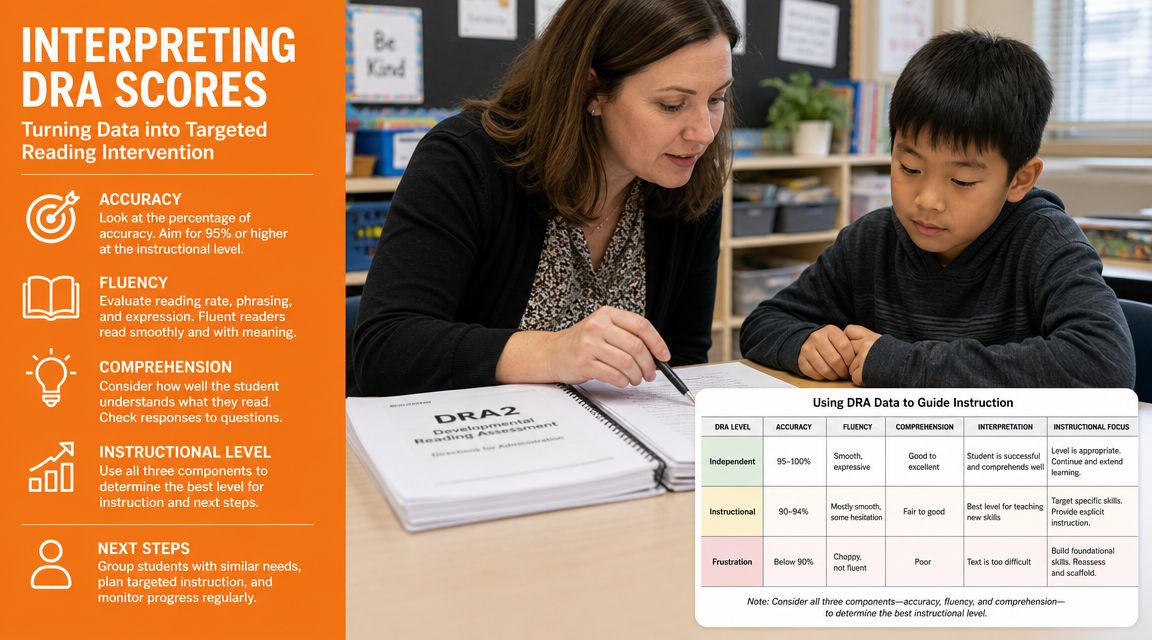
In practice, three instructional zones are commonly considered: independent, instructional, and frustrational. The exact cut points may vary by school or kit guidance, but the working logic is stable. Independent means the student can manage the text with little support. Instructional means the student can succeed with targeted teaching. Frustrational means the demands of the text are so high that the reading behaviour no longer reflects stable skill.
A practical example
Leo is in a classroom reading block and appears, at first glance, to be doing “fine”. He reads aloud with acceptable pacing and doesn't make many obvious substitutions. Then the retell begins. He gives a few isolated facts, skips the central problem, and can't explain why a character acted the way they did.
Leo's profile suggests a key distinction. His surface reading behaviour looks stronger than his meaning construction.
That leads to different intervention choices than a child who miscues on nearly every line. With Leo, I would examine:
Retell quality. Does he sequence events logically?
Question type. Can he answer literal questions but miss inferential ones?
Language load. Does comprehension improve when the passage is discussed orally?
What the zones mean in real teaching
When a student's DRA performance is independent, classroom instruction can focus on broadening reading volume, discussion quality, and written response.
When performance is instructional, that is usually where the strongest small-group teaching happens. The text is hard enough to reveal habits, but not so hard that every sentence becomes damage control.
When performance is frustrational, the examiner should be cautious. Text at this level often tells you less about genuine reading skill and more about overload.
If the child is failing at everything on the page, you no longer know which process broke first.
Reading the notes, not just the level
The most useful part of many DRA administrations is the qualitative record. Look for patterns in errors and behaviours:
Frequent self-corrections can suggest active monitoring.
Flat, word-by-word delivery often points to weak automaticity.
Thin retells with accurate oral reading raise questions about language comprehension, memory, or attention.
Strong oral discussion paired with weak independent reading often suggests decoding remains the main barrier.
Parents often struggle with this kind of score interpretation across assessments, not just in reading. A plain-language explanation of Iowa Assessment scores for parents can help when you need a parallel example of how standardised scores and instructional meaning are not the same thing.
When a DRA pattern stays stubborn despite appropriate teaching, it may be time to step back and ask whether there is a broader learning profile involved. That's where a more formal look at the assessment of learning disabilities becomes relevant.
Instructional Strategies for Common Reading Gaps
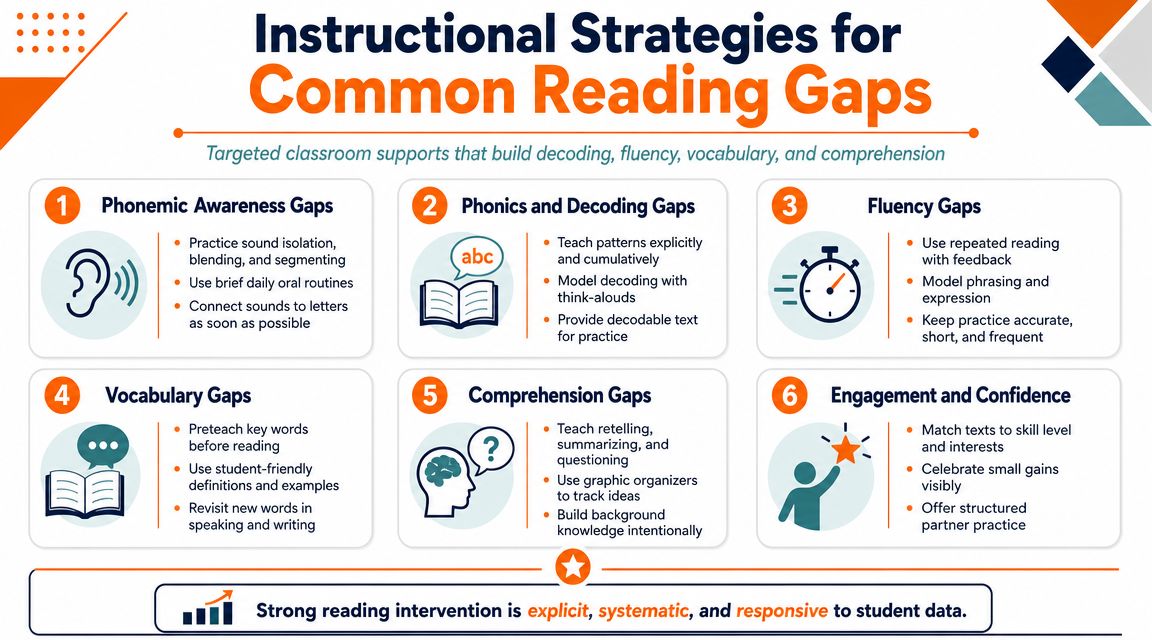
Once the DRA shows where the breakdown occurs, intervention should become simpler, not more complicated. The aim is to reduce the mismatch between the student's needs and the task you're asking them to do.
Improving accuracy
Accuracy problems usually require directness. Students who guess from the first letter or use pictures to mask weak decoding need explicit attention to print.
Try a small set of routines:
Word sorts with a tight pattern focus. Group words by vowel team, ending, or syllable pattern. Ask the student to explain why each word belongs.
Error-based review. Pull several real miscues from the DRA text and teach the pattern that links them.
Phrase-level decoding practice. Some students can decode single words in isolation but lose control in connected text. Short phrases expose that gap quickly.
A practical example: if a student repeatedly confuses visually similar words, stop assigning more “just right books” and return to targeted pattern work inside short passages.
Boosting fluency
Fluency work should sound like reading, not like drill detached from meaning.
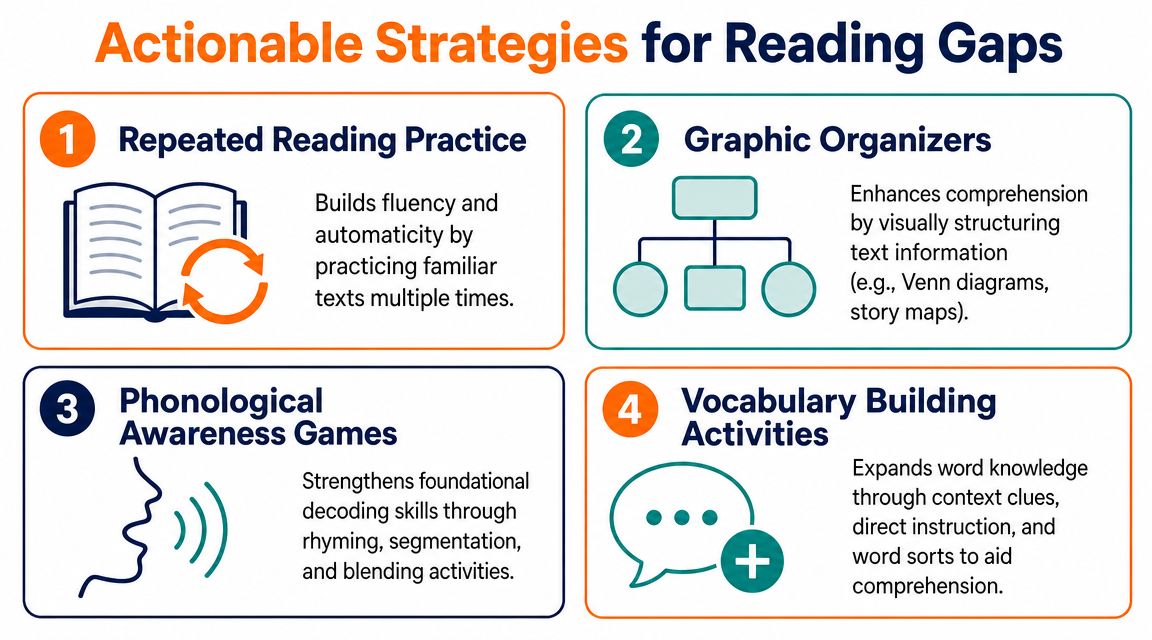
Repeated reading is often useful when the issue is effortful, choppy oral reading rather than severe decoding weakness. Reader's theatre, echo reading, and partner reading can also help because they pair rehearsal with expression and attention to syntax.
What doesn't work well is asking one child to struggle publicly through a passage while everyone else waits. Group round-robin reading gives very little actual practice.
Three strong fluency moves look different in practice:
Repeated reading of short familiar text builds automaticity and confidence.
Echo reading with an adult model helps students hear phrasing and punctuation.
Performance reading gives a reason to reread beyond mere compliance.
For students whose attention regulation also affects reading stamina, this guide to improving ADHD reading offers practical classroom and home ideas that complement text-based intervention.
Deepening comprehension
Comprehension teaching works best when it is visible. If the child cannot explain how they arrived at meaning, they often need a scaffold for thinking, not just more questions.
Use tools that externalise the structure of the text:
Story maps for character, setting, problem, action, and resolution
Cause-and-effect chains when a student recalls details but misses sequence
Stop-and-retell prompts after a short section rather than waiting until the end
Prediction checks that require the student to revise an earlier idea using evidence from the text
Strong comprehension instruction doesn't ask only “What happened?” It asks “How do you know?” and “What in the text helped you decide that?”
Matching the method to the learner
A common mistake is giving the same intervention package to every low reader. A student with decoding errors needs different support from a student with weak inferencing. A child who tires quickly may need shorter passages and tighter feedback loops. A bilingual learner may need vocabulary and syntax support that looks different again.
When persistent reading problems raise questions about broader patterns such as phonological weakness or dyslexic-type errors, it helps to review how reading differences are framed in a wider context. A concise guide to dyslexia in Canada can support those discussions with families and school teams.
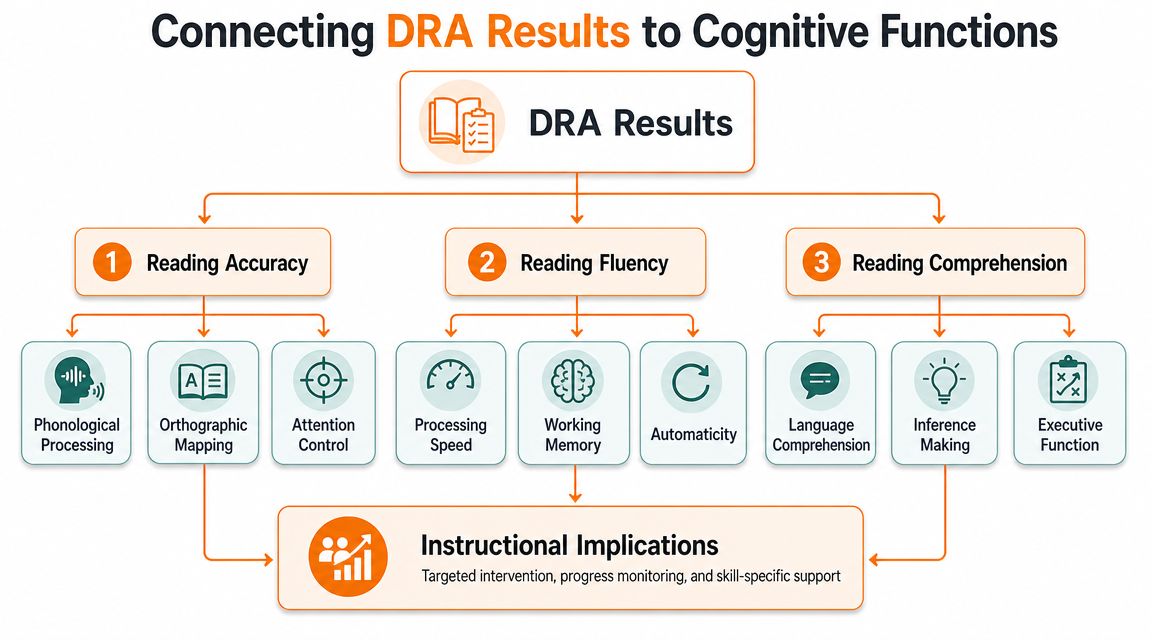
Connecting DRA Results to Cognitive Functions
DRA reading levels become more than a literacy label. A reading profile can offer clues about the cognitive work happening underneath the page.
That does not mean the DRA diagnoses anything. It doesn't. But it can help educators and clinicians form better hypotheses.
When fluency points beyond reading
A student who reads accurately but painfully slowly may have a reading-specific automaticity issue. They may also be showing broader inefficiency in processing speed. In day-to-day terms, this student often needs more time to stabilise visual input, retrieve a sound pattern, and produce the word smoothly.
That distinction matters. If the team interprets slow reading only as laziness or poor effort, the intervention will fail. If they recognise that the child's processing system is working hard but inefficiently, they can adjust pacing, text length, and rehearsal demands accordingly.
When retell and recall suggest memory load
Some DRA performances break down after the reading appears complete. The student gets through the text, then produces a weak retell, omits key events, or loses sequence.
That profile often raises questions about working memory. The child may decode well enough in the moment but struggle to hold, organise, and integrate what they have just read. In intervention, these learners usually benefit from chunking, brief pauses for rehearsal, and visual supports such as story frames.
A related issue is executive control. If the student can answer questions when prompted but doesn't spontaneously monitor for meaning, they may not be consistently checking comprehension as they read.
When inference and flexibility are the weak points
Inference tasks rely on more than vocabulary. They require the reader to suppress irrelevant details, connect information across sentences, and revise an emerging interpretation. Those are executive demands.
That is why some students look competent on literal questions and then collapse on anything that requires integration. The text is not always too hard. The cognitive coordination is too heavy.
A multi-sensory teaching approach can be useful for some learners because it reduces the burden on a single channel and gives the student more routes into the material. For a practical overview, this article on the benefits of multi-sensory education is a helpful starting point.
Using DRA as a hypothesis generator
Here's the practical stance I recommend:
Treat decoding errors as possible indicators of phonological or orthographic weakness.
Treat effortful but accurate reading as a clue to automaticity or processing inefficiency.
Treat poor retell with decent oral reading as a signal to look at working memory, language organisation, or attention.
Treat weak inference as a prompt to consider executive functions, vocabulary depth, and background knowledge.
This is also where one broader tool can complement classroom data. Orange Neurosciences offers assessment and training tools, including ReadON and OrangeCheck, that examine areas such as attention, memory, executive function, processing speed, and related skills. In cases where reading intervention stalls, that kind of profile can add useful context rather than replacing educational assessment.
If your team wants a shared framework for these terms, a guide on what cognitive function means in practice can make the conversation more precise.
From Assessment to Sustainable Student Progress
The DRA is valuable because it slows us down enough to ask the right question. Not “Is this student a good reader?” but “What part of reading is working, what part is fragile, and what should we teach next?”
Used carefully, DRA reading levels help with text selection, grouping, intervention planning, and progress monitoring. Used carelessly, they become a shorthand label that hides important differences between learners. The score matters less than the pattern.
The strongest reading support plans usually combine three habits. They read the DRA qualitatively, they teach directly to the observed weakness, and they stay open to the possibility that reading behaviour reflects deeper cognitive demands as well as literacy skill. When a student keeps struggling despite sensible instruction, that isn't a reason to double down blindly. It's a reason to widen the lens.
If you're trying to make sense of uneven reading progress, visit Orange Neurosciences to explore how cognitive assessment can complement classroom reading data and help build a more complete support plan for students, families, and clinical teams.

Orange Neurosciences' Cognitive Skills Assessments (CSA) are intended as an aid for assessing the cognitive well-being of an individual. In a clinical setting, the CSA results (when interpreted by a qualified healthcare provider) may be used as an aid in determining whether further cognitive evaluation is needed. Orange Neurosciences' brain training programs are designed to promote and encourage overall cognitive health. Orange Neurosciences does not offer any medical diagnosis or treatment of any medical disease or condition. Orange Neurosciences products may also be used for research purposes for any range of cognition-related assessments. If used for research purposes, all use of the product must comply with the appropriate human subjects' procedures as they exist within the researcher's institution and will be the researcher's responsibility. All such human subject protections shall be under the provisions of all applicable sections of the Code of Federal Regulations.


© 2026 by Orange Neurosciences Corporation