Center of Attention: How the Brain Chooses What to Focus On

You may be reading this while a child drifts away from a lesson, a colleague speaks during a meeting, or your own mind jumps between tabs. In ordinary conversation, the center of attention is the person or idea everyone notices. In cognitive science, however, attention is less like a single spotlight and more like a team of systems deciding what deserves mental effort.
California has repeatedly become a centre of attention in the wider cultural sense. After gold was discovered in 1848, San Francisco's population grew from 300 to 30,000 within a few years, and historical accounts described the city as the “center of world attention.” Later, Hollywood and Silicon Valley helped California become a global hub for media and innovation, while the state drew 35 million new residents between 1900 and 2010. These shifts show how attention can gather around a place, a story, or an idea, but the brain must still decide what each person notices and remembers. California's modern history and changing global role offers a useful starting point for understanding that broader meaning.
What It Really Means to Be the Center of Attention
A child looks toward the classroom window while the teacher explains a new task. At the same time, a parent in a video meeting realises they've been listening without absorbing the discussion. Neither person is necessarily careless. Their brains may have assigned priority to something else, such as movement outside, an internal thought, or an unfinished concern.
The phrase center of attention carries two everyday meanings:
Social focus: A speaker, performer, event, or person holds a group's attention.
Personal focus: An individual's attention becomes unusually strong, weak, narrow, or difficult to redirect.
The first meaning can be positive. A storyteller who keeps a room engaged has successfully guided other people's attention. The second can feel frustrating, especially when someone wants to focus but can't stay with the task in front of them. People may then use labels such as distracted, lazy, anxious, or overly absorbed before understanding the underlying pattern.
Practical rule: Describe what attention does before deciding what it means.
Attention also connects with perception. The brain doesn't just receive the world like a camera. It selects, interprets, and prioritises information, which is why learning about what perception means can clarify why two people may notice different details in the same room.
The social consequences matter, too. A child who misses instructions may be corrected repeatedly. An adult who loses the thread of a conversation may avoid meetings. Someone whose worry pulls attention toward imagined judgement may need support with how to overcome social anxiety, rather than criticism for appearing disengaged.
The useful question is not, “Why won't this person pay attention?” It's, “Which part of attention is struggling, in which setting, and under what conditions?” That question leads from a social description to measurable brain functions, observable patterns, and more informed support.
The Brain's Attention Systems Explained
The brain's attention systems work together like a team, with each part handling a different demand. One system notices change, another selects relevant information, another maintains effort, and another helps organise competing goals. These skills may support a person well in one setting and become strained in another.

A useful sequence begins with automatic orienting and develops toward deliberate control.
Automatic orienting
Orienting is the rapid response to something new. A sudden sound, bright movement, or someone calling your name can draw focus before you consciously choose to look. This response helps detect changes in the environment. Repeated notifications, hallway noise, or nearby conversations can also interrupt work by capturing attention again and again.
Sustained attention
Sustained attention means remaining with one task over time. A student uses it while reading a page, completing a worksheet, or listening through a lesson. An adult uses it to review a document or follow a long conversation.
Interest changes the experience. Someone may stay absorbed in drawing or building, yet struggle to continue routine work. Task demands, motivation, and mental effort all affect how long attention remains available.
Selective attention
Selective attention filters relevant information from distractions. Listening to a teacher while ignoring hallway noise requires selection. Finding one name in a crowded list or following a conversation in a busy café uses the same skill.
The system helps the brain decide what deserves priority and what can remain in the background. Physical comfort can influence extended screen-based work, too. Readers who experience eye strain may discuss best lenses for screen work with an appropriate optical professional.
Divided and executive attention
Divided attention involves handling two streams at once, such as cooking dinner while helping with homework. Rapidly switching between tasks can feel productive, even though each activity may receive less consistent attention.
Executive attention coordinates deliberate control. It supports planning, impulse inhibition, performance monitoring, and task switching. For example, it helps someone pause a message, finish an assignment, and respond afterward instead of allowing every new demand to take over.
These systems depend on interacting brain regions and networks, including dorsal and ventral attention systems. A plain-language guide to the brain's lobes can help families connect attention functions with broader brain organisation. Digital assessment can then examine how these skills perform under structured conditions, adding measurable information to everyday observations.
When Focus Shifts Too Far or Too Little
Attention problems don't always look like a complete absence of focus. Sometimes attention becomes too narrow and resistant to redirection. At other times, it fragments so quickly that a task rarely receives steady mental effort.
A student might build an elaborate block structure for hours but struggle to begin a worksheet. The student may show strong sustained attention under conditions of interest, yet find task initiation, selective filtering, or executive control much harder when the work feels repetitive. In a classroom, adults may notice unfinished work, missed instructions, or frequent movement before they notice the contrast between deep absorption and difficulty shifting.
An adult may read a technical book for a long period but miss key points in meetings. The issue may involve selective attention, working memory, task switching, or the demands of processing spoken information. At home, a teenager may notice every doorbell and hallway sound while forgetting homework instructions moments after hearing them.
What the four systems can reveal
Sustained attention: The person starts strongly but loses effort during routine tasks.
Selective attention: Background sounds, visual movement, or internal thoughts repeatedly pull focus away.
Divided attention: Two simultaneous demands cause one stream to disappear.
Executive attention: Planning, inhibition, task initiation, or switching creates the greatest difficulty.
These descriptions are observations, not diagnoses. Sleep, stress, anxiety, learning demands, sensory sensitivity, medication effects, and many other factors can influence performance. A practical classroom response may include shorter instructions, written reminders, reduced distractions, or planned movement breaks. Resources on managing difficult classroom behaviours can help educators respond to behaviour while investigating the need behind it.
Families should record patterns rather than isolated incidents. Note the task, time of day, setting, instructions, distractions, and what helped. A guide to working memory and ADHD may offer useful background, but a qualified professional must interpret individual concerns.
Real-World Examples Across Ages and Settings
Maya is 9 years old. During independent work, she stares out the window while classmates complete their worksheets. She begins an instruction, forgets the next step, and starts a conversation when the class is working in silence. Her teacher sees incomplete tasks and misplaced materials.
At home, Maya's parents notice a confusing contrast. She can draw for a long stretch, choosing colours and refining small details, but she becomes distracted during chores. They sometimes call the pattern laziness, while Maya experiences the task as difficult to hold in mind. Across repeated weeks, the same cues appear: missed verbal instructions, delayed starts, and stronger engagement when an activity is highly interesting.
Daniel is 38 years old and manages projects at work. He reads the same email three times, cares a great deal about deadlines, and still submits work late. In meetings, colleagues notice that he misses key points or asks for information already discussed. By mid-afternoon, he feels mentally exhausted.
His family may dismiss the problem because Daniel appears capable and responsible. He may also wonder whether anxiety or poor motivation explains everything. The pattern becomes more informative when it repeats across different projects, despite effort and concern about the consequences.
What observers can and can't see
Teachers, colleagues, and relatives see outcomes: unfinished work, missed details, interruptions, or delayed responses. They often can't see the brief lapses, mental effort, or compensatory strategies that occur between those moments.
What someone notices | What it may indicate | What it cannot establish |
|---|---|---|
Work remains incomplete | Difficulty sustaining effort or initiating tasks | A specific diagnosis |
Instructions are forgotten | Working-memory or selective-attention demands | The cause of the difficulty |
Long focus appears on preferred tasks | Attention varies with interest and context | That all attention systems are working well |
Observation provides important context, but it rarely captures the full profile. Families and professionals need a way to examine performance under consistent conditions before deciding what support fits.
From Guesswork to Data in Cognitive Assessment
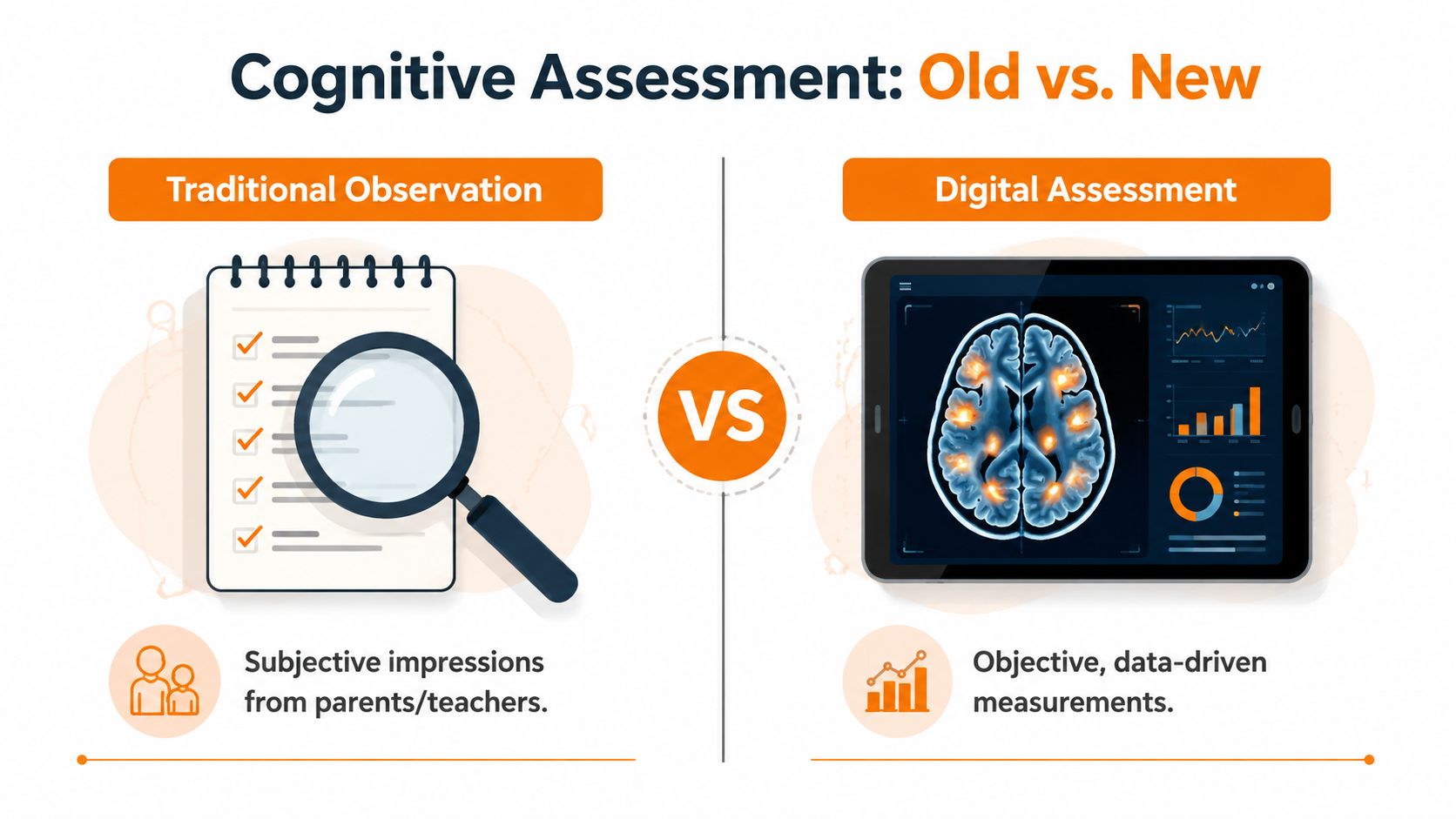
Observation starts the conversation, but objective digital assessment can make that conversation more precise. A parent may remember the worst homework evening. A teacher may see only classroom behaviour. An adult may judge performance through the lens of stress or embarrassment. These perspectives matter, yet mood, memory, setting, and expectations can shape them.
Standardised digital tasks create repeated opportunities to examine how a person responds. Depending on the assessment, useful measures may include reaction time, accuracy, response variability, and distractibility. Platforms such as OrangeCheck and ReadON by Orange Neurosciences can deliver structured cognitive tasks and support assessment or training workflows, while cognitive assessment tools provide broader context for comparing available approaches.
Three differences that change the discussion
Dimension | Observation alone | Digital cognitive assessment |
|---|---|---|
Timeline to insight | Information accumulates through daily experiences and reports | Structured tasks can provide an immediate performance snapshot |
Depth of data | Anecdotes describe behaviour and context | Metrics describe responses across repeated trials |
Consistency | Different observers may use different standards | Standardised tasks support more consistent comparison |
A checklist might say, “Often distracted.” A digital task may show that errors increase when distractions appear, that responses become slower as demands continue, or that performance varies from trial to trial. Those findings don't explain a person's whole life, but they give clinicians and educators a shared point of reference.
Data should anchor clinical reasoning, not replace it.
The most useful assessment combines both forms of information. A clinician needs history, context, and functional impact. A teacher contributes classroom observations. A family describes sleep, routines, and changes over time. Digital results add structured evidence that can help identify which cognitive skills deserve closer attention.
Assessment also needs clear boundaries. A screening profile isn't automatically a diagnosis, and a single result shouldn't determine a child's education or an adult's treatment. Its value lies in reducing guesswork, guiding follow-up questions, and helping the care team decide whether a fuller evaluation or targeted intervention is appropriate.
Why Early Objective Assessment Changes Outcomes
Waiting can feel safer than investigating. Families may hope a child will mature, teachers may try another classroom strategy, or an adult may keep compensating until work becomes unsustainable. Early objective measurement offers a more practical alternative: establish a baseline, identify the areas that need support, and review whether the plan is helping.
For educators, timely information can support adjustments before frustration becomes the dominant classroom pattern. A student may need instructions presented in smaller units, fewer simultaneous demands, visual prompts, or a quieter location. The appropriate strategy depends on the observed profile, not on a generic label.
Clinicians also benefit from a clearer starting point. Attention complaints can overlap with anxiety, sleep disruption, stress, learning differences, medication effects, or other health concerns. A structured cognitive profile doesn't settle those questions on its own, but it can show which functions warrant deeper assessment and which questions should be asked next.
Addressing common concerns
Cost and effort: Assessment takes resources, but years of trial-and-error can also carry educational, emotional, and clinical costs. Objective information may help teams avoid repeating strategies that don't match the person's needs.
Access: Remote and digital options can make structured screening more feasible for families who face travel, scheduling, or geographic barriers. Access still depends on appropriate supervision, technology, privacy practices, and professional interpretation.
Privacy: Families should ask how information is collected, stored, shared, and deleted. Reputable providers should explain their data standards in plain language and make clear whether results support care, education, research, or another purpose.
A baseline also makes progress easier to discuss. Instead of asking whether someone “seems better,” families and clinicians can compare current functioning with earlier observations and assessment results, while still considering daily life. The aim isn't to reduce a person to a score. It's to replace vague concern with a more specific understanding of where attention succeeds, where it falters, and what support deserves a fair trial.
Bringing It All Together and Taking the Next Step
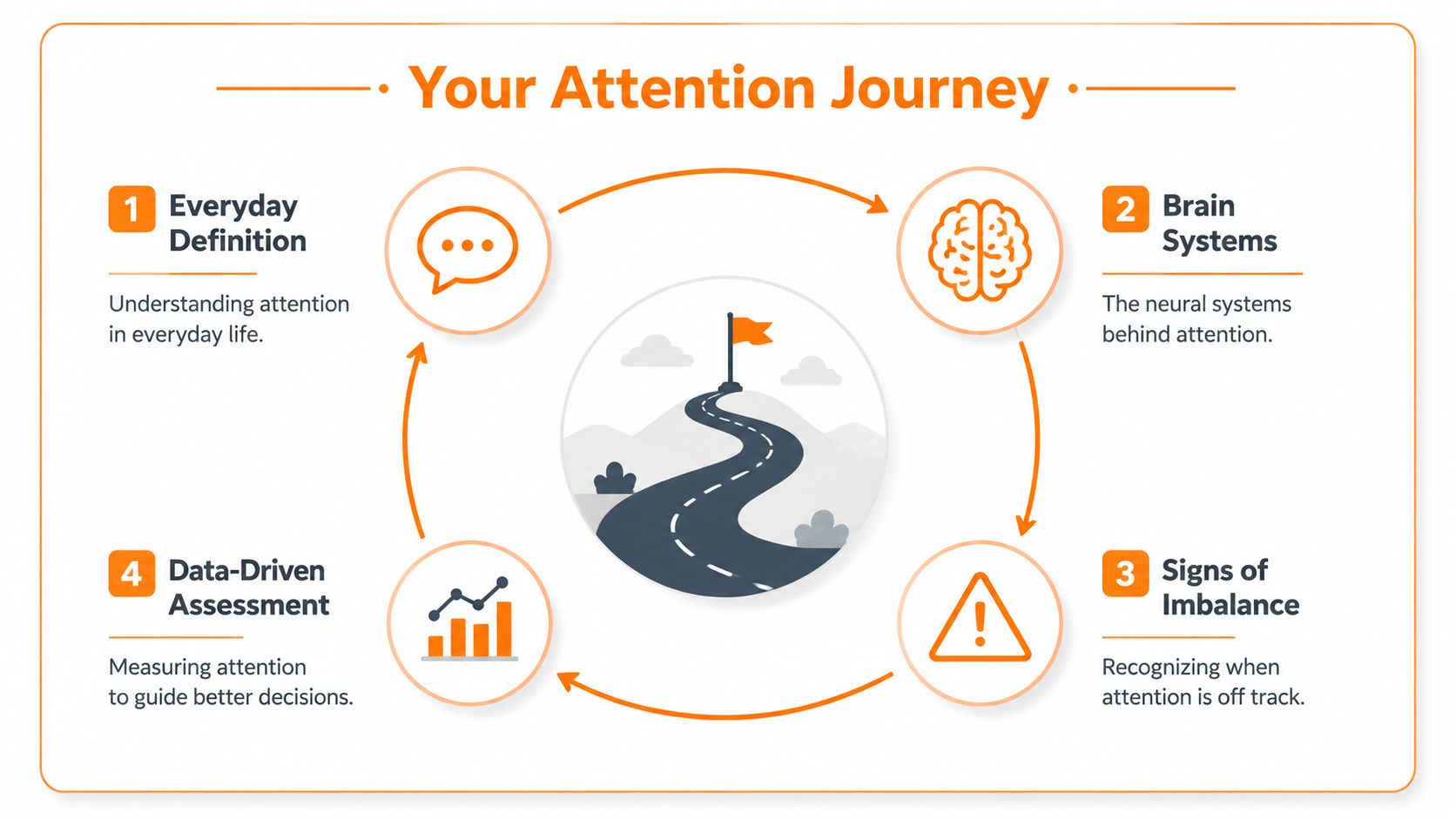
The phrase center of attention begins as a social description. Someone holds a room's focus, or someone struggles to keep their own focus on the task everyone else is doing. Neuroscience adds detail by showing that attention includes sustained, selective, divided, and executive skills, each contributing differently to learning, work, communication, and daily routines.
Three practical takeaways matter most:
Recognise patterns, not labels. Notice when focus changes with task interest, noise, time of day, instructions, stress, or competing demands.
Seek objective information before guessing. Observation provides context, while structured digital tasks can add measurable information about accuracy, reaction time, variability, and distractibility.
Choose support early and review it deliberately. Strategies should match the person's needs, and progress should be revisited rather than assumed.
Before requesting help, write down two or three specific concerns. For example, you might note that your child forgets spoken instructions but completes visual tasks, that a student loses focus when background noise increases, or that you reread work repeatedly despite adequate sleep and strong motivation. Concrete examples help a clinician understand function rather than hearing only a broad statement such as “attention is poor.”
You can also explore ways to improve focus and concentration while deciding whether formal screening makes sense. Attention is measurable, and support can be adjusted when the evidence shows what is changing. Understanding the pattern is more useful than worrying about the label.
Orange Neurosciences offers AI-powered cognitive assessment and training tools that measure attention alongside memory, executive function, processing speed, perception, and related skills, while supporting targeted digital exercises. Visit Orange Neurosciences to explore the platform, request a consultation, or email the team about whether objective cognitive screening may suit your child, student, or yourself.

Orange Neurosciences' Cognitive Skills Assessments (CSA) are intended as an aid for assessing the cognitive well-being of an individual. In a clinical setting, the CSA results (when interpreted by a qualified healthcare provider) may be used as an aid in determining whether further cognitive evaluation is needed. Orange Neurosciences' brain training programs are designed to promote and encourage overall cognitive health. Orange Neurosciences does not offer any medical diagnosis or treatment of any medical disease or condition. Orange Neurosciences products may also be used for research purposes for any range of cognition-related assessments. If used for research purposes, all use of the product must comply with the appropriate human subjects' procedures as they exist within the researcher's institution and will be the researcher's responsibility. All such human subject protections shall be under the provisions of all applicable sections of the Code of Federal Regulations.


© 2026 by Orange Neurosciences Corporation