Category Fluency Test: A Clinician's Practical Guide

A patient sits across from you, stopwatch ready. You give the instruction, start the timer, and hear a quick sequence: dog, cat, horse, cow. Then the pace slows. The patient searches, repeats dog, pauses again, and finishes with a few more familiar animals. The total count matters, but the shape of that minute often tells you more.
That's the practical value of the category fluency test. It turns a simple naming task into a brief view of semantic retrieval, language access, working organisation, and executive monitoring. Used carefully, it can support decisions in neurology, rehabilitation, geriatric care, and educational assessment. Used as a standalone verdict, it can mislead.
What the Category Fluency Test Really Measures
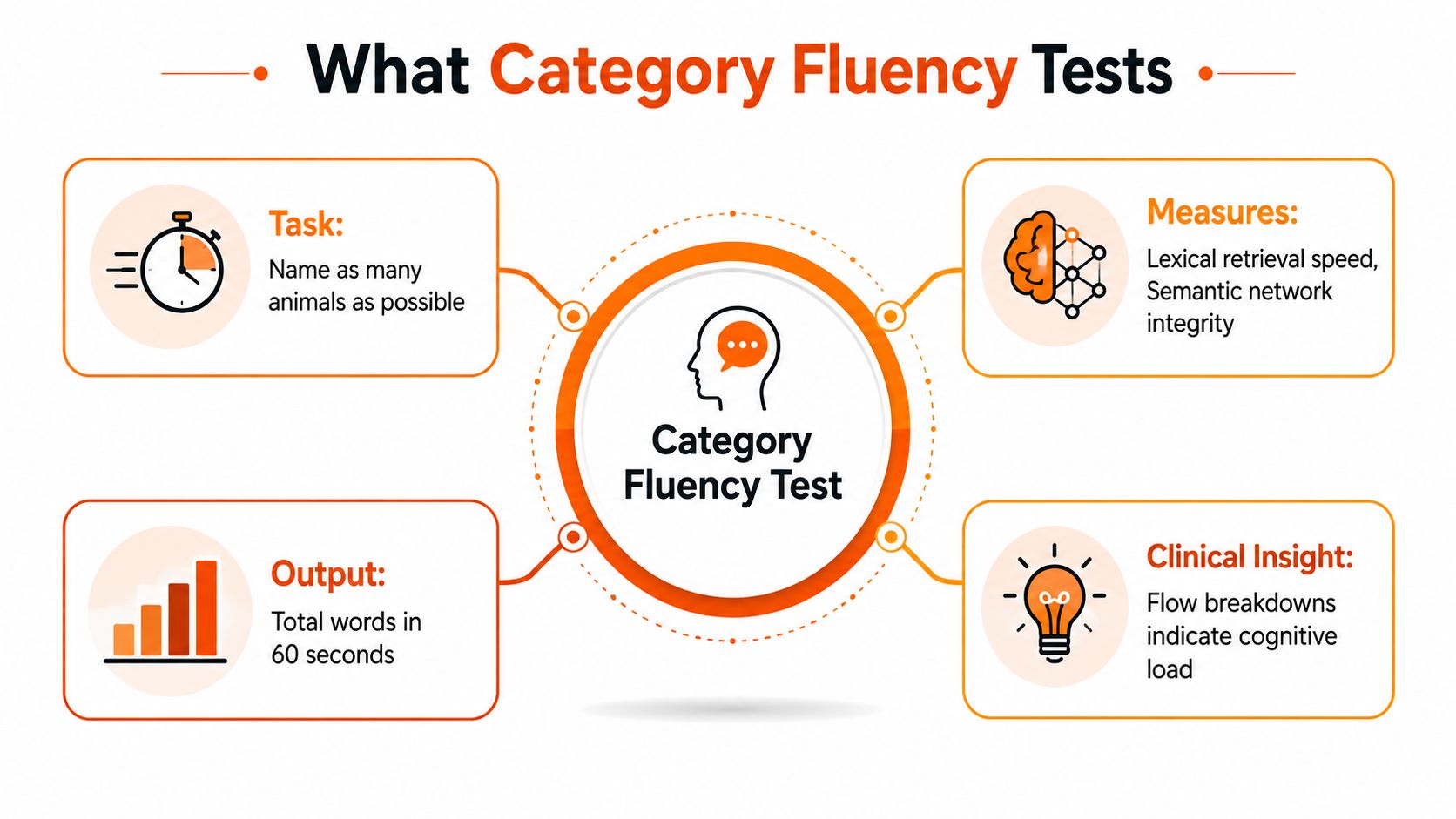
In the usual format, you ask a person to name as many unique examples from a category as possible, often animals, during 60 seconds. The score is the number of correct, non-repeated responses. This makes the task quick to administer, but it isn't a vocabulary quiz. A patient may know many animal names and still struggle to retrieve them rapidly under time pressure.
The task combines two processes. Semantic memory supplies the knowledge, such as the fact that a dolphin, robin, and tiger belong to meaningful concepts. Executive retrieval organises the search, keeps the person inside the category, notices repetitions, and shifts when one part of the semantic network becomes exhausted.
A patient who says dog, cat, rabbit, hamster, and guinea pig is showing a cluster around household animals. If they then move to eagle, sparrow, pigeon, and robin, that shift suggests they can leave one semantic neighbourhood and search another. If the flow breaks after a few responses, the problem may involve access, monitoring, processing speed, fatigue, anxiety, or language exposure rather than a simple absence of knowledge.
Practical rule: Treat the 60-second response as a stream of behaviour, not just a final number.
The timing creates useful pressure. Early responses often come from highly accessible concepts, while later responses require broader search and more active switching. A clinician can therefore observe both the person's starting speed and how effectively they maintain retrieval as the minute continues.
The task also travels well across settings. In a rehabilitation clinic, it can provide a compact probe of language and executive systems. In a school assessment, it can sit alongside broader language and learning measures, especially when a child's performance needs interpretation within developmental and educational context. Clinicians working with children may find this guide to neuropsychological testing children useful when deciding how a fluency result fits into a wider assessment.
The broader idea is learning by association. Words aren't stored as an alphabetical list. They're connected through meaning, experience, sound, and use. A related explanation of learning by association can help clinicians explain why category-based retrieval feels different from simple word recognition.
How Semantic Retrieval Works Under the Hood
Think of the mind as a large warehouse, and the category fluency test as a request to find one kind of stock quickly. The semantic system is the warehouse inventory. It contains concepts and relationships, including the fact that a dog is an animal, a terrier is a kind of dog, and a salmon is different from a shark.
The executive system acts like the librarian and floor supervisor. It chooses an aisle, checks whether each item belongs, remembers what has already been called out, and decides when to move elsewhere. If the person begins with farm animals, the supervisor may permit a run of cow, horse, pig, sheep, and goat. Once that aisle becomes less productive, the supervisor should direct the search toward pets, birds, sea life, or insects.
Clustering and switching become useful. Clustering describes related responses produced close together, such as dog, cat, rabbit, and hamster. Switching describes movement between those groups, such as moving from pets to birds and then to aquatic animals.
A patient can have a reasonable total score through very different routes. One person may produce a long, orderly cluster and then stop searching. Another may produce fewer words in each group but switch often and maintain a steady pace. Those patterns place different demands on semantic organisation and executive control.
What changes across the minute
The first part of the trial often draws on the most available concepts. The middle requires more active search, and the closing moments can expose fatigue, reduced monitoring, or difficulty generating a new route. Research using timed semantic fluency found that participants retrieved about seven words in the first 15 seconds, while semantic fluency averaged 26.6 correct words, compared with 18.8 for phonemic fluency; the task took only 4–5 minutes per subject in the California Cognitive Assessment Battery (PLOS ONE).
That timing pattern gives you a practical observation point. If a patient starts slowly but accelerates, the issue may involve initiation or uncertainty. If they begin rapidly and then collapse, sustained retrieval or switching may deserve closer attention. Neither pattern proves a diagnosis, but both add context to the final count.
A concise overview of cognitive skills can also help when explaining that semantic retrieval is one coordinated ability within a larger cognitive profile.
Administering the Test in Real Clinical Workflows
A patient pauses after naming several farm animals. The room is quiet, the timer is running, and the temptation is to offer “animals in the sea.” Resist that cue. Administration should preserve the patient's search process, because the way they respond can provide information beyond the final word count.
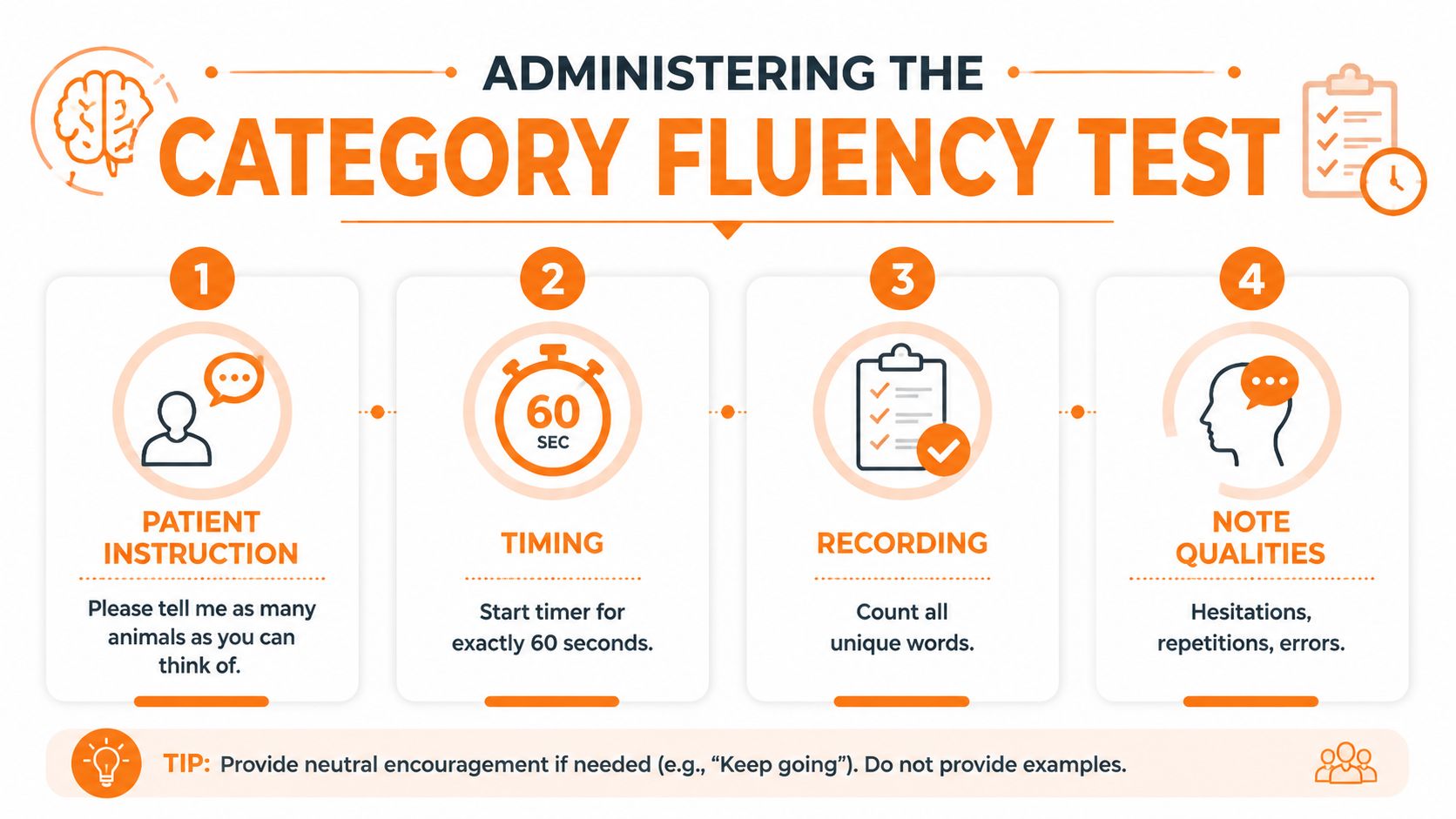
Before starting, use a quiet room, confirm that the patient can hear you, and keep the wording, timing, and prompts consistent across sessions. A standard administration can follow this sequence:
Give the instruction: “Please tell me as many animals as you can think of.”
Start the timer: Use exactly 60 seconds for the standard category trial.
Record every response: Write each word in order, including repetitions, intrusions, and unusual answers.
Avoid unnecessary coaching: If the patient pauses, use a neutral prompt such as “Keep going,” only if that wording belongs to your established protocol.
Stop at the signal: Do not extend the trial after an interruption or distraction unless you document the deviation.
Score consistently: Count correct, unique category members, then mark errors and process features separately.
Agree on scoring rules before testing. Define how your team will handle compound terms, regional vocabulary, specific breeds, and related responses that do not clearly belong to the category. For example, decide whether “German shepherd” counts separately from “dog.” Apply the same rule to dialect variants and translations, and record any exception.
If a patient remains in one semantic group, let the pattern stand. Record the sequence, the length of the cluster, and whether the patient changes groups without help. A narrow list may reflect a restricted search route, while repeated shifts may show a different retrieval strategy.
If the patient stops completely, “Anything else?” may fit some protocols. “What about animals in the sea?” changes the task by supplying a semantic route, so document it as a deviation.
Digital platforms such as OrangeCheck can reduce transcription demands while preserving the response sequence. They can also support process-level review, including clustering, switching, intrusions, and repetitions, giving the clinician more diagnostic signal than a single total. This reflects the broader role of transforming healthcare with AI, where automation supports clinical workflow without replacing standardised judgment. Teams pairing the task with the MoCA can consult these MoCA administration instructions to keep related procedures organised.
Scoring Beyond a Single Word Count
Consider this fictional transcript:
dog, cat, rabbit, hamster, cow, horse, pig, sheep, eagle, robin, pigeon, salmon, shark, dolphin, dog, car, whale, tiger
The patient produced 18 spoken responses, but the score isn't automatically 18. The second dog is a repetition. “Car” is an intrusion because it doesn't belong to the animal category. The remaining valid responses contribute to the correct unique total.
The sequence also shows clusters:
Pets: dog, cat, rabbit, hamster
Farm animals: cow, horse, pig, sheep
Birds: eagle, robin, pigeon
Sea life: salmon, shark, dolphin
Large or wild animals: whale, tiger
The patient switches from pets to farm animals, then birds, then aquatic animals, and finally wild animals. That's a very different retrieval pattern from a patient who says cow, horse, pig, sheep, goat and remains in one narrow group for most of the trial.
Process Metrics at a Glance
Metric | What it captures | Clinical signal |
|---|---|---|
Total correct words | Overall productive output | Broad index of timed retrieval |
Clusters | Related words produced together | Organisation of semantic search |
Switches | Movement between semantic groups | Flexibility and search control |
Intrusions | Responses outside the category | Monitoring, comprehension, or language effects |
Perseverations | Repeated responses | Self-monitoring and response control |
Early output | Responses in the opening interval | Initiation and rapid access |
A total of 18 responses could therefore conceal a lower correct score, a repetition problem, or a strong ability to switch. It may also reveal that the patient's first few seconds were productive but the later search became inefficient. One study found that the most clinically meaningful differences appeared in the first 15 seconds, supporting the value of short-interval analysis rather than relying only on the endpoint (PubMed research on verbal fluency processes).
Digital scoring makes this analysis more practical. A paper form captures order only if the examiner writes rapidly and accurately. A digital platform can preserve response timing and support later review of clusters, switches, intrusions, and perseverations. That distinction matters when a team wants to compare sessions or examine change over time. Guidance on test-retest reliability statistics is relevant when deciding how much confidence to place in a change between administrations.
The headline count still has a place. It's familiar, easy to communicate, and useful when interpreted against appropriate norms. But the richer clinical signal often lies in how the person searches, especially at the beginning of the trial and at moments when the search breaks down.
Normative Adjustments That Change Interpretation
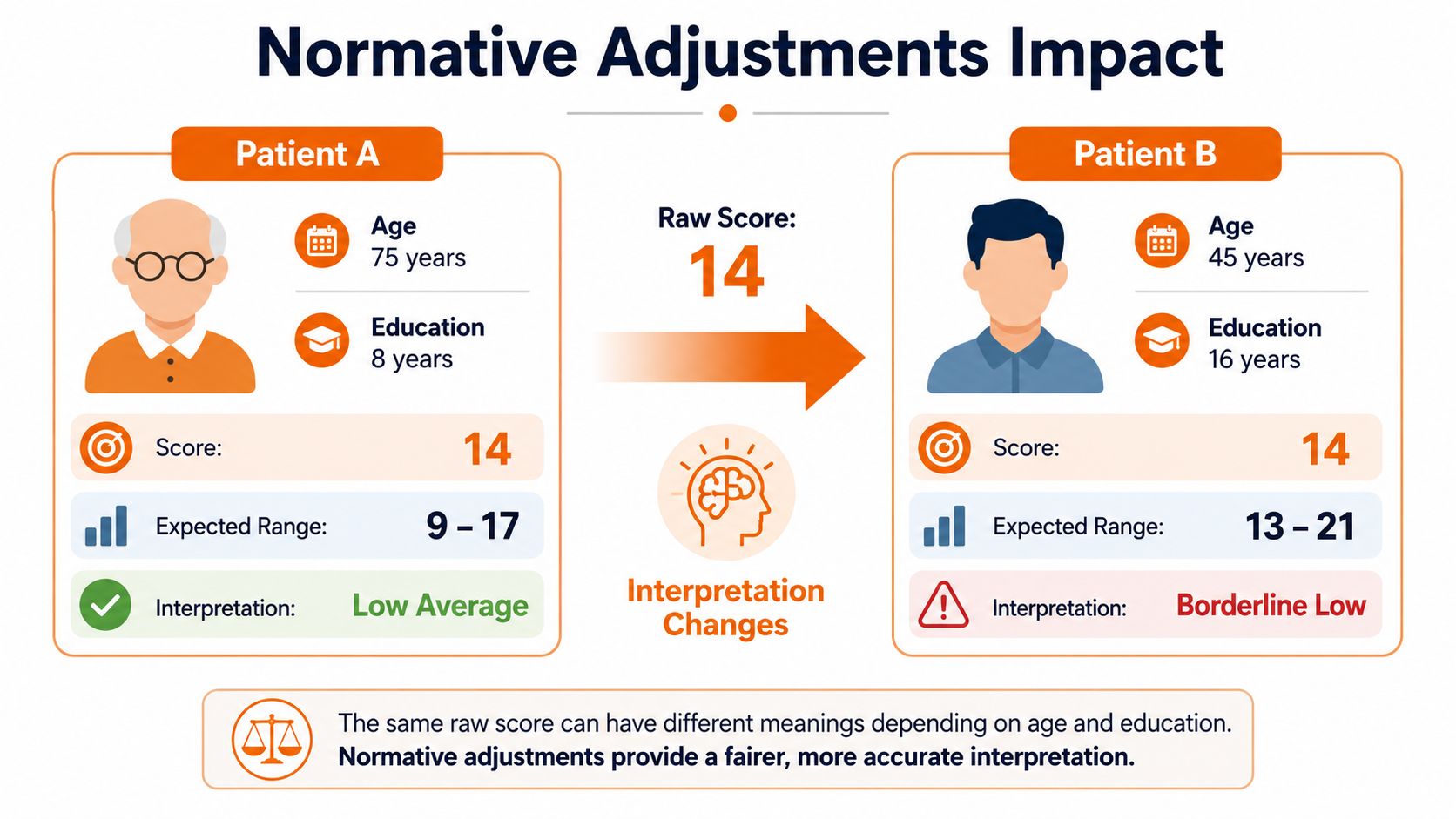
A patient produces 14 animal names. Whether that result is reassuring depends on who produced it. Age, education, ethnicity, language, and regional experience shape category fluency, so a generic cutoff can make expected performance look impaired or hide an unexpectedly weak result.
The foundational California-linked norms paper developed demographically corrected standards in 768 normal adults. Its equations used 403 participants and were cross-validated on 365 more, with adjustments for age, education, and ethnicity (demographically corrected fluency norms). The practical gain is a patient-specific expectation rather than one threshold applied to everyone.
Consider two fictional patients with the same score:
Patient A: Age 75, eight years of education. Fourteen correct animal names may fall within a lower expected range after adjustment.
Patient B: Age 45, 16 years of education. The identical score may raise more concern because the expected output is higher.
Education can change the meaning of a borderline result. Reported animal-fluency cutoffs range from 9 to 13 correct words depending on education level (Spanish-language and bilingual fluency norms). Ignoring schooling risks treating limited educational opportunity as cognitive decline. In a digital platform such as OrangeCheck, demographic context should accompany the total count and the process measures, including clustering, switching, and intrusions. Those measures do not replace norms. They help explain why a score falls where it does.
Language and regional context
The language used for testing must match the comparison group whenever possible. Canadian French-Quebec normative work used 60-second category trials and illustrates why adult performance needs regional interpretation (French-Quebec semantic fluency norms). Canadian validation work also developed local norms for related verbal fluency tasks in mild cognitive impairment, supporting comparisons with an appropriate linguistic and regional group (Canadian validation study).
For a Spanish-speaking or bilingual patient in a California clinic, testing in English may suppress retrieval when semantic knowledge is stronger in Spanish. That result does not, by itself, indicate neurodegeneration. Document acculturation, literacy, schooling history, proficiency, and the language used in daily life.
Use a language-of-assessment framework to record the selected language, the patient's proficiency, and whether the available norms fit that language and population. A well-matched comparison group often provides more useful interpretation than a superficially precise cutoff.
Choosing the Right Fluency Variant
Category fluency is only one member of the verbal fluency family. The best choice depends on the referral question, because each variant places a different demand on the person.

Category fluency asks for members of a semantic group, such as animals. The semantic network provides many connections, so the task is particularly useful when you want to examine access to conceptual knowledge, organisation within that knowledge, and the efficiency of semantic search.
Phonemic fluency asks for words beginning with a specified letter. The MoCA, for example, awards 1 point when a person produces 11 or more words in 60 seconds for the letter task, and the published MoCA document describes a total score of 26 or above as normal (MoCA English instructions). A letter constraint offers fewer semantic hooks, so the task often places greater pressure on strategic search, inhibition, and executive control.
Category switching alternates between categories, such as animals and fruits. It adds a deliberate flexibility demand because the patient must maintain two rules and shift between them without losing track. This format is associated with executive-function assessment, including the category-switching approach used in the Delis-Kaplan Executive Function System.
A quick decision aid
Referral question | Useful starting point |
|---|---|
Concern about semantic memory or suspected neurodegenerative change | Category fluency |
Concern about initiation, inhibition, or frontal-executive control | Phonemic fluency |
Concern about cognitive flexibility | Category switching |
Older-adult screening requiring demographic comparison | Category fluency with adjusted norms |
For adults over 55, the Mayo Older Americans Normative Studies provide age-adjusted animal-naming data and add education adjustment (Mayo older-adult fluency norms). That resource can support interpretation when category fluency is part of a broader older-adult battery.
The variants shouldn't be treated as interchangeable. A low animal score and a low letter score may arise from different bottlenecks. Administering more than one can be useful, but only when the additional task answers a clinical question rather than adding testing for its own sake.
Where Interpretation Goes Wrong
A low animal-naming score is not automatically a dementia signal. The task is sensitive to many influences, and some of them have nothing to do with neurodegeneration.
A patient with limited schooling may have had fewer opportunities to develop broad category labels or practise rapid test-like retrieval. A bilingual patient tested in their less dominant language may know the concepts but access them less efficiently. Someone who is anxious may spend the opening moments monitoring the examiner rather than searching the semantic network.
Fatigue, hearing difficulty, pain, depression, unfamiliarity with the testing context, and culturally shaped vocabulary can also affect the response stream. For example, a patient who uses a regional term for an animal may be marked wrong if the examiner applies a narrow scoring rule. The error belongs to the assessment process, not necessarily to the patient.
A low score is a prompt for investigation, not a diagnosis.
Longitudinal evidence does support the clinical value of semantic fluency. In one study of 239 participants, animal-category fluency declined faster than letter fluency, with a significantly steeper decline in both cognitively normal participants and those with prevalent Alzheimer's disease (longitudinal semantic fluency study). That finding makes change over time informative, but it doesn't turn one low result into proof of disease.
The safest interpretation combines the fluency result with history and broader testing:
Check language history: Ask which language the patient uses at home, work, and socially.
Review education and literacy: Record schooling rather than guessing from age or occupation.
Observe the process: Note initiation, pauses, clustering, switching, repetitions, and intrusions.
Compare related measures: Look for agreement or mismatch across semantic, phonemic, memory, attention, and executive tasks.
Repeat thoughtfully: A later result is useful only if practice effects, timing, language, and administration remain controlled.
Category fluency is best understood as a window into semantic and executive systems. It can raise or lower concern, but clinical decisions should rest on the full pattern.
Digital Implementation and What Comes Next
Paper-and-pencil administration remains workable, but it places a heavy recording burden on the examiner. A stopwatch can tell you when the minute ends, yet it won't automatically preserve the exact timing of each response or classify the sequence into clusters, switches, intrusions, and perseverations.
A digital workflow can capture those process-level details and place verbal fluency beside other cognitive measures. Orange Neurosciences offers OrangeCheck as an AI-powered assessment platform that can generate profiles across attention, memory, executive function, perception, processing speed, and eye-hand coordination in under 30 minutes. It isn't a diagnostic service, but its structured data can help clinicians decide whether further evaluation is warranted.

The practical next step is modest. Run a digitally recorded fluency trial, check the administration against local age-, education-, and language-appropriate norms, and review the response pattern instead of relying on one cutoff. Then use the broader cognitive profile to decide whether the patient needs a fuller neuropsychological evaluation, monitoring, rehabilitation planning, or no immediate escalation.
Use Orange Neurosciences to explore digital cognitive assessment that places category fluency within a broader, structured profile. Review the process data with the same clinical caution you'd apply to a paper score, and use the results to guide informed follow-up rather than making a decision from one word count.

Orange Neurosciences' Cognitive Skills Assessments (CSA) are intended as an aid for assessing the cognitive well-being of an individual. In a clinical setting, the CSA results (when interpreted by a qualified healthcare provider) may be used as an aid in determining whether further cognitive evaluation is needed. Orange Neurosciences' brain training programs are designed to promote and encourage overall cognitive health. Orange Neurosciences does not offer any medical diagnosis or treatment of any medical disease or condition. Orange Neurosciences products may also be used for research purposes for any range of cognition-related assessments. If used for research purposes, all use of the product must comply with the appropriate human subjects' procedures as they exist within the researcher's institution and will be the researcher's responsibility. All such human subject protections shall be under the provisions of all applicable sections of the Code of Federal Regulations.


© 2026 by Orange Neurosciences Corporation