Aphasie De Broca: A Clinician and Caregiver Guide

A person reaches for a glass of water, points, and tries to speak. Their jaw works hard, the first sound begins, then the sentence breaks apart. They may understand the nurse's question perfectly, yet produce only a laboured “wa... wa...” or a gesture toward the cup.
This is the lived reality behind aphasie de Broca, also called Broca aphasia. Reduced speech output can look alarming, but it doesn't automatically mean confusion, hearing loss, or reduced intelligence. A stroke survivor may follow a conversation, know exactly what they want to say, and still struggle to produce a short request.
This guide is for speech-language pathologists, physicians, nurses, rehabilitation assistants, family members, and care partners. It connects clinical description with everyday communication, so assessment captures preserved competence as well as impaired speech. The practical focus is Canadian rehabilitation guidance, structured cognitive profiling, supported conversation, and treatment choices that make progress easier to observe.
When Speech Gets Stuck
At the bedside, a father may try to say his child's name and produce only the first sound. In a hospital hallway, a patient may understand the nurse's question about pain but be unable to answer with a sentence. An older adult may track a family discussion, smile at the right moment, and then become visibly frustrated when a simple request will not come out.
These moments are often misread. A person who speaks very little may still understand much of what others say. They may recognise the problem, feel embarrassed by it, and work intensely to communicate. Speech output is visible, but communicative competence is broader than speech.
Practical rule: Assume there is more understanding and more to say than the person can currently express.
Broca aphasia usually involves effortful, non-fluent language after injury to the language network, often following a stroke. The person may communicate through pointing, facial expression, writing, drawing, gesture, or a communication aid while spoken language remains slow and fragmented. Those abilities should be assessed, supported, and documented rather than treated as secondary.
The consequences reach beyond conversation. A person may struggle to answer a consent question, explain a new symptom, book a follow-up appointment, or participate in decisions about discharge. Family members may begin speaking on their behalf, intending to help but unintentionally removing opportunities to respond.
Canadian stroke recommendations emphasise assessment of activity, participation, relationships, vocation, leisure, and quality of life across rehabilitation, not impairment alone. They also support supported-conversation training for professional teams, with techniques that help a person get a message in and out rather than having others speak for them. The Canadian language and communication recommendations provide a useful clinical foundation.
What Aphasia de Broca Actually Means
Broca aphasia is a non-fluent aphasia. The person knows what they want to communicate, but producing words and sentences requires unusual effort. Speech may be slow, abbreviated, and grammatically incomplete. Comprehension is often stronger than expression, especially in familiar everyday conversation, although the full language profile varies from person to person.
A useful analogy is a warehouse with much of its stock still available, but a jammed conveyor belt. The request arrives, the relevant language may be present, and the person may understand the situation. The delivery system moves slowly, loses pieces, or stops before the message reaches the other person.
The term has a major historical foundation. In 1861, French physician Paul Pierre Broca presented the case of Louis-Victor Leborgne, a 51-year-old man whose speech was largely restricted to the repeated syllable “Tan.” Leborgne also had right-sided hemiplegia, consistent with damage to the left cerebral hemisphere. After Leborgne died on 17 April 1861 from complications involving gangrene of the right lower limb, Broca performed an autopsy and identified destructive lesions in the second and third frontal convolutions of the left hemisphere, extending toward the inferior Sylvian fissure, insula, and adjacent striatum. Broca presented the findings the following day and later published his observations that year. The region became known as Broca's area, and the clinical syndrome became known as Broca aphasia. The historical account is documented in this review of Broca aphasia and the Leborgne case.

Modern clinicians shouldn't treat Broca's area as a single speech switch. Non-fluent aphasia can involve a broader language network, including the left inferior frontal gyrus, nearby motor and language regions, insula, and connecting white matter pathways. A person's communication profile depends on the location and extent of injury, the language functions affected, and the networks that remain available for recovery. Readers wanting a broader orientation to brain regions can consult this guide to the brain lobes.
The condition can follow an ischemic or haemorrhagic stroke, and acquired language impairment can also occur after other forms of brain injury. Severity varies widely. One person may produce short phrases with considerable effort, while another may have very limited speech but useful comprehension, writing, gesture, or alternative communication.
The Language Profile You Can Expect
The most recognisable feature is non-fluent, effortful speech. A person may pause frequently, struggle to initiate a word, or repeat part of a phrase while trying to complete it. Speech may sound halting, with disrupted rhythm and reduced grammatical structure.
For example, “I'm walking the dog in the park” might become “walk dog... park.” The message can remain understandable even though articles, prepositions, verb endings, and other grammatical elements are missing. A person may know that the sentence is incomplete and show frustration while trying to repair it.
What may be difficult
Spoken sentence production: The person may have difficulty combining words into a complete sentence, even when each individual word is familiar.
Word retrieval: Naming a common object, such as a cup or key, may require prolonged searching, a gesture, or a first sound cue.
Speech movement: Apraxia of speech may occur alongside aphasia, causing inconsistent sound errors, visible groping, and difficulty planning the movements for speech. Dysarthria may also contribute weak, slow, or poorly coordinated articulation.
Repetition: Repeating a sentence can be impaired, particularly when the sentence is long or grammatically complex.
Reading aloud and writing: Reading aloud may resemble spoken output, while writing may show the same abbreviated, agrammatic pattern as speech.
Complex comprehension: Everyday understanding may be relatively strong, but passive sentences, embedded clauses, or instructions with several linguistic relationships can be harder to interpret.
The person's social intent often remains clear. They may use eye contact, gesture, humour, facial expression, drawing, or pointing to keep an interaction moving. A pause doesn't mean they have nothing to contribute.
A practical comparison
Domain | Typically impaired | Typically preserved |
|---|---|---|
Spoken language | Fluency, grammatical formulation, initiation, articulation, connected speech | Communicative intent and some meaningful words |
Comprehension | Complex syntax, lengthy or linguistically demanding instructions | Much everyday conversation, depending on severity |
Repetition | Words or sentences, especially with greater length | Some automatic or highly familiar phrases |
Reading and writing | Reading aloud, written grammar, spelling, written sentence formulation | Some word recognition, copying, or personally meaningful writing |
Non-verbal communication | Selecting an effective strategy may require support | Gesture, pointing, drawing, facial expression, and social engagement |
The central misconception is that limited speech reflects limited intelligence. A person can think, understand, notice errors, and make decisions while struggling to express those abilities through speech. Clinicians and families should allow extra response time, offer more than one way to answer, and check understanding without converting every interaction into a test.
How Clinicians Assess Broca Aphasia
A thorough assessment begins with the person, not a score. The speech-language pathologist asks about onset, medical history, languages used, premorbid communication, work and family roles, and the situations in which communication matters most. Someone may prioritise ordering coffee, discussing medication, returning to work, or telling a partner what happened during the day.
Canadian guidance recommends that suspected communication impairment be assessed by a speech-language pathologist or another appropriately trained professional using standardised, valid methods across the rehabilitation continuum. Initial stroke rehabilitation screening should ideally begin within 48 hours of admission, as outlined in the Canadian initial stroke rehabilitation screening recommendations.
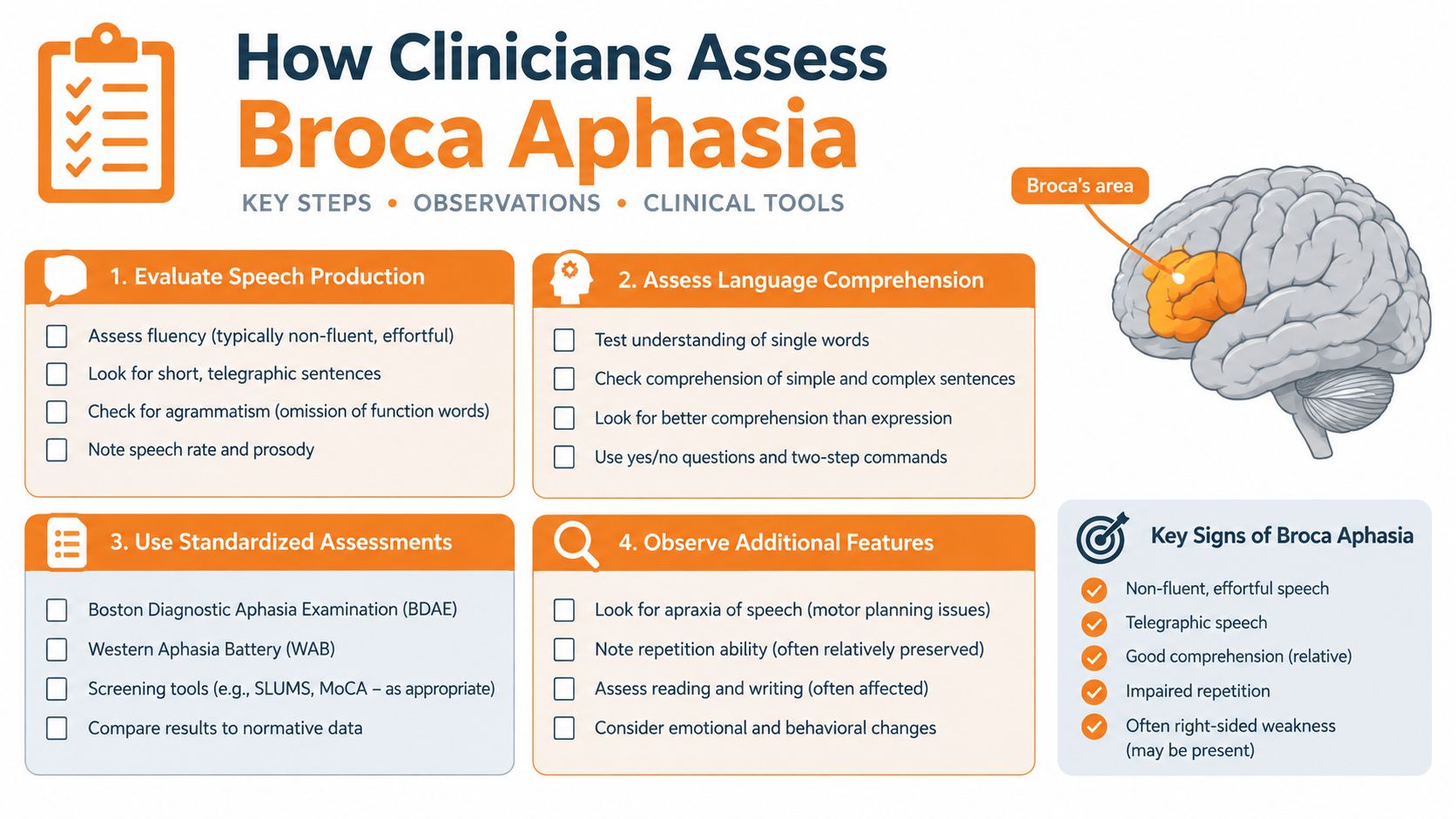
Four assessment lenses
Speech production includes fluency, phrase length, grammatical structure, articulatory effort, prosody, phonemic errors, initiation, and word-finding pauses. The clinician may ask the person to describe a picture, explain a routine, or tell a short story. Connected speech shows how language works outside isolated test items.
Auditory comprehension should move beyond yes-or-no questions. The clinician may compare understanding of single words, simple instructions, sentences with different grammatical structures, and information presented in conversation. A person who answers simple questions accurately may still need support with a passive sentence or a multi-step instruction.
Reading and writing help identify channels that can support communication. Tasks may include word-to-picture matching, reading comprehension, reading aloud, copying, spelling, writing a name, and composing a message. A written response can reveal preserved knowledge that speech alone hides.
Functional communication asks whether the person can achieve a real-world goal. The Functional Communication Profile and the Communication Activities of Daily Living, Third Edition, are examples of tools clinicians may consider alongside broader aphasia batteries such as the Western Aphasia Battery, the Boston Diagnostic Aphasia Examination, or the MT-86. Screening tools such as the Frenchay Aphasia Screening Test may help identify the need for fuller assessment.
The exact tool should fit the person's language, culture, education, sensory abilities, fatigue, and communication method. A bilingual or multilingual client may need tasks in each relevant language, interpreted by someone with appropriate linguistic competence. A test conducted when the person is exhausted may underestimate ability.
A useful report names both the barrier and the route around it: “Sentence formulation is effortful, but the person communicates preferences reliably with written choices and gesture.”
Clinicians should document strengths, breakdowns, cueing response, and participation goals. A naming score is useful, but it shouldn't replace information about whether the person can request help, participate in consent, or maintain a conversation with a partner. Further practical context is available in this speech-language pathology assessment guide.
Distinguishing Broca Aphasia From Related Conditions
A short, effortful utterance can result from more than one communication disorder. Differential diagnosis matters because language therapy, motor-speech treatment, swallowing care, and cognitive rehabilitation may require different priorities.
Condition | Fluency | Comprehension | Repetition | Naming | Typical lesion |
|---|---|---|---|---|---|
Broca aphasia | Effortful, non-fluent, often agrammatic | Relatively preserved for everyday language, with difficulty as syntax becomes complex | Often impaired | Impaired, with pauses and effort | Left frontal language network, often involving the inferior frontal region |
Wernicke aphasia | Fluent, sometimes excessive, with paraphasias or jargon | Often substantially impaired | Often impaired | Impaired, with errors that may be fluent | Posterior temporal language network |
Global aphasia | Very limited output and broad language impairment | Severely impaired | Severely impaired | Severely impaired | Large left-hemisphere language injury |
Conduction aphasia | Relatively fluent, with phonemic errors | Relatively preserved | Particularly poor | Impaired, often with sound-based errors | Connections between language regions |
Anomic aphasia | Generally fluent, with word-finding pauses | Relatively preserved | Relatively preserved | Word retrieval is the main difficulty | Variable language-network injury |
The comparison is a guide, not a substitute for assessment. Aphasia can change during recovery, and one person may show features that cross traditional categories. Lesion location alone doesn't determine the full communication profile.
Language versus motor speech
Dysarthria is primarily a motor speech disorder. The person may have weak, slow, or poorly coordinated speech muscles, while word choice and sentence organisation remain relatively intact. Speech may sound slurred, quiet, strained, or imprecise.
Apraxia of speech involves difficulty planning and programming speech movements. Inconsistent sound errors, visible groping, trial-and-error attempts, disrupted prosody, and better performance on automatic than voluntary speech can prompt closer motor-speech analysis. Aphasia, apraxia, and dysarthria may coexist.
A clinician should investigate further when a person produces the correct word in writing but cannot articulate it, makes different sound errors on repeated attempts, shows marked groping, or has speech that is much less intelligible than their language formulation suggests. The distinction helps the team avoid treating every speech problem as a vocabulary or comprehension problem.
Rehabilitation Approaches That Move the Needle
Consider a person with chronic non-fluent aphasia beginning an intensive therapy block. At the first visit, they can name a few familiar objects with cues, produce short requests, and communicate reliably through gesture and writing. The speech-language pathologist chooses goals that matter at home, such as asking for tea, describing pain, and producing a sentence about a family activity.
Treatment may combine Semantic Feature Analysis, action naming, sentence production work, script training, and supported conversation. For a verb such as “open,” the clinician might build a network of features, act out “open the door,” then shape the phrase “I open the door” with visual, written, and spoken cues. The aim is not merely to name a picture. It is to make language useful in a real exchange.
Sentence-level approaches such as the Sentence Production Program for Aphasia and Treatment of Underlying Forms may be considered for agrammatic language. Script training can target a personally relevant sequence, such as calling a clinic, greeting a neighbour, or explaining what help is needed. The clinician records baseline performance, practises the script with fading support, and tests whether the person can use it in a natural setting.
Connecting treatment to recovery
A Canadian neuroimaging study of chronic aphasia followed nine participants receiving intensive Semantic Feature Analysis therapy. Naming improvement was more strongly related to damage in Broca's area, described as the left inferior frontal gyrus near Brodmann area 45, than to total lesion size. Greater damage to that region negatively predicted naming gains, while therapy-related recovery involved increased recruitment of left posterior and nearby language-related regions. The study is small and mechanistic, so it supports individualised monitoring rather than a promise of a particular outcome. The findings are described in this Canadian study of therapy-induced neuroplasticity in chronic aphasia.
For that reason, progress should be tracked across several measures:
Picture naming: Can the person retrieve a word with fewer cues?
Connected speech: Are phrases longer, more grammatical, or easier to understand?
Functional communication: Can the person complete a phone call or explain a need?
Cueing response: Does a written word, first sound, gesture, or rhythm help?
Generalisation: Does a practised phrase appear outside the therapy task?
Constraint-induced language therapy can increase reliance on spoken language within a structured task, while action naming can support verbs and sentence building. Home practice may use printed targets, clinician-recorded models, or a telepractice programme when the person has suitable hearing, vision, cognition, technology access, privacy, and caregiver support.
Group therapy and communication-partner training can add social practice. Transcranial direct current stimulation may be considered only within appropriate clinical and research frameworks, with careful attention to the individual's medical status and the evidence for the selected protocol. English-language therapy materials may need French adaptation for francophone Canadian clients. A consistent measure such as the Western Aphasia Battery, Revised can help show change over time, but it should sit beside functional outcomes rather than replace them.
More information about rehabilitation planning and technology-supported care is available through neurorehabilitation resources.
Practical Strategies for Caregivers and Clinicians
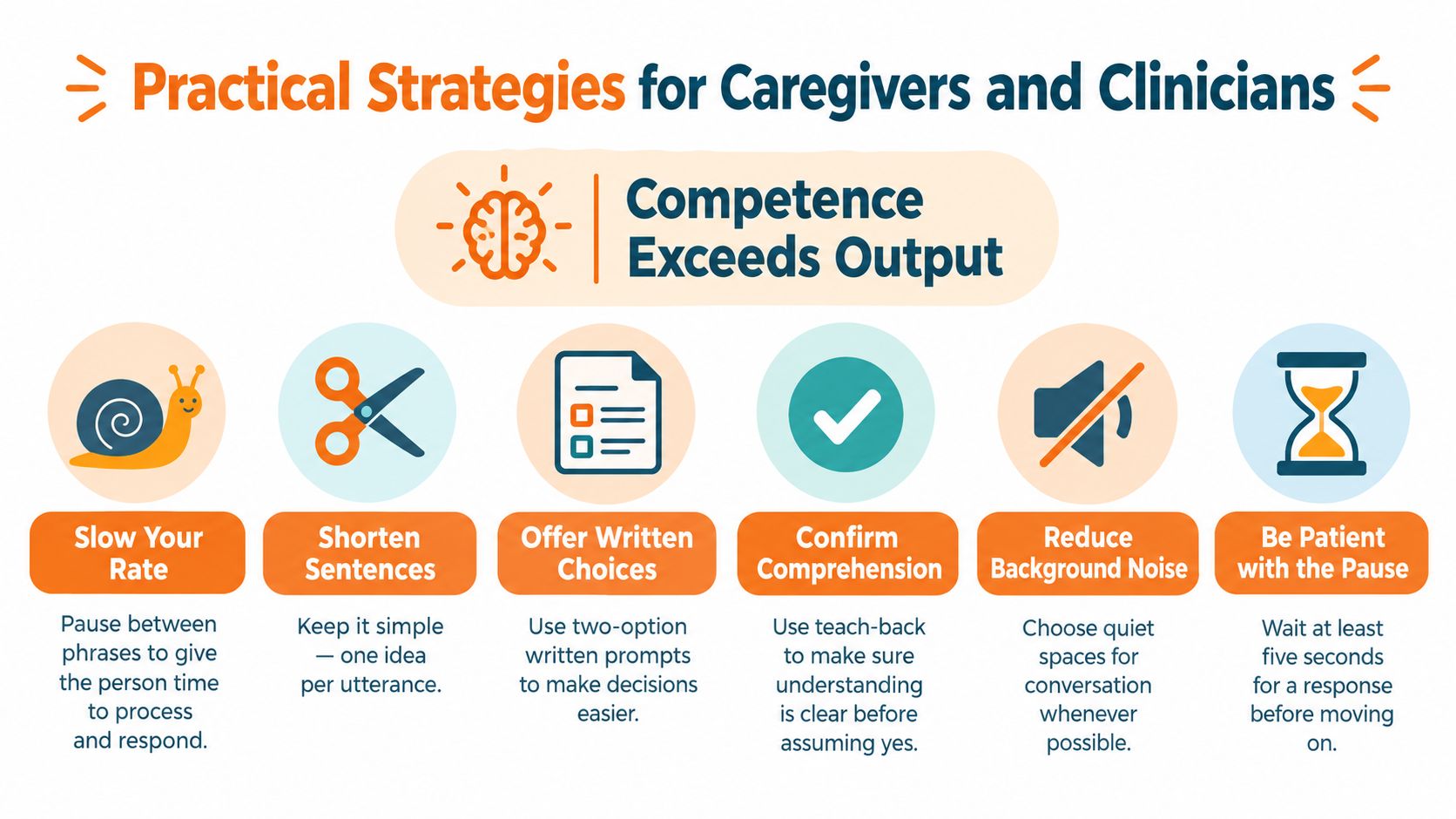
Begin with one principle: competence exceeds output. A person who says only two words may still be able to choose, understand, remember, joke, disagree, and participate. The communication partner's job is to make those abilities easier to show.
Slow your rate, but don't exaggerate every sound. Use one idea at a time, pause between phrases, and allow the person time to respond without immediately filling the silence. Offer written keywords, pictures, gesture, or two clear choices. Then confirm the intended meaning before acting.
Supported Conversation for Adults with Aphasia uses a practical sequence often described as acknowledge, reveal, ask:
Acknowledge: Treat the person as a competent adult and address them directly.
Reveal: Use writing, gesture, drawing, or key words to make the topic visible.
Ask: Ask a focused question and allow time for the person to answer through any available channel.
Three everyday exchanges
Booking an appointment
Clinician: “You want a follow-up appointment.”
The clinician writes: FOLLOW-UP. MORNING OR AFTERNOON?
Patient points to morning.
Clinician: “Morning. Is Tuesday okay?”
Patient shakes their head and points to the calendar. The clinician offers two alternative dates rather than assuming the reason.
Explaining a new medication
Nurse: “This medicine is for blood pressure.” The nurse writes BLOOD PRESSURE and shows the medication label.
Nurse: “Tell me what it is for, or point to the matching card.”
The patient points to the blood-pressure card. The nurse then checks when and how it should be taken, using a written schedule and teach-back.
Planning a weekend outing
Partner: “Park or family lunch?” The partner writes both options and adds simple drawings.
Patient points to park, then gestures toward the child's coat.
Partner: “The park with your child. Morning or afternoon?”
The patient points to the afternoon option. The partner confirms the plan aloud and in writing.
A printable fridge note can contain five reminders:
Slow the pace: Pause between phrases.
Shorten the message: Share one idea at a time.
Offer choices: Write or show two options.
Check the meaning: Confirm before assuming agreement.
Protect the environment: Reduce noise and face the person.
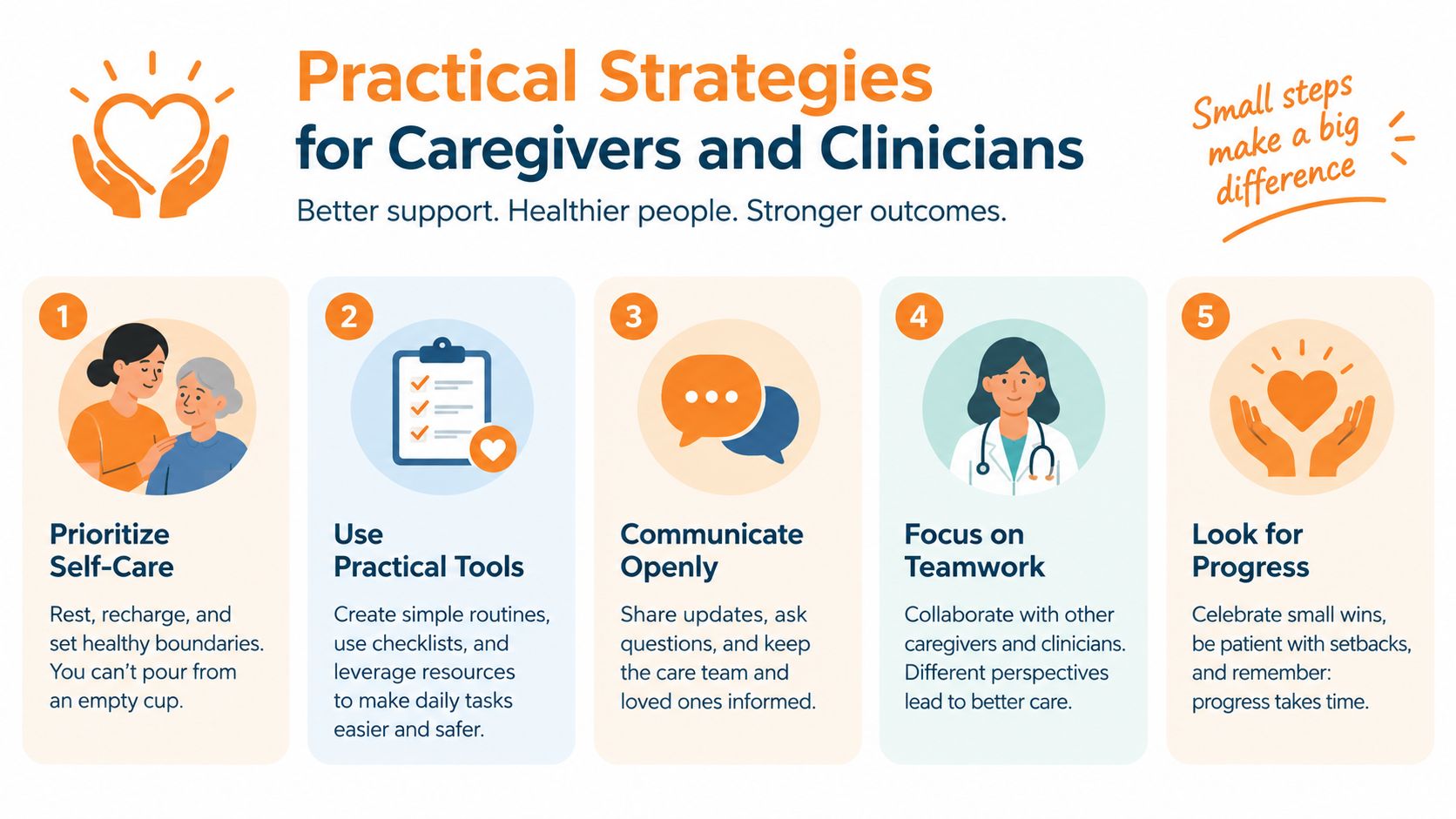
Care partners need breaks too. Fatigue can make conversations shorter and less frequent, so schedule support from family, community services, or the clinical team. Home activities can include personally meaningful naming, sorting, reading, or conversation rather than turning every interaction into a drill. Some families may also find structured word games for older adults useful when they fit the person's abilities and interests.
When to Refer and How Objective Tools Help
New expressive difficulty after a stroke or other brain event requires prompt medical and speech-language assessment. Referral is also appropriate when word-finding loss progresses, frustration leads to withdrawal from conversation, or a person is preparing to return to work or another demanding community role.
The pathway depends on where the person is in recovery:
Acute hospital care: The team screens communication, identifies immediate safety and participation needs, and recommends ways to communicate with staff.
Outpatient rehabilitation: A speech-language pathologist develops goals, measures change, and adjusts treatment as the person returns to home and community routines.
Community care: Therapy may focus on conversation, family training, communication aids, work participation, and maintaining gains over time.
At intake, ask whether the service assesses comprehension, spoken language, reading, writing, speech motor control, cognitive-communication, and functional participation. Ask how the clinician will include the person's preferred language, what communication supports should be brought to appointments, and how progress will be documented between therapy blocks. Canadian service data show why continuity matters. In a cited report, only 16% of people with stroke accessed inpatient rehabilitation in 2014, and only half of those reached rehabilitation centres within two weeks of their stroke. These figures are access benchmarks, not a prediction for an individual, and they support early baseline documentation and repeated reassessment. The Canadian access context is summarised in this stroke rehabilitation services source.
A structured cognitive profile can complement, not replace, speech-language assessment. Attention, memory, executive function, perception, and processing speed can influence how a person learns a strategy, manages a conversation, or responds to therapy. A conversational interview may not reveal these influences, particularly when the person uses familiar routines to compensate.
Digital tasks can provide a consistent baseline and support reassessment across therapy blocks. They can help clinicians compare performance over time, identify areas that deserve closer examination, and discuss whether a communication breakdown may also involve attention or executive demands. The results should be interpreted alongside language testing, medical history, sensory factors, fatigue, and the person's real-world goals. A digital profile isn't a diagnosis and shouldn't replace a qualified assessment.
A practical next step is to choose one communication goal, document the current baseline, complete a language and cognitive assessment suited to the person, and review the results with the care team. For people who want an accessible starting point, cognitive assessment tools can help frame the questions that clinicians need to answer.
Orange Neurosciences offers AI-supported cognitive assessment and therapy tools that create individualised profiles in under 30 minutes, with tasks covering areas such as attention, memory, executive function, and processing speed. Visit Orange Neurosciences to explore how structured baseline data and progress tracking can complement aphasia rehabilitation planning for clinicians, families, and care teams.
Orange Neurosciences' Cognitive Skills Assessments (CSA) are intended as an aid for assessing the cognitive well-being of an individual. In a clinical setting, the CSA results (when interpreted by a qualified healthcare provider) may be used as an aid in determining whether further cognitive evaluation is needed. Orange Neurosciences' brain training programs are designed to promote and encourage overall cognitive health. Orange Neurosciences does not offer any medical diagnosis or treatment of any medical disease or condition. Orange Neurosciences products may also be used for research purposes for any range of cognition-related assessments. If used for research purposes, all use of the product must comply with the appropriate human subjects' procedures as they exist within the researcher's institution and will be the researcher's responsibility. All such human subject protections shall be under the provisions of all applicable sections of the Code of Federal Regulations.


© 2026 by Orange Neurosciences Corporation