10 Engaging Word Games for the Elderly to Boost Brain Health in 2025
Dec 31, 2025
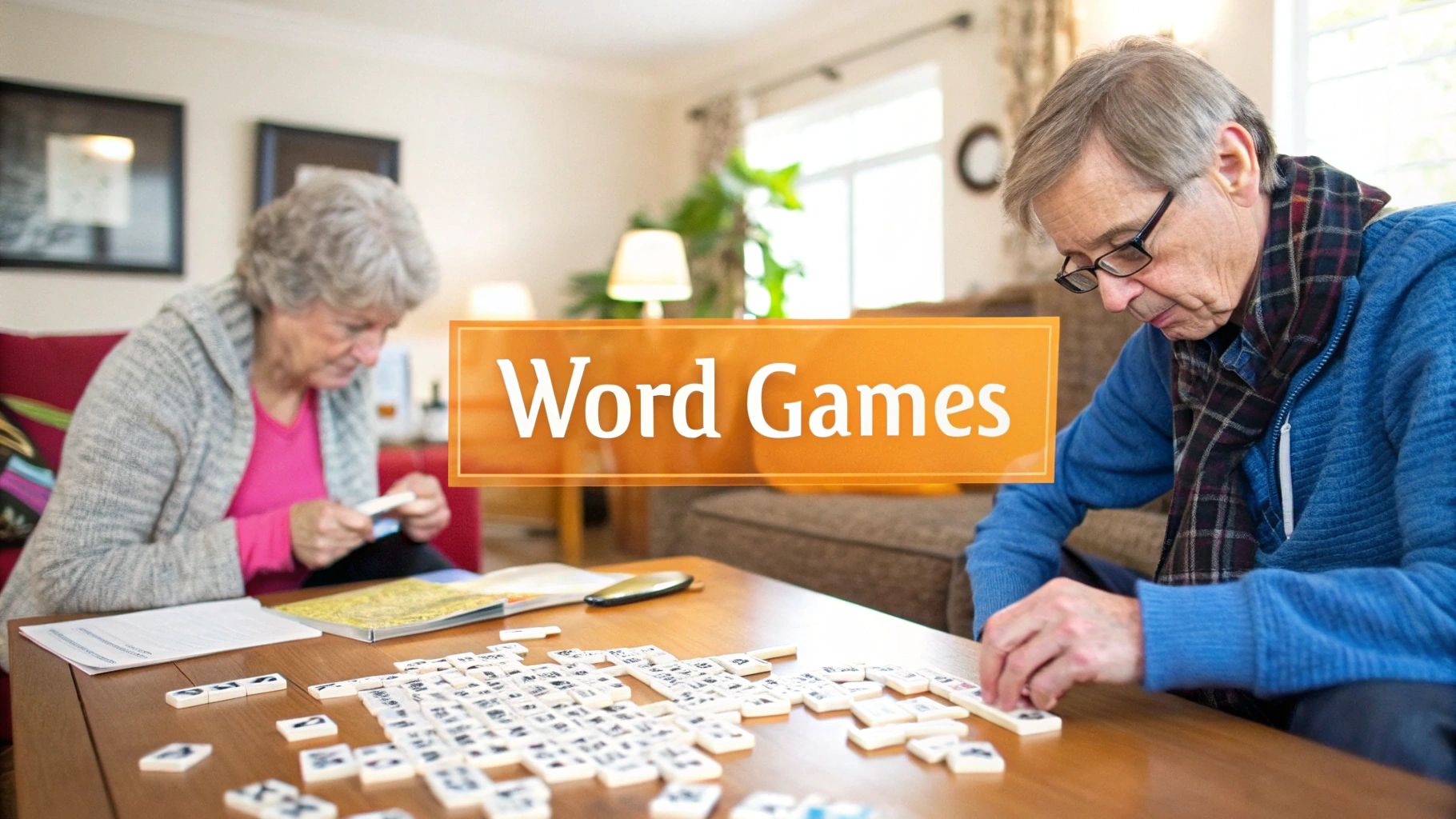
Welcome to your comprehensive guide on leveraging the proven power of word games to enhance cognitive health and well-being in older adults. In an age where maintaining mental sharpness is as crucial as physical fitness, engaging in stimulating activities is paramount. This article moves beyond generic advice, offering a curated roundup of 10 effective word games for the elderly.
This listicle provides practical, step-by-step instructions for each game, exploring the specific cognitive domains targeted—from memory and attention to executive function. You will discover actionable tips for adaptation and engagement, ensuring the activities are both challenging and enjoyable. We delve into how to play with purpose, turning familiar pastimes into powerful tools for cognitive maintenance.
You will learn not just what to play, but how to implement these games effectively in various settings, from one-on-one sessions to group activities. To further enhance brain health and explore a broader spectrum of mental stimulation, you might also consider other effective cognitive activities for seniors.
Furthermore, we will connect these playful exercises to structured cognitive tools, such as those offered by Orange Neurosciences. This guide illustrates how informal games can complement precise assessments and targeted training, creating a holistic and evidence-informed approach to brain health. Let’s explore how these enjoyable pastimes can become powerful tools for building cognitive resilience and fostering social connection.
1. Crossword Puzzles
Crossword puzzles are a classic and highly effective word game for the elderly, involving a grid of intersecting squares that participants fill with words based on corresponding clues. This structured activity challenges the brain to search its vocabulary, understand nuanced clues, and strategically place answers, making it a comprehensive cognitive workout.
Research consistently shows a correlation between regular crossword puzzle engagement and delayed onset of cognitive decline, particularly in memory. By actively retrieving information and making connections, seniors reinforce neural pathways, which is a cornerstone of cognitive maintenance.
Key Cognitive Domains Engaged
Language & Vocabulary: Requires recalling a wide range of words and understanding synonyms, antonyms, and wordplay.
Memory (Semantic): Involves accessing long-term knowledge about facts, concepts, and word meanings.
Executive Function: Engages planning and problem-solving skills as one strategizes which clues to tackle first and uses intersecting letters to solve other words.
Attention: Demands sustained focus on clues and the grid, filtering out distractions.
Implementation and Adaptation
To effectively integrate crosswords into a cognitive care plan, start with accessible options and gradually increase the challenge.
Start Simple: Begin with puzzles from sources like AARP or local community papers, which are often designed with simpler clues. For example, a clue might be "A small, domesticated feline" for "CAT," rather than a more abstract clue.
Prioritise Accessibility: Use large-print crossword books, available at most bookstores and pharmacies, to accommodate visual impairments. Ensure the pen or pencil used provides good contrast against the paper.
Foster Social Interaction: Turn it into a group activity. Organise a "Crossword Corner" in a care home where participants collaborate on a large, whiteboard-based puzzle, promoting both cognitive and social engagement.
Clinical Insight: The act of solving a crossword puzzle mimics a real-world problem-solving scenario. It requires hypothesis testing (trying a word), error correction (erasing it when it doesn't fit), and flexible thinking, all of which are critical executive functions.
For individuals seeking structured ways to enhance their cognitive abilities, activities like crosswords provide a practical and enjoyable method. To delve deeper into the science behind these benefits, you can explore our resources to learn more about how to improve cognitive function.
2. Scrabble and Word Tile Games
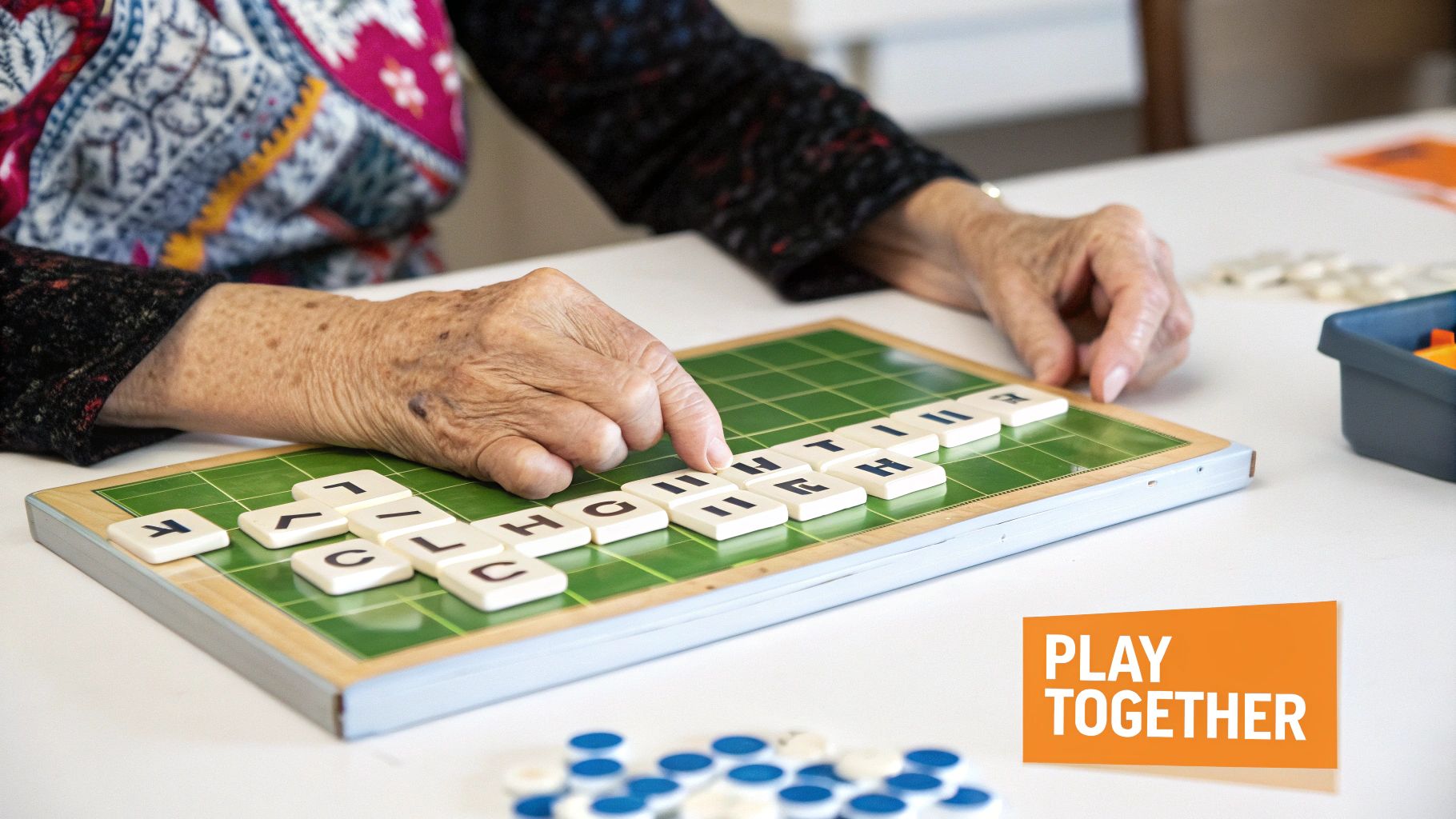
Scrabble and similar word tile games are dynamic and strategic activities ideal for seniors. Players draw letter tiles and place them on a game board to form words, earning points based on letter values and special board squares. This classic game provides a robust cognitive challenge, combining vocabulary recall with spatial reasoning and mathematical calculation, making it one of the most comprehensive word games for the elderly.
The competitive yet social nature of Scrabble is proven to support cognitive vitality. Regular play helps maintain crystallized intelligence, the accumulation of knowledge and skills over a lifetime. Furthermore, the game's blend of linguistic skill and strategic planning offers a well-rounded mental exercise that promotes both cognitive function and social connection.
Key Cognitive Domains Engaged
Language & Vocabulary: Requires a broad vocabulary to form high-scoring words from a random set of letters.
Executive Function: Involves strategic planning, such as tile placement to maximise scores, block opponents, and manage one's rack of letters for future turns.
Processing Speed: Engages the ability to quickly scan the board for opportunities and mentally form potential words.
Attention: Demands focused concentration on one's own tiles and the evolving state of the game board.
Implementation and Adaptation
To ensure Scrabble is an enjoyable and beneficial activity, it should be adapted to the specific needs of the players.
Improve Visibility: Use large-print Scrabble sets or digital versions like Words With Friends, which offer adjustable text sizes to assist with visual impairments.
Create a Relaxed Environment: Establish house rules, such as allowing the use of a dictionary or giving players extended time for their turns, to reduce pressure. A practical example is the "open dictionary" rule, where anyone can look up a word before playing it.
Promote Socialisation: Organise a weekly Scrabble club at a senior centre or care home. Combining game time with refreshments can foster a strong sense of community and routine.
Clinical Insight: The strategic element of Scrabble, which involves calculating potential scores and anticipating an opponent's moves, directly engages the prefrontal cortex. This part of the brain is responsible for planning, decision-making, and working memory, making the game a powerful tool for exercising these critical functions.
Activities like Scrabble provide a practical and stimulating way to support brain health. For those interested in targeted strategies to strengthen these cognitive skills, you can explore our resources to learn more about how to improve executive function.
3. Word Search Puzzles
Word search puzzles are a highly accessible and engaging word game for the elderly. They involve a grid of letters containing hidden words that can be found horizontally, vertically, or diagonally. The goal is to locate and circle these words from a provided list, offering a gentle yet effective mental exercise that enhances visual scanning and attention.
Unlike games that require word recall or spelling, word searches focus on pattern recognition and focus. This lower cognitive barrier makes them an excellent starting point for individuals at various cognitive levels, providing a sense of accomplishment while still stimulating key brain functions. Their straightforward nature makes them easy to adopt in both individual and group settings.
Key Cognitive Domains Engaged
Attention: Requires sustained focus to scan the grid and selective attention to identify target words amongst distractors.
Processing Speed: Challenges the brain to quickly scan rows, columns, and diagonals to find patterns.
Executive Function: Involves using a systematic search strategy (e.g., scanning line by line) to complete the puzzle efficiently.
Language & Vocabulary: Reinforces word recognition and spelling, even though it doesn't demand active recall.
Implementation and Adaptation
To make word searches a successful part of a senior’s routine, focus on accessibility and personal interest.
Prioritise Visual Comfort: Always opt for large-print puzzle books or digital versions with adjustable font sizes to prevent eye strain. A practical tip is to use a coloured ruler to guide the eyes line by line.
Use Themed Puzzles: Select puzzles with themes that align with the participant's hobbies or past experiences, such as gardening, classic films, or travel, to boost engagement. For example, a puzzle themed around "1950s Actors" can trigger positive memories.
Encourage Group Collaboration: In a care centre, project a digital word search onto a screen and have residents work together to find words, fostering communication and teamwork.
Clinical Insight: The visual scanning required in a word search is directly related to real-world tasks like finding a specific item on a grocery store shelf or locating a name in a directory. Consistently engaging in this activity can help maintain and improve the efficiency of these practical visual-perceptual skills.
These types of focused activities are a cornerstone of effective cognitive stimulation. To discover more engaging activities, you can explore our detailed guide on memory games for seniors.
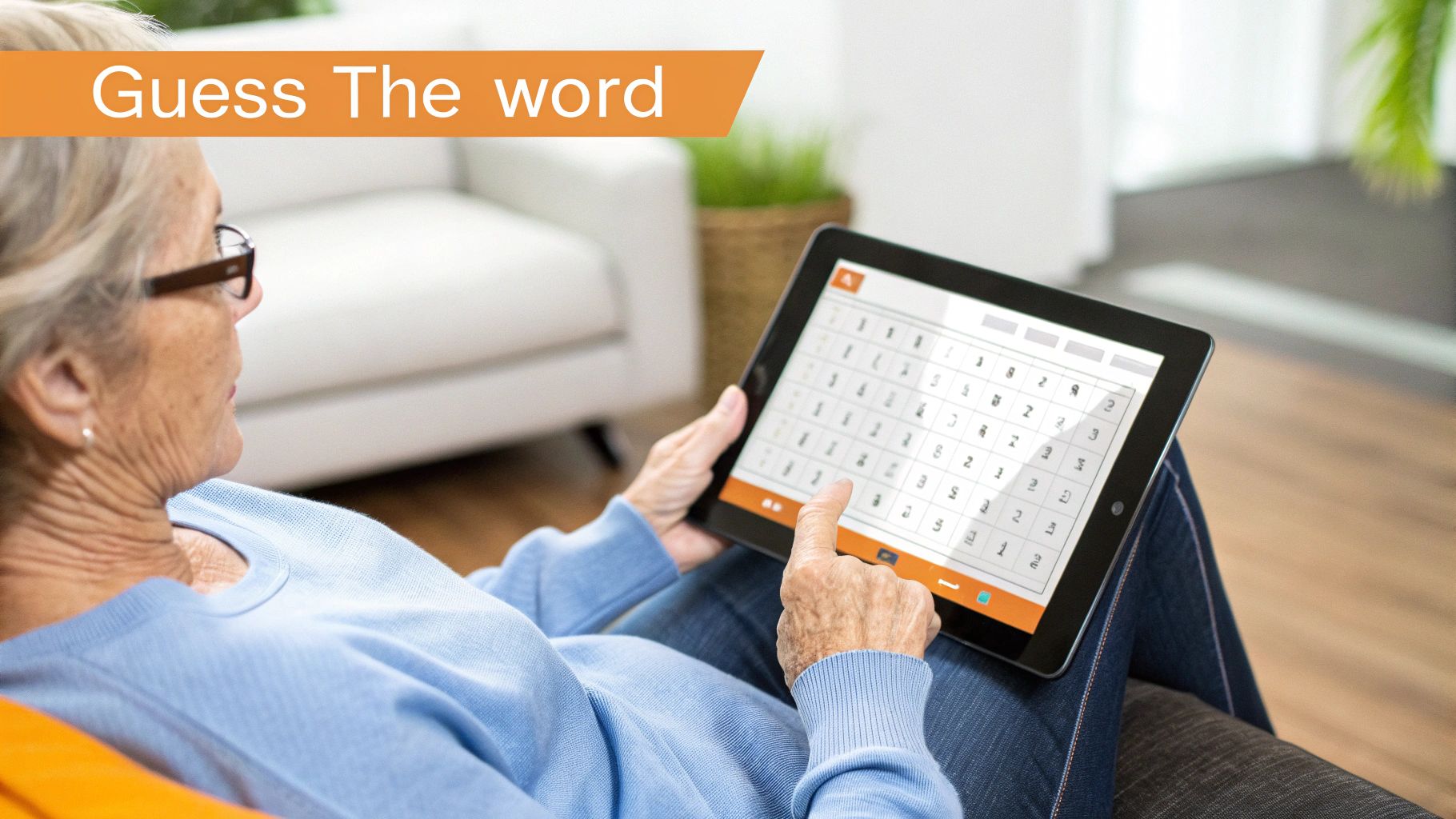
4. Hangman and Letter-Guessing Games
Hangman and its modern variants are classic word-guessing games where one player thinks of a word and another tries to identify it by suggesting letters. Each correct guess reveals the letter’s position, while incorrect guesses incrementally build a simple stick figure. This game powerfully engages deductive reasoning, vocabulary recall, and working memory, making it one of the most adaptable word games for the elderly.
The resurgence of this format, highlighted by the global success of Wordle, demonstrates its timeless appeal. The game is highly valuable for seniors as it combines linguistic challenges with logical deduction in a framework with a very manageable cognitive load.
Key Cognitive Domains Engaged
Language & Vocabulary: Requires players to access their internal dictionary to think of possible words that fit the revealed letters and structure.
Working Memory: Involves mentally tracking guessed letters (both correct and incorrect) and holding potential word patterns in mind.
Deductive Reasoning: Engages the ability to use letter frequency and positional clues to logically eliminate possibilities and deduce the correct word.
Pattern Recognition: Challenges the brain to identify common letter combinations and word structures (e.g., "QU" or "ING").
Implementation and Adaptation
To make letter-guessing games effective and enjoyable, focus on customisation and a supportive environment.
Use Themed Categories: Prime the brain by providing a category like "fruits" or "household items." This narrows the search field and supports word retrieval. For example, knowing the category is "Animals" makes a five-letter word ending in 'E' more likely to be "HORSE."
Start with Common Words: Begin with high-frequency, familiar words before progressing to more complex or less common vocabulary to build confidence.
Embrace Digital Versions: Introduce apps like Wordle or Hangman Unlimited. The structured, once-a-day format of Wordle is excellent for building a consistent cognitive habit.
Encourage Collaboration: Play in pairs or small groups, encouraging participants to verbalise their reasoning. This adds a social dimension and reinforces logical thinking processes.
Clinical Insight: The process of deducing a word from partial information in Hangman or Wordle exercises probabilistic reasoning. Players implicitly calculate the likelihood of certain letters appearing based on the patterns they see, a sophisticated executive function that is crucial for everyday decision-making and problem-solving.
These simple guessing games provide a fun, low-stress method for maintaining critical cognitive skills. To understand how targeted training can further enhance these abilities, you can learn more about how to improve cognitive function with our evidence-based programs.
5. Anagram and Word Unscrambling Games
Anagram and word unscrambling games challenge players to rearrange a jumble of letters into valid words. This engaging activity directly targets crucial cognitive skills by requiring the brain to recognise spelling patterns, access its vocabulary, and flexibly test different letter combinations. Popular digital versions like Wordscapes have made these word games for the elderly highly accessible, offering a rewarding mental workout.
The process of mentally manipulating letters and forming words strengthens orthographic processing and cognitive flexibility. Regularly engaging in anagrams can improve the speed and efficiency with which the brain retrieves and organises linguistic information, a key component of maintaining sharp cognitive function.
Key Cognitive Domains Engaged
Language & Vocabulary: Requires players to search their mental dictionary for words that fit the given letters.
Executive Function: Involves problem-solving, cognitive flexibility, and strategic thinking to systematically try letter combinations.
Working Memory: Players must hold the jumbled letters in mind while mentally rearranging them and testing potential solutions.
Attention: Demands focused concentration to sort through the visual clutter of letters and identify viable word patterns.
Implementation and Adaptation
To make anagrams an effective and enjoyable tool, it is important to tailor the experience to the individual's comfort level and abilities.
Start Simple: Begin with short anagrams of three or four letters (e.g., unscrambling 'tac' to 'cat' or 'npa' to 'pan') to build confidence and establish the rules of the game.
Encourage Verbalisation: Saying letter combinations out loud can help with auditory processing and may trigger word recognition more easily. For example, when unscrambling "L-P-A-P-E," saying "apple" might suddenly click.
Use Hints Strategically: Most apps and games offer hints. Encourage their use to prevent frustration and maintain a positive, motivating experience.
Set Daily Goals: Incorporate a few minutes of anagram-solving into a daily routine, using apps like Word Cookies which are popular in retirement communities.
Clinical Insight: Anagrams are a powerful exercise for working memory and mental flexibility. The task of holding and reordering a set of letters in one's mind while simultaneously cross-referencing with one's vocabulary is a direct workout for the brain's executive control network.
For those interested in strengthening the cognitive abilities that anagrams target, further resources can provide valuable strategies. You can explore our guide to learn more about how to improve working memory.
6. Rhyming Word Games and Verse Creation
Rhyming games and simple verse creation engage seniors in the playful and rhythmic aspects of language. These activities range from identifying words with similar ending sounds to collaboratively completing lines of a poem, tapping into phonological processing and creative expression. This makes them excellent word games for the elderly, especially those who connect strongly with music, poetry, and song.
These games are highly effective because they often evoke positive emotional responses and access deeply embedded memories tied to nursery rhymes, songs, and familiar poems. This emotional connection can make cognitive engagement feel less like a task and more like a joyful, shared experience.
Key Cognitive Domains Engaged
Language & Vocabulary: Encourages phonological awareness (the ability to recognize and work with sounds in spoken language) and semantic association.
Memory (Episodic & Semantic): Triggers memories of songs, poems, and personal experiences, while also requiring access to one's vocabulary.
Attention: Requires active listening to identify rhyming patterns and focus to generate appropriate words.
Executive Function: Involves cognitive flexibility to think of multiple rhyming options and creative problem-solving to complete a verse.
Implementation and Adaptation
To make rhyming activities inclusive and enjoyable, focus on familiarity and reduce performance pressure.
Leverage Music: Use well-known songs or nursery rhymes as a foundation. Start a line and encourage participants to finish it with the rhyming word, such as "Twinkle, twinkle, little ____" (star).
Use Visual Cues: Present a word like "cat" on a whiteboard and ask the group to brainstorm all the words that rhyme with it (e.g., hat, sat, mat, flat).
Create Group Poems: Start a simple two-line poem and have each person add a rhyming couplet. For instance, begin with "The sun is shining in the sky..." and ask the next person for a line that rhymes with "sky."
Be Flexible: Allow for "close enough" rhymes to keep the activity fun and frustration-free, prioritising participation over perfection.
Clinical Insight: Rhyming activates the brain's auditory processing centres in a unique way. For individuals in memory care, the musicality and rhythm of rhyming can bypass language-processing challenges, making it a powerful tool for connection and cognitive stimulation even when other forms of communication are difficult.
Rhyming games provide a gentle yet potent cognitive workout. To learn how these enjoyable activities can be part of a structured cognitive improvement plan, visit the Orange Neurosciences website and explore our programs.
7. Trivia and Definition-Based Word Games
Trivia and definition-based word games challenge participants to identify words based on specific clues, questions, or definitions. These activities are particularly effective for seniors as they tap into crystallized intelligence, the vast knowledge and vocabulary accumulated over a lifetime. This reliance on established knowledge makes these games both an engaging cognitive exercise and a powerful confidence builder.
Games like Trivial Pursuit Seniors edition or custom Jeopardy! formats ask players to retrieve specific information from their long-term memory. This process of searching for and articulating an answer strengthens the neural pathways associated with information recall, helping to maintain cognitive agility and processing speed.
Key Cognitive Domains Engaged
Memory (Semantic & Episodic): Requires accessing a deep well of general knowledge (semantic) and often triggers personal memories associated with the facts (episodic).
Language & Vocabulary: Involves understanding nuanced questions and articulating precise answers, reinforcing word-finding abilities.
Attention: Demands focused listening or reading to fully comprehend the clue before searching for the answer.
Processing Speed: Encourages quick thinking and rapid information retrieval, especially in timed or competitive formats.
Implementation and Adaptation
To make trivia an inclusive and stimulating activity, tailor the content and format to the participants' abilities and interests.
Customise Content: Create trivia categories based on participants' personal histories, local community facts, or shared interests. For example, use categories like "Songs of the 1960s" or "Famous Movie Quotes from the Golden Age of Hollywood."
Adapt for Accessibility: Use large-print question cards or project questions onto a screen. For those with hearing impairments, provide written clues.
Encourage Team Play: Organise participants into small groups to foster collaboration and social interaction. This reduces individual pressure and makes the game more enjoyable.
Clinical Insight: Successfully answering a trivia question provides immediate positive reinforcement, which can boost mood and self-esteem. This is crucial for maintaining motivation in cognitive engagement activities, as feelings of competence encourage continued participation.
Understanding an individual's specific cognitive strengths and weaknesses is key to personalising activities like trivia. To learn more about how detailed evaluations inform these strategies, explore our comprehensive cognitive assessments.
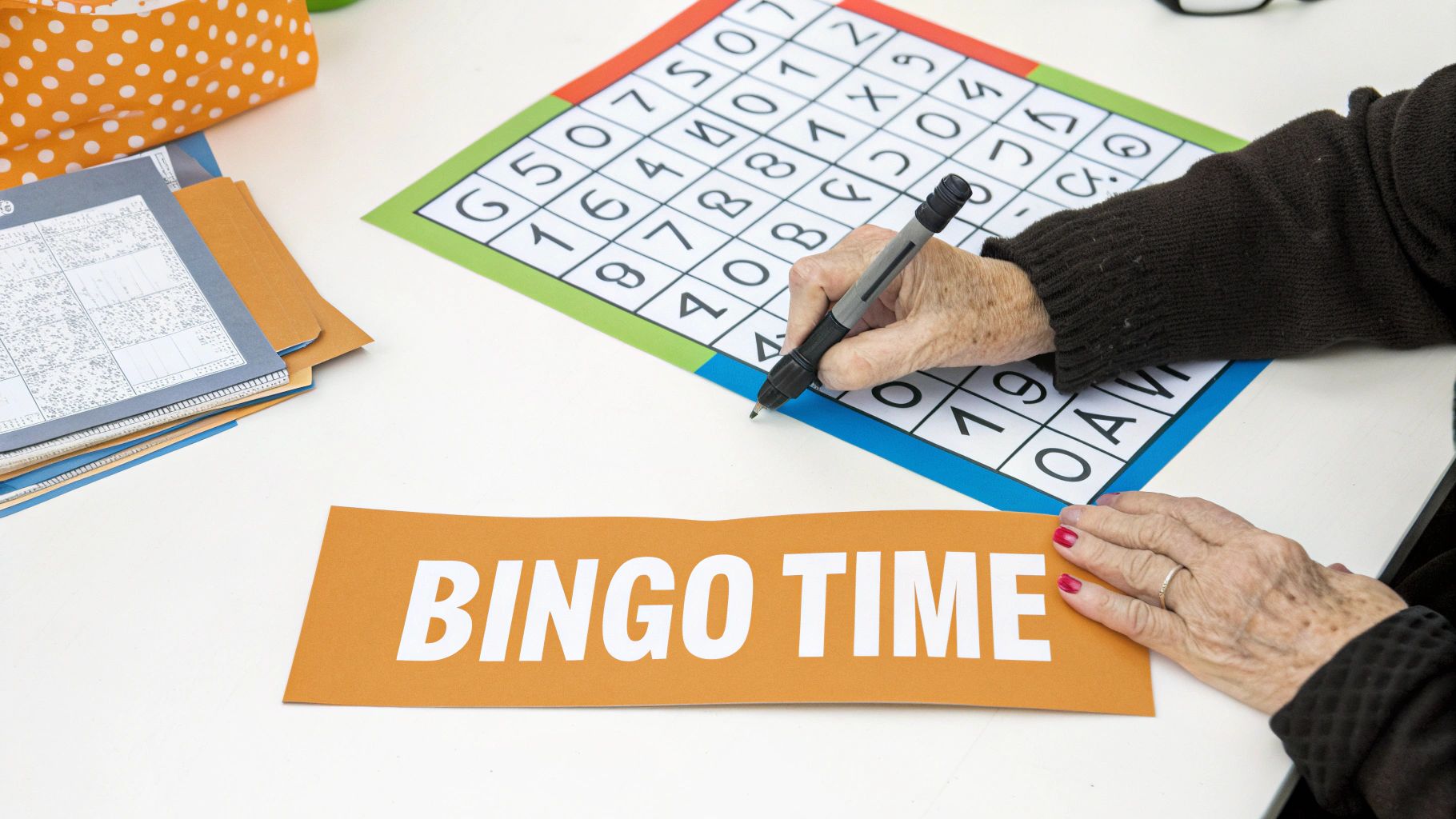
8. Bingo and Letter-Matching Games
Bingo and its letter-matching variations are highly social and engaging word games for the elderly. Participants listen for called-out letters, numbers, or words and mark them on their cards. This seemingly simple activity requires rapid visual scanning, sustained attention, and quick processing, making it a valuable cognitive exercise disguised as entertainment.
The structured nature of Bingo, with its clear auditory cues and repetitive actions, helps support attention maintenance, even for those with mild cognitive impairments. Its widespread popularity in senior centres and care facilities is a testament to its effectiveness in combining cognitive stimulation with crucial social interaction, reducing feelings of isolation.
Key Cognitive Domains Engaged
Attention: Requires sustained focus to listen for calls and visual attention to scan the card for matches.
Processing Speed: Demands quick recognition of letters or words and a prompt physical response to mark the card.
Auditory Processing: Involves accurately hearing and interpreting the called-out items.
Visual Scanning: Engages the ability to efficiently search a grid-like visual field for a specific target.
Implementation and Adaptation
Bingo can be easily adapted to suit various cognitive and physical abilities, ensuring broad participation.
Enhance Visibility: Use extra-large print cards with squares at least one inch in size to accommodate visual challenges.
Simplify Motor Actions: Provide ink daubers instead of pens or small chips, as they require less fine motor control to mark a square. This makes the action faster and more satisfying.
Ensure Clarity: The caller should speak clearly, at a moderate pace, and repeat each call to give everyone adequate processing time. For example: "B... 12. That's B as in Boy... one-two... 12."
Promote Socialisation: Integrate the game with social time, such as offering refreshments before or after, to strengthen community bonds.
Clinical Insight: The auditory-visual-motor loop in Bingo is a powerful tool for reinforcing cognitive pathways. The external cue (the call) triggers a specific search-and-respond action, which helps maintain and practise procedural memory and executive function in a low-stress, rewarding environment.
For those interested in structured cognitive training that incorporates similar principles of attention and processing speed, exploring targeted digital solutions can be a valuable next step. Discover how Orange Neurosciences' programs build on these foundational skills by visiting our site to learn more about our cognitive training solutions.
9. Word Association and Semantic Linking Games
Word association games challenge participants to generate related words from a single prompt, building chains of semantic connections. This activity directly exercises the brain’s ability to navigate its vast network of stored knowledge, making it one of the most effective word games for the elderly to enhance cognitive flexibility and processing speed.
These games tap into the brain's semantic memory, the system responsible for our general world knowledge. By encouraging rapid, creative connections between concepts, they strengthen the neural pathways that allow for quick information retrieval and flexible thinking, which are vital for everyday problem-solving and communication.
Key Cognitive Domains Engaged
Language & Vocabulary: Encourages the active recall and expression of a wide range of words and concepts.
Memory (Semantic): Directly targets the retrieval of facts, concepts, and relationships stored in long-term memory.
Executive Function: Involves cognitive flexibility to shift between different categories and concepts, as well as organisation of thought.
Processing Speed: Requires quick thinking to form connections between words in a fluid and timely manner.
Implementation and Adaptation
To make word association a powerful and enjoyable cognitive tool, focus on creating a supportive and adaptive environment.
Create a Low-Pressure Setting: Emphasise that there are no "wrong" answers. The goal is to explore connections, not to find a single correct word.
Use Themed Prompts: Start with a category, such as ‘things you find in a kitchen’ or ‘animals that start with B’, to provide structure and scaffold the associations. A practical example is giving the prompt "beach" and asking for five related words (e.g., sand, water, sun, shells, waves).
Foster Deeper Thinking: Gently encourage participants to explain the connection between words. This enhances metacognition, or thinking about one’s own thought processes.
Vary the Prompts: Use a diverse range of prompt words (e.g., "warm," "music," "journey") to assess and stimulate different areas of an individual’s semantic network.
Clinical Insight: In a therapeutic setting, word association chains can reveal an individual's semantic organisation. A person who links "apple" to "pie," "baking," and "grandmother" shows strong experiential connections, whereas a link to "fruit," "tree," and "Red Delicious" shows more categorical organisation. Both are valuable cognitive patterns.
Activities like word association provide a window into cognitive processing while simultaneously strengthening it. To see how these principles are integrated into structured cognitive training, you can explore our customised programs.
10. Sentence Completion and Cloze Exercises
Sentence completion, often structured as a cloze exercise, is a highly effective word game for the elderly. This activity involves presenting a sentence with one or more words removed, and the participant must fill in the blank based on the surrounding semantic and syntactic context. It directly targets predictive language processing and grammatical knowledge, making it an excellent tool for both assessment and cognitive stimulation.
This method, originally standardized for assessing reading comprehension, has been widely adopted in therapeutic settings. For seniors, it provides a structured way to maintain language comprehension and processing skills, offering a moderate cognitive challenge with clear and immediate feedback on their performance.
Key Cognitive Domains Engaged
Language & Vocabulary: Requires understanding of sentence structure, grammar, and word meanings to select the most appropriate term.
Executive Function: Engages context analysis and logical reasoning to predict the missing word based on the information provided.
Memory (Semantic): Involves retrieving words and concepts from long-term memory that fit the sentence's meaning.
Attention: Demands focused concentration on the sentence to grasp its overall message and identify the correct word.
Implementation and Adaptation
To be effective, sentence completion exercises should be tailored to the individual’s cognitive and linguistic abilities.
Adjust Difficulty: Start with sentences that have strong contextual clues and offer multiple-choice options. For example: "For breakfast, I like to drink a cup of ______ (juice, water, rocks)." Then progress to open-ended completion like "The best part of my day is ______."
Personalise Content: Use thematic sentences that align with the participant’s interests, such as gardening, history, or family, to enhance engagement and motivation.
Provide Accessibility: Ensure materials are presented in large, clear print. For group settings, read the sentences aloud and discuss possible answers together.
Combine Modalities: After completing a sentence, ask the participant to read it aloud or write it down to integrate pronunciation and motor skills.
Clinical Insight: Cloze exercises are valuable diagnostic tools in speech-language pathology. An individual's pattern of errors can reveal specific deficits, such as a reliance on syntactic cues over semantic ones, which helps therapists tailor interventions more precisely.
Activities like sentence completion offer a quantifiable way to track progress in language processing. To see how these principles are integrated into structured cognitive training, you can learn more about how to improve cognitive function with our evidence-based programs.
Word Games for Seniors — 10-Item Comparison
Activity | Implementation Complexity 🔄 | Resource Requirements ⚡ | Expected Outcomes 📊⭐ | Ideal Use Cases 💡 | Key Advantages ⭐ |
|---|---|---|---|---|---|
Crossword Puzzles | Medium 🔄 (requires clue comprehension; progressive difficulty) | Low ⚡ (paper/digital; large-print available) | Strong vocabulary, semantic memory and sustained attention; cognitive maintenance ⭐⭐⭐ | Independent practice; group puzzle clubs; gradual cognitive training | Widely accessible, adjustable difficulty, immediate intersecting-word feedback |
Scrabble & Word Tiles | Medium–High 🔄 (rules, scoring, strategy) | Medium ⚡ (board/tiles or apps; large-print sets) | Vocabulary, strategic planning, pattern recognition; social engagement ⭐⭐⭐ | Competitive or social clubs; executive-function training; mixed cognitive goals | Combines linguistic + numeric challenge; highly social; clear scoring feedback |
Word Search Puzzles | Low 🔄 (simple rules, repetitive format) | Very Low ⚡ (printables/apps; large-print) | Improves visual scanning, sustained attention and processing speed; limited vocabulary impact ⭐⭐ | Short sessions, attention training, mixed-ability groups | Low barrier to entry, quick completion, minimal frustration |
Hangman & Letter-Guessing | Very Low 🔄 (simple sequential guessing) | Minimal ⚡ (none or digital) | Boosts deductive reasoning, working memory and letter-pattern recognition; quick gains ⭐⭐ | Brief engagement (Wordle-style), speech therapy prompts, casual play | Fast, no materials, immediate feedback; adaptable difficulty with categories |
Anagram / Unscrambling | Low–Medium 🔄 (rearrangement strategies) | Low ⚡ (apps or paper puzzles) | Strengthens orthographic processing, cognitive flexibility and spelling; measurable progress ⭐⭐⭐ | Progressive digital training, spelling practice, rehab exercises | Scalable difficulty, clear success metrics, good for focused practice |
Rhyming & Verse Creation | Low 🔄 (creative, flexible rules) | Minimal ⚡ (oral/printed prompts; music) | Enhances phonological processing, semantic links and emotional recall; high engagement ⭐⭐⭐ | Music/poetry groups, memory care, low-literacy activities | Multisensory, mood-enhancing, accessible across literacy levels |
Trivia & Definition Games | Low–Medium 🔄 (question design affects challenge) | Low ⚡ (cards/apps, multimedia) | Leverages crystallized intelligence and recognition memory; confidence-building ⭐⭐⭐⭐ | Group trivia nights, cognition-strengthening for retained knowledge | Uses lifetime knowledge; inclusive; easy to scaffold by topic |
Bingo & Letter-Matching | Low 🔄 (structured, externally paced) | Low ⚡ (cards, caller, daubers) | Supports visual scanning, sustained attention and processing speed; strong social impact ⭐⭐ | Large-group social events, frequent low-effort sessions, accessibility-focused programs | Highly social, easy rules, fast rounds, strong participation rates |
Word Association & Semantic Linking | Low–Medium 🔄 (open-ended; variable constraints) | Minimal ⚡ (verbal or card prompts) | Improves semantic networks, conceptual organization and executive categorization ⭐⭐⭐ | Therapeutic assessment, group brainstorming, semantic flexibility training | Flexible format, diagnostic value, encourages divergent thinking |
Sentence Completion / Cloze | Medium 🔄 (designing contextually clear items) | Low ⚡ (worksheets/apps) | Assesses comprehension, predictive language and grammar; reliable measurement ⭐⭐⭐⭐ | Formal assessment, targeted language therapy, comprehension training | Direct measure of language processing; scalable and objectively scored |
From Play to Progress: Integrating Word Games into a Cognitive Health Strategy
Throughout this guide, we have explored ten distinct categories of word games for the elderly, moving far beyond simple entertainment. We've seen how activities ranging from the classic structure of Crossword Puzzles to the creative spontaneity of Rhyming Games serve as powerful tools for targeted cognitive engagement. Each game, whether it's the strategic tile placement in Scrabble or the focused letter-finding in Word Search, offers a unique pathway to stimulate specific domains of brain function, including memory, executive function, language, and attention.
The central insight is that purposeful play is not just beneficial; it is a fundamental component of a proactive cognitive health regimen. The true value emerges when these activities are chosen and adapted with intention. By aligning a game's inherent challenges with an individual's specific cognitive goals and personal preferences, caregivers, therapists, and family members can transform leisure time into a sustainable and enjoyable routine that actively supports mental agility, processing speed, and social connection. This tailored approach ensures that the engagement remains meaningful and motivating over the long term.
Key Takeaways for Actionable Implementation
To translate this knowledge into practice, focus on these core principles:
Personalisation is Paramount: The most effective word game is one that is consistently played. Success hinges on matching the game's complexity and theme to the individual's interests and current cognitive capacity. For example, a history buff will engage more with a trivia game about World War II than a word search of modern pop stars.
Variety Stimulates More: Relying on a single type of game, like Word Search puzzles, can lead to habituation where the cognitive benefits plateau. A well-rounded "cognitive diet" that includes games targeting different skills—such as the strategic planning of Scrabble and the rapid lexical recall of Trivia—will challenge the brain more comprehensively.
From Fun to Function: While enjoyment is the primary motivator, it's crucial to connect these activities back to real-world cognitive health. Frame the games not as mere pastimes, but as active exercises for the mind. This perspective helps in building a structured routine that is seen as an integral part of daily well-being. Integrating these playful exercises into daily schedules is a crucial step towards a more holistic approach, contributing positively to comprehensive elderly care strategies focused on overall well-being.
Moving Beyond Guesswork: The Role of Objective Measurement
While the cognitive benefits of word games for the elderly are well-established, understanding their precise impact on an individual level requires moving from subjective observation to objective measurement. How can you be certain that a chosen set of activities is yielding tangible improvements in specific cognitive domains like working memory or processing speed? This is where a data-driven approach becomes indispensable.
Key Insight: Combining engaging, accessible activities like word games with precise, scientific assessment creates a powerful synergy. The games provide the consistent cognitive stimulation, while the assessments offer the empirical data needed to validate progress, identify areas needing more support, and refine the intervention strategy over time.
This structured approach transforms a well-intentioned activity into a targeted therapeutic tool. By establishing a cognitive baseline and periodically re-assessing, clinicians and caregivers can make informed decisions, tailor game selection more effectively, and demonstrate measurable outcomes. This elevates the practice from simply "keeping busy" to strategically enhancing cognitive resilience and function, ensuring that every puzzle solved and every word found contributes to a larger goal of sustained brain health.
Ready to bridge the gap between enjoyable cognitive activities and measurable neurological progress? Orange Neurosciences provides the clinical-grade assessment tools needed to quantify the impact of interventions like word games. Our platform allows you to establish a precise cognitive baseline and track changes over time, empowering you to create truly personalised and effective brain health strategies. Visit Orange Neurosciences to discover how our technology can help you move from play to proven progress.

Orange Neurosciences' Cognitive Skills Assessments (CSA) are intended as an aid for assessing the cognitive well-being of an individual. In a clinical setting, the CSA results (when interpreted by a qualified healthcare provider) may be used as an aid in determining whether further cognitive evaluation is needed. Orange Neurosciences' brain training programs are designed to promote and encourage overall cognitive health. Orange Neurosciences does not offer any medical diagnosis or treatment of any medical disease or condition. Orange Neurosciences products may also be used for research purposes for any range of cognition-related assessments. If used for research purposes, all use of the product must comply with the appropriate human subjects' procedures as they exist within the researcher's institution and will be the researcher's responsibility. All such human subject protections shall be under the provisions of all applicable sections of the Code of Federal Regulations.


© 2026 by Orange Neurosciences Corporation