A Guide to the Test for Dyslexia Adults
Dec 24, 2025
If you've spent years feeling like reading, writing, or even just organizing your thoughts is an uphill battle, you're far from alone. Taking the first step towards getting a test for dyslexia in adults isn't about getting a label—it's about finally understanding yourself and finding the right tools to make things click.
That journey from suspicion to real support starts with a few simple, manageable steps. Your action plan is straightforward: Suspect, Screen, and Assess.
Suspecting Dyslexia: What Are the First Steps?
That quiet feeling that something is "off" with your reading or spelling is a familiar starting point for countless adults who were never diagnosed in school. Maybe you find yourself re-reading the same email over and over, struggling to structure a simple report, or feeling completely drained after just a few minutes of reading. These aren't signs of laziness or lack of effort; they're genuine clues that your brain might just be wired a bit differently.
This initial suspicion is the most critical part of the whole process. For many, it’s a moment of pure validation after a lifetime of feeling frustrated or like they weren't smart enough. The best part? It’s never too late to get answers.
This path, from wondering to knowing, is more straightforward than you might think.
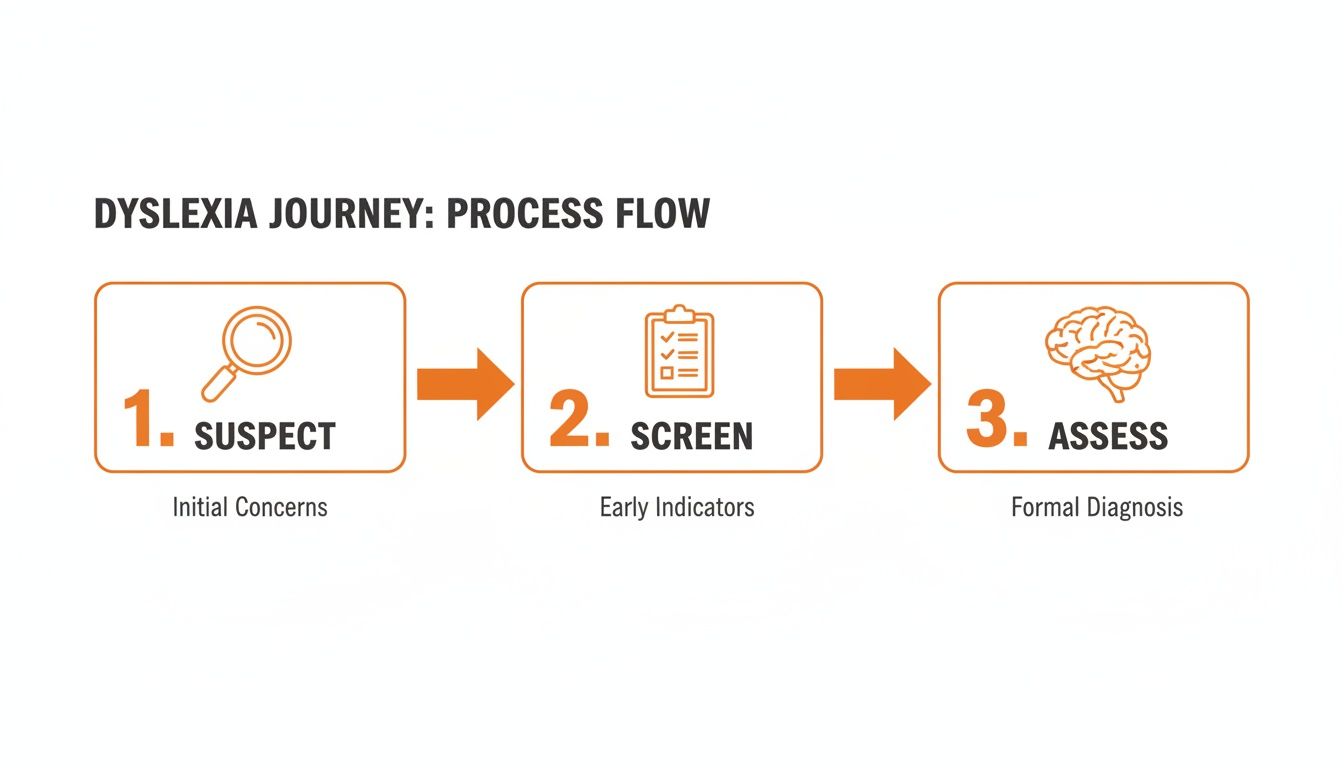
As you can see, it's a structured journey, not a confusing maze.
Understanding the Scale of Unrecognized Dyslexia
It might surprise you just how many adults are walking around with undiagnosed dyslexia. While conservative numbers suggest dyslexia affects 15–20% of the population, some researchers believe it could be the real reason behind as much as 70–85% of adult illiteracy. That's a huge number of people who could be thriving with the right support.
Because this is so widespread, there are more resources and professionals ready to help than ever before. You are definitely not navigating this alone.
From Initial Clues to Definitive Answers
Getting clarity usually happens in two key stages, each with a specific job to do on your path to understanding your unique cognitive profile.
Screeners: Think of these as the first alert. They're often quick online questionnaires or informal tests designed to flag potential signs of dyslexia. A screener is like a smoke detector—it tells you there might be a fire, but it doesn't confirm it. It simply gives you a strong signal that a full assessment is probably a good idea.
Formal Assessment: This is the deep dive. It's a comprehensive evaluation carried out by a qualified professional, like a registered psychologist. This is what leads to a definitive diagnosis. More importantly, it gives you a detailed report outlining your specific cognitive strengths and weaknesses, along with tailored recommendations for support.
A diagnosis isn't an endpoint; it's a starting point. It's the roadmap you need for self-advocacy, helping you get accommodations at work or school and find strategies that actually work with the way you think.
Taking these steps can feel incredibly empowering. For a closer look at the situation here at home, check out our guide on understanding dyslexia in Canada. In the next sections, we'll walk you through each part of this process, from what to expect in a screener to making sense of your final report.
Using Screening Tools for Initial Insights
Before diving into a full-blown evaluation, an initial screening tool can give you some incredibly valuable clues. Think of it like a smoke detector for your cognitive profile—it’s built to alert you to a potential issue, not to confirm there’s a five-alarm fire. It's a low-stakes, often free or low-cost first step that can bring the clarity you need to decide if a formal test for dyslexia adults is the right next move.
It’s important to know that these screeners are not diagnostic tools. They don't give you a "yes" or "no" answer. Instead, they gather information about your lifelong experiences with reading, writing, and language to see if they match up with the common patterns seen in dyslexia.
Actionable Insight: Use a screener to organize your concerns into a clear list. This will be invaluable when you speak with a professional, helping you explain exactly what challenges you're facing.
What Do Dyslexia Screeners Actually Measure?
Screening tools are designed to be quick and efficient, zeroing in on the key indicators of dyslexia. They won’t hand you a diagnosis, but they will give you a risk profile—low, moderate, or significant—based on your answers.
They usually ask questions that touch on a few core areas:
Personal and Family History: This looks into your own struggles in school, whether reading has always felt like an uphill battle, and if any family members have had similar challenges.
Phonological Awareness: This is all about your ability to hear and play with the sounds in spoken language. For example, a screener might ask if you still mix up similar-sounding words (like saying pacific when you mean specific).
Reading Fluency and Speed: You’ll likely see questions about how quickly you read, if you often have to reread sentences just to make sense of them, or if you feel drained after just a few minutes of reading.
Spelling and Writing: These questions often explore common spelling mistakes you make (like mixing up b and d), how hard it is to get your thoughts down on paper, or whether you just plain avoid writing whenever you can.
Screeners are a fantastic starting point. For those who are curious about a broader look at their cognitive health, you can learn more about how a cognitive screening test online works and what it might uncover.
Interpreting Your Screener Results
After you finish a screener, you’ll get a result that puts you into a risk category. It's so important to understand what this means: a high-risk result is a strong signal that a formal assessment is a logical next step. It is not a self-diagnosis.
Validated adult screening tools are widely recommended as a first-line step for identifying adults who might have dyslexia. One of the most common is the Adult Reading History Questionnaire (ARHQ), a self-report tool that even has sex-specific scoring. For males, a score above 42 suggests a significant risk; for females, a score over 39 points to the same. You can discover more insights about the ARHQ and other screening tools from leading dyslexia organizations.
The goal of a screener is not to give you a definitive label, but to give you data. It transforms a vague feeling that "something is wrong" into a concrete reason to seek professional guidance.
Ultimately, a screening tool is empowering. It helps you take control of your journey by offering an accessible, pressure-free way to explore your concerns. If the results point toward a significant risk, you'll walk into the next stage with more confidence and a much clearer case when you reach out for a formal, comprehensive assessment—which we'll explore next.
What to Expect from a Comprehensive Dyslexia Assessment
If a screening tool suggests a formal test for dyslexia adults, the next step is a comprehensive neuropsychological evaluation. That phrase can sound a little intimidating, but it's really just a structured way to understand how your specific brain is wired.
Think of it as creating a detailed user manual for your own mind. The goal is to highlight your unique strengths and pinpoint the exact areas where you might need more support. Knowing what’s coming can help you walk in feeling prepared and confident, ready to get the clarity you’re looking for.

Finding the Right Professional in Canada
First things first, you need to find the right person for the job. In Canada, assessments for learning disabilities are typically done by a registered psychologist or a neuropsychologist. Your family doctor can be a great starting point for a referral, or you can check with your provincial psychological association.
Actionable Insight: When contacting a potential psychologist, ask two key questions: "Do you have specific experience with adult dyslexia assessments?" and "What does your assessment process involve?" This ensures you find someone who understands the unique challenges adults face.
The Clinical Interview: It Starts with Your Story
Your assessment will almost certainly kick off with a detailed clinical interview. This isn't a test; it's a conversation. The psychologist needs to get to know your personal history—what school was like for you, challenges you've run into at work, and if there's any family history of learning difficulties.
Practical Example: Be ready to share specific situations, such as, "I avoid taking minutes in meetings because I can't listen and write at the same time," or "I was always in the lowest reading group in elementary school."
Think of the clinical interview as the foundation of your assessment. The psychologist is gathering the qualitative data—your lived experiences—that will help them interpret the quantitative data from the formal tests.
Cognitive Testing: Understanding How You Think
After the interview, you'll move into cognitive testing. This part of the evaluation looks at your overall intellectual abilities to map out your cognitive strengths and weaknesses. A very common tool for this is the Wechsler Adult Intelligence Scale (WAIS-IV).
This isn't an "intelligence test" in the way most people think of it. Instead, it measures different facets of your thinking:
Verbal Comprehension: How well you grasp and use language.
Perceptual Reasoning: Your knack for solving non-verbal, visual puzzles.
Working Memory: How well you can hold and work with information in your head for short bursts.
Processing Speed: How quickly and accurately you can scan and process simple information.
A common pattern for adults with dyslexia is a noticeable gap between strong verbal skills and weaker scores in working memory or processing speed. Seeing this pattern is a key piece of the diagnostic puzzle. For a deeper look, check out our guide on what a full learning disabilities assessment involves.
Academic Achievement and Phonological Tests
Next, the assessment zooms in on the specific academic skills tied to dyslexia. This is where the psychologist really gets to the heart of reading, writing, and the sound-based processing that is often the core issue.
A go-to tool here is the Wechsler Individual Achievement Test (WIAT), which measures things like:
Word Reading: Your ability to accurately sound out single words.
Reading Comprehension: How well you understand what you've just read.
Spelling: Your accuracy when spelling different words.
Written Expression: Your ability to organize your thoughts and write them down clearly.
The most revealing part of this section often involves phonological processing tests. These tasks are specifically designed to test your ability to work with the sounds of language, totally separate from your vocabulary or smarts. You might be asked to read nonsense words like "plim" or "zorp." Because they aren't real, you can't rely on memory; you have to actively decode the sounds, which shows the psychologist exactly how that part of your brain is working.
Knowing this step-by-step roadmap can take a lot of the anxiety out of the process. While our focus here is on dyslexia, many neurodevelopmental assessments follow a similar path. For a wider view on the assessment journey, you might find some great insights from personal accounts about navigating neurodevelopmental assessments. When you understand what’s coming, you can approach your evaluation as an opportunity, not an obstacle.
How to Understand Your Assessment Report
After going through a comprehensive test for dyslexia adults, you’ll be handed a detailed diagnostic report. At first glance, this document can feel pretty overwhelming—it’s often packed with technical terms and a whole lot of numbers. But it’s not a final grade.
Think of it as a personalized instruction manual for your brain. It’s your roadmap to understanding exactly how you learn and what kind of support will help you thrive. This report is the key to getting official accommodations and, just as importantly, learning how to advocate for yourself.
Decoding the Numbers: Standard Scores and Percentiles
Your report will be full of data, but two numbers matter most: standard scores and percentiles. Getting a handle on these is the first step, and it's simpler than it looks.
Picture a classic bell curve, where the score of 100 represents the absolute average for the general population.
Standard Scores: These scores show where your performance lands on that curve. A score of 100 is perfectly average. Most people score somewhere between 85 and 115. A score below 85 can point to a weakness in a specific skill, while a score above 115 suggests a real strength.
Percentiles: This number shows how you did compared to other people your age. If you score in the 25th percentile, it means you performed as well as or better than 25% of your peers in the sample group. A score in the 90th percentile means you did better than 90% of them.
It's critical to remember these scores are not a measure of your intelligence. They are simply tools used to spot the unique patterns in your cognitive profile.
Identifying the Classic Dyslexia Profile
The real insight from the report doesn't come from a single number, but from the pattern that emerges across all the different scores. A dyslexia diagnosis isn't based on one low score; it’s about the gap between your strengths and your challenges. For adults, the classic dyslexia profile shows a noticeable difference between overall intellectual ability and specific skills related to reading and sound processing.
For instance, you might see a pattern that looks something like this:
Verbal Comprehension (WAIS-IV): High average to superior (e.g., a Standard Score of 118). This shows you have a strong vocabulary and great reasoning skills.
Phonological Processing: Low average (e.g., a Standard Score of 82). This points to a clear difficulty in hearing, identifying, and working with the sounds in words.
Word Reading Fluency (WIAT): Low (e.g., 15th percentile). This reflects the struggle to read quickly and without errors.
This specific combination—high verbal intelligence paired with low scores in sound processing and reading fluency—is a hallmark of dyslexia. It provides the official evidence that your reading challenges aren't about a lack of intelligence, but stem from a specific, identifiable neurological difference.
Turning Recommendations into Actionable Steps
The most powerful part of your report is the recommendations section. This is where the psychologist lays out concrete strategies and accommodations designed specifically for you. This section is your toolkit for self-advocacy, whether at work or in your studies.
Actionable Insight: Don't just file the report away. Create a one-page summary of the key findings and top 3-5 recommendations. This becomes your quick-reference guide for meetings with your manager, HR, or your school's accessibility office.
For example, if your report flags a weakness in working memory, a recommendation might be to use assistive tech like text-to-speech software. If it notes a slower processing speed, you might be recommended extra time on exams or workplace assignments. To get a better feel for how these skills are measured, you can explore the Wechsler Individual Achievement Test, a tool commonly used in these evaluations.
Once you have the report, make sure to schedule a follow-up meeting with the psychologist. Go in with questions ready, like, "Can you explain what this score means for my day-to-day life?" or "Which three recommendations should I focus on first?" This conversation is your opportunity to turn that report into a powerful tool for getting the support you deserve. For personalized guidance on putting these strategies into practice, connect with our team to see how our tools can help.
Turning Your Diagnosis into Actionable Next Steps
Getting the results from a test for dyslexia adults can feel like a moment of true clarity. But it’s not the end of the road—it’s the starting line. Now you have the language and the evidence to finally understand how your brain is wired and find the support that actually works for you. The focus shifts from assessment to action.
Think of your diagnosis as the key that unlocks accommodations and strategies designed to level the playing field. It's the official documentation you need to advocate for yourself, whether you're in a classroom or a boardroom, making sure you have the tools to succeed based on your strengths, not your challenges.

Advocating for Yourself in the Workplace
Your diagnostic report is a powerful tool for requesting reasonable accommodations at work. Under Canadian human rights legislation, employers have a duty to support employees with documented disabilities. The trick is to approach the conversation proactively, framing it around solutions that will help you excel in your role.
Some practical accommodations you could request include:
Assistive Technology: Getting access to text-to-speech software (like Speechify or NaturalReader) to have lengthy documents or emails read aloud.
Meeting Materials: Receiving agendas, reports, or presentation slides ahead of time so you can pre-read everything at your own pace.
Quiet Workspace: Having a designated quiet spot to minimize distractions when you need deep focus for tasks like writing or analysing data.
Verbal Instructions: Having the option to get complex instructions verbally, either in addition to or instead of written ones.
Actionable Insight: When you meet with your manager, don't just state the problem. Propose a solution. For instance: "My assessment showed that I have slower processing speed. To ensure I produce high-quality work, could I get reports 24 hours in advance of meetings? This will allow me to come prepared and contribute effectively."
Securing Support in Post-Secondary Education
For adult learners navigating Canadian universities and colleges, a formal diagnosis is your ticket to accessing academic support. Your first stop should be your school's Accessibility Services or Student Accommodations office. They’ll review your assessment and work with you to create a personalized plan.
Common academic accommodations often include:
Extended Time: Getting 1.5x or even 2x the standard time for exams and major assignments.
Note-Taking Support: Accessing notes from a peer or using software that records lectures and syncs them with what you’ve written down.
Alternative Formats: Requesting your course materials in a format that works best for you, like audiobooks or digital text files.
It's crucial to understand that getting these supports hinges on accurate identification. A positive screener result isn't a diagnosis. It's a sign that you should get a referral for comprehensive testing, because that formal process is what opens the doors to accommodations in both education and employment.
Building Skills with Evidence-Based Training
Accommodations are vital, but so is building up your skillset. A diagnosis points you toward training programs specifically designed to strengthen certain cognitive areas. This isn’t about "curing" dyslexia; it's about learning more efficient strategies for reading and processing information.
Structured Literacy programs, for instance, provide explicit, systematic instruction in phonology, sound-symbol association, and other core reading skills. These evidence-based approaches have proven highly effective for adults looking to boost their reading fluency and confidence.
These programs help you work with your brain's unique wiring, not against it. For many adults with dyslexia, learning how to tackle dense reading material is a game-changer. In fact, this a guide to reading and summarizing dense texts offers some fantastic techniques and workflows. Exploring different cognitive therapies can also provide targeted training to sharpen skills like working memory and processing speed.
Your journey doesn't end with a report—it begins with a clear path forward. If you're ready to turn your assessment results into a personalized action plan, our team is here to help. Book a consultation with Orange Neurosciences today to explore how our evidence-based tools can support your next steps toward professional and academic success.
Your Top Questions About Adult Dyslexia Testing, Answered
Deciding to get a formal test for dyslexia as an adult is a big step, and it naturally comes with a lot of practical questions. How much will it cost? What do I do with an old diagnosis? What happens next? It can feel a bit overwhelming.
Think of this section as your practical guide. We'll walk through the most common concerns, giving you direct, clear answers to help you navigate the process with confidence.
How Much Does a Dyslexia Test Cost in Canada?
A formal psychoeducational assessment is a specialized service from a registered psychologist, which means it’s not usually covered by provincial health plans like OHIP or MSP. In Canada, you can expect the cost for a comprehensive adult evaluation to be somewhere between $2,500 and $4,000.
But don't let that number stop you. You might not have to pay for it all out of pocket. Many workplace or private extended health insurance plans include coverage for psychological services.
Actionable Insight: Before booking, call your insurance provider and ask specifically about your coverage for "psychological assessment services." Knowing your exact coverage amount upfront helps you budget and plan. Also, ask the clinic if they offer payment plans.
It's also worth noting that some Canadian universities offer these assessments at a lower cost for their students. It never hurts to check with your school's accessibility or health services centre.
Can I Use an Online Screener to Get Accommodations?
The short answer is no. While an online screener is a fantastic starting point for self-awareness, it won’t be enough to secure formal accommodations at your job or in school. To qualify for support under Canadian human rights laws, you'll need an official diagnostic report from a qualified professional, like a registered psychologist.
Think of a screener like a smoke detector—it alerts you to a potential issue. The formal assessment is the firefighter's full report—it confirms what's happening, details the specifics, and lays out a clear plan. That's the report employers and schools need to see.
This official document is crucial because it provides the proof they need and, more importantly, gives them specific, personalized recommendations for the support that will help you most.
I Was Tested as a Kid. Do I Need to Do It Again?
This is a great question, and the answer really hinges on what you need the diagnosis for. For your own personal insight, that childhood assessment is still gold. It gives you the backstory to your learning profile and can offer clues that are just as relevant today.
However, if you need it for any formal reason, an updated assessment is almost always necessary.
Post-Secondary Education: Most Canadian universities and colleges want to see a psychoeducational assessment that was done within the last 3-5 years, or at least during your adult years. This ensures the support and accommodations they offer match your current needs in a demanding academic setting.
Professional Exams: If you're looking for accommodations on big professional exams (like the bar, medical boards, or accounting certifications), they will also require a recent and comprehensive report.
Practical Example: If you are a 30-year-old applying for extra time on a professional certification exam, the board will need to see how dyslexia impacts you as a professional now, not how it affected you as a 10-year-old student.
Are There Hurdles for Multilingual Adults Getting Tested?
Yes, this is a situation that requires a specialist. Assessing dyslexia in someone who is multilingual or learning English as an additional language is complex. The key is to distinguish between a genuine learning disability and the completely normal struggles that come with mastering a new language.
The psychologist conducting the assessment absolutely must have experience working with multilingual clients.
How it Works in Practice: A skilled assessor won't just rely on language-based tests. They'll use tools like non-verbal reasoning tasks to get a clearer picture of your underlying cognitive skills. They'll also take a deep dive into your linguistic history to understand your journey and fluency with each language.
This careful, nuanced approach is the only way to get an accurate diagnosis that isn't just a reflection of your language proficiency. Before you commit, be sure to ask any potential assessor about their experience with multilingual individuals—it’s essential for a fair evaluation.
Navigating the path to a dyslexia diagnosis is a powerful step toward understanding yourself and unlocking your potential. With the right information, that diagnostic report becomes a roadmap for success. At Orange Neurosciences, we create evidence-based platforms that support cognitive assessment and training, helping people and their clinicians build clear, actionable plans. Discover how our tools can support your journey by visiting https://orangeneurosciences.ca.
Orange Neurosciences' Cognitive Skills Assessments (CSA) are intended as an aid for assessing the cognitive well-being of an individual. In a clinical setting, the CSA results (when interpreted by a qualified healthcare provider) may be used as an aid in determining whether further cognitive evaluation is needed. Orange Neurosciences' brain training programs are designed to promote and encourage overall cognitive health. Orange Neurosciences does not offer any medical diagnosis or treatment of any medical disease or condition. Orange Neurosciences products may also be used for research purposes for any range of cognition-related assessments. If used for research purposes, all use of the product must comply with the appropriate human subjects' procedures as they exist within the researcher's institution and will be the researcher's responsibility. All such human subject protections shall be under the provisions of all applicable sections of the Code of Federal Regulations.


© 2026 by Orange Neurosciences Corporation