Quizzes on the brain: A practical guide to cognitive assessments
Mar 8, 2026
From quick social media polls to in-depth clinical tools, quizzes about the brain have popped up everywhere. These tools can range from harmless fun to serious cognitive screeners, but telling them apart is absolutely critical. We're here to help you understand what separates simple entertainment from an evidence-based assessment and what practical steps you can take with the results.
The Rise of Brain Quizzes: From Fad to Clinical Tool
It’s easy to find a quiz online that claims it can reveal everything from your personality type to which side of your brain is dominant. While they're often fun to do, most are built for entertainment, not accuracy. Think of it like comparing a novelty mood ring to a clinical-grade thermometer—both give you a "reading," but you'd only trust one to make important health decisions.
Making that distinction is more important than ever, as the need for accessible cognitive and behavioural screening tools grows. For families, a quick screener might offer peace of mind or flag potential concerns about an aging parent. For educators, these tools can help spot students who might need a bit more support.
The Growing Need for Accessible Assessment
The demand for reliable screening tools is especially urgent in youth mental health. Take, for example, California's youth mental health crisis, which has revealed a massive need for faster ways to assess what's going on. With over 35% of teens reporting persistent sadness and nearly two-thirds of the 284,000 children with major depression going untreated, the gap in care is staggering.
The scale of this issue, affecting roughly 190,000 young Californians who aren't getting treatment, shows exactly why early and accessible detection tools are no longer a luxury—they're a necessity. You can explore more about these significant findings on California's mental health landscape.
This has created a surge of interest in digital tools that can deliver quick, objective data. People are actively looking for ways to understand their cognitive health without the long waits and high costs that often come with a traditional neuropsychological exam.
A key shift is happening: people are moving beyond simple curiosity. They are now actively seeking tools that provide meaningful, actionable insights into how their brain works. This isn't just about measuring "intelligence," but about understanding the very building blocks of cognition, like attention, memory, and processing speed.
This guide will demystify the world of brain quizzes by breaking them down into clear, understandable categories. You’ll learn how to spot a scientifically sound instrument and, just as importantly, what to do with the results. Our goal is to give you the knowledge to confidently evaluate any "quiz on the brain" you come across, whether you're a concerned parent, a clinician, or simply someone interested in cognitive wellness.
Ready to learn how to tell the difference and make more informed choices? Keep reading, or explore the resources on our website to see how validated assessments are changing the field of cognitive care.
The term "brain quiz" gets thrown around a lot, and it can mean anything from a social media distraction to a serious clinical tool. It’s a bit like the word "engine"—you could be talking about the one in a toy car or the one in a Formula 1 racer. To really understand what you're looking at, you have to know the difference.
Let's break down the four main types. Getting a handle on these categories is the first step from just being a user to being an informed consumer of cognitive tools.
A Quick Guide to Different Brain Quiz Types
This table gives you an at-a-glance comparison of the four main categories of brain quizzes, helping you quickly understand their purpose, validity, and use.
Quiz Type | Primary Purpose | Scientific Validity | Example Use Case | Interpreted By |
|---|---|---|---|---|
Fun Quizzes | Entertainment & social sharing | None | A fun 5-minute distraction on social media. | The user (for fun). |
Cognitive Screeners | General mental "check-in" | Low to moderate | Tracking your own memory score in a brain training app. | The user (for personal insight). |
Validated Assessments | Precise measurement | High (Standardized) | A clinician identifying a specific cognitive deficit. | A qualified professional. |
Rehab/Training Games | Skill improvement | High (Purpose-built) | A therapist using a game to help a patient regain reading skills. | A qualified professional. |
Now that you have the big picture, let's dive into what each of these really means.
1. Fun and Entertainment Quizzes
You’ve definitely seen these. They pop up on your social media feed with catchy titles like, "Are You Right-Brained or Left-Brained?" or "What's Your Brain's True Age?" Their entire purpose is engagement—to be fun, shareable, and to keep you on a website for a few more minutes.
Practical Example: You take a "What Animal is Your Spirit Brain?" quiz, get "Dolphin," and share it with friends. It's a great conversation starter but has zero scientific meaning. No action is needed.
2. General Cognitive Screeners
These are a step up. You'll often find them inside popular "brain training" apps or on wellness websites. They usually present game-like challenges that give you a score on things like memory, attention, or problem-solving, which you can then track over time.
While they feel more structured, many of these screeners haven't gone through the rigorous scientific validation needed for any kind of clinical use. They can be a good starting point for becoming more aware of your own cognitive patterns, but they just aren't precise enough to diagnose or even identify a specific cognitive issue.
Practical Example: An app shows your "attention score" dropped 10% this week. This is an actionable insight to investigate: Were you more tired? Stressed? It's a personal flag, not a clinical data point.
This is the journey most people take, from simple quizzes toward more powerful tools.
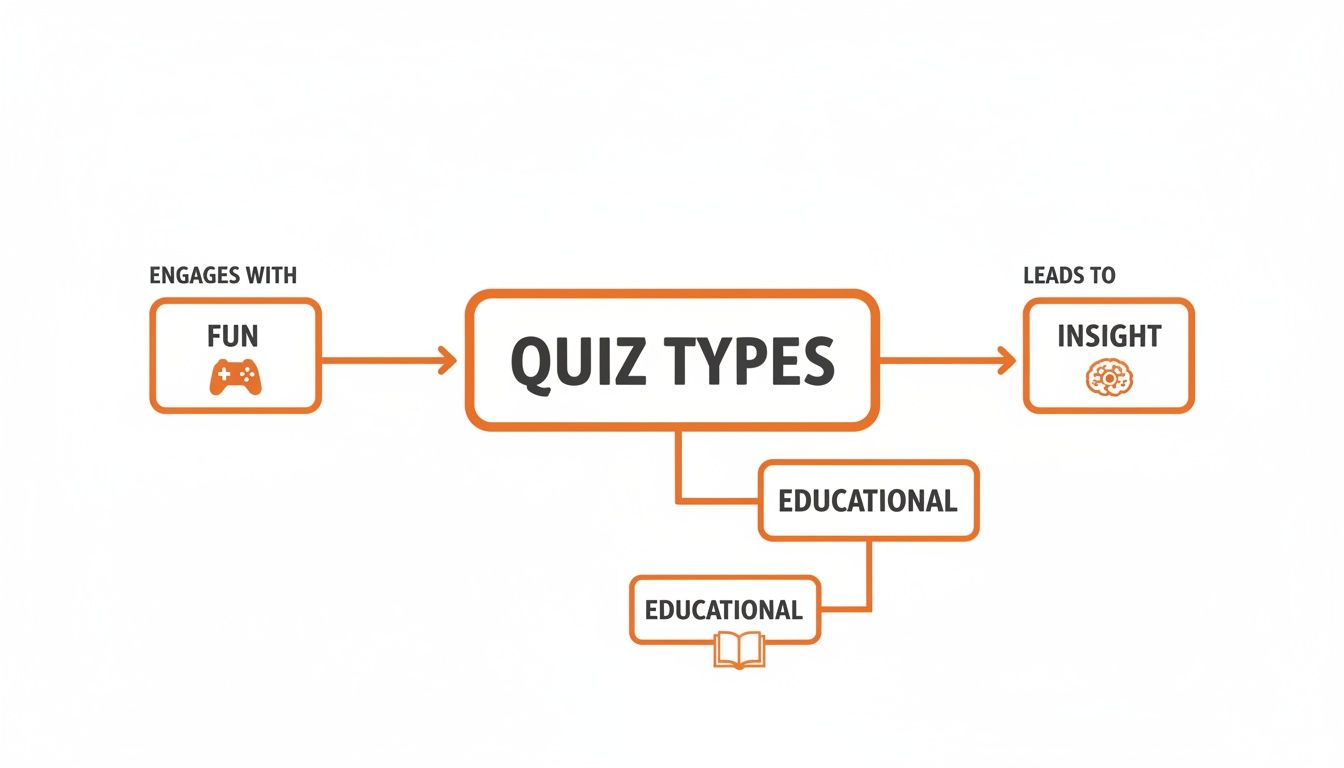
As you can see, the path from a fun quiz to genuine cognitive insight requires a huge leap in scientific rigour and clear purpose.
3. Validated Neurocognitive Assessments
This is where we get into the "professional grade" tools. These are the gold standard—scientifically designed and validated instruments, like the ones we've developed here at Orange Neurosciences. They're built from the ground up to be used by clinicians, researchers, and educators who need objective, reliable, and precise data.
For a tool to be considered "validated," it has to clear some very high bars:
Standardization: The test must be given and scored in the exact same way for every single person. No exceptions.
Reliability: It has to produce stable and consistent results. If you took a similar test tomorrow, the results should be very close, assuming nothing has changed.
Validation: The test must be proven to measure what it claims to measure. This is often done by comparing it against long-established, traditional neuropsychological tests.
Normative Data: Your score isn't just a number; it’s compared to a massive database of scores from a relevant population. This is how we know if a score is average, above average, or a cause for concern.
Practical Example: A pediatrician administers a validated assessment to a child struggling in school. The results show the child is in the 90th percentile for verbal memory but the 15th for processing speed. This actionable insight tells the teacher to provide notes beforehand and allow more time on tests. The data leads to a targeted, practical solution.
4. Gamified Rehabilitation and Training Programs
Finally, we have tools that use a quiz-like format not just to measure, but to improve. These are gamified therapeutic programs designed to actively strengthen specific cognitive skills. Our own ReadON program is a perfect example—it uses a series of engaging games to target and rebuild the foundational skills that make fluent reading possible.
The key distinction here is purpose. An assessment takes a snapshot of your cognitive function right now. A rehabilitation program works to actively change that function through targeted, repetitive exercises cleverly disguised as games.
Practical Example: After a stroke, a patient uses a gamified program on a tablet to improve their executive function. The game challenges them to plan a virtual shopping trip, requiring them to create a list, navigate aisles efficiently, and stay on budget. The difficulty adapts as they improve, providing a structured, engaging way to rebuild crucial life skills.
How to Identify a Valid Cognitive Assessment Tool
So, we've broken down the four main types of quizzes on the brain. Now comes the crucial part: learning to spot real quality. How can you actually tell if a tool is scientifically sound or just a slick piece of marketing? This is where we shift from just knowing things to having a practical skill—a checklist you can use to identify a valid cognitive assessment.
Think of it like buying a car. You wouldn't be sold on the flashy paint colour alone; you’d want to look under the bonnet. A credible brain assessment is no different. It’s built on specific engineering principles that guarantee its performance and safety.
The Four Pillars of Credibility
When you're evaluating any tool that claims to assess cognition, you need to look for evidence of four key pillars. A company that’s proud of its work won't hide this information. If you have to dig for it, or can't find it at all, that's a major red flag.
Standardization: This means the test must be given and scored in the exact same way for every single person. It’s the only way to ensure results are consistent and not swayed by outside factors.
Validation: The tool absolutely has to measure what it claims to measure. This is usually proven by showing its results align with established, gold-standard neuropsychological tests.
Reliability: An assessment has to give you stable and consistent results over time. If nothing has changed for the individual, a reliable tool should produce very similar scores on repeat tests.
Normative Data: A score on its own is meaningless. The tool must compare an individual's results to a large, relevant database of other people. This is what tells you if a score is within, above, or below the average range for their peer group.
Actionable Tip: How to Spot a Genuine Tool in 60 Seconds
Knowing the pillars is one thing, but finding them is another. A reputable provider will always be transparent about their science. When you land on their website, you shouldn't have to wade through pages of marketing fluff to find the research.
Here’s a quick guide on what to look for:
Green Lights (Signs of a Credible Tool)
Peer-Reviewed Publications: The company proudly links to studies in scientific journals that either use or validate their tool. This is non-negotiable proof.
Clear Methodology: They clearly explain how the test was standardized and describe the populations that make up their normative data.
Transparent Metrics: They aren't afraid to openly discuss their reliability and validity statistics, like test-retest reliability scores. Understanding what makes a score dependable is critical, which is why we've created a guide to help you learn more.
Red Flags (Signs of a Gimmick)
Vague, Fluffy Claims: They rely on buzzwords like "brain boosting" or "mind sharpening" but offer zero data to back it up.
No Published Research: Their only "proof" comes from customer testimonials and five-star reviews. While nice, these are not scientific evidence.
Hidden Science: You can't find a single shred of information on standardization, normative data, or how the tool was validated.
Think of it this way: a validated assessment is like a Michelin-star chef's recipe. It is precise, has been tested hundreds of times, and delivers a consistent, high-quality result every time. A fun online brain quiz, on the other hand, is like a potluck dinner—you never really know what you’re getting, and the quality is completely unpredictable.
A Practical Example of Evaluation
Let's put this into a real-world scenario. Imagine you're a clinician looking at a new digital screener for ADHD. The provider's website makes a big deal about their 15-minute game that "accurately measures attention."
Your first move is to ignore the marketing slogans and hunt for the science. Do they have a link to a published study showing their tool's results correlate with an established test like the CPT 3? Do they specify that their normative data includes thousands of children in the correct age range?
If the answers are yes, you’re on the right track. But if all you find are feel-good testimonials and vague promises, it’s a clear signal to move on.
By arming yourself with this checklist, you can confidently cut through the noise in the crowded market of quizzes on the brain and choose tools that provide real, meaningful insights. To see what a truly validated tool looks like, visit our website and explore our solutions.
From Results to Action: When a Quiz Score Means You Should Talk to a Professional
A score from a brain quiz is just a number until you understand what it means and, more importantly, what you should do next. This is where the real work begins—turning a piece of data into a constructive step forward. Knowing how to read the results in context, and recognizing when a score is a red flag, is a crucial skill.
It helps to think of these online tools as signals, not diagnoses. A good cognitive screener is like a smoke detector. It can’t tell you if it’s a small stovetop flare-up or a serious fire, but it makes a loud noise to let you know you need to investigate. A fun quiz on social media? That’s more like a scented candle—it’s just there for a bit of fun.
How to Interpret Your Results: A Practical Guide
What you do with a score comes down to the type of quiz you took. Here are a few real-world examples of when a score should prompt you to take that next step and contact a professional:
A Sudden, Sharp Drop: You’ve been using a brain-training game to track your memory. If you see your score take a sudden, significant nosedive and it stays low for a few weeks, that’s an actionable insight. Your next step: Schedule an appointment with your doctor and bring a screenshot of the score trend.
A Consistent Low Score: Your child repeatedly scores well below their peers on a school-administered screener for attention. This is valuable, objective information. Your next step: Request a meeting with the teacher and school counselor to discuss the results and ask about a referral for a developmental pediatrician.
A Pattern of Difficulty: You try a few different reputable online screeners and notice a consistent theme—you always struggle with tasks related to planning and organizing (what we call executive function). Your next step: Mention this specific pattern to your doctor at your next check-up and ask if a formal evaluation for executive function deficits would be appropriate.
A quiz result is not a verdict; it’s a signpost. Its real job is to point you toward the right questions, not to hand you all the answers. The goal is to shift from worry and self-diagnosis to an informed dialogue with an expert.
Turning Data Into a Dialogue
Once you have a result that concerns you, the next step is getting ready to talk to a professional. This is where an objective score stops being just a number on a screen and becomes a powerful way to get the right help, faster.
Think about the difference. Instead of saying, "I'm worried about my memory," you can now walk in and say, "I've been tracking my cognitive performance on this validated screener for three months. My short-term memory scores have dropped by 20%, and I've brought the data with me."
This simple change gives your doctor concrete information to work with. It helps them grasp your concerns much more clearly and figure out the best next steps. To get a better sense of what a more formal evaluation looks like, have a look at our guide on what is a neuropsychological assessment.
Getting access to specialists can be a huge hurdle. In California, for example, there are significant workforce challenges, with the state having the highest number of mental health Health Professional Shortage Areas (HPSAs) in the entire United States. According to the Steinberg Institute's 2024 report, over 10 million Californians live in these areas. This is where digital cognitive tools become so important—they help primary care providers triage patients and get them to the right support more effectively.
Ultimately, using these quiz results is about being proactive. If a score highlights an area where you could use a boost, exploring things like targeted brain health supplements for cognitive performance can be another proactive topic to discuss with your healthcare provider. The goal is to use these digital tools to inform, not to self-diagnose, and to open the door to faster, more effective care. For more actionable strategies, visit our website and sign up for our newsletter.
Real-World Impact: How Quizzes on the Brain Deliver Actionable Insights
It’s one thing to understand the theory behind different types of brain quizzes, but the real magic happens when you see how they work in the real world. So, how do these tools actually fit into a busy clinic, a bustling classroom, or a concerned family’s life?
Let's move past the checklists and talk about the tangible impact these assessments can have. They aren't here to replace professional judgment. Far from it. Think of them as a tool to support that judgment, bridging the gap between a subjective feeling—like "I just feel foggy"—and objective, measurable data about how the brain is functioning.
For Clinicians and Patient Care
In any healthcare setting, time is the most precious resource, and good data is gold. Validated cognitive assessments give providers a way to gather reliable information quickly, helping to guide decisions and manage patient care far more effectively.
Here’s a scenario we see all the time:
Dr. Evans, a paediatrician, is seeing a 10-year-old patient named Leo. His parents are at their wit's end. He’s disruptive at school, can’t seem to follow instructions, and his grades are slipping. They think it might be ADHD, but the waitlist for a full neuropsychological evaluation is over six months.
Rather than simply adding Leo to the queue, Dr. Evans has him complete a rapid, gamified cognitive assessment right there in her office. It takes less than 30 minutes. The results give her a detailed profile of Leo's cognitive functions, showing that while his working memory and processing speed are fine, his sustained attention scores are significantly below the average for his age.
This data isn't a diagnosis, but it does two critical things. First, it gives Dr. Evans concrete evidence to strengthen her referral, which could help get Leo seen by a specialist sooner. Second, it gives the family and the school specific information they can use to support Leo right now, without having to wait months for a formal label.
For Leo's family, this one assessment turns months of anxious waiting into proactive support. This is how a validated digital assessment goes from being a simple test to a vital part of a modern care pathway.
For Educators Pinpointing Learning Needs
In a classroom of 25 students, it can be incredibly difficult for a teacher to figure out why a student is falling behind. Is it a lack of effort? A behavioural issue? Or an underlying cognitive challenge that isn't immediately obvious?
Take Ms. Garcia, a fourth-grade teacher, who notices that a student named Maya is struggling with reading comprehension. Maya reads the words on the page fluently, but just moments later, she can't recall what the paragraph was about.
The school's learning specialist uses a validated screener to look at Maya's cognitive skills. The results are eye-opening. Maya’s vocabulary and decoding skills are excellent, but her scores for working memory—the brain's "sticky note" for holding and working with information—are very low. This explains everything. She can read the words, but she can't hold onto the meaning of the sentences long enough to piece together the whole passage.
Armed with this specific data, the school can now use strategies targeted at supporting Maya's working memory. This might involve memory aids, breaking instructions into smaller chunks, or using reading techniques designed to reduce her cognitive load. It's a much smarter approach than just telling her to do "more reading practice." You can learn more about how to improve executive function in our detailed guide.
For Families Monitoring Cognitive Health
For families, these tools offer a way to be proactive, especially when it comes to the cognitive health of aging parents and loved ones. The fear of cognitive decline is a major source of stress for so many of us.
Meet Sarah, who is worried about her 75-year-old father, Robert. He lives alone and has been misplacing his keys more often and forgetting appointments. Sarah is worried about the possibility of dementia but doesn't want to cause alarm by rushing him to a specialist without a good reason.
She introduces him to a simple, gamified cognitive screener on her tablet that he can do once a month. To him, it feels like a set of fun brain games, not a scary test. For six months, his scores remain stable and well within the normal range for his age group, which brings both Sarah and Robert enormous peace of mind.
Then, one month, Sarah notices a significant drop in her father’s scores for short-term memory and spatial awareness. The scores stay low the following month. Now, instead of going to his doctor with vague worries, she has specific, objective data to share. That conversation is no longer about fear; it's about facts. This prompts a timely clinical evaluation and turns a potentially difficult situation into a proactive step toward getting her father the right care at the right time.
Making Informed Decisions with Orange Neurosciences
Knowing the difference between a fun quiz and a real assessment is one thing. But what comes next? How do you move from simply being aware of the options to taking meaningful action for a child, a patient, or a family member?
Guesswork and unreliable online screeners can create more anxiety than they solve. That’s where we come in. At Orange Neurosciences, we built our platform to provide the objective, scientifically-backed data that professionals and families have been missing. We replace uncertainty with clarity.
From Engagement to Evidence
We believe that gathering reliable cognitive information shouldn't feel like a test. That's why our assessments are designed as engaging, gamified experiences that kids and even adults actually enjoy. But don't let the fun fool you—these are sophisticated tools built to precisely measure core cognitive functions.
In less than 30 minutes, our assessments generate a detailed cognitive profile. This isn't just a single score; it's a rich, nuanced picture of an individual’s cognitive landscape—their unique strengths and areas needing support.
This profile gives you objective metrics across the domains that matter most, helping you see the whole person:
Attention: Gauging the ability to focus, including both sustained and divided attention.
Memory: Looking at both short-term recall and working memory capacity.
Executive Function: Evaluating critical skills like planning, problem-solving, and mental flexibility.
Creating Faster, More Effective Care Plans
Having this kind of evidence changes everything. For clinicians, it means no more relying solely on subjective reports. You get concrete data right away to guide referrals, track a patient's progress, and build care plans that are both faster and more effective.
For families, it’s a breath of fresh air. It helps replace that feeling of unease with clear, understandable insights into their loved one's needs. You can learn more about our solution and see how it fits into a modern approach to care.
Ultimately, the right data makes for better conversations and allows for quicker, more targeted support. When professionals can base their clinical judgment on reliable cognitive metrics, the strategies they develop are far more likely to lead to real, lasting success. Ready to see the difference for yourself? Visit our website or sign up for our newsletter to receive actionable tips directly in your inbox.
Answering Your Questions About Brain Quizzes
As you start to navigate the world of brain quizzes, it's completely normal for some practical questions to pop up. Let's walk through some of the most common ones that we hear from parents, teachers, and curious adults.
Can I Use a Brain Quiz to Diagnose ADHD or Dementia?
This is a big one, and the short answer is no. A quiz you find online, even one that looks quite professional, can't give you a medical diagnosis.
Conditions like ADHD or dementia are complex. A real diagnosis only comes after a deep dive by a qualified healthcare professional. This usually involves talking through your medical history, a clinical interview, and a whole series of validated tests. Think of an online quiz as a small flag, a gentle nudge suggesting it might be time to have a conversation with a professional. It’s a starting point, never a final answer.
How Is a Clinical Tool Different From a Free Brain Game?
It really comes down to three things: scientific proof, consistency, and the end goal. The free brain games you find on an app store are built for fun and to keep you tapping. Their scores are for bragging rights, not for clinical insight.
On the other hand, clinical-grade tools, like the ones we've developed at Orange Neurosciences, are built on a foundation of science. They are standardised, which means they’re given the same way every time to ensure the results are fair and reliable. They’re also scientifically validated against gold-standard neuropsychological tests to prove they actually measure what they say they do. The data is meant to support real-world clinical decisions, not just chase a high score.
What Should I Expect From a School-Based Cognitive Screening?
If your child’s school suggests a cognitive screening, it's often the first step in trying to understand if a learning or behavioural challenge might have roots in how they process information.
You should expect a short, often gamified, assessment that looks at specific skills like attention, working memory, or how quickly your child can process information.
The point isn't to slap on a label or a diagnosis. It’s about gathering clear, objective data to help everyone understand what’s going on. The results should be a launchpad for a conversation with you and the school staff about the best next steps, whether that's new supports in the classroom or a referral for a full evaluation with a specialist.
You now know how to separate the fun brain games from the serious clinical facts. The next step is moving from guesswork to informed action. The team at Orange Neurosciences provides the validated, objective tools that professionals and families need to make a real difference. Explore our evidence-based solutions at https://orangeneurosciences.ca.
Orange Neurosciences' Cognitive Skills Assessments (CSA) are intended as an aid for assessing the cognitive well-being of an individual. In a clinical setting, the CSA results (when interpreted by a qualified healthcare provider) may be used as an aid in determining whether further cognitive evaluation is needed. Orange Neurosciences' brain training programs are designed to promote and encourage overall cognitive health. Orange Neurosciences does not offer any medical diagnosis or treatment of any medical disease or condition. Orange Neurosciences products may also be used for research purposes for any range of cognition-related assessments. If used for research purposes, all use of the product must comply with the appropriate human subjects' procedures as they exist within the researcher's institution and will be the researcher's responsibility. All such human subject protections shall be under the provisions of all applicable sections of the Code of Federal Regulations.


© 2026 by Orange Neurosciences Corporation