Pi Cognitive Assessment: A Practical Guide
Feb 16, 2026
The PI Cognitive Assessment is a pre-employment screening tool. It's a fast, 12-minute test with 50 questions designed to give companies a quick snapshot of a job candidate's general cognitive ability. It’s a business tool, built to predict on-the-job performance and how quickly someone can learn a new role.
It is absolutely not a clinical diagnostic instrument.
What Clinicians Need to Know About This Tool
So, what should you do when a patient brings up their score from a PI Cognitive Assessment? Your first action is to place it in the correct context for them.
Here's a practical analogy: the PI assessment is like a workplace first-aid kit. It's useful for a quick check-up but isn't equipped for in-depth surgery. A comprehensive neuropsychological evaluation, in contrast, is the full operating room—designed for deep, specific clinical insights.
The PI assessment isn't built to provide a detailed map of cognitive functions. Its goal is to rapidly evaluate a person's ability to learn and adapt, which is a strong predictor of success in many jobs. Your actionable insight here is to explain that its purpose is to help hiring managers make a more informed guess about who will adapt and learn the fastest.
To give you a clearer picture, here’s a quick breakdown of what the PI Cognitive Assessment covers.
PI Cognitive Assessment at a Glance | |
|---|---|
Feature | Description |
Test Format | A 12-minute timed test with 50 multiple-choice questions. |
Purpose | Pre-employment screening to predict job performance and trainability. |
Constructs Measured | Verbal, Numerical, and Abstract Reasoning. |
Score | A single composite score representing "general cognitive ability." |
Context | A business and hiring tool, not a clinical diagnostic instrument. |
This table neatly summarises the key details, reinforcing that its design and purpose are firmly rooted in the corporate world, not the clinic.
Core Components of the Assessment
The test is built around three core pillars, with questions that get progressively harder under a tight time limit. Knowing what these pillars are helps clarify what the test is—and isn't—actually measuring.
Verbal Reasoning: This looks at how well someone can understand and work with written information. Think of it like solving word puzzles or spotting the logical flow in a paragraph.
Numerical Reasoning: This part gauges a person's comfort with numbers, like interpreting charts or solving practical math problems.
Abstract Reasoning: Here, the focus is on recognizing patterns and logical rules in sequences of shapes and figures, completely independent of language.
A key takeaway for clinicians is that while these domains touch on cognitive skills, the PI Cognitive Assessment rolls them all into a single score for "general cognitive ability." This score is a business metric, not a clinical one. For a deeper understanding of clinical approaches, you can learn more about what a cognitive assessment entails in a healthcare setting.
This distinction is everything. A patient’s score reflects how they performed on one specific, time-crunched task created for the business world. It doesn't offer the nuanced, detailed profile we need for making clinical decisions.
Understanding this context allows you to frame the results properly for your patient and steer the conversation toward what really matters: their actual, clinically relevant concerns.
What the PI Assessment Actually Measures
When a client brings in results from a PI Cognitive Assessment, it's easy to jump to conclusions about their "intelligence." But this test isn't a broad measure of intellect like a clinical IQ test. It’s a highly specific tool built for the business world, designed to predict one thing: how quickly someone can learn and adapt on the job.
It does this by measuring performance across three distinct cognitive areas. For clinicians, the key is to reframe a patient's score—it's not a definitive label of intelligence, but a snapshot of their performance on very specific, work-related tasks under pressure.
All three sections combine to produce a single score for what hiring managers call 'general cognitive ability' or the 'g-factor'. In a corporate setting, this number is a surprisingly strong predictor of job performance. But it's critical to remember this is not the same as the detailed cognitive domains we assess in a clinical evaluation.
The Three Pillars of the Assessment
The PI Cognitive Assessment is built on three core types of reasoning. Each section presents questions that get progressively harder, forcing the test-taker to think quickly and efficiently. Let's look at what each one actually involves.
Verbal Reasoning: This is all about how well a person can understand and work with written information. A practical example would be an analogy question, like "Doctor is to Hospital as Teacher is to ____?" or identifying the logical connection between words.
Numerical Reasoning: This isn't about complex math. It’s about practical numerical literacy. For instance, a question might show a simple bar chart of monthly sales and ask the test-taker to identify the month with the highest percentage increase.
Abstract Reasoning: This measures a person's ability to see patterns in non-verbal information. A classic example involves a sequence of shapes with changing patterns (e.g., rotation, shading) and asking the test-taker to choose the next shape in the sequence.

This structure breaks down the broad concept of "cognitive ability" into three tangible, interconnected skills that are relevant to most job roles.
Connecting PI Constructs to Clinical Concepts
While the PI assessment is miles away from a clinical tool, the abilities it measures do have some clinical parallels. Understanding these connections helps bridge the gap between a corporate screening score and a meaningful clinical conversation.
The 'g-factor' is a concept used to predict trainability and on-the-job problem-solving. It is not a direct measure of clinical constructs like executive function, working memory, or processing speed, though it may draw upon them. A low score does not equate to a clinical deficit, just as a high score does not rule one out.
For instance, the abstract reasoning component clearly overlaps with aspects of fluid intelligence and problem-solving skills we explore in neuropsychological testing. Verbal and numerical reasoning also tap into comprehension and logical deduction.
But here’s the crucial difference: the PI assessment’s strict 12-minute time limit. This high-pressure environment heavily rewards speed. It favours rapid processing over deep, methodical thinking.
This distinction is everything. A client might struggle with the PI assessment due to test anxiety, slower processing speed, or even a reading disorder—factors a comprehensive clinical evaluation is designed to identify and account for, but a pre-employment screener simply ignores.
To get a clearer picture of the clinical side of these abilities, you can explore this detailed definition of cognitive skills and see how they are properly evaluated in a healthcare context.
How to Interpret Scores and Understand Its Limitations
When a patient brings up their score on a PI Cognitive Assessment, the first step is knowing how that number came to be. The process itself is quite simple: a candidate has 12 minutes to answer as many of the 50 questions as they can. The number of correct answers is their raw score.
But that raw score isn't what employers typically see. Instead, it gets converted into a scaled score. This is the key part. The scaled score gives the raw number context, showing how the individual stacks up against a much larger group of people who have taken the same test.
It’s a bit like taking a single blood sugar reading versus getting an A1c value. One is a snapshot in a specific moment, while the other gives a more comparative picture. The scaled score on the PI assessment is built to give hiring managers a quick reference point against a benchmark they've set for a particular job.
The Critical Limitations of a Screening Tool
It's absolutely essential to understand this tool's profound limitations. The PI Cognitive Assessment is a screening tool for hiring, plain and simple. It was never intended to be a diagnostic instrument. By design, it completely sidesteps many factors that are fundamental to any real clinical evaluation.
A person's score can be thrown off by all sorts of variables the test doesn't account for. For instance:
Test Anxiety: The intense, timed pressure-cooker format can easily penalize someone who struggles with anxiety, which has nothing to do with their actual cognitive ability.
Cultural and Linguistic Background: The test's reliance on English verbal and numerical problems can put non-native speakers or people from different educational backgrounds at a real disadvantage.
Undiagnosed Conditions: Someone with an undiagnosed learning disability like dyslexia, or an attention disorder like ADHD, might score poorly not because of their cognitive capacity, but because the test format itself is an obstacle.
A low score on the PI Cognitive Assessment should never be taken as a measure of a person's intelligence or overall worth. It is a single data point from a 12-minute corporate screening test, not a reflection of their cognitive health or potential.
Actionable Advice for Clinical Conversations
So, if a patient sits in your office, worried about a "low" score, your job is to help them put it in its proper place. Explain that this test is designed to predict how quickly someone might learn a new job, not to measure the complex, nuanced aspects of cognition that matter in a clinical setting.
The growing use of cognitive assessments in healthcare really drives this point home. The North American market for these tools is expanding fast, with clinical trials moving away from subjective scales toward precise, computerized data. While old-school pen-and-paper tests still made up 47% of the market in 2023, the shift to digital tools shows just how much demand there is for the kind of objective data the PI assessment was never built to deliver.
Your guidance can help a patient see their score for what it truly is: just one piece of information. If other symptoms or concerns are present, it might simply be a signal that a proper clinical evaluation is a logical next step. It's a signpost, not a diagnosis. To better understand the consistency and validity required for clinical tools, you can check out our guide on test-retest reliability.
Comparing the PI Assessment to Clinical Neuropsychological Evaluation
It's absolutely critical to draw a sharp line in the sand between the PI Cognitive Assessment and a comprehensive clinical evaluation. They serve fundamentally different purposes and operate in entirely different worlds. Confusing them can lead to serious misinterpretations for patients and create a real mess for everyone involved.
Let’s put it this way: think of the PI assessment as a smoke detector. It’s a simple, fast tool designed to do one thing—signal a potential issue. In the hiring world, it flags whether a candidate has the general cognitive horsepower for a job. But it can’t tell you the cause, size, or location of the fire.
A full neuropsychological evaluation, on the other hand, is the entire fire department showing up to investigate. It’s a deep, methodical process designed to give a detailed analysis of exactly what's happening, why it’s happening, and what to do next.
Purpose and Scope: A World Apart
The primary goal of the PI assessment is to predict job performance. That's it. It produces a single score for "general cognitive ability" to help a hiring manager make a business decision. Its scope is narrow, its application commercial.
A clinical neuropsychological evaluation has a much broader, more profound objective. Its purpose is diagnostic—to identify and understand cognitive disorders, inform treatment planning, and assess a person's real-world functional capacity. You can learn more about what a neuropsychological assessment involves in our detailed guide.
This infographic really drives home the conceptual limits of a PI assessment score—it's just a number, not a narrative.
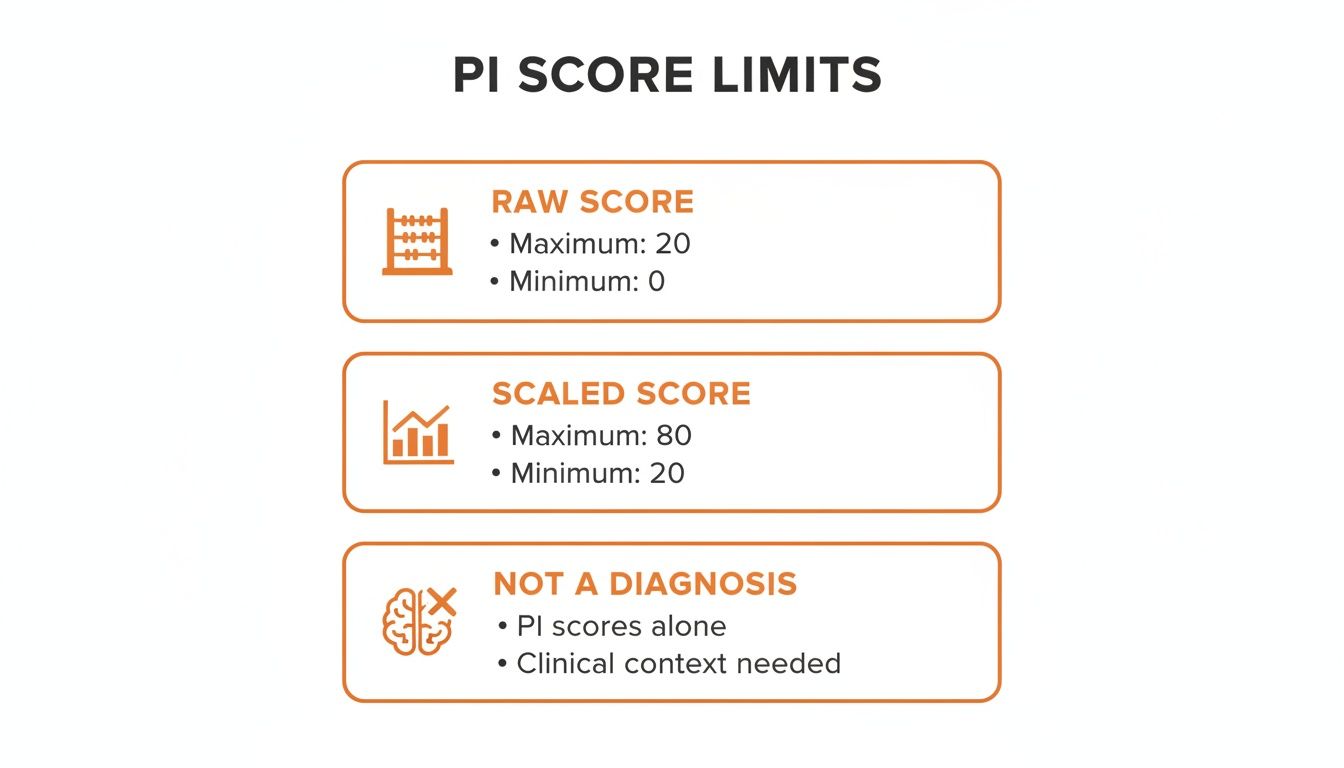
As you can see, while the PI assessment generates scores, these numbers are completely stripped of the diagnostic depth needed for any kind of clinical use.
Administration and Interpretation: Chalk and Cheese
The way these two assessments are administered couldn't be more different. The PI assessment is a 12-minute, unproctored online test, often taken on a candidate’s home computer.
A clinical evaluation, however, is a 2 to 8-hour affair. It’s a face-to-face session with a trained clinician who is actively observing behaviour, gathering a detailed history, and using a whole battery of validated tests.
This contrast is mirrored in what you get at the end.
PI Assessment: Delivers a single scaled score that gets compared against a company’s target benchmark.
Neuropsychological Evaluation: Produces a rich, multi-domain profile of specific functions like memory, attention, executive control, and language. This profile is then carefully interpreted within the patient's full medical and personal context.
To truly understand this divide, let's look at the two approaches side-by-side.
Comparison of PI Assessment and Clinical Neuropsychological Evaluation
Attribute | PI Cognitive Assessment | Clinical Neuropsychological Evaluation |
|---|---|---|
Primary Goal | Predict job performance; talent selection | Diagnose cognitive disorders; inform treatment |
Scope | Measures a single construct: "general cognitive ability" | Assesses multiple cognitive domains (memory, attention, etc.) |
Administration | 12-minute, online, unproctored test | 2-8 hour, in-person session with a clinician |
Output | A single scaled score against a job target | A comprehensive report with diagnostic impressions |
Interpretation | Done by HR or hiring managers for business decisions | Done by a trained neuropsychologist for healthcare decisions |
Context | Commercial and organizational | Clinical and personal (medical, social, educational history) |
Use Case | Screening job candidates | Medical diagnosis, treatment planning, rehabilitation |
As the table makes clear, one is a blunt instrument for business, and the other is a precise tool for healthcare.
The healthcare industry’s own trajectory highlights this gap. By 2026, North America's cognitive assessment market in healthcare is poised to reach USD 3.92 billion, with clinical trials alone commanding a 43.22% share. This massive industry shift toward objective, granular data only widens the chasm between specialized clinical tools and general screeners like the PI assessment, which simply weren't built for the rigorous demands of healthcare diagnostics.
Ultimately, a PI score is a single data point for a hiring manager. A neuropsychological report is a comprehensive roadmap for a clinician, a patient, and their family, providing the language and evidence needed to make life-altering healthcare decisions. A corporate screening tool can never, and should never, replace a thorough clinical workup.
Actionable Guidance for Clinicians
When a patient presents with concerns about a PI Cognitive Assessment score from a job application, what is your most effective course of action? Your role is to be a source of clarity, guiding the conversation away from a single, misleading number toward a meaningful discussion about their cognitive health.
The most critical action is to set firm professional boundaries: never use PI results as a basis for any diagnosis. It simply isn't validated for that purpose. Your first step should be to educate the patient. For example, explain, "This test is a business tool to predict how quickly someone might learn a new job. It's not a medical test and doesn't measure your overall cognitive health." Frame the score as a minor data point that only warrants a second look if other clinical signs are already present.
A Practical Alternative for Clinical Screening
When you need a quick but clinically sound snapshot of cognitive function, you need a tool designed for the job. This is where modern, validated platforms offer a clear path forward. For instance, Orange Neurosciences' OrangeCheck provides a practical, clinically relevant alternative.
Unlike the PI assessment, which gives a single, generalized score, tools like OrangeCheck are built for clinical decision support. They deliver a rapid, multi-domain cognitive profile, giving you actionable insights across key areas like memory, attention, and executive function. This bridges the gap between a patient's concern and a full neuropsychological evaluation, moving from a vague number to a clear, actionable picture of their cognitive state.
For clinicians, the key is to adopt tools that align with clinical standards. The demand for such solutions is rapidly growing. In 2023, North America commanded a 38.7% share of the global cognitive assessment market, and the solutions segment is projected to hold a 54.6% share by 2025 due to the need for automated, precise assessments. This trend highlights the market's shift toward sophisticated platforms that deliver objective profiles and real-time decision support, moving far beyond simplistic employment screeners. Read more about the trends in the cognitive assessment market to understand this shift.
Empowering Patients and Making Informed Decisions
Your guidance can empower patients. A practical step is to help them understand that a test designed to screen job applicants can't define their cognitive abilities. A low score on a hiring tool doesn't mean something is wrong; it just means it's a poor measure of what truly matters for their health. While not a clinical tool, understanding the constructs it measures can sometimes spark conversations about real-world performance, like improving workplace productivity.
Ultimately, your job is to equip patients with accurate information and a clear path forward. To do that well, you need the right tools in your own toolkit.
Explore our comprehensive guide on selecting the right cognitive assessment online to see how platforms designed specifically for clinical use can support your practice. By embracing clinically validated technology, you can provide better care, reduce patient anxiety, and make more informed decisions about what comes next.
Frequently Asked Questions
It’s becoming more and more common for patients to bring up pre-employment test results in a clinical setting, and knowing how to navigate those conversations is key. Here are a few common questions you might encounter, with some practical ways to respond.
Can the PI Cognitive Assessment Screen for ADHD or Learning Disabilities?
Absolutely not. The PI Cognitive Assessment is not designed, validated, or approved for any kind of clinical diagnosis. It completely lacks the nuance and specificity needed to identify complex conditions like ADHD or various learning disabilities.
A practical way to explain this is to say, "A diagnosis for these conditions requires a comprehensive evaluation, like a full medical check-up. The PI assessment is like taking your temperature with a broken thermometer—it gives a number, but it’s not reliable and can't diagnose the problem."
A low score could be influenced by an underlying condition—the intense time pressure might be tough for someone with slower processing speed, for instance—but it can’t diagnose it. That requires a proper evaluation by a qualified professional using clinically validated tools.
How Should I Respond to a Patient Distressed by Their PI Score?
The first step is always empathy and reassurance. Your most actionable response is to immediately reframe the test's purpose. Explain that it’s a screening tool for a specific job, not a measure of their overall intelligence or worth.
A simple analogy can be very effective. For example: "A score on this test is like answering one random question in a trivia game—it doesn’t reflect your total knowledge or capabilities."
Remind them that factors like test anxiety, a poor night's sleep, or unfamiliarity with the format can easily affect performance on a brief, high-pressure test. Validate their feelings, but gently reframe the score as a single, limited data point from a business tool. If their concerns about cognition seem genuine, this is your opportunity to guide them toward a proper clinical screening to get an accurate and meaningful picture.
Are There Better Clinical Alternatives for a Quick Cognitive Screening?
Yes, absolutely. While a full neuropsychological evaluation is the gold standard for diagnosis, modern digital tools provide a reliable and efficient middle ground for rapid clinical screening. These are built from the ground up to deliver clinically relevant data.
Platforms like Orange Neurosciences' OrangeCheck are designed specifically for clinical settings. They can deliver an objective profile across multiple cognitive domains in under 30 minutes. Unlike the PI assessment, these tools give clinicians actionable data to help decide on next steps, whether that's pursuing further evaluation or considering specific interventions.
This kind of targeted screening provides a far more useful snapshot of a patient's cognitive state than a simple pass/fail score from a hiring tool. It empowers both you and your patient with meaningful information to guide the next steps in their care journey.
Ready to move beyond the limitations of pre-employment screeners? Discover how Orange Neurosciences provides the clinically validated data you need to make confident decisions. Explore our AI-powered assessment tools and see how you can get objective cognitive profiles in under 30 minutes. Visit us at https://orangeneurosciences.ca to learn more or to request a demo for your practice.
Orange Neurosciences' Cognitive Skills Assessments (CSA) are intended as an aid for assessing the cognitive well-being of an individual. In a clinical setting, the CSA results (when interpreted by a qualified healthcare provider) may be used as an aid in determining whether further cognitive evaluation is needed. Orange Neurosciences' brain training programs are designed to promote and encourage overall cognitive health. Orange Neurosciences does not offer any medical diagnosis or treatment of any medical disease or condition. Orange Neurosciences products may also be used for research purposes for any range of cognition-related assessments. If used for research purposes, all use of the product must comply with the appropriate human subjects' procedures as they exist within the researcher's institution and will be the researcher's responsibility. All such human subject protections shall be under the provisions of all applicable sections of the Code of Federal Regulations.


© 2026 by Orange Neurosciences Corporation