ICD 9 Code for ADHD: A Clinician's Reference Guide
May 2, 2026
You’re reviewing an old chart before a follow-up visit. The patient is now an adolescent or adult, the current problem list uses ICD-10, but buried in the historical record is 314.00 or 314.01. The note may be thin, the payer wants clarity, and your research team is trying to clean longitudinal data without losing diagnostic meaning.
That’s where the icd 9 code for adhd still matters.
In practice, legacy ADHD coding isn’t just archival trivia. It affects whether you can reconcile past treatment decisions, defend historical claims in an audit, and interpret symptom patterns across the ICD-9 to ICD-10 transition. It also shapes how confidently you can map an old diagnosis to a present formulation when the original charting was brief, subtype language was inconsistent, or the patient’s presentation changed over time.
Clinicians, coders, and health information managers run into the same problem repeatedly. The old code is there, but the supporting detail may not be. When that happens, you need to know what the code meant at the time, what it likely maps to now, and what documentation would make that historical diagnosis more defensible today.
Why ICD-9 ADHD Codes Still Matter in 2026
A familiar scenario: a patient transfers care, and the first ADHD diagnosis in the chart predates October 2015. The current medication list suggests longstanding treatment. The school history fits. The patient and family recall “ADD” or “ADHD”, but the record itself only shows 314.00 or 314.01.
That old code still carries practical weight. It tells you how the condition was framed clinically, how earlier services were billed, and how a payer or auditor may read the medical necessity of prior care. It also matters when researchers are building longitudinal cohorts and need to preserve continuity across coding systems instead of flattening all historical ADHD diagnoses into an unspecified modern label.
Where legacy coding still shows up
The most common places are routine and unglamorous:
Historical chart review: Prior diagnoses, medication justification, school accommodation records, and consultant letters often preserve ICD-9 language.
Billing audits: Retrospective reviews still examine whether the selected code matched the note at the time.
Data migration projects: EHR clean-up efforts need a sensible crosswalk rather than a blind one-to-one replacement.
Clinical reconciliation: A subtype documented years ago may explain why earlier treatment focused on behavioural regulation versus academic support.
A legacy code is only as useful as the note attached to it. The code gives you direction. The documentation gives you credibility.
When I review old ADHD records, I’m rarely asking whether ICD-9 is still active. It isn’t. I’m asking whether the historical code still helps me understand the patient. Usually, it does.
For teams updating assessment workflows, it also helps to compare old subtype language with current evaluation practices such as structured symptom review, collateral input, and objective attention testing. A current framework like ADHD assessment guidance in BC is useful because it shows how much cleaner modern documentation can be when you’re trying to interpret a legacy diagnosis.
What still works and what doesn’t
A few trade-offs are worth naming directly.
Situation | What works | What fails |
|---|---|---|
Old ADHD code in a sparse chart | Reviewing symptoms, school/work impact, and collateral documentation | Assuming the code alone proves subtype |
Longitudinal dataset with mixed ICD-9 and ICD-10 entries | Preserving original code and adding mapped modern equivalent | Overwriting the original diagnosis field |
Audit preparation | Matching billing code to exact charted features | Retrofitting a subtype that was never documented |
The practical point is simple. ICD-9 ADHD codes still matter because patients’ histories still matter.
Quick Reference for Primary ICD-9 ADHD Codes
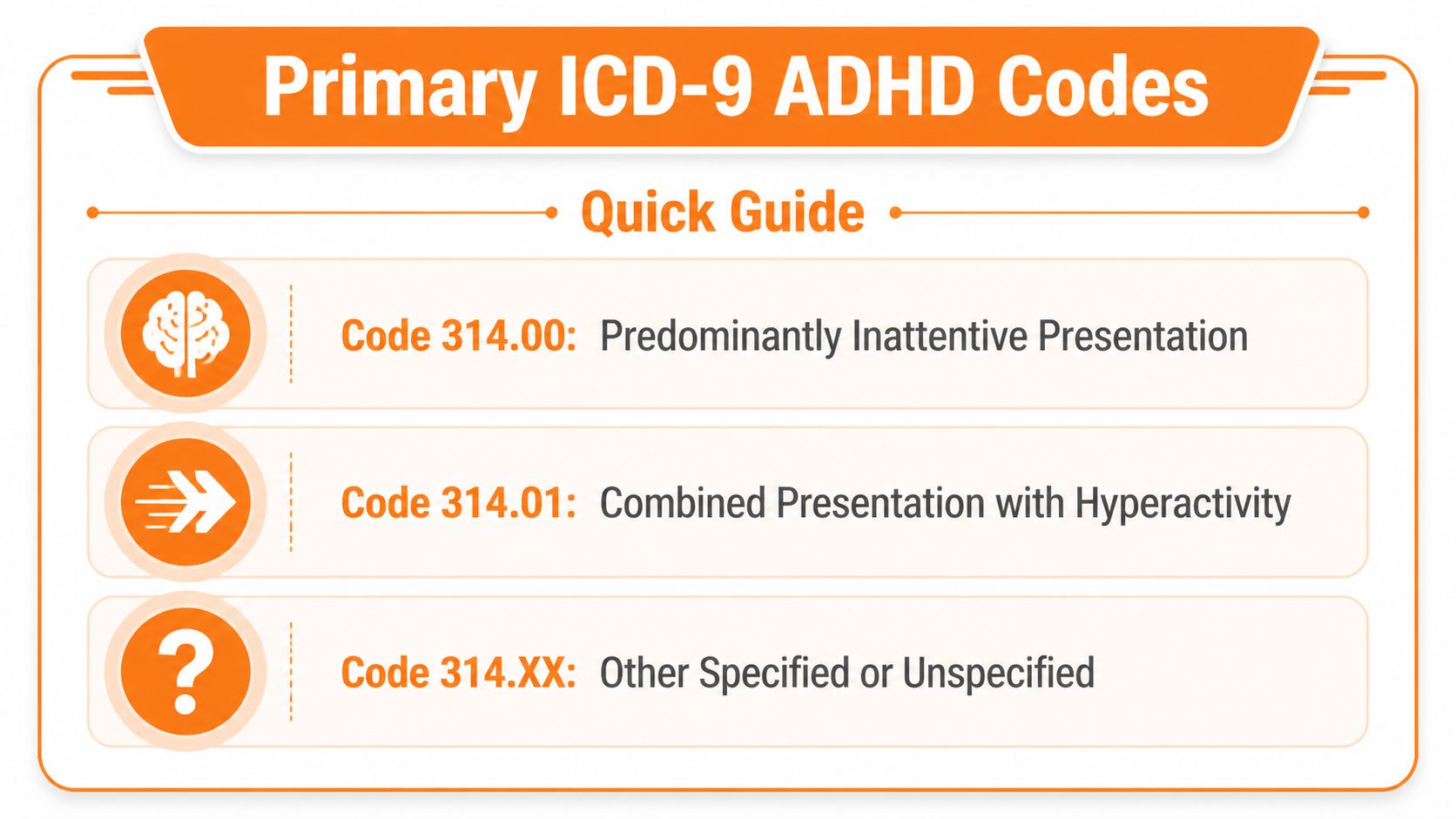
If you need the short answer first, these are the primary ADHD-related ICD-9 codes most clinicians still encounter in legacy records.
Core codes at a glance
314.00
Attention deficit disorder of childhood without mention of hyperactivity. Historically used for predominantly inattentive presentations.314.01
Attention deficit disorder with hyperactivity. Used when hyperactivity was a defining feature alongside attentional symptoms.314.9
Hyperkinetic syndrome of childhood, unspecified. The fallback code when documentation didn’t support a more precise subtype.
How to use this quick reference correctly
Don’t treat these codes as interchangeable. In old charts, they often reflect real differences in symptom emphasis, school concerns, and billing logic.
A practical example helps. If a historical note describes distractibility, slow task completion, missed instructions, and academic underperformance without clear overactivity, 314.00 is usually the legacy code you’d expect to see. If the same record highlights fidgeting, disruptive motor activity, impulsive classroom behaviour, and poor behavioural regulation, 314.01 is the more likely historical fit.
Fast chart rule: Read the assessment text before you read the code description. The note should tell you whether the code was specific or merely convenient.
For chart abstraction, quality review, or clinical reconciliation, that distinction saves time later.
Decoding 314.00 Attention Deficit Without Hyperactivity
314.00 was the historical ICD-9 code for attention deficit disorder of childhood without mention of hyperactivity. In practical terms, it captured the patient whose main difficulty was inattention rather than overt overactivity.

Inattentive presentations were often under-recognised when behaviour disruption was the dominant referral trigger. A child could struggle for years with sustained attention, disorganisation, incomplete work, and inconsistent classroom performance while drawing less concern than a peer who was visibly impulsive or restless.
According to AAPC’s ICD-9 entry for 314.0, 314.00/314.01 appeared as principal diagnoses in 10.2% of child mental health visits in national CDC data from 2012. The same source states that 314.00 comprised 45% of ADHD codes in 2013 Medi-Cal claims for ages 3 to 17, and that billing accuracy using 314.00 cut insurer denials by 18%.
What 314.00 usually meant clinically
In a good chart, this code should align with documentation such as:
Sustained attention problems: Trouble finishing schoolwork, losing track of instructions, or drifting during tasks.
Low behavioural disruption: Limited evidence that hyperactivity was a primary driver.
Functional impairment: Academic inefficiency, organisational strain, or missed details affecting performance.
A practical example: if a referral note says a child is bright, quiet, forgetful, slow to complete written work, and frequently misses multi-step instructions, 314.00 is historically coherent. If the note only says “possible ADD”, the code may still appear in the claim, but the documentation is weak.
Why 314.00 still deserves careful review
Older records using 314.00 often sit beside learning concerns. The AAPC summary notes that this code often correlated with learning-disorder comorbidities. That’s useful when you’re interpreting why a patient’s old treatment plan leaned heavily on classroom support, psychoeducational testing, or executive-function coaching rather than behaviour management.
For present-day teams, that historical pattern can sharpen current formulation. If a legacy 314.00 diagnosis sits beside persistent difficulties in working memory, follow-through, and task organisation, it’s worth revisiting those domains directly. A current review of ADHD and working memory can help frame what the old chart may have been describing, even when the original wording was dated.
Documentation test: If hyperactivity isn’t described, don’t let retrospective assumptions turn an old 314.00 into a combined presentation on data export.
What worked then and what still works now
A specific inattentive code worked best when the note separated attention failure from simple underachievement or general behavioural difficulty. What didn’t work was vague language like “poor focus” with no examples, no setting-based impairment, and no collateral input.
That lesson hasn’t changed. Better subtype documentation still produces better continuity of care.
Understanding 314.01 Attention Deficit With Hyperactivity
314.01 identified attention deficit disorder with hyperactivity. In legacy ADHD coding, this was the key distinction when the record supported not only attentional impairment but also clear hyperactive or impulsive features.

In practical terms, this code carried more than descriptive value. It shaped how a clinician framed the case, how schools understood the behavioural burden, and how billing staff justified a more specific ADHD diagnosis.
Per AAPC’s ICD-9 entry for 314.01, 314.01 was used in 40-50% of hyperactivity-dominant cases in California. The same source reports that the California Department of Health Care Services recorded 314.01 in 35% of 2012 paediatric psych visits, and that correct documentation of this code reduced claim denials by 15-20%.
What had to be documented
A defensible 314.01 chart usually needed more than “patient is active”.
The note had to support a pattern such as:
Motor overactivity: Difficulty remaining seated, excessive movement, or constant fidgeting.
Impulsivity: Blurting, interrupting, poor waiting, or acting before considering consequences.
Attention impairment alongside hyperactivity: Not just behavioural dysregulation in isolation.
Functional consequences: School disruption, discipline problems, unsafe behaviour, or major home impairment.
That distinction matters because not every restless child belonged under 314.01. Anxiety, environmental stress, sleep problems, and developmental differences could all create apparent overactivity. A specific code needed specific evidence.
A practical charting contrast
Consider two brief examples.
Weak note
“ADHD symptoms present. Very active. Start treatment.”
Stronger note
“Parent and teacher report persistent inattention across settings with frequent interrupting, inability to remain seated, excessive movement during class, and impulsive behaviour affecting school participation.”
Only the second note clearly supports why 314.01 was chosen.
When hyperactivity is the subtype driver, name the behaviours. “Active” is an opinion. “Leaves seat repeatedly and interrupts peers across settings” is documentation.
Why 314.01 still matters in old records
This code often explains historical care pathways. If a child’s legacy record consistently used 314.01, it may clarify why the chart contains behaviour plans, classroom conduct reports, safety counselling, or medication decisions aimed at impulsivity and motor regulation.
It also helps when reconciling old and new diagnostic language. If a patient now presents with less overt overactivity but longstanding impulsive history, the legacy code can preserve context that would otherwise disappear during chart simplification.
For audits and retrospective reviews, 314.01 remains a reminder that subtype specificity was not a technical detail. It affected reimbursement, tracking, and clinical communication.
Navigating Unspecified and Adult ADHD ICD-9 Codes
The hardest legacy records are rarely the clean ones. They’re the charts with partial evaluations, shorthand diagnoses, or code selection that never fully matched the note. That’s where 314.9 and adult residual ADHD documentation become important.
According to Find-A-Code’s summary of California pre-transition data, 314.01 accounted for 58% of paediatric encounters, 314.00 for 28%, and 314.9 for 14% in 2014 OSHPD data. The same source notes that CHIA audits identified a best practice for adult residual ADHD documentation by pairing the diagnosis with Z73.1, and that vague ADHD codes carried an average claim denial rate of 12% in California.
When 314.9 showed up
314.9 was the unspecified bucket. Sometimes that was appropriate. Often it reflected incomplete charting.
You’d see it when:
the clinician suspected ADHD but hadn’t clearly subtype-tested the presentation
collateral information was still pending
symptoms were recorded, but not in enough detail to support 314.00 or 314.01
the encounter focused on follow-up rather than full diagnostic clarification
Used briefly and followed by better documentation, unspecified coding can be understandable. Used repeatedly, it creates friction for billing, care planning, and research abstraction.
Adult charts created a different problem
ICD-9 was never elegant for adult ADHD documentation. Historical records often inherited a childhood code or used non-specific language that didn’t reflect residual symptoms well. That’s why the CHIA audit guidance about pairing adult residual ADHD with Z73.1 is worth remembering in retrospective review and coding policy discussions.
If you’re cleaning an adult chart today, do not copy forward the old diagnosis label without review. Re-read the historical symptom pattern. Look for functional markers such as missed deadlines, disorganisation, impulsive decision-making, and difficulty sustaining task completion. In some adult care pathways, non-pharmacological support becomes just as important as diagnosis itself. For patients who need practical coping strategies, this guide to managing time effectively with ADHD is a useful adjunct resource.
A sensible approach to adult legacy records
A workable process looks like this:
Preserve the original ICD-9 code in the historical field.
Review whether the old subtype was supported by the note.
Document current presentation separately using current standards.
Avoid “upgrading” an unspecified historical code unless the chart supports it.
For clinicians reassessing adult presentations, current screening frameworks can make the handoff from legacy coding far cleaner. A practical starting point is this review of ADHD screening for adults.
What doesn’t work is pretending the old adult chart is more precise than it was. That creates neat data and bad documentation.
The Essential ICD-9 to ICD-10 Crosswalk for ADHD
When teams ask for the shortest useful tool on this topic, they usually want the crosswalk. Historical records still contain ICD-9 entries, but active problem lists, claims, and most modern reporting use ICD-10. The challenge isn’t just converting codes. It’s preserving meaning.
Here’s the practical comparison table most clinicians and health information staff need.
ICD-9 to ICD-10 ADHD code crosswalk
ICD-9 Code | ICD-9 Description | ICD-10 Code | ICD-10 Description |
|---|---|---|---|
314.00 | Attention deficit disorder of childhood without mention of hyperactivity | F90.0 or F90.9 | Predominantly inattentive type, or unspecified when the old note lacks enough subtype detail |
314.01 | Attention deficit disorder with hyperactivity | F90.1, F90.2, or F90.9 | Predominantly hyperactive type, combined type, or unspecified depending on what the historical documentation actually supports |
314.9 | Hyperkinetic syndrome of childhood, unspecified | F90.9 | Attention-deficit hyperactivity disorder, unspecified type |
How to use the crosswalk safely
The key point is that a crosswalk is not a diagnosis. It is a translation tool.
If a chart has 314.01, don’t automatically map it to F90.2 just because combined presentation feels familiar in modern practice. Some old records support a hyperactive formulation more strongly than a combined one. Others don’t provide enough detail and should remain unspecified when migrated. The same caution applies to 314.00. If the historical note is weak, forcing F90.0 may overstate the evidence.
Mapping rule: Crosswalk the documentation, not just the code label.
That distinction matters for chart integrity, payer review, and research validity. It also affects treatment continuity. A patient whose historical record clearly reflected inattentive difficulties may need a different current discussion than one whose old chart emphasised behavioural impulsivity.
For clinicians advising adults on current treatment options after diagnosis reconciliation, practical overviews such as medical ADHD management at XO Medical can help patients understand what modern care pathways may involve, beyond the coding itself.
What works best in EHR migration projects is dual visibility. Keep the original ICD-9 diagnosis in the historical record, then add a clearly dated ICD-10 equivalent with a note explaining the rationale for the mapping.
Common Coding Pitfalls and Documentation Best Practices
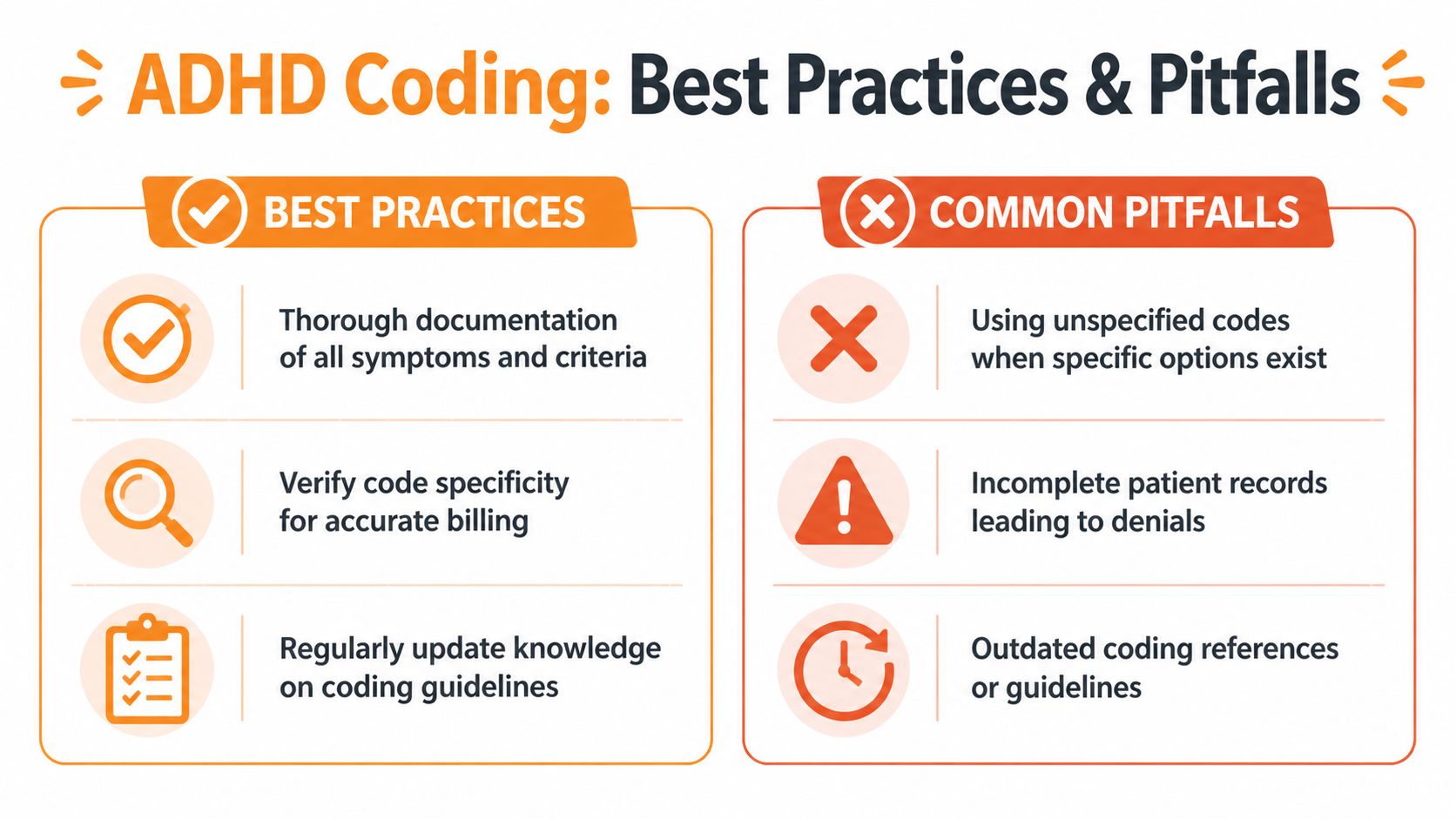
Most ADHD coding errors aren’t dramatic. They’re small documentation shortcuts that gradually create denials, confusion, or poor data quality later.
The most persistent problem is overuse of unspecified coding when the chart could support more detail. A projection cited by Imed Claims on F90.9 notes that unspecified coding persists in 25% of LA/Orange County claims despite ICD-10, often because of incomplete phenotyping. The same source references a 12% rise in ADHD evaluations in California in 2025 as a projection, while highlighting continued strain around documentation for insurance pre-authorisation and research protocols.
Pitfalls that trigger trouble
Using an unspecified code by habit
If the note already describes inattentive versus hyperactive features clearly, unspecified coding weakens the record.Documenting symptoms without functional impact
“Distractible” isn’t enough. You need to show how symptoms affect school, work, home, or relationships.Relying on one observer only
ADHD charting is stronger when it reflects more than a single impression, especially in children.Mixing historical and current labels carelessly
A patient may have an old ICD-9 code in the chart and a current ICD-10 code today. Keep the dates and rationale distinct.
Do this and not that
Do this | Not that |
|---|---|
Record subtype-driving behaviours with examples | Write “ADHD symptoms” and stop there |
Note impairment across settings when present | Assume one setting is enough in every case |
Preserve original legacy code in history | Replace old entries without traceability |
Reassess current presentation separately | Treat the old code as permanently self-explanatory |
Charting language that holds up better
Weak
“History of ADHD. Ongoing focus issues.”
Better
“Historical ADHD diagnosis in legacy record. Current concerns include sustained inattention, missed deadlines, disorganisation, and task incompletion affecting work performance. Hyperactive behaviours are not prominent in the present review.”
Weak
“ADHD combined type by history.”
Better
“Legacy chart lists 314.01. Prior records describe inattention with impulsive interruption and difficulty remaining seated in school settings. Current note distinguishes historical presentation from present symptom profile.”
Better coding starts with better phenotype description. If the note can’t tell another clinician why the subtype fits, the code is doing too much work.
For teams refining documentation standards, it also helps to think beyond ADHD alone. Comorbid anxiety often muddies symptom presentation and can push clinicians toward vague coding if they don’t separate attentional symptoms from anxious inattention. This review of ADHD medications and anxiety is useful for that differential thinking.
What works in real workflows
The most reliable workflow is simple:
Front-end clarity: document symptom clusters and setting-based impairment during the assessment itself
Coder-clinician alignment: make sure the chosen diagnosis reflects the actual note
Retrospective restraint: don’t “improve” historical specificity unless the source record supports it
That approach reduces friction in audits and makes future chart review much easier.
Enhance Diagnostic Accuracy Beyond Legacy Codes
Understanding the icd 9 code for adhd is important. It helps you read old records accurately, protect billing integrity, and preserve longitudinal meaning. But coding by itself has always been downstream of something more important: the quality of the assessment.
The strongest ADHD documentation doesn’t begin with the billing code. It begins with a careful account of attention, impulse control, executive function, task persistence, and real-world impairment. That’s why modern care benefits from tools that add objective cognitive data to the clinical picture, especially when legacy records are incomplete or a current reassessment needs stronger support.
Why objective data changes the conversation
Historical charts often contain broad labels such as “ADD”, “hyperactive”, or “poor focus”. Those phrases are familiar, but they don’t always tell you what the patient struggled with. Objective cognitive profiling can help separate attentional inefficiency from memory weakness, processing-speed issues, or broader executive dysfunction.
That matters in clinics, rehabilitation settings, and research environments. It also matters for families and adult patients who want a clearer explanation than a recycled legacy code can provide. For people exploring whether their current symptoms warrant formal review, this overview of ADHD screening for adults can be a useful starting point before a full assessment pathway is considered.
Better continuity comes from better characterisation
When you pair historical coding knowledge with clearer present-day cognitive data, several things improve:
Clinical handoffs get sharper
Subtype assumptions become easier to verify or reject
Comorbid patterns become easier to discuss
Research datasets become more defensible
That last point matters more than many teams realise. ADHD rarely appears in isolation, and a narrow focus on code mapping can hide the full clinical picture. A broader review of comorbidity in ADHD is often where better diagnostic formulation begins.
Legacy codes still matter. They just shouldn’t be asked to do the whole job.
If your team is working through legacy ADHD records, audit preparation, or current cognitive assessment workflows, Orange Neurosciences is worth exploring. Their platform gives clinicians and organisations objective cognitive profiles that can support cleaner documentation, stronger longitudinal interpretation, and better-informed next steps. If you’d like to see how that could fit your setting, visit the website or contact the team directly.

Orange Neurosciences' Cognitive Skills Assessments (CSA) are intended as an aid for assessing the cognitive well-being of an individual. In a clinical setting, the CSA results (when interpreted by a qualified healthcare provider) may be used as an aid in determining whether further cognitive evaluation is needed. Orange Neurosciences' brain training programs are designed to promote and encourage overall cognitive health. Orange Neurosciences does not offer any medical diagnosis or treatment of any medical disease or condition. Orange Neurosciences products may also be used for research purposes for any range of cognition-related assessments. If used for research purposes, all use of the product must comply with the appropriate human subjects' procedures as they exist within the researcher's institution and will be the researcher's responsibility. All such human subject protections shall be under the provisions of all applicable sections of the Code of Federal Regulations.


© 2026 by Orange Neurosciences Corporation