Unlocking Potential with ADHD Working Memory Strategies
Jan 16, 2026
Ever feel like your brain has a little sticky note for holding onto information, but for someone with ADHD, that note is just... not very sticky? Maybe it's too small, or it keeps getting knocked aside by a dozen other thoughts. That's a pretty good picture of what challenges with ADHD working memory feel like. It has nothing to do with how smart someone is; it’s all about the brain’s capacity to hold and actively use information in the moment.
What Is ADHD Working Memory and How Does It Feel

Think of working memory as your brain's active workspace—the mental countertop where you juggle ingredients while following a recipe. It's not just about passively holding information; it’s a dynamic, short-term system that lets you manipulate that information to get things done.
It’s the mental juggler keeping several balls in the air. For example, you hold the beginning of a sentence in your mind while listening to the end, or you keep a few numbers handy while you do mental math. It's essential for almost everything we do, from having a conversation to planning our day.
For someone with Attention-Deficit/Hyperactivity Disorder (ADHD), this mental workspace can feel incredibly unreliable. Information seems to vanish just moments after it arrives. This isn't a matter of not trying hard enough. It's a fundamental neurological difference affecting the brain's executive functions.
The Real-World Impact Across Ages
This struggle with working memory shows up in different ways at different stages of life, and it’s often mistaken for laziness, carelessness, or a lack of motivation. Knowing what to look for is the first step toward providing real support.
Here are a few practical examples:
For a Child: The teacher says, "Put your homework in the bin, grab your lunchbox, and line up by the door." A child with working memory challenges might only catch the first step, or get distracted halfway through and forget the last instruction completely.
For a Teenager: While writing an essay, they struggle to hold their main argument, key supporting points, and the sentence they're currently crafting in their mind all at once. The result is often disorganized writing that doesn't truly reflect what they know.
For an Adult: In a meeting, they might lose the thread of the conversation or forget the brilliant point they were about to make. Managing a project with multiple moving parts can feel like a constant battle, as crucial details seem to slip away.
This isn't a failure of willpower. It's the cognitive equivalent of trying to carry your groceries home in a bag with a hole in it. You're putting in all the effort, but things just keep falling out.
Recognizing these patterns for what they are is a game-changer for parents, teachers, and individuals. It shifts the perspective from a "behaviour problem" to a cognitive challenge that needs specific strategies. Our comprehensive guide to ADHD dives deeper into how these core symptoms are all connected.
Once we understand what ADHD working memory really feels like, we can trade frustration for empathy and start building a support system. The goal isn't just to demand better performance, but to provide the scaffolding that helps individuals manage their cognitive load, accomplish daily tasks, and truly shine.
The Evolving Impact of Working Memory from Childhood to Adulthood
Working memory challenges in ADHD aren't a static problem. They shift, morph, and grow as life gets more complicated. The mental "sticky note" we all depend on gets tested in very different ways, from the school playground to the corporate boardroom. Understanding how these challenges evolve is the first step in providing the right support at the right time.
The journey usually starts in childhood, where working memory deficits first bubble up as struggles with schoolwork and organization. These are the moments that are so often misunderstood by well-meaning teachers and parents.
Childhood: The First Signs in the Classroom
For a young child, a classroom is a whirlwind of multi-step instructions that can instantly overload a taxed working memory. A simple request like, "Finish your worksheet, put it in the blue folder, and then get your art smock," can feel like an impossible puzzle. The child might only catch the first part and get lost, leading to half-done tasks and frustration.
You can see this strain in core academic skills, too:
Mental Math: Solving 12 + 25 isn't just about knowing numbers. It requires holding both numbers in your head, adding the ones column, carrying over, and then adding the tens. If the original numbers vanish from that mental workspace, the whole process falls apart.
Reading Comprehension: To really get a paragraph, a child has to hold the meaning of the first sentence in their mind while they read the second, connecting the ideas as they go. When that link breaks, they might read the words perfectly but have no clue what they just read.
Organization: The simple act of keeping a backpack tidy is an executive function nightmare. It involves remembering which books are for homework, where finished papers go, and what needs to be brought back to school. For a child with a weak working memory, this daily task is a monumental effort.
These early struggles are too often mislabeled as laziness or not caring. In reality, they're the first clear signals of an executive function challenge that needs strategic support, not criticism.
Adolescence: The Pressure Intensifies
As kids hit their teenage years, the demands on their executive functions—especially working memory—skyrocket. The academic and social worlds become infinitely more complex, demanding a much greater ability to plan, organize, and manage information over longer stretches.
Long-term school projects, for instance, become a huge source of friction. Acing a research paper means juggling a thesis statement, multiple sources, outlines, and deadlines for weeks on end. For a teen with ADHD, keeping all those moving parts active in their working memory is a daily battle, often leading to procrastination and frantic, last-minute work.
Socially, the landscape is just as tricky. Navigating complex friendships requires tracking conversations, remembering social cues, and recalling past interactions to figure out how to act now. This is another area where working memory is absolutely vital. A teen might forget an inside joke or a friend's important story, leading to social stumbles that are completely unintentional.
Adulthood: Professional and Personal Hurdles
By adulthood, the consequences of a strained working memory shift into professional and personal life. The external scaffolding of parents and teachers is gone, placing the entire burden of organization squarely on the individual's shoulders.
Common pain points for adults often include:
Missed Deadlines at Work: Managing several projects with competing priorities means holding a massive amount of information in your head—client needs, team responsibilities, and timelines. An important detail, like a client's specific request from a phone call, can easily slip through the cracks.
Household and Financial Management: Paying bills on time, scheduling appointments, and keeping a budget all hinge on a reliable working memory to track due dates, appointments, and financial figures. Forgetting a credit card payment isn't a moral failing; it's often a working memory lapse.
Chronic Disorganization: That persistent feeling of being overwhelmed and disorganized often comes from the inability to hold a plan in mind long enough to actually follow through with it. This can affect everything from keeping a home tidy to remembering important family birthdays.
If these patterns feel familiar, exploring a formal assessment can be a powerful next step. Our guide offers some great information on ADHD screening for adults.
Ultimately, understanding that these challenges change over time is crucial. The support that helped a child with homework won't be the same as what an adult needs to manage a career. This is why adaptable, lifelong strategies are so essential.
How to Identify Working Memory Challenges
Figuring out if someone has a strained working memory is the first, most critical step toward getting them the right support. We've talked about what working memory is and how it develops, but now it’s time to get practical. Spotting these challenges isn’t about making a diagnosis; it’s about noticing patterns that tell you the brain's "mental countertop" might be getting overloaded.
These signs often hide in plain sight during everyday conversations, homework sessions, and simple chores. For parents and educators, learning to view these behaviours through the lens of ADHD working memory can be a game-changer. It shifts the dynamic from frustration to a focused, supportive plan of action.
Spotting the Signs in Daily Life
Long before any formal testing, simple observation gives us the richest clues. A child or adult struggling with their working memory isn’t trying to be defiant or lazy. They're genuinely finding it hard to hold onto and work with information.
Keep an eye out for these common patterns:
Losing Track Mid-Sentence: They might launch into a story, pause for a second, and then completely lose their train of thought.
Difficulty with Multi-Step Directions: Ask them to "grab your shoes, get your backpack, and meet me by the door," and you might find only the shoes are on. The rest of the instructions simply evaporated.
Trouble Retelling a Story: When you ask about a book they just finished or a movie they just watched, they may scramble the sequence of events, mixing up the beginning, middle, and end.
Forgetting the "Why": They walk into a room and stop, completely blanking on why they went in there in the first place. A new thought or distraction simply pushed the original goal out of their mind.
These aren't just moments of simple forgetfulness. They point to a core cognitive struggle with holding and manipulating information in real-time—a classic hallmark of ADHD working memory challenges.
Moving from Observation to Assessment
While watching for these daily signs is essential, it can sometimes feel subjective. That's where more structured, formal methods come in to provide clarity and a clear path forward. Clinicians use a range of tools to objectively measure working memory capacity, taking the guesswork out of the equation.
One of the most well-known methods is the digit span test. In its simplest form, a person listens to a sequence of numbers (like "7-1-9") and repeats them back. The real test of working memory comes next, when they’re asked to repeat the numbers in reverse order ("9-1-7"). This simple switch heavily taxes the brain's ability to hold and manipulate information. Our guide on the digit span test provides a deeper look into how these assessments work.
The Power of Objective Data
Formal assessments are so important because they give us solid, objective data to build effective interventions. In Canada, ADHD affects roughly 5-7% of children, and for them, working memory deficits are a primary concern. In fact, research shows that a staggering 62% to 85% of children with ADHD have significant trouble with tasks requiring executive working memory. This makes these challenges a central part of the condition, not just a side effect. Clinicians now use computerized tests that can classify ADHD with 80-90% accuracy, which also helps predict related issues like social difficulties and poor emotional regulation. Discover more insights from this research on executive functioning in ADHD.
Modern digital tools have made this assessment process much faster and more accessible. Platforms like OrangeCheck can deliver a clear and rapid cognitive snapshot, often in less than 30 minutes. This kind of objective profile of a person's working memory and other cognitive functions empowers everyone involved.
For a parent, it means having concrete data to share with teachers. For an educator, it provides the insight needed to tailor classroom support. And for the individual, it offers a clear understanding of their own unique cognitive profile. By moving from simple observation to data-driven insights, you can create a support plan that is truly personalized and effective. Ready to see what's possible? Visit the Orange Neurosciences website to explore how our tools can help you take the next step.
Actionable Strategies to Strengthen Working Memory
Knowing that ADHD affects working memory is one thing, but figuring out how to actually help is another ball game entirely. The good news? You're not powerless. A smart mix of environmental supports, targeted brain exercises, and professional help can make a world of difference.
The goal isn't to find a single "fix." Instead, it's about building a personalized toolkit of proven strategies that work for any age, whether at school, at home, or in the office. This approach empowers individuals by giving them the structure they need to succeed while also helping to build up the underlying brain pathways.
In the Classroom Accommodations
For students with ADHD, the classroom is often ground zero for working memory overload. A few simple, consistent accommodations can be the difference between a student who is constantly frustrated and one who is finally able to shine.
Put It in Writing (and Pictures!): Spoken directions are like smoke—they can vanish in a second. Always back up verbal instructions with notes on the board, a handout, or a digital classroom tool. A practical example is providing a printed checklist for a science lab so students don't have to remember every step.
Break Down the Mountain: A massive, multi-week research paper can feel like an impossible climb. The secret is to break it down into smaller, more manageable hills with their own deadlines. For a history project, this could look like: Week 1: Choose a topic. Week 2: Find five sources. Week 3: Write an outline. This makes the process less overwhelming and easier to track.
Lean on Checklists and Organizers: For any multi-step task, from a science experiment to writing an essay, a checklist is a lifesaver. It provides a clear roadmap, freeing up precious mental energy. Graphic organizers do the same for thoughts, helping students visualize connections without having to hold it all in their heads at once.
At Home and in Daily Life
Bringing supportive routines into the home can dramatically cut down on daily friction and build crucial life skills. The real magic here is consistency.
For kids and teens, a visual schedule for the morning or evening routine can be transformative. Instead of a parent repeating "get ready!" a dozen times, a chart with simple words or pictures—"Brush Teeth," "Get Dressed," "Pack Bag"—acts as an external guide. This fosters independence and reduces the need for nagging.
Another fantastic tool is turning memory practice into a game. For example, play the "I went to the market" game where each person adds an item to a growing list. Classics like "Memory" (matching card pairs) or sequencing games like "Simon Says" can also be fun, low-pressure ways to give those working memory muscles a gentle workout.
At its core, effective support is about "cognitive offloading"—moving information from a taxed internal working memory to the external environment. This creates a predictable world where the brain doesn't have to work so hard just to keep up.
Beyond these home-based techniques, specialized apps can offer some powerful digital support. You can find some of the best apps for ADHD adults to manage focus and routines that provide clever ways to manage tasks and stay on track.
Cognitive Training and Professional Support
Beyond simple accommodations, we can also work on directly strengthening the neural pathways that support working memory. This is where targeted, evidence-based programs come into play.
Engaging, game-like platforms such as ReadON offer a structured way to exercise specific cognitive skills, including working memory. These tools are designed to adapt to a user's performance, providing a "just-right" challenge that encourages brain growth and improves function. Their interactive nature keeps users motivated, turning what could be a tedious task into something truly rewarding. To dive deeper into specific techniques, check out our guide on how to improve working memory.
This diagram illustrates the different ways working memory issues can be identified, ranging from informal observations to formal clinical assessments.
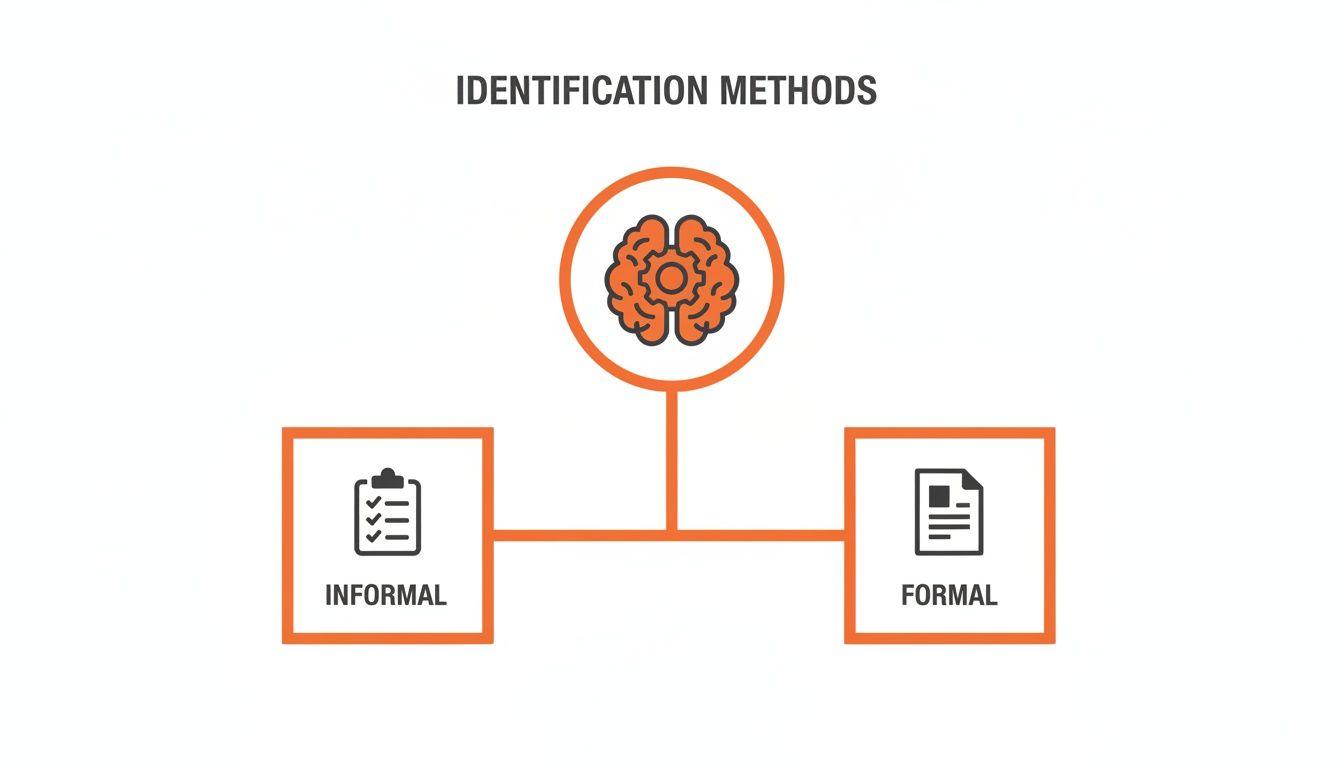
As you can see, both everyday observations and professional evaluations are valid and important starting points for building a support plan.
Cognitive training has shown particular promise for students. Post-secondary students in Canada with ADHD face huge academic hurdles, with a staggering 67%-71% showing impairment in at least one area of working memory. One key study found that a focused, 25-session cognitive training program led to significant boosts in working memory performance, with gains that were still present at a 3-month follow-up.
Finally, medication can be a critical piece of the puzzle. When prescribed by a doctor, stimulant and non-stimulant medications can improve attention and reduce distractibility, which provides a more stable foundation for working memory to function. This is a conversation that should always be had with a qualified healthcare professional to see if it's the right choice.
Working Memory Strategies at a Glance
To bring it all together, here’s a quick summary of practical strategies you can use to support working memory challenges across different settings. These examples can be adapted to fit anyone’s unique needs.
Strategy Type | Example for Children/Teens | Example for Adults |
|---|---|---|
Environmental Support | Use a visual schedule with pictures for the after-school routine (e.g., snack, homework, playtime). | Set up a dedicated "launch pad" by the door with a designated spot for keys, wallet, and phone to reduce morning scramble. |
Cognitive Offloading | Use a whiteboard in their room to list weekly chores and project deadlines. | Use a digital task manager app with reminders and sub-tasks for complex work projects. |
Skill-Building & Training | Play games that involve sequencing and memory, like story-building games ("I went to the store and I bought..."). | Practise mindfulness or meditation for 5-10 minutes daily to improve focus and the ability to hold information without distraction. |
Instructional Adaptation | Teachers provide a written outline of the lesson on the board and check for understanding by asking students to repeat key instructions. | During meetings, take notes using a mind-map format instead of linear notes to visually connect ideas without overloading memory. |
Technology Aids | Use a smartwatch with vibrating alarms as a discreet reminder for switching classes or taking medication. | Use voice-to-text apps to quickly capture ideas or to-do list items before they are forgotten. |
Remember, the most effective approach is often a combination of these strategies. The goal is to create a supportive ecosystem that reduces the daily strain on working memory while actively building its strength over time.
Building a Collaborative and Data-Driven Support Team

Tackling the challenges of ADHD working memory is never a solo mission. The most powerful results emerge when a unified team—parents, educators, and clinicians—rallies together, all pushing toward the same goals.
When this team clicks, support is no longer a series of disconnected efforts. It becomes a powerful, coordinated strategy, ensuring that insights from a clinical assessment translate into practical actions at school and at home. This is how we create a consistent, supportive environment where an individual can truly thrive.
Turning Meetings into Action Plans
Parent-teacher meetings are a cornerstone of this collaboration, but they can easily get stuck on problems instead of solutions. To make these conversations truly productive, the focus needs to shift from simply listing challenges to collaboratively building a real plan.
The key is to come prepared. Vague statements like "He's not paying attention" are far less helpful than, "He lost track of the instructions after the first step during yesterday's math lesson." This level of detail helps the team pinpoint exactly where working memory is getting overloaded and brainstorm targeted solutions.
For Parents: Before a meeting, jot down 2-3 specific examples of working memory struggles you've seen at home. Think along the lines of, "When I ask him to clean his room, he starts but gets sidetracked and forgets the original goal."
For Educators: Bring specific work samples or observations. For instance, "Here's an essay where the ideas are strong, but the paragraphs don't connect, showing a struggle to hold the main argument in mind."
A successful meeting ends not with a list of problems, but with a shared list of actionable next steps. This might include trying a new visual aid in the classroom, implementing a checklist for homework, or scheduling a follow-up.
Translating Clinical Insights into Everyday Strategies
For clinicians, the work doesn't end with a diagnosis. The most critical step is translating complex findings into clear, family-friendly strategies that parents and teachers can put into practice immediately.
A report stating a deficit in "visuospatial working memory" needs to be paired with practical advice. A clinician might explain, "This means holding visual information in mind is tricky. So, to help, let's try using a graphic organizer for writing assignments and a physical checklist for morning routines."
This bridge between clinical data and real-world application is what makes an assessment truly valuable. It empowers the entire support team with the "why" behind a behaviour and the "how" for providing effective support.
The Power of Data-Driven Progress Monitoring
How do you know if your strategies are actually working? Guesswork and subjective feelings can be misleading. The answer lies in consistent, objective progress monitoring.
This is where modern cognitive tools become indispensable. Using a platform from Orange Neurosciences for regular check-ins provides objective data on working memory performance and other executive functions. It transforms the support process from a guessing game into a precise, data-informed strategy.
This approach creates a positive feedback loop:
Assess: Get a clear baseline of cognitive strengths and weaknesses.
Implement: Use the data to create a targeted intervention plan.
Monitor: Use brief, regular check-ins to track progress objectively.
Adjust: Use the new data to refine and improve the support strategies.
When the entire team—parent, teacher, and clinician—has access to this objective data, conversations become more focused and effective. Everyone is aligned, celebrating small wins and making smart adjustments along the way. To learn more about this approach, explore how we work to create these data-driven support systems. This collaborative model is the key to unlocking an individual's full potential.
Where Do We Go From Here?
This guide has laid out the landscape of working memory challenges in ADHD, and if there's one thing to take away, it's this: these hurdles are real, but they are absolutely manageable. The impact is felt throughout life, but you are not powerless.
With the right mix of practical strategies, a strong support system, and clear, data-driven insights, you can turn points of friction into genuine opportunities for growth. The key is turning this knowledge into action.
Taking steps to address ADHD working memory is one of the most powerful things you can do to improve daily life, cut down on frustration, and build confidence that lasts. It's all about creating an environment where skills can truly flourish.
Don't let guesswork guide your strategy. Objective data gives you the clearest path forward, helping you understand the specific cognitive strengths and weaknesses at play. This is the foundation for any support plan that is truly personalized and effective.
Ready to take that next step? We encourage you to visit the Orange Neurosciences website to learn how our rapid cognitive assessments and personalized training programs can provide the roadmap you need.
Discover a clearer path to improved focus, organization, and confidence today. Our tools are designed to empower clinicians, educators, and families with the insights needed to make a real, lasting difference.
Your Questions About ADHD and Working Memory, Answered
When you're trying to understand the connection between ADHD and working memory, a lot of questions can pop up. Let's walk through some of the most common ones to give you the clarity you need as a parent, educator, or individual navigating this yourself.
Is a Poor Working Memory the Same as Having ADHD?
Not always. It's a common misconception, but they aren't one and the same. While the vast majority of people with ADHD struggle with working memory, you can have a weak working memory for other reasons entirely—think learning disabilities or even just high levels of stress.
The real clue is in the pattern. Poor working memory becomes a strong indicator of ADHD when it shows up consistently alongside the other hallmark symptoms, like persistent inattention or hyperactivity. Ultimately, a comprehensive professional evaluation is the only way to connect the dots and get an accurate diagnosis.
Can Working Memory Be Permanently Improved?
Yes, absolutely. It's better to think of working memory not as a fixed trait you're stuck with, but as a mental muscle that can be strengthened. Even though ADHD is a lifelong condition, the right interventions can lead to real, lasting improvements in how the brain functions.
This happens in a couple of key ways:
Building Scaffolding: This involves using external tools to do some of the heavy lifting. Think checklists, visual schedules, and phone reminders. They act as an external hard drive for the brain, freeing up mental space.
Direct Brain Training: This means engaging in specific, structured programs and activities designed to strengthen the underlying neural pathways that support working memory.
The secret ingredient here is consistency. Just like physical exercise, you have to keep at it to maintain the benefits. Regularly tracking progress is also key to making sure the strategies you're using are actually working.
What Are Some Simple Ways to Support a Child at Home?
You can start making a difference right away by building a more memory-friendly environment at home. These aren't complicated fixes; they're small habits that reduce daily frustration and boost a child's confidence.
Start with three simple things. First, make information visual. Use checklists for morning and evening routines and hang a big family calendar where everyone can see it. Second, give instructions one at a time, not in a long list. Third, play games that gently challenge memory, like matching card games or "I Spy," which build skills without the pressure.
For anyone who wants to go deeper into the science behind how our minds work, exploring the field of psychology can offer a wealth of knowledge. By providing these simple, consistent supports, you create a home where your child can truly thrive.
Understanding your own cognitive profile is the first real step toward getting the right support. At Orange Neurosciences, our evidence-based tools deliver the objective data needed to build a plan that’s right for you. Visit our website at https://orangeneurosciences.ca to see how our quick assessments and training programs can help you find a clearer path forward.

Orange Neurosciences' Cognitive Skills Assessments (CSA) are intended as an aid for assessing the cognitive well-being of an individual. In a clinical setting, the CSA results (when interpreted by a qualified healthcare provider) may be used as an aid in determining whether further cognitive evaluation is needed. Orange Neurosciences' brain training programs are designed to promote and encourage overall cognitive health. Orange Neurosciences does not offer any medical diagnosis or treatment of any medical disease or condition. Orange Neurosciences products may also be used for research purposes for any range of cognition-related assessments. If used for research purposes, all use of the product must comply with the appropriate human subjects' procedures as they exist within the researcher's institution and will be the researcher's responsibility. All such human subject protections shall be under the provisions of all applicable sections of the Code of Federal Regulations.


© 2026 by Orange Neurosciences Corporation