Definition Cognitive Skills: A Practical Guide to Sharpen Your Mind
Jan 10, 2026
Think of your brain as a command centre, running an incredibly complex operation every second of every day. The expert crew making it all happen? Those are your cognitive skills. They're the mental processes you use to think, learn, remember, solve problems, and pay attention.
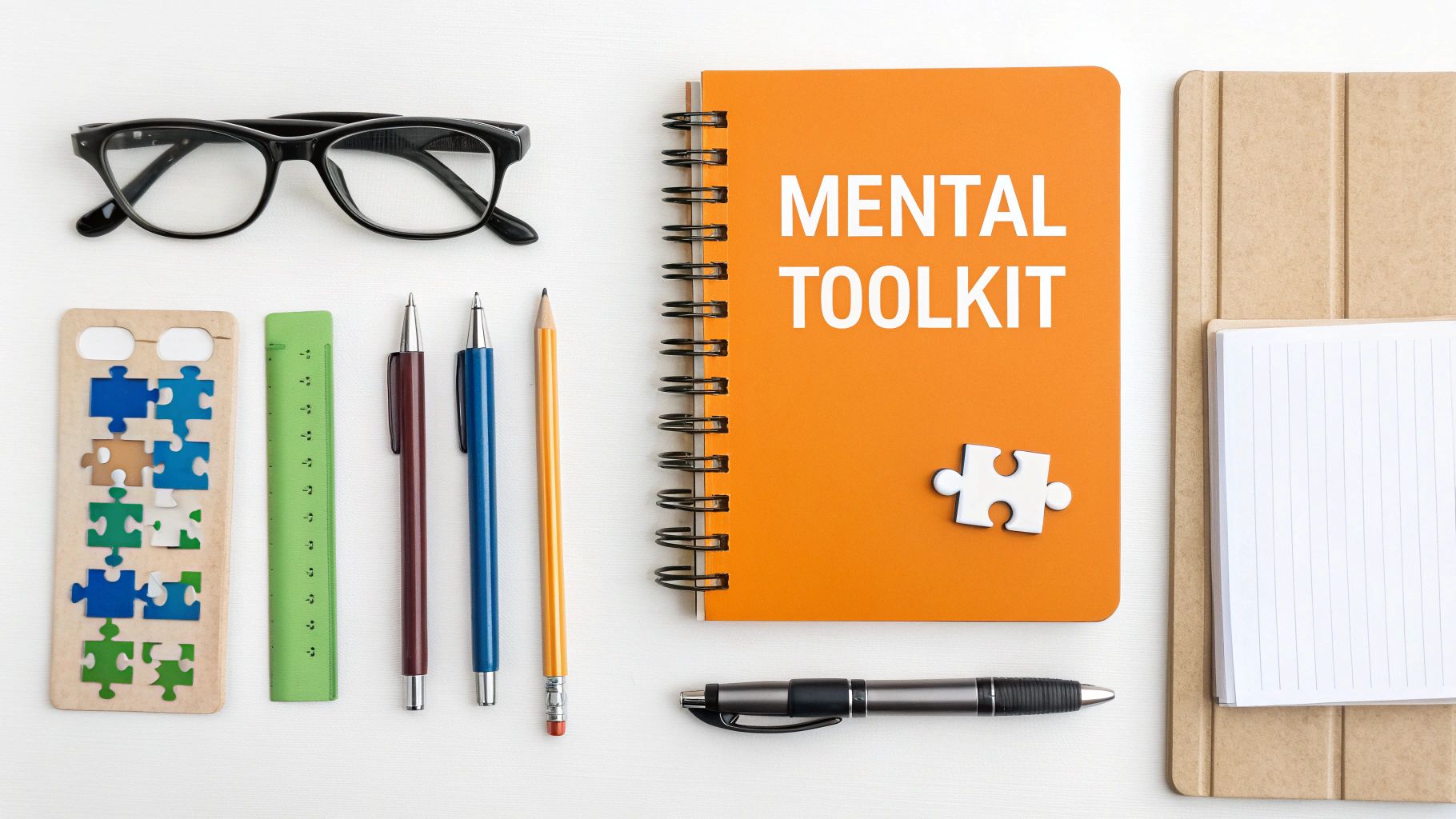
They are the essential tools in your mental toolkit, and just like any toolkit, they can be sharpened with the right approach. Without them working behind the scenes, even simple tasks like following a recipe or remembering a phone number would feel impossible. Understanding these skills is the first step toward taking control of your mental performance.
What Are Cognitive Skills, Really?
This idea of a "mental toolkit" is a powerful way to get a handle on the practical definition of cognitive skills. Each tool has its job, but they all work together seamlessly, allowing you to process information, make decisions, and interact with the world.
The Core Domains of Cognition
When we talk about cognitive skills, we're not just talking about being "smart." We're talking about specific, measurable abilities that form the blueprint of our mental performance. These are the core building blocks of how we acquire, store, and use information.
In Canada, these domains are so fundamental that they form the basis of most psychoeducational and neuropsychological assessments. It’s a way to systematically understand how a person’s brain is working and where they might need support.
To give you a clearer picture, here’s a quick breakdown of the key domains in your brain’s toolkit.
Your Brain's Toolkit Key Cognitive Skill Domains
Cognitive Skill Domain | What It Helps You Do | Practical Example |
|---|---|---|
Attention | Focus on what's important while filtering out distractions. | Reading a book in a busy café by tuning out the background noise. |
Memory | Store, retain, and recall information and past experiences. | Remembering the names of people you met at a networking event yesterday. |
Executive Functions | Plan, organize, make decisions, and manage your time and actions. | Creating a weekly meal plan, writing a shopping list, and sticking to a budget. |
Perception | Make sense of the information you receive through your senses. | Recognizing a song on the radio after hearing just a few notes. |
Processing Speed | Quickly and accurately perform mental tasks. | Following a fast-paced conversation and responding without missing a beat. |
Eye–Hand Coordination | Use your eyes to guide the movement of your hands. | Quickly typing a text message on your phone without looking at the keys. |
Each of these skills is crucial, and they all rely on each other to function effectively.
Why This Definition Matters to You
Understanding the different components of your cognitive toolkit has very real-world applications. It helps us move beyond vague terms like "brain fog" and get to the root of a challenge.
For example, knowing the difference between a weakness in attention versus executive function helps clarify why someone might struggle with specific tasks. You can explore the core differences in cognitive skills like attention regulation between ADHD and Autism to see how these distinctions play out in neurodevelopmental conditions.
Cognitive skills are the underlying mechanics of learning and performance. When one skill is weak, it can affect your ability to perform tasks you might not expect. For instance, a subtle attention issue can make it harder to follow conversations, not just get distracted from work.
By breaking down the broad idea of "brainpower" into these specific skills, we can begin to measure them, understand them, and—most importantly—take targeted action to strengthen them. For a deeper dive, our guide on what is mental acuity explains how these individual skills come together to create overall mental sharpness.
Exploring The 6 Core Cognitive Skills
So, we have a general idea of what cognitive skills are. Now, let’s get our hands dirty and look at the six essential domains that make up your mental toolkit. Think of your brain as an orchestra—each of these skills is a distinct instrument, but they all need to play in harmony to create something beautiful.
Attention: The Brain's Spotlight
Attention is your brain's ability to shine a spotlight on one thing while everything else fades into the background. It’s what allows you to zero in on a specific task, thought, or conversation, filtering out the constant stream of distractions vying for your focus. It’s the director of your mental energy.
Practical Example: A software developer debugging code must use sustained attention to scan thousands of lines for a single error, ignoring office chatter and email notifications. This is a clear, actionable use of this cognitive skill.
Without strong attention, every little distraction would pull you off course, making focused work feel next to impossible.
Memory: The Brain's Filing System
Memory is the incredible process of taking in information, filing it away, and pulling it back out when needed. It’s not just one thing; it’s a whole system with a few key parts, mainly short-term (or working) memory and long-term memory.
Short-Term Memory: This is like your brain’s sticky note. It holds a small bit of information for a short time. For example, when a colleague tells you a verification code, you hold it in your working memory just long enough to type it into your computer.
Long-Term Memory: This is the massive archive where you store everything from your first childhood pet to the complex skills you've learned over the years. For example, when you bake a cake using a recipe you learned years ago, you’re tapping into long-term memory.
When either of these systems isn't working smoothly, it can throw a wrench in daily life, making it tough to learn new things or remember important events.
Executive Functions: The Brain's CEO
If your brain were a company, executive functions would be the CEO sitting in the corner office. This sophisticated suite of skills is in charge of managing, directing, and organising all your other cognitive abilities to get things done. Think planning, problem-solving, decision-making, and self-control.
Practical Example: Imagine planning a family trip. You have to set a budget (planning), research destinations (problem-solving), book flights (decision-making), and pack everything on time (organisation). Each step requires your brain's CEO to manage tasks and keep the project moving forward.
Executive functions are the glue that holds everything together. We dive much deeper into strengthening these critical skills in our guide on how to improve cognitive function.
Perception: The Brain's Interpreter
Perception is how your brain translates the raw data coming in from your senses—sight, sound, touch, and so on. It’s not just about seeing or hearing; it’s about making sense of it all to build a picture of the world around you.
Practical Example: A driver uses visual perception to judge the speed and distance of other cars, allowing them to merge safely onto a highway. Auditory perception helps them identify the sound of a siren long before they see the emergency vehicle.
Without strong perception, the world would just be a chaotic jumble of sensory noise.
Processing Speed: The Brain's Engine
Processing speed is the rate at which you can take in new information, make sense of it, and respond. It’s a measure of how quickly and efficiently your mind works. This skill underpins nearly everything you do, from reading a book to solving a math problem.
Practical Example: A cashier who quickly scans your items, calculates the change, and processes your payment is demonstrating high processing speed. Similarly, a gamer reacting instantly to on-screen events relies on this skill to succeed.
When processing speed is slower, it can make a classroom feel overwhelming for a child or leave an adult struggling to keep up at work.
Eye-Hand Coordination: The Brain's Physical Connection
Finally, eye–hand coordination is the seamless teamwork between what your eyes see and what your hands do. This skill is absolutely fundamental, powering countless daily actions that require precise, visually guided movements.
Practical Example: You use it every time you thread a needle, catch a ball, or even just guide your fork to your mouth. In a professional setting, a surgeon performing a delicate operation relies on exceptionally fine-tuned eye-hand coordination.
It’s a foundational skill that supports us in everything from basic self-care to the complex movements required in sports and art.
Why Understanding Cognitive Skills Matters
It’s one thing to define cognitive skills, but it’s another thing entirely to grasp their real-world impact. This is where the theory hits the pavement. These mental abilities aren't just abstract concepts; they are the invisible engine powering our performance in every part of life. Even a small weakness in one area can create surprisingly big challenges.
Think about it. A subtle dip in attention can easily lead to missed deadlines and careless mistakes at work. A slight decline in memory might show up as constantly forgetting appointments or struggling to recall key details from a conversation you just had.
For a child, a bottleneck in processing speed can make the classroom feel like a race they are always losing, leading to immense frustration. These aren't character flaws or a lack of effort. More often than not, they are the direct result of an underlying cognitive weakness that needs support. Truly understanding your cognitive profile is crucial for achieving holistic wellness.
The Real-World Consequences of Cognitive Gaps
Ignoring these subtle struggles can create a domino effect. A student who has trouble with executive functions might fall behind, not because they aren't smart, but because they simply can't plan and organise their work effectively. An adult with a shaky memory may start to withdraw from social events, afraid of being embarrassed.
This map helps visualize how these core cognitive skills radiate from the brain, showing just how interconnected they all are.
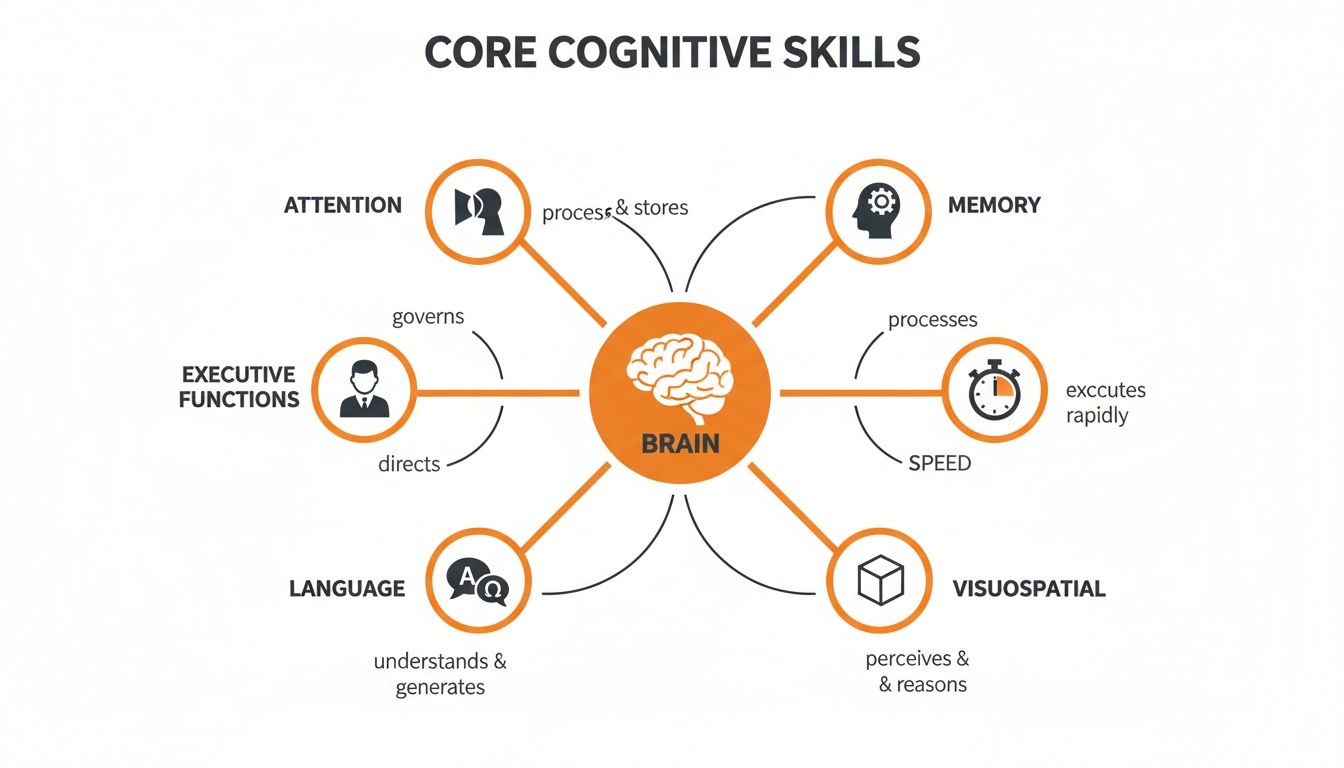
As you can see, a weakness in one skill, like processing speed, can directly slow down the efficiency of others, such as executive functions or memory. It's all connected.
The societal impact is huge. According to the Public Health Agency of Canada, conditions that involve cognitive impairment—like ADHD, learning disabilities, or traumatic brain injuries—cost our country billions each year in healthcare and lost productivity.
Turning Insight Into Action
This is exactly why identifying cognitive strengths and weaknesses with objective measurement is such a game-changer. It shifts the conversation from a frustrating "What's wrong with me?" to a hopeful "Okay, what's next?"
A clear cognitive profile is more than just data; it is a roadmap. It provides the specific, actionable insights needed to create targeted support plans that lead to better outcomes at school, at work, and in life.
When you know precisely where the challenges are, you can bring in the right interventions. Whether that means targeted training for attention, strategies to enhance memory, or organisational tools for executive function, the right support can make a profound difference. This proactive approach empowers individuals, families, and professionals to stop guessing and start building a real foundation for success.
How We Measure and Track Cognitive Health
Getting a clear, objective picture of someone's cognitive strengths and weaknesses used to be a real marathon. The traditional route often involved days of pen-and-paper neuropsychological exams, leading to painfully long waits for both the assessment and the results. This created huge roadblocks for families, educators, and clinicians who needed timely insights to help.
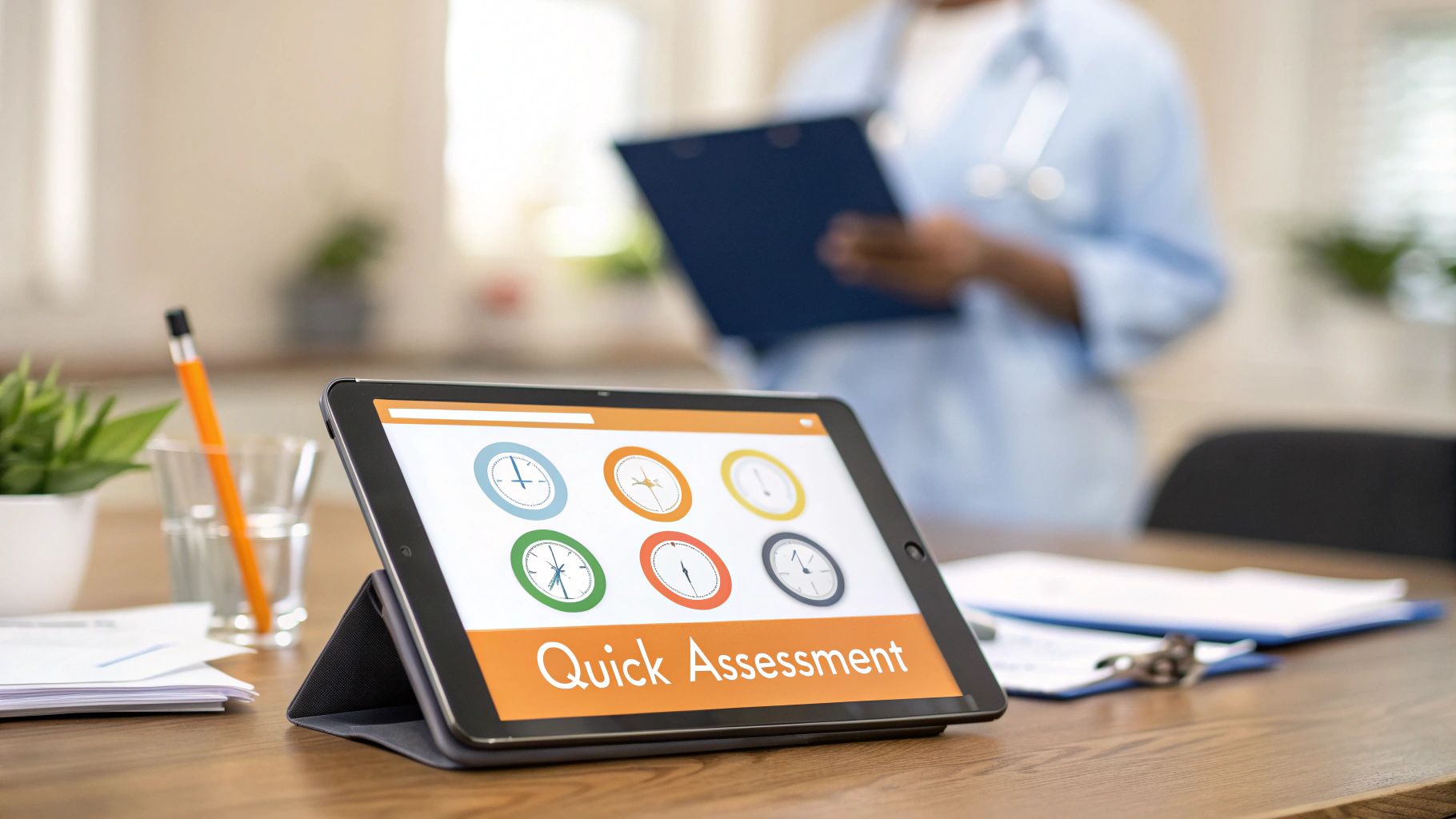
Fortunately, the way we measure cognitive health has changed dramatically. Think of it like the difference between an exhaustive, multi-day physical exam and a quick, precise health screening that gives you actionable data in minutes. Modern digital tools have opened up a much more accessible and efficient path forward.
The Shift to Digital Assessment
The move toward technology-driven solutions isn't just a trend; it's a fundamental shift. Market analyses show that software-based solutions now hold over 70% of the global cognitive assessment and training market. This reflects a major departure from paper tests in favour of automated scoring, real-time dashboards, and the ability to track changes over time. You can discover more about this industry trend and its growth.
This evolution from manual to digital is about more than just convenience. AI-powered platforms can deliver an objective cognitive profile in under 30 minutes, arming clinicians and educators with immediate insights that once took weeks to get. This speed cuts out the frustrating delays and allows for much faster, more effective support.
A rapid digital screening serves as a powerful first step. It provides an immediate, data-driven baseline of cognitive function, helping to quickly identify areas of concern without the long wait associated with traditional methods.
Practical Benefits of Modern Screening
The benefits of this modern approach are tangible for everyone. It turns the definition of cognitive skills from an abstract concept into something we can actually measure, track, and improve.
To really see the difference, let’s compare the two approaches.
Cognitive Assessment Methods: A Comparison
The table below breaks down the key distinctions between old-school pen-and-paper tests and today's digital screening platforms. It highlights how far we've come in making cognitive health measurement faster, more accessible, and more useful for tracking progress.
Feature | Traditional Assessment | Modern Digital Screening |
|---|---|---|
Time Commitment | Often requires several hours over multiple days. | Typically completed in under 30 minutes. |
Accessibility | Limited by the availability of specialized clinicians. | Can be administered easily in clinics, schools, or even remotely. |
Results | May take weeks to score and compile a report. | Provides immediate, real-time data and analysis. |
Progress Tracking | Re-testing is cumbersome and expensive. | Allows for easy and frequent re-assessment to monitor changes. |
This new level of efficiency is a game-changer. For a student struggling in school, a quick screening can pinpoint a processing speed issue, allowing educators to put support strategies in place right away. For an adult recovering from an injury, it provides a vital baseline to track rehabilitation progress over time.
To learn more about what's involved, you can read our comprehensive guide on what is cognitive assessment. This shift empowers us to move from simply talking about cognitive skills to actively measuring and improving them.
From Assessment to Action: Strengthening Your Brain
Getting your cognitive assessment report back isn't the end of the story—it's actually the most powerful starting point you can have. The report gives you the "what" and "where" of your cognitive profile, but the really exciting part is what comes next: taking clear, targeted action. This is all possible thanks to a remarkable, evidence-backed concept called neuroplasticity.
Think of neuroplasticity as your brain's incredible, natural ability to remodel itself. It’s a lot like how physical exercise strengthens your muscles. In the same way, targeted mental exercises can forge and reinforce new neural pathways. This means that with the right approach, you can actively work to strengthen the very cognitive skills that were measured in your assessment.
Building a Stronger Brain
Strengthening your cognitive skills isn’t about just one thing; it’s a combination of targeted training and supportive lifestyle habits. The real goal is to create an environment where your brain can truly thrive and adapt.
An effective plan usually brings together a few key pieces:
Targeted Training Exercises: These are highly specific activities designed to challenge a particular cognitive area—like your working memory or processing speed—based directly on your assessment results. For example, if attention is a challenge, you might engage in exercises that require you to track multiple moving objects on a screen.
Lifestyle Adjustments: You can't overlook the fundamentals. Nutrition, physical activity, and sleep are the foundational pillars of brain health. Regular aerobic exercise, for example, boosts blood flow to the brain and supports neuroplasticity.
Smart Daily Habits: Weaving small, brain-healthy activities into your daily routine can provide consistent mental stimulation. This could be anything from learning a new skill, like a language or instrument, to playing strategic thinking games.
The key takeaway is that your cognitive health is not set in stone. Armed with precise data from an assessment and the right tools, you can actively engage in practices that lead to real, measurable improvements in your mental performance.
The Role of Personalized Digital Tools
This is where modern technology really changes the game. Personalized, game-based training tools can make the whole process of strengthening your brain both highly effective and, just as importantly, engaging. These platforms take the data from your initial assessment and build a training program that is tailored specifically to you.
For example, if your assessment flagged a weakness in attention, your training program would zero in on game-like exercises that demand sustained focus and the ability to filter out distractions.
The system adapts to your performance in real time, making sure the tasks are always challenging enough to stimulate growth but never so hard that they become overwhelming. This constant, subtle adaptation is what really drives neuroplasticity. Better yet, these tools track your progress with every single session, giving you clear, objective data that shows exactly how your cognitive skills are improving over time.
This powerful feedback loop—objective assessment followed by personalized training—is what makes the difference. To explore these evidence-based strategies further, check out our detailed guide on how to improve cognitive function. The journey from assessment to action has never been more accessible.
Taking the First Step Toward Cognitive Clarity
You’ve now got a solid grasp on what we mean by cognitive skills—they're the fundamental tools your brain uses to navigate life. We’ve looked at how they can be measured objectively and, more importantly, how you can actually strengthen them with the right approach. Now, it’s time to take that knowledge and put it into action.
It’s time to stop guessing about your cognitive performance and start knowing. Your journey forward begins with one clear, decisive step.
The greatest progress comes from moving from awareness to action. Understanding your cognitive profile is the first step toward sharpening the skills that matter most in your daily life.
The clearest path forward is to get an objective look at where you stand—your unique cognitive strengths and the areas that could use a boost. Head over to Orange Neurosciences to see how our quick assessment tools can give you the clarity you need to move forward with confidence. For a deeper dive into what this involves, check out our guide on finding a cognitive assessment online.
As you start on this path, keep learning with ongoing insights and tips on cognitive performance. Subscribe to our newsletter for evidence-based strategies sent right to your inbox, helping you build a stronger, more resilient mind.
Your Questions About Cognitive Skills, Answered
Let's dig into some of the most common questions we hear about cognitive skills, with practical answers to help you understand how they're assessed and improved.
When Is the Right Time to Assess Cognitive Skills?
There’s really no wrong time. For kids, an early assessment can be a game-changer, identifying learning challenges and opening the door for support when it matters most.
For adults, it’s a great way to establish a personal baseline. This becomes incredibly useful for tracking changes over time, especially after an injury or simply as part of a proactive approach to healthy aging. And for seniors, it's a critical tool for catching the earliest signs of cognitive decline.
Actionable Insight: If you or your child are struggling with focus, memory, or organization, that's a clear signal to seek an assessment. Don't wait for the problem to grow.
Can Cognitive Skills Actually Be Improved?
Yes, absolutely. The brain has an incredible capacity to change and adapt, a concept known as neuroplasticity. Think of it like going to the gym for your brain. Just as physical exercise strengthens your muscles, targeted cognitive training strengthens the brain’s neural pathways.
Actionable Insight: The key is targeted practice. A general crossword puzzle is fine, but if your specific weakness is processing speed, then timed, game-like exercises designed for that skill will deliver far better results.
A digital screening tool is a highly reliable way to quickly flag potential areas of concern and create an objective cognitive profile. It’s an excellent first step to figure out if a full, traditional evaluation is necessary, which can save a great deal of time and resources.
Think of it this way: a digital screening is like a quick, accurate snapshot to get initial data, while a traditional evaluation with a neuropsychologist is the comprehensive deep dive for a formal diagnosis.
Ready to move from questions to real answers? Orange Neurosciences can provide the clarity you need to understand your own cognitive profile. Discover how our rapid, AI-powered assessments can be your first step toward better brain health. Visit us at https://orangeneurosciences.ca to learn more and take an assessment today.
Orange Neurosciences' Cognitive Skills Assessments (CSA) are intended as an aid for assessing the cognitive well-being of an individual. In a clinical setting, the CSA results (when interpreted by a qualified healthcare provider) may be used as an aid in determining whether further cognitive evaluation is needed. Orange Neurosciences' brain training programs are designed to promote and encourage overall cognitive health. Orange Neurosciences does not offer any medical diagnosis or treatment of any medical disease or condition. Orange Neurosciences products may also be used for research purposes for any range of cognition-related assessments. If used for research purposes, all use of the product must comply with the appropriate human subjects' procedures as they exist within the researcher's institution and will be the researcher's responsibility. All such human subject protections shall be under the provisions of all applicable sections of the Code of Federal Regulations.


© 2026 by Orange Neurosciences Corporation