Mental Acuity Definition and How to Sharpen Your Mind
Dec 8, 2025
When we talk about mental acuity, we’re really talking about the sharpness of your mind. It’s a measure of how quickly and clearly you can think, focus, and sort through information. This isn't about how many facts you have stored away; it’s about your brain’s real-time performance and efficiency. For example, it's the ability to quickly grasp the main point in a meeting or easily follow a complex movie plot without getting lost.
What Is Mental Acuity, Really?
Here’s a good way to think about it: imagine your brain is a high-end camera. Your intelligence is the camera’s technical potential—its maximum resolution, its sensor size. Mental acuity, on the other hand, is how fast and accurately the lens can focus to capture a crisp, clear image right now. It's the practical, on-the-spot agility of your mind.
This sharpness isn't just one skill. It's the result of several core cognitive abilities working together in harmony. When these functions are running smoothly, your thinking feels fluid, responsive, and effortless.
Mental acuity is fundamentally about the efficiency of your thought processes. It’s the difference between owning a powerful computer and having one that actually runs smoothly without lag, allowing you to access and use its power effectively whenever you need it.
To really get a handle on mental acuity, we can break it down into four key pillars that support your overall cognitive performance.
The Four Pillars of Mental Acuity
These four core cognitive skills work together to create that feeling of mental sharpness. Understanding them helps pinpoint where things might be going right or where a little support is needed.
Component | What It Means in Simple Terms | Practical Example |
|---|---|---|
Attention | The ability to concentrate on what matters while filtering out distractions. | Focusing on a single conversation at a loud party. |
Memory | The brain's system for storing, retaining, and recalling information. | Remembering a grocery list without writing it down. |
Processing Speed | How quickly you can take in information, make sense of it, and respond. | Instantly understanding a joke and laughing at the right time. |
Executive Functions | The "CEO" skills of the brain, used for planning, problem-solving, and deciding. | Planning the steps needed to cook a multi-course dinner. |
When all four pillars are strong, you feel mentally on top of your game. A weakness in one area can affect your overall sense of clarity and focus.
Getting to know these components is the first step toward appreciating the intricate workings of your own brain. If you're curious about how clinicians and educators measure these skills, you can learn more in our detailed guide on what is cognitive assessment.
Exploring the Four Pillars of a Sharp Mind
To really understand mental acuity, we need to pop the hood and see what makes the engine run. A sharp mind isn't just one thing; it's a team effort between four crucial cognitive skills. When you know what they are, you start to see them in action every day—and you can see how they all work together to power your overall mental performance.
This map breaks mental acuity down into its core functions: Attention, Memory, Speed, and Executive Function.
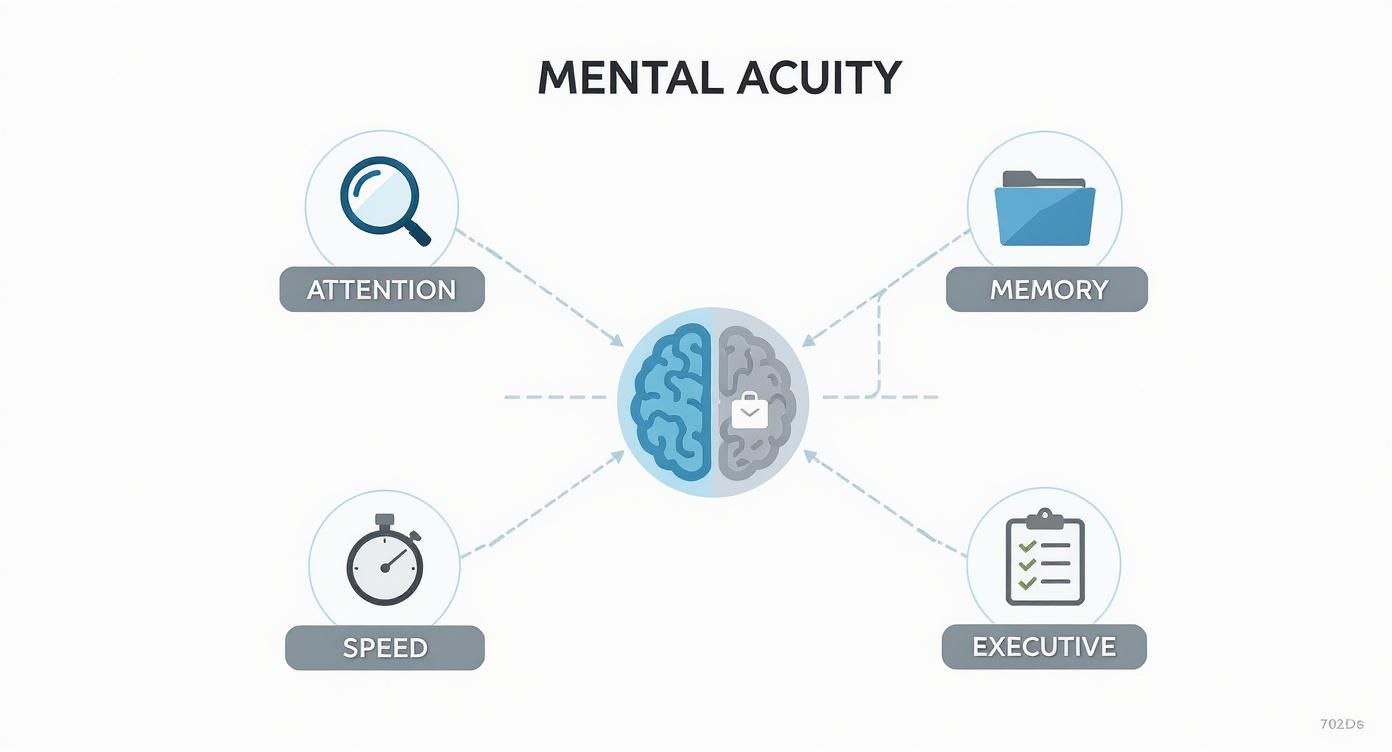
As you can see, each pillar is a critical piece of the puzzle. They all need to be strong for you to feel like you're truly firing on all cylinders.
Attention: Your Mind's Spotlight
Think of attention as the spotlight your mind shines on whatever needs focus. It’s the skill that lets you tune out the clatter of a noisy café to read a book, or zero in on a single voice during a hectic meeting.
Without strong attentional control, your cognitive resources are scattered. A practical example is trying to follow a recipe while your kids are asking questions and the TV is on—information becomes a blur, tasks drag on, and everything just feels harder. It’s the foundation that all other mental skills are built upon.
Memory: Your Brain's Filing System
Next up is memory, which is much more than just remembering facts. It’s your brain’s complex system for filing away information and pulling it back out when needed. This includes both your short-term (or working) memory, which acts like a temporary notepad, and your long-term memory, where you store knowledge and life experiences.
A healthy memory system lets you learn from the past, connect new ideas to what you already know, and recall important details on the spot. Working memory is particularly vital for active problem-solving—like when you mentally calculate a 20% tip on a restaurant bill. To dive deeper, check out our guide on how to improve working memory.
The ability to quickly pull up relevant memories is a hallmark of a sharp mind. It helps you make sense of new information faster, leading to smarter, more confident decisions.
Processing Speed and Executive Functions: From Thought to Action
The last two pillars are all about turning thought into action. They work hand-in-hand.
Processing Speed: This is how fast you can take in information, make sense of it, and respond. It’s your brain’s reaction time. Think about how quickly you get a joke or how you instantly adjust your driving when a car brakes in front of you. That’s processing speed in action.
Executive Functions: These are the "CEO" of your brain. They’re the high-level skills that manage everything else: planning, decision-making, problem-solving, and self-control. Executive functions help you organize a big project, resist the urge to check your phone, and pivot your strategy when things don’t go as planned. For example, when your planned route to work is blocked by traffic, your executive functions help you quickly devise an alternate route.
Together, these four pillars are what define your mental acuity. They determine how well you can navigate the challenges and opportunities your day throws at you.
Mental Acuity vs. Intelligence: What’s the Real Difference?

It’s easy to throw around terms like “intelligence” and “mental acuity” as if they’re the same thing. In reality, they describe very different aspects of how our brains work. Getting this distinction right is crucial if we want to accurately pinpoint and strengthen our cognitive skills.
Let's break it down with an analogy. Picture your brain as a high-performance sports car.
Intelligence is the engine's raw horsepower. It's the maximum potential your car has—its top speed, its overall capacity. This is your stored knowledge and your fundamental ability to solve problems.
Mental Acuity is how that car actually performs on the road. Think quick acceleration, responsive steering, and sharp braking. Acuity is how efficiently and effectively you can use that horsepower in any given moment.
You could have a car with a massive engine (high intelligence), but if the steering is sloppy and it takes forever to get up to speed (low mental acuity), its real-world performance will be disappointing. It's not just about having the power, but about being able to deploy it with precision.
Performance Under Pressure
This difference really comes to life when you think about decision-making. We've all met someone who is incredibly smart—a walking encyclopedia—but who seems to freeze up when they need to make a quick, clear-headed choice under pressure. All that knowledge is there, but their ability to access and apply it in the moment is lagging.
That’s where mental acuity shines.
A person with high mental acuity can rapidly sort through information, filter out the noise, and execute a decision with clarity and confidence. This is the practical application of intelligence, powered by sharp executive functions and quick processing speed.
This is exactly why looking only at traditional measures of intelligence misses so much of the picture. True cognitive performance isn't just about what you know, but how you think.
By understanding mental sharpness as a distinct set of skills, we can stop focusing on just accumulating knowledge and start training the core components that let us use it well. If you're ready to get started, our guide on how to improve executive function is an excellent first step.
Common Factors That Dull Your Mental Edge
Ever have one of those days where your brain just feels… sluggish? We call it "brain fog," and it can happen to even the sharpest minds. This dip in mental acuity rarely comes out of nowhere. It's usually the result of specific, often overlooked, factors messing with your brain's ability to fire on all cylinders.
Figuring out what these culprits are is the first real step toward getting your clarity back. Most of the time, they're tied to our daily routines and choices, quietly chipping away at our cognitive resources until the difference is impossible to ignore.
Lifestyle and Environmental Triggers
The small habits we practice every day have a massive impact on our mental edge. Chronic stress, for example, isn't just a feeling. It floods your brain with cortisol, a hormone that, over time, can seriously get in the way of memory and focus. A practical example is forgetting simple things when you're facing a tight deadline at work.
Poor sleep is another major offender. When you don't get enough quality rest, your brain misses its chance to perform critical overnight maintenance—like clearing out toxins and cementing memories. This is why the link between issues like concussions and sleep is so crucial for anyone focused on cognitive recovery.
And of course, we can't forget diet. There are plenty of common foods that cause brain fog, and they can be a direct line to that feeling of sluggishness.
Health Conditions and Natural Processes
Sometimes, the cause goes deeper than our daily habits. Underlying health conditions, especially those that affect metabolic health or cause chronic inflammation, can directly disrupt brain function. The natural aging process also plays a role, bringing subtle changes to brain structure and chemistry that can slow things down.
Mental health conditions also have a direct and powerful impact on our cognitive sharpness. Consider this: in California alone, over 5.5 million adults live with a mental health condition. Many of these conditions come with symptoms like impaired concentration that directly drag down mental acuity.
This is a widespread issue, and it highlights just how important it is to treat mental wellness as a core part of cognitive health. Once you can pinpoint these factors, you can start building a real plan to get your focus back.
How Do Professionals Actually Measure Cognitive Performance?
When you work with a professional to get a handle on your cognitive health, they won't just hand you a single "mental acuity score." It's not that simple. Instead, they use a series of specific, targeted evaluations to build a complete picture of how your brain handles different jobs.
Think of it like a thorough car inspection. A good mechanic doesn’t just kick the tires and say the car is "good" or "bad." They check the engine, the brakes, the transmission, and the electrical system separately. This process pinpoints exactly where the strengths and weaknesses are. Cognitive assessment works the same way.
These aren't your typical high-pressure academic exams. They’re practical, task-based challenges designed to see your brain in action. You might be asked to:
Juggle information in your head: For example, remembering and then repeating a sequence of numbers or words (working memory).
React on the fly: Measuring how quickly you can respond to a sound or something you see on a screen (reaction-time).
Plan and adapt: Maybe you'll have to sort objects according to a rule that keeps changing, or map out how to complete a multi-step task (executive function).
From Cognitive Skills to Clinical Care
This detailed approach gives a much clearer profile of your individual cognitive functions. It allows a clinician or educator to develop strategies tailored specifically to what you need.
This idea of breaking down a person's state into measurable parts is common in healthcare. It's closely related to the concept of "patient acuity," which is used to assess a person's overall condition—including their mental state—to prioritize care. In California emergency rooms, for instance, acuity scoring helps clinicians classify patients by urgency. One study found this system can predict care needs with around 89% accuracy using just the clinical notes. This shows how measuring different aspects of a person's condition, whether physical or cognitive, directly shapes the support they receive.
A professional assessment takes the guesswork out of the equation. It provides objective data to understand exactly which of your cognitive gears are turning smoothly and which might need a little oil. This forms the foundation for any effective training or support plan.
Getting a clear picture of your cognitive profile is the essential first step toward strengthening it. To learn more about the structured methods professionals use, take a look at our detailed guide on what is a neuropsychological assessment. This deeper dive explains exactly how clinicians map out brain function to create effective support plans.
Actionable Strategies to Boost Your Mental Acuity
Knowing what mental acuity is and actually sharpening it are two different things. The good news is that improving your cognitive edge doesn't require a life overhaul. It's really about weaving consistent, science-backed habits into four key parts of your daily routine.
Think of these strategies as supporting your brain's fundamental health. They encourage neuroplasticity—your brain’s amazing ability to rewire itself and form new connections—and strengthen those cognitive pillars we just talked about.
Nurture Your Brain with Diet and Movement
Getting your body moving is one of the single most powerful things you can do for your brain. Aerobic exercise, whether it's a brisk walk or a bike ride, cranks up blood flow to the brain, delivering a fresh supply of oxygen and nutrients. Actionable Insight: Try scheduling a 20-minute walk during your lunch break three times a week. It’s an easy way to start upgrading the fuel line to your brain’s engine.
What you put on your plate matters just as much. A diet rich in omega-3 fatty acids, found in foods like salmon and walnuts, helps build and repair brain cells. Actionable Insight: Add a handful of walnuts to your morning oatmeal or yogurt to get a daily dose of brain-building nutrients.
Prioritise Restorative Sleep
For a sharp mind, sleep is completely non-negotiable. While you're in deep sleep, your brain is hard at work consolidating memories and clearing out the metabolic junk that builds up during the day. Skimping on sleep is like letting temporary files clog up your computer—eventually, everything just slows to a crawl. Actionable Insight: Set a "digital curfew" an hour before bed. Put your phone and laptop away to help your brain wind down for better quality rest. For more tips, this guide on how to increase deep sleep is a great resource.
Lifestyle habits are the foundation of mental sharpness. In fact, research using wearable devices to track sleep and activity shows a direct link to mental acuity scores in areas like working memory and reaction time. Participants who averaged 6–8 hours of sleep consistently performed better. You can read more about those findings here.
Train Your Brain with Targeted Stimulation
Finally, just like any other muscle, your brain gets stronger with a good workout. Taking on new and challenging activities helps build up a "cognitive reserve," forging stronger and more efficient neural connections.
Learn Something New: Picking up a new language or a musical instrument forces your brain to create entirely new pathways, boosting its overall flexibility.
Play Strategic Games: Activities like chess or even complex puzzles push you to use executive functions like planning, strategizing, and problem-solving.
Use Structured Training Tools: For a more focused approach, digital cognitive tools from Orange Neurosciences provide a direct route to training specific skills. Our engaging, game-based exercises are designed to target and strengthen core functions like attention and processing speed, offering a clear path to measurable improvement.
These actionable steps are your starting point. If you're ready to take the next step and get personalized insights, visit our website or sign up for our newsletter for more tips delivered directly to you. Explore our solutions at Orange Neurosciences and see how structured training can help you sharpen your mental edge.
Your Mental Acuity Questions, Answered
We've covered a lot of ground, from what mental acuity means to its core components and how you can start sharpening your mind. But it's natural to still have a few questions. Let's tackle some of the most common ones.
Can You Improve Mental Acuity at Any Age?
Absolutely. One of the most incredible things about the human brain is its lifelong ability to adapt and forge new pathways—a quality known as neuroplasticity.
This means that no matter your age, you can enhance your mental acuity. A practical example is a retiree who learns to play the piano; this new skill builds new neural connections, improving memory and coordination. Staying physically active and using targeted cognitive training are all effective ways to build a sharper, more resilient mind.
How Long Does It Take to See Improvements?
There's no one-size-fits-all timeline; it really depends on the individual and the strategies they're using. Many people report feeling more focused and clear-headed within just a few weeks of making consistent lifestyle changes, like prioritizing sleep or adding regular exercise to their routine.
For more significant gains from structured cognitive training, you're likely looking at several weeks to a few months of consistent practice before you notice measurable progress.
The real secret is that consistency trumps intensity every time. Small, regular efforts to challenge your brain and support its health will compound, leading to lasting improvements in your mental sharpness and performance.
Is Brain Fog the Same as Low Mental Acuity?
This is a great question. Think of it this way: brain fog is a common symptom of low mental acuity, but it isn't the condition itself.
Low mental acuity is the underlying issue—things like slower processing speed or a dip in your attention span. "Brain fog" is the subjective feeling that results from that cognitive dip, like when you walk into a room and completely forget why you're there. By addressing the root causes through lifestyle shifts and targeted training, you can clear the fog and get back to feeling mentally clear.
Ready to put this knowledge into practice? The digital tools from Orange Neurosciences are specifically designed to help you measure and strengthen the core skills that define your mental acuity. For more actionable tips and updates, subscribe to our email list below.
Discover how our evidence-based platform can support your cognitive health journey.
Orange Neurosciences' Cognitive Skills Assessments (CSA) are intended as an aid for assessing the cognitive well-being of an individual. In a clinical setting, the CSA results (when interpreted by a qualified healthcare provider) may be used as an aid in determining whether further cognitive evaluation is needed. Orange Neurosciences' brain training programs are designed to promote and encourage overall cognitive health. Orange Neurosciences does not offer any medical diagnosis or treatment of any medical disease or condition. Orange Neurosciences products may also be used for research purposes for any range of cognition-related assessments. If used for research purposes, all use of the product must comply with the appropriate human subjects' procedures as they exist within the researcher's institution and will be the researcher's responsibility. All such human subject protections shall be under the provisions of all applicable sections of the Code of Federal Regulations.


© 2026 by Orange Neurosciences Corporation