Concussion and Sleep: A Practical Recovery Guide
Nov 21, 2025
When you get a concussion, the injury doesn't just stay at the surface—it sends a shockwave right through your brain's internal clock and the delicate systems that regulate sleep. This jolt often triggers a whole host of sleep problems, from frustrating insomnia and overwhelming daytime sleepiness to constantly waking up during the night.
Getting quality rest becomes absolutely critical for healing, but ironically, it's one of the hardest things to achieve. This guide provides actionable insights to help you understand why this happens and what practical steps you can take to reclaim your sleep and accelerate your recovery.
Why Concussions Disrupt Your Sleep Cycle
A concussion does more than just cause a headache; it throws your brain’s finely tuned sleep-wake orchestra completely out of sync. Right after the injury, the brain scrambles into crisis mode. It’s dealing with a storm of metabolic changes, breakdowns in communication between neurons, and widespread inflammation.
All this internal chaos directly targets the very systems responsible for managing rest and recovery.
Think of your brain post-concussion as a city that’s just been hit by an earthquake. The communication lines (your neural pathways) are down, the power grid (energy metabolism) is unstable, and emergency crews (inflammatory responses) are rushing everywhere. In this state of high alert, the normal, peaceful transition into sleep becomes nearly impossible. For example, you might lie down feeling exhausted, but your mind races with anxious thoughts, a classic sign of your nervous system being stuck in "fight or flight" mode.
The Immediate Aftermath of Injury
The initial injury kicks off a cascade of chemical and metabolic changes that directly interfere with your ability to sleep. Your brain is working overtime trying to repair itself, which explains why you might feel completely exhausted yet find it impossible to get truly restorative rest.
This is why understanding the underlying biology—like the presence of inflammatory markers—can help explain why sleep suddenly becomes such a struggle. This disruption isn't just a minor inconvenience; it's a major roadblock on the path to getting better. Making sleep a priority is one of the most powerful things you can do to heal, because it's during deep sleep that the brain does its most critical repair work.
Long-Term Sleep Challenges
For many people, sleep problems don't just disappear after a few days. They can become one of the most stubborn and persistent symptoms of a concussion, lingering long after the initial headache and dizziness have faded and getting in the way of daily life.
A landmark study revealed just how common this is. It found that a staggering 67% of individuals with a history of TBI reported excessive daytime sleepiness 18 months or more after their injuries, compared to just 19% in people without a brain injury.
This really drives home the point that post-concussion sleep issues aren't just a short-term hiccup. If they aren't managed properly, they can turn into a chronic problem. You can learn more about how this connects to other lasting symptoms in our guide to the long-term effects of concussion.
Understanding the deep connection between a concussion and your sleep is the first step toward taking back control. Once you know why your rest has been thrown off course, you can start using targeted strategies to reclaim your sleep and give your brain the support it needs to heal.
Common Sleep Problems After a Concussion
After a concussion, it's not just about feeling a bit tired. A whole range of specific sleep disturbances can emerge, each with its own cause rooted in the brain's injury and recovery process. Here's a look at some of the most common issues you might face.
Sleep Disturbance | What It Feels Like | Why It Happens After Concussion |
|---|---|---|
Insomnia | Trouble falling asleep, staying asleep, or waking up way too early. You feel tired but "wired." | The injury can disrupt the production of sleep-regulating hormones like melatonin and increase alertness-promoting chemicals like orexin. Pain and anxiety also play a big role. |
Hypersomnia (Excessive Daytime Sleepiness) | An overwhelming need to sleep during the day, even after a full night's rest. You might find yourself dozing off at work or during conversations. | The brain is using a massive amount of energy to heal, leading to profound fatigue. It's a sign of the immense metabolic effort happening behind the scenes. |
Fragmented Sleep | Waking up frequently throughout the night. Your sleep feels light and unrefreshing. | The brain's "gatekeeper" for sleep, the thalamus, can be affected, making you more sensitive to noise or light. It can also be linked to pain or breathing issues like sleep apnea. |
Delayed Sleep Phase Syndrome | Your internal body clock shifts, making you feel wide awake late at night and extremely groggy in the morning. It's like having permanent jet lag. | The concussion can throw off your circadian rhythm, the 24-hour cycle that governs your sleep-wake patterns. The brain's master clock in the hypothalamus is often directly impacted. |
Recognizing which of these patterns fits your experience is a huge step. It allows you and your healthcare provider to move beyond just saying "I'm tired" and start targeting the specific mechanisms that are keeping you from getting the rest you need.
How a Concussion Rewires Your Brain for Poor Sleep
A concussion is much more than just a bump on the head. It's a complex neurological event that can fundamentally rewire the very parts of your brain that control sleep. Think of the impact as sending a shockwave through delicate brain structures, scrambling the precise chemical and electrical signals your brain needs for restorative rest. This is exactly why sleep problems are one of the most common—and frustrating—symptoms after a head injury.
The injury can directly affect the key areas that act as your brain's sleep control centre. Regions like the hypothalamus, which manages your internal 24-hour body clock (your circadian rhythm), and the brainstem, which oversees the transitions between being awake and asleep, can easily sustain damage. When these command centres are compromised, the whole system starts to break down.
The Disrupted Messenger System
To get a clearer picture of the chemical chaos, imagine your brain’s sleep messengers (neurotransmitters) are a fleet of delivery drivers with a set of critical nightly routes. Melatonin, the hormone that tells your body it's time for bed, and GABA, a chemical that calms the brain down, are two of these key drivers.
After a concussion, it's as if all the road signs have been scrambled and the delivery routes are full of roadblocks. Melatonin might not get released at the right time, or its signal might just be too weak to do its job. Meanwhile, stimulating neurotransmitters like orexin—which promotes wakefulness—could be stuck in overdrive, keeping you alert when you should be winding down.
This infographic shows the simple but damaging sequence from injury to sleep disruption.
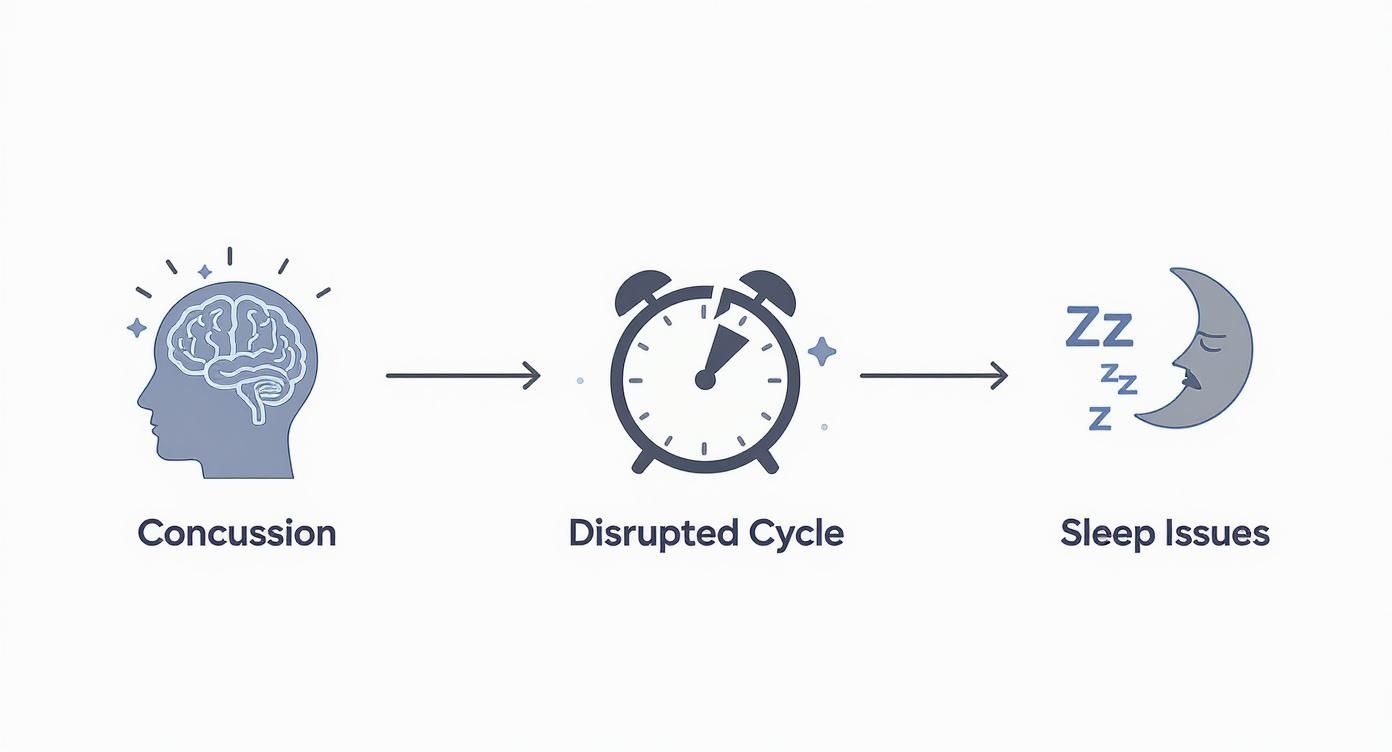
As you can see, the initial jolt to the brain directly leads to a disrupted internal clock. That, in turn, sparks persistent sleep issues, creating a frustrating cycle that can be incredibly difficult to break.
The Vicious Cycle of Symptoms and Sleeplessness
On top of the direct neurological damage, a concussion creates a vicious cycle where symptoms and sleeplessness feed each other. It’s a frustrating loop that can make recovery feel downright impossible.
For instance, a persistent post-concussion headache makes it incredibly difficult to get comfortable enough to fall asleep. That lack of sleep then lowers your pain threshold, making the headache feel even more intense the next day. It’s a classic chicken-and-egg problem where each issue makes the other one worse.
This cycle isn't just about physical pain. Other common symptoms are major contributors, too:
Anxiety and Racing Thoughts: A concussion often puts the nervous system on high alert. This can lead to overwhelming anxiety and a mind that just won’t shut off at night—a state of hyperarousal that is the direct enemy of sleep.
Depression and Low Mood: Feelings of depression can throw your sleep architecture out of whack, often causing you to wake up far too early or feel excessively sleepy all day without any real refreshment.
Sensory Sensitivities: Heightened sensitivity to light or sound can turn minor disturbances—like a partner shifting in bed or a distant car—into major sleep disruptions.
This interconnected web of symptoms is why simply "trying harder to sleep" so often fails. The problem isn't a lack of effort; it's a physiological and psychological battle being fought on multiple fronts. Each symptom just acts as another log on the fire of insomnia.
Understanding these underlying mechanisms—the brain rewiring, the chemical chaos, and the symptom cycle—is the first crucial step toward getting better. It helps you recognize that your sleep problems are a direct result of the injury, not a personal failing. This knowledge is essential for building a targeted recovery plan and figuring out when it's time to seek professional help. For a deeper look at the cognitive side of things, our guide explains what is involved in a neuropsychological assessment.
By understanding the 'why' behind your sleep issues after a concussion, you're much better equipped to find effective strategies that address the root causes, not just the symptoms.
Proven Strategies to Reclaim Your Sleep
Knowing why your sleep has gone off the rails is one thing; getting it back is another. Generic advice just doesn't cut it for a recovering brain, which needs a playbook of specific, evidence-based techniques. This is where we shift from understanding the problem to actively fixing it, building a solid foundation for the kind of restorative sleep that truly speeds up healing.
The real goal isn't just to feel less tired. It's about giving your brain the deep, uninterrupted rest it desperately needs to repair neural pathways and get a handle on your symptoms. Let’s dive into the strategies that actually work for concussion recovery.
Master Your Sleep Hygiene
Think of sleep hygiene as more than just skipping that late-night coffee. It’s about creating a consistent, brain-calming routine that signals safety and predictability to your now-sensitive nervous system. After a concussion, your brain is on high alert and easily overstimulated, making these habits absolutely non-negotiable.
Here are a few game-changing adjustments for a recovering brain:
Create a Strict Schedule: Get to bed and wake up at the same time every single day. Yes, even on weekends. For example, set an alarm for 10 PM to start your wind-down and another for 6 AM to wake up. This consistency is your best tool for stabilizing your circadian rhythm—your brain's internal clock that the injury likely threw completely out of whack.
Design a "Buffer Zone": Carve out the last 60-90 minutes before bed as a completely screen-free wind-down period. That blue light from phones, tablets, and TVs is notorious for suppressing melatonin and keeping your brain in an alert, ready-to-go state. A practical example is plugging your phone in to charge across the room at 9 PM and picking up a book or listening to calming music instead.
Optimize Your Environment: Your bedroom needs to become a sleep sanctuary: cool, dark, and quiet. Blackout curtains, a white noise machine, or earplugs can be your best friends, minimizing the sensory input that can so easily derail your fragile sleep.
This isn't about being perfect overnight. It's about consistency. Small, steady changes here can make a world of difference in your ability to fall asleep and stay asleep.
Retrain Your Brain with CBT-I
If you spend your nights staring at the ceiling, feeling that familiar wave of frustration and anxiety, your brain has probably started to associate your bed with stress instead of sleep. This is where Cognitive Behavioural Therapy for Insomnia (CBT-I) comes in. It's a powerful, drug-free approach designed to break that vicious cycle.
CBT-I works by helping you identify and change the very thoughts and behaviours that are sabotaging your sleep. A core principle is stimulus control, which is all about re-establishing your bed as a place only for sleep.
A key CBT-I instruction is the "20-minute rule." If you haven't fallen asleep within about 20 minutes, get out of bed. Go to another room and do something quiet and relaxing—like reading a book in dim light—until you feel sleepy, then return to bed. This prevents your mind from cementing the link between your bed and wakeful frustration.
This technique, among others in the CBT-I toolkit, helps rebuild a strong, positive connection between your bed and sleep. It's a common and critical challenge in the journey of neurorehabilitation after a brain injury.
Embrace Activity Pacing to Avoid the Crash
One of the biggest pitfalls in concussion recovery is the "push-crash" cycle. You have a good day, feel a flicker of your old self, and dive back into work, chores, or social plans. The result? You’re completely wiped out by evening, too exhausted and overstimulated to sleep.
Activity pacing is the antidote. It's a simple but profound strategy for managing your daily energy to keep from overwhelming your brain. Picture your brain's energy like a phone battery that now drains much, much faster. Pacing is about using that battery wisely throughout the day so you have enough charge left for restorative sleep.
Let’s look at an example:
Before Pacing: Someone tries to power through a four-hour work block. By noon, they’re battling a splitting headache and bone-deep fatigue. The rest of the day is a write-off, and by bedtime, they're too pained and wired to sleep.
With Pacing: That same person works for 45 minutes, then takes a 15-minute, screen-free break in a quiet space. By repeating this cycle, they finish their tasks feeling tired but not depleted, making it far easier to wind down at night.
By breaking tasks into manageable chunks and scheduling actual rest, you prevent the cognitive overload that fuels insomnia. Many people recovering from a concussion also deal with heightened anxiety, which is another major sleep disruptor. If that sounds familiar, it can be helpful to explore the different ways therapy can help you manage anxiety and, in turn, find better rest.
Putting these strategies into practice gives you a sense of control over your own recovery. When you master your sleep hygiene, retrain your brain with CBT-I, and pace your daily activities, you're creating the ideal conditions for your brain to do its healing work.
Comparing Sleep Management Approaches Post-Concussion
Choosing the right approach—or combination of approaches—can feel overwhelming. The key is to find what aligns with your specific symptoms, lifestyle, and recovery goals. Below is a quick comparison to help guide you.
Strategy | Best For | Key Principles | Considerations |
|---|---|---|---|
Sleep Hygiene | Everyone, as a foundational practice. Especially helpful for those with inconsistent routines. | Consistency, environmental control, and creating a calming pre-sleep ritual to signal rest to the brain. | Essential, but may not be sufficient on its own for severe or chronic insomnia. |
CBT-I | Individuals with conditioned insomnia, where anxiety and negative thoughts about sleep are a major factor. | Breaking the link between the bed and wakefulness; challenging unhelpful beliefs about sleep. | Requires commitment and guidance from a trained professional for best results. |
Activity Pacing | Those experiencing the "push-crash" cycle of cognitive and physical fatigue that disrupts sleep at night. | Energy conservation, taking scheduled breaks before fatigue sets in, and respecting the brain's limited energy reserves. | Can be challenging to implement initially; requires self-awareness and discipline. |
Pharmacological Options | Severe, acute sleep disruption where behavioural strategies alone aren't providing relief. | Using medication (e.g., melatonin, specific sedatives) to temporarily regulate the sleep-wake cycle under medical guidance. | Should be a short-term solution and used in conjunction with behavioural strategies; potential side effects. |
Ultimately, a multi-faceted approach often yields the best results. Combining strong sleep hygiene with activity pacing and targeted CBT-I can create a powerful synergy that helps you reclaim restorative sleep and support your brain's recovery.
How Sleep Accelerates Your Cognitive Recovery
You simply can’t heal a brain after a concussion without restorative sleep. It’s not just about passive rest; sleep is an active, powerful process that directly fuels cognitive recovery. Think of your brain as a busy workshop. A concussion is like a storm that has blown through, leaving debris everywhere and projects in disarray. Sleep is the specialized cleanup crew that comes in each night to get that workshop back in working order.
This nightly maintenance is absolutely critical. While you sleep, your brain is hard at work clearing out metabolic waste products that build up when you're awake. This process, driven by the glymphatic system, is essential for tamping down inflammation and creating a healthy environment for your neurons to repair themselves. At the same time, sleep is key for memory consolidation—the brain’s filing system for organizing and storing the day's information so you can actually use it later.
The High Cost of Sleep Deprivation on a Healing Brain
When concussion disrupts sleep—which it so often does—this critical repair work gets put on hold. The result? The very symptoms you’re trying to recover from get worse. That persistent brain fog, the struggle to concentrate, and the frustrating memory lapses all become more pronounced. It gets incredibly difficult to tell what’s from the injury and what’s from sheer exhaustion.
This overlap creates a confusing and demoralizing cycle. Are you struggling to focus because of the concussion, or because you only got four hours of broken sleep? Without decent rest, your cognitive baseline is constantly dragged down, making it almost impossible to know if you're making real progress. You end up fighting a two-front war against both the injury and the sleep deprivation.
Measuring the Impact of Sleep on Cognition
To cut through this confusion, clinicians need objective data. This is where tools that provide precise cognitive assessments become so valuable. They offer a way to measure cognitive performance without the guesswork, showing exactly how sleep—or a lack of it—is affecting recovery.
This screenshot shows the Orange Neurosciences dashboard, which gives clinicians objective insights into a patient's cognitive health.
By tracking metrics like attention and processing speed, a healthcare provider can draw a direct line between better sleep habits and real cognitive gains.
Imagine a patient whose initial cognitive scores are low, showing major deficits in attention and memory. Their clinical team puts a structured sleep plan in place. Two weeks later, a follow-up assessment shows a dramatic jump in those same scores. That data is concrete proof that better sleep directly translates to a sharper, more efficient mind. It’s incredibly motivating for the patient and confirms the treatment plan is working.
"Sleep is not lost time, but an investment in the mind's resilience. For the concussed brain, it is the primary currency of recovery, enabling the consolidation of memories and the clearing of neural pathways essential for cognitive function."
This link between sleep and mental well-being is also crucial for what happens down the road. For instance, research shows that poor sleep quality can be a major factor in the relationship between multiple concussions and the severity of depression. This tells us that proactively managing sleep after a concussion could be a key strategy for protecting long-term mental health. You can discover more insights from this University of California study on the topic.
Ultimately, we have to start seeing sleep as an active part of therapy, not a passive one. By prioritizing restorative rest and using objective tools to track its impact, both patients and clinicians can pave a much faster road to full cognitive recovery.
Sleep Challenges Across Different Age Groups
A concussion isn’t a one-size-fits-all injury, and that’s especially true when it comes to sleep. The way a teenager's developing brain reacts is worlds away from how an older adult's brain copes. Getting a handle on these age-specific differences is the first step toward finding sleep strategies that actually work.
With kids and teens, recovery is happening against a chaotic backdrop of developmental leaps, school pressures, and social drama. For older adults, the real trick is often figuring out where concussion symptoms end and the normal sleep changes of aging begin. Taking a tailored approach is the only way to ensure everyone gets the guidance they truly need.
Children and Adolescents: A Unique Storm
When a young person gets a concussion, it creates a perfect storm of biological vulnerability and environmental stress. Their brains are still very much under construction, which makes them more susceptible to the injury's disruptive fallout. On top of that, they're juggling the intense demands of school, sports, and social circles—all of which can easily sabotage sleep.
Managing screen time is often the biggest battleground. We all know the blue light from phones and tablets is the enemy of melatonin, but to a teen, that phone is a social lifeline. Just telling them to shut it down an hour before bed is a strategy doomed to fail.
A more realistic approach is to find a compromise that still calms the brain down.
Example: Instead of a hard "no screens" rule, try suggesting a switch. They could swap out stimulating video games or endless social media scrolling for listening to a podcast or an audiobook in a dimly lit room. It creates a "wind-down" period that feels less like a punishment but still gives their brain a break from the intense visual input.
Another massive factor is the pressure to keep up with school. A teenager might pull a late-nighter trying to finish an essay, pushing their already injured brain way past its limit. This kicks off a vicious cycle of cognitive fatigue and terrible sleep. It's vital for parents and teachers to work together to lighten the academic load, creating space for essential cognitive rest. You can find more supportive strategies for parents and individuals navigating concussion recovery here.
Interestingly, more sleep isn't always the answer for this age group. While rest is crucial, too much sleep can be a red flag. A major study found that adolescents who slept more than 9.9 hours a night in the first two weeks post-concussion actually had a higher risk of persistent symptoms. You can read more about these findings on sleep duration and pediatric concussion recovery.
This really highlights the delicate balance needed. The goal isn’t just piling on more hours of sleep; it's about fostering better quality, well-timed sleep that supports the brain's healing process.
Older Adults: Untangling Complex Factors
For older adults, a concussion throws new sleep problems into the mix while aggravating ones that were likely already there. The natural aging process already changes our sleep patterns—think lighter sleep, waking up more often, and shifting body clocks. A concussion can turn the volume way up on these issues, making it tough to figure out what's causing what.
Is their trouble staying asleep a direct result of the injury, or is it an age-old pattern that's just gotten worse?
Medication is another big piece of the puzzle. Older adults are often taking multiple medications for other health issues, and throwing sleep aids on top can be a risky move. Many common over-the-counter sleep aids can cause next-day grogginess, increase the risk of falls, and mess with cognitive function—all things you’re already worried about after a concussion.
A practical first step is a thorough medication review with a doctor or pharmacist.
Example: A patient struggling with insomnia might be taking another medication in the morning that has a stimulating side effect. Simply moving that dose to an earlier time of day could potentially help them fall asleep at night, all without adding another prescription.
On top of that, conditions like sleep apnea or restless leg syndrome, which are more common as we age, can be made much worse by a concussion. It's so important to look into these possibilities rather than just chalking all sleep issues up to the brain injury. Helping an older adult manage their sleep requires a careful, holistic approach that looks at their entire health picture, not just the recent injury.
Your Game Plan for Better Sleep and Recovery
Trying to figure out the connection between a concussion and sleep can feel like a lot to handle, but you’re not powerless here. You can actively manage your recovery. The real trick is turning what you know into what you do, consistently. This simple roadmap boils it all down, helping you focus on what truly matters for healing your brain.
Your recovery journey begins the moment you decide sleep is a non-negotiable priority. It's not just downtime; it's the most productive healing period your brain gets. Once you commit to that idea, the practical steps fall into place much more easily. The whole point is to create a predictable, calm environment that lets your nervous system finally stand down.
Building Your Foundation
To start seeing a real difference in your sleep after a concussion, zero in on these core actions. Think of them as the building blocks for a more restful night and a more resilient brain.
Get Serious About Sleep Hygiene: Go to bed and wake up at the same time every single day—yep, even on weekends. Create a 60-minute, screen-free "buffer zone" before bed to help your brain wind down on its own terms. Your bedroom should be a sanctuary: dark, cool, and quiet.
Pace Your Daily Activity: We all know the "push-crash" cycle. It leaves you overstimulated by day and completely wired by night. Avoid it by breaking tasks into smaller chunks and scheduling actual rest breaks. This helps conserve your brain's very limited energy supply.
Know When to Call in a Pro: If sleep problems are still hanging around after a few weeks, don't just tough it out. A professional can help. Techniques like CBT-I or a formal assessment can pinpoint underlying issues and offer therapies that are targeted to what you actually need.
Just remember, progress isn’t a straight line. You’ll have good nights and bad nights. The goal here is consistency over perfection, slowly creating the conditions your brain needs to repair itself and get back to its best.
Taking these steps gives you a tangible way to support your own healing. You're not just waiting around to feel better; you're actively building the foundation for better concussion and sleep outcomes.
Ready to take the next step? Head over to our website and download a free Post-Concussion Sleep Hygiene Checklist—it’s a practical tool to help you build these healthy habits. Or, schedule a consultation to see how a comprehensive cognitive assessment can create a recovery journey personalised just for you.
Your Top Questions About Concussion and Sleep, Answered
Trying to make sense of your sleep patterns after a concussion can feel overwhelming. Let’s clear up some of the most common questions we hear from patients and their families.
Is It Normal to Sleep Constantly After a Concussion?
Yes, absolutely. In the immediate aftermath of the injury, it's very common to feel an overwhelming need to sleep. This is called hypersomnia, and it's your brain's way of kicking its healing process into high gear. Think of it as your brain dedicating a massive amount of energy to running its internal repair shop.
While this initial exhaustion is normal, if you find that intense sleepiness drags on for several weeks without any improvement, it’s a good signal to check in with your doctor.
How Long Will My Sleep Problems Last?
This is the million-dollar question, and the answer is different for everyone. Many people find their sleep starts to get back on track within a few weeks as the brain’s initial crisis mode subsides.
For others, particularly those dealing with post-concussion syndrome, sleep disturbances can stick around longer. The encouraging news is that you don't have to just wait it out. Being proactive with things like good sleep hygiene and carefully pacing your daily activities can make a huge difference in shortening that recovery timeline.
Don't just hope for the best. If your sleep issues continue beyond two or three weeks, are making it hard to function during the day, or you notice new symptoms like loud snoring or pauses in breathing, it's time to seek professional medical advice.
Are Over-the-Counter Sleep Aids a Good Idea?
This is a critical one: please avoid using over-the-counter sleep aids unless your doctor has specifically given you the green light. Many common sleep medications can actually interfere with your brain's delicate healing process.
For instance, they can leave you feeling groggy the next morning, which only makes other concussion symptoms like brain fog feel ten times worse. More importantly, they might be masking a deeper issue that needs a proper diagnosis and the right kind of treatment.
Understanding how your brain is healing is the first step toward reclaiming your cognitive health. The tools at Orange Neurosciences provide objective data to track your recovery, helping you and your clinician make informed decisions. Learn more about our cognitive assessment and therapy solutions.

Orange Neurosciences' Cognitive Skills Assessments (CSA) are intended as an aid for assessing the cognitive well-being of an individual. In a clinical setting, the CSA results (when interpreted by a qualified healthcare provider) may be used as an aid in determining whether further cognitive evaluation is needed. Orange Neurosciences' brain training programs are designed to promote and encourage overall cognitive health. Orange Neurosciences does not offer any medical diagnosis or treatment of any medical disease or condition. Orange Neurosciences products may also be used for research purposes for any range of cognition-related assessments. If used for research purposes, all use of the product must comply with the appropriate human subjects' procedures as they exist within the researcher's institution and will be the researcher's responsibility. All such human subject protections shall be under the provisions of all applicable sections of the Code of Federal Regulations.


© 2026 by Orange Neurosciences Corporation