A Guide to Cognitive Testing for Adults
Feb 27, 2026
Think of cognitive testing for adults less like a scary exam and more like a routine check-up for your brain. It’s a way to get an objective look at crucial functions like memory, attention, and problem-solving, giving you a clear, proactive tool to manage your cognitive well-being. This guide provides practical examples and actionable insights, showing you how modern digital tests can empower you and your healthcare provider to make smarter health decisions.
Why Adult Cognitive Testing Matters More Than Ever
Staring at a blank page can be intimidating. For many, so is the idea of a cognitive test. But what if we reframed it? Instead of a pass-or-fail exam, think of it as a crucial check-up—a way to gather objective, concrete information about your mental performance so you can take action.
The need for this kind of clarity has never been greater. Many adults notice subtle shifts in their thinking, from minor memory slips to that persistent feeling of "brain fog" after an illness. For example, you might forget a colleague's name in a meeting or struggle to follow the plot of a TV show you used to love. These experiences can be unsettling, but cognitive testing offers a way to move beyond just guesswork. It gives you a clear snapshot of your brain’s performance at a specific moment in time.
Establishing a Clear Cognitive Baseline
One of the most powerful reasons to get an assessment is to establish a personal baseline. This baseline becomes your reference point, allowing you and your provider to track any changes over time, for better or for worse. It’s an actionable first step in long-term brain health.
Proactive Health Management: Just like you monitor your blood pressure or cholesterol, a cognitive baseline helps you take charge of your brain health. Practical example: A 50-year-old can take a baseline test and then re-test every few years to see if their processing speed is changing, allowing for early lifestyle adjustments.
Post-Injury Monitoring: For someone recovering from a concussion or another traumatic brain injury (TBI), a baseline provides an objective measure of recovery. It’s invaluable for guiding decisions about returning to work or sports.
Informing Treatment Plans: If you are experiencing changes, an initial assessment provides the hard data needed to create a support plan that’s targeted and effective. You can learn more about how to spot these changes in our detailed guide on what is cognitive decline.
The focus on cognitive health has exploded recently. In fact, the global market for cognitive assessment and training is set to expand from roughly USD 8.46 billion to an incredible USD 73.08 billion by 2034. This growth signals a major shift in healthcare—a recognition that brain health is absolutely central to our overall well-being.
Demystifying Changes and Empowering Action
Cognitive assessments aren't just about spotting problems; they're about finding solutions. We know that chronic stress, for example, can take a serious toll on our cognitive abilities. That's why understanding how to reduce cortisol levels naturally is a practical step for keeping your brain in top shape.
By providing objective data, these tests help demystify what’s really going on inside your head and pave the way for actionable steps forward. This guide will walk you through the entire process, showing how modern, digital assessments are empowering both patients and clinicians alike.
Understanding What Cognitive Tests Actually Measure
When you hear the word “cognition,” it’s easy to get lost in a sea of complex medical definitions. Let’s simplify. Think of cognition as your brain's control panel—the intricate web of mental processes that lets you think, learn, remember, and engage with the world. Cognitive testing for adults isn't designed to judge your intelligence; it’s about carefully checking how well the different switches and dials on that control panel are working.
Instead of giving you a single, simplistic score, a good assessment creates a detailed profile of your unique cognitive abilities. The process breaks down your mental performance into several key areas, which we call cognitive domains. By looking at each one individually, you and your healthcare provider can spot specific strengths and pinpoint areas that might need a bit more support. This provides an actionable roadmap instead of a simple pass-or-fail result.
This visual helps illustrate how cognitive testing is a clear, three-step process designed to assess, understand, and ultimately improve your brain health.
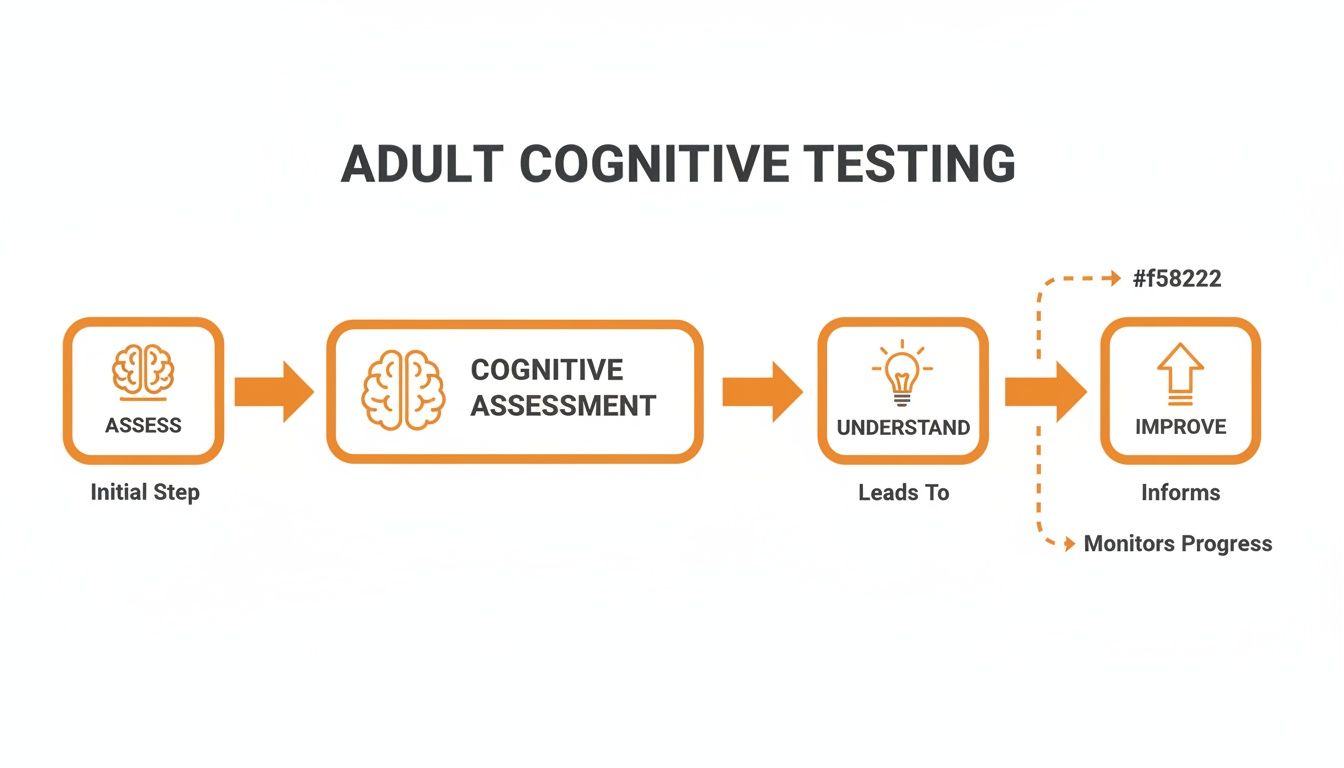
As you can see, the assessment is just the starting point. It leads directly to actionable insights and targeted strategies for improvement.
The Key Cognitive Domains Explored
Each cognitive test battery is built to measure specific brain functions. While the exact combination of tests can vary, they almost always evaluate a core set of abilities that are essential for navigating everyday life. Understanding these domains helps demystify what an assessment is actually looking at.
To make this tangible, the table below breaks down the main cognitive domains and connects them to practical, real-world situations you likely encounter every day.
Key Cognitive Domains and Everyday Examples
Cognitive Domain | What It Measures | Practical Example |
|---|---|---|
Attention | The ability to focus on specific information while filtering out distractions. Your brain's "spotlight." | Holding a conversation in a noisy restaurant without getting sidetracked by other tables. |
Memory | The capacity to encode, store, and retrieve information, both short-term (working) and long-term. | Recalling a grocery list you made an hour ago or remembering directions to a new place. |
Executive Function | Higher-level skills like planning, problem-solving, organizing, and self-control. The "CEO" of your brain. | Planning the steps to cook a complex meal or adjusting your budget when an unexpected bill arrives. |
Processing Speed | How quickly you can perceive information, make sense of it, and react. Your mental quickness. | Quickly reading and understanding road signs while driving or keeping up with a fast-paced online meeting. |
These domains work together constantly, and a weakness in one area can easily affect another. That's why a comprehensive look is so important.
A common misconception is that cognitive testing is only about memory. In reality, it provides a 360-degree view of your brain's performance, assessing everything from mental flexibility to reaction time, which are all vital for daily independence.
Connecting Cognitive Skills to Daily Life
These abstract-sounding concepts become much clearer when you see how they show up in your day-to-day. For instance, struggling with executive function might not just mean a low test score; it could manifest as real difficulty managing household bills or feeling overwhelmed when organizing a project at work. In the same way, a dip in processing speed could make driving feel more stressful or following a group conversation feel exhausting.
To get a deeper understanding of these concepts, you can explore our complete definition of cognitive skills and how they impact everyday function. By translating test results into tangible, daily experiences, cognitive assessments become a practical tool for improving your quality of life. The goal is to provide you with a clear, actionable roadmap for your brain health journey.
Common Reasons to Consider a Cognitive Assessment
Knowing when to think about cognitive testing for an adult is every bit as important as knowing what the test is. The decision usually starts with noticing subtle, but persistent, changes in yourself or someone you care about. These shifts can be unsettling, but getting to the root cause is the first actionable step toward managing your brain health.
An assessment isn't just for when something feels wrong; it’s a proactive way to understand and navigate different life stages and health events. It gives you objective data that can move you past worry and into a place of clarity and informed action.
Monitoring Recovery After a Brain Injury
One of the most clear-cut reasons to get a cognitive assessment is after a traumatic brain injury (TBI), like a concussion. Following an injury, it’s tough to judge recovery based on symptoms alone. A person might feel better, but are their attention and processing speed truly back to where they were before?
A formal assessment provides hard data to answer that very question.
Establishing a Post-Injury Baseline: The first test after an injury creates a starting point for recovery, showing exactly which cognitive areas were hit the hardest.
Tracking Progress Objectively: Follow-up tests can measure improvement over time, offering real proof that rehabilitation is working or flagging areas where more support is needed.
Informing Return-to-Activity Decisions: Practical example: An athlete can use test data to know when it's safe to return to play, or an office worker can determine if they're ready to handle complex project management tasks again.
Investigating "Brain Fog" and Other Unexplained Changes
Sometimes, the reasons for seeking an assessment are less dramatic but just as worrying. Many people describe a persistent "brain fog" that makes everyday tasks feel like a struggle.
Practical example: Take Maria, a 62-year-old who has always been proud of her sharp mind. Lately, she finds herself struggling to keep up with conversations at family dinners and is constantly misplacing her keys. She feels like her thinking is "muddier" than it used to be, and it's causing her a lot of anxiety.
For Maria, a cognitive assessment is a way to put a number on these feelings. It can help her and her doctor figure out if these changes are a normal part of aging or if they point to an underlying issue that needs a closer look. This is especially true for people with lingering symptoms after illnesses like COVID-19, where brain fog is a common complaint affecting up to 80% of long COVID patients.
An assessment transforms vague concerns like "feeling foggy" into a structured cognitive profile. It helps pinpoint whether the issue lies with memory, attention, or executive function, which is the first step toward finding a real solution.
Addressing Underlying Health Conditions
Many health conditions can have a direct impact on how well our brains function, even when they seem totally unrelated. For instance, conditions like sleep apnea can significantly impair cognitive function, which is a common reason to consider an assessment. To learn more, you can review some key sleep apnea facts and statistics that show the connection.
Other situations where testing can be incredibly valuable include:
Managing Chronic Illness: Conditions like diabetes, heart disease, or autoimmune disorders can all affect brain health.
Evaluating Medication Side Effects: Some medications can cause cognitive side effects, and an assessment helps track their impact.
Baseline for High-Demand Professions: Pilots, surgeons, or executives might choose to establish a cognitive baseline to ensure they are always performing at their peak.
If any of these scenarios sound familiar, taking the next step can be an empowering move. To get a clear picture of your cognitive health and discover the insights you need, email us today to learn more about our assessments.
The Shift from Traditional to Digital Cognitive Assessments
The world of cognitive testing has changed, and for the better. For decades, the gold standard was a pen-and-paper assessment. You might picture a thick binder of questions, timed puzzles, and a clinician manually scoring every response with a stopwatch and a red pen.
While these traditional methods built the foundation of modern neuropsychology, they weren’t without their headaches. They took a long time to administer, left room for human error in scoring, and could sometimes lean on subjective interpretation.
Think of it like the difference between a hand-drawn map and a GPS. The old map was incredibly valuable and got you where you needed to go, but it was static and took a lot of careful work to use. Today’s digital cognitive assessments are the GPS—they're dynamic, precise, and offer actionable data we once could only imagine.
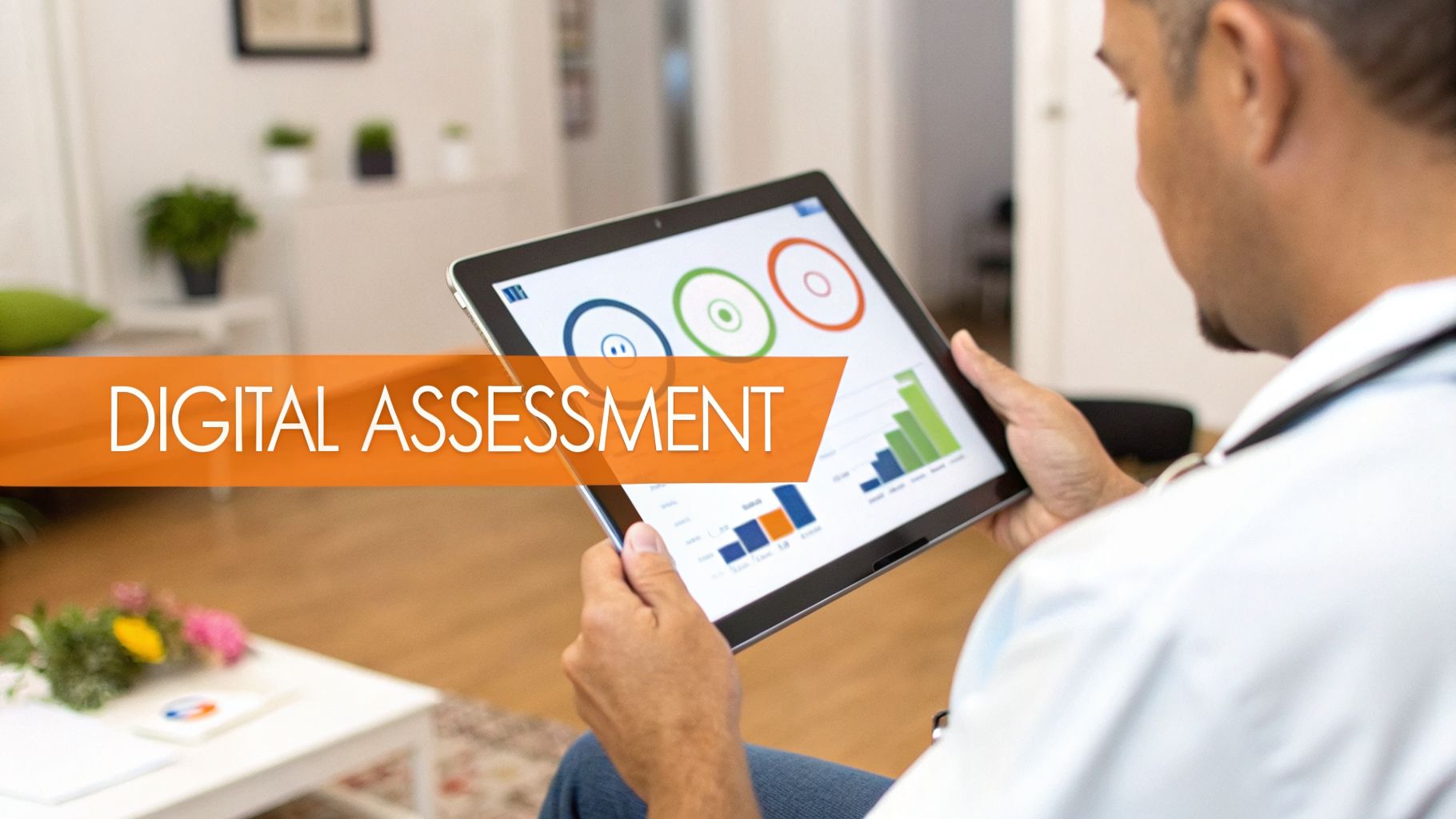
This isn't just a simple tech upgrade. It’s a genuine shift toward making cognitive testing more accessible, objective, and seamlessly woven into the fabric of modern healthcare.
The Power of Precision and Speed
One of the biggest leaps forward with digital platforms is their ability to capture thousands of subtle data points that pen-and-paper tests just can't catch. They can measure response times down to the millisecond, notice tiny hesitations, and analyze patterns in a way that paints a much richer, more nuanced cognitive picture.
This precision takes a lot of the guesswork out of the equation. Practical example: Instead of just noting if a memory task was answered correctly, a digital test can record how long a person hesitated before answering. This subtle data can reveal underlying processing challenges that would otherwise be missed.
And then there's the speed. What used to take hours of a clinician’s time can now often be done in under 30 minutes. This efficiency tackles one of the biggest bottlenecks in cognitive care: the long waits for specialist appointments and the even longer waits for results.
"The move to digital isn't just about convenience; it's about depth. By capturing thousands of data points in minutes, we get an evidence-based cognitive profile that is more objective and detailed, allowing for faster and better-informed care decisions."
This shift has been widely embraced, especially in North America, which has cemented its role as the dominant region for cognitive assessment, projected to account for 56.40% of the market share by 2026. This reflects a robust healthcare infrastructure and a growing focus on wellness. You can explore more on this trend in the cognitive assessment market report from Fortune Business Insights.
Seamless Integration and Longitudinal Monitoring
Modern digital platforms, like the ones we’ve developed here at Orange Neurosciences, are designed to fit right into a clinician's existing workflow. Results pop up instantly in clear, easy-to-read reports that can be shared with patients to start productive conversations. This immediacy closes the gap between assessment and action.
Plus, the ease of digital testing makes ongoing monitoring—what we call longitudinal tracking—far more practical. A person's cognitive profile can be re-assessed at regular intervals to:
Track Recovery: Objectively measure cognitive gains after a TBI or stroke.
Monitor Treatment Efficacy: See how a particular intervention or medication is impacting cognitive function over time.
Observe Progression: Follow the subtle changes associated with a neurodegenerative condition in a standardized, reliable way.
This ability to easily track cognitive health over time is a cornerstone of proactive brain health. Our guide on cognitive assessment online dives deeper into how these tools empower both individuals and their care teams.
Making Cognitive Care More Accessible
When you get right down to it, the shift to digital is about democratizing access to high-quality cognitive testing. By bringing down costs, slashing assessment times, and allowing for remote administration, these tools are breaking down barriers that have stood for far too long.
This progress firmly positions digital assessment as the new standard of care, giving more people than ever the power to get a clear, objective look at their brain health and take meaningful steps to protect it.
What to Expect During Your Digital Cognitive Assessment
The thought of taking a cognitive test can be a little intimidating, but knowing what to expect can make all the difference. Forget any ideas you have about high-pressure exams. A modern digital assessment is a far cry from that.
Think of it less as a test you can pass or fail and more like an interactive session designed to get a clear, accurate snapshot of your brain's performance right now.
Most digital assessments feel more like a series of brain games on a tablet or computer. You might be asked to tap the screen when a certain shape pops up, remember a short sequence of items, or solve a simple puzzle. The entire experience is designed to be straightforward, even if you don't consider yourself tech-savvy.
The Typical Assessment Experience
For most people, a digital cognitive assessment is surprisingly quick and painless. The whole thing is often over in less than 30 minutes. All you really need is a quiet, comfortable space where you can focus without being interrupted. A calm environment is key to making sure the results truly reflect your cognitive abilities, not your level of distraction.
Here’s a simple, actionable breakdown of what the process looks like:
Getting Started: You’ll get clear directions on how to begin, whether you're in a clinic or taking the assessment at home through a secure link.
Practice Round: Every task kicks off with easy-to-follow instructions. You'll usually get a practice round to help you get the hang of it before the actual measurement starts.
The Main Event: You’ll work your way through a series of short, engaging activities that measure different cognitive skills like your attention, memory, and processing speed.
All Done: Once you’ve finished the last task, that's it! There's no waiting around for someone to score it by hand; the platform analyzes your performance instantly.
This shift towards user-friendly, automated platforms is a huge trend in cognitive care. In fact, software and digital solutions now represent the biggest piece of the pie in the cognitive assessment market, making up 54.6% of the market share. This just goes to show the massive demand for advanced, accessible solutions that create a better experience for everyone. If you're interested in the details, you can discover insights about the cognitive assessment market.
Tips for Getting the Most Accurate Results
Simple things, like how tired you are, can affect your performance on a cognitive test. A little preparation can go a long way in ensuring your results are a true reflection of your abilities. Here are some actionable tips:
Get a Good Night's Sleep: Being well-rested is one of the best things you can do to make sure your focus and attention are sharp.
Avoid Rushing: Give yourself plenty of time. Feeling pressured or stressed won't help.
Find a Quiet Spot: Minimize distractions. Put your phone on silent, close the door, and find a place where you won't be disturbed.
The goal of cognitive testing for adults isn't to "ace the test." It's to get an honest, accurate measure of your current cognitive function. By creating a calm and focused environment, you help ensure the data is reliable and useful for planning your next steps.
What Clinicians Can Expect
For healthcare providers, the digital process is just as streamlined. Administration is simple and takes up very little staff time. But the real game-changer is the immediate access to data-rich reports.
These reports give you a clear, objective profile of a patient’s cognitive health. This helps make communication easier and allows you to build an effective care plan without any delay.
To see how our platform transforms this process into a clear, manageable experience, visit our website and request a demo to discover how you can integrate precise cognitive testing into your practice.
How to Use Your Results to Plan Your Next Steps
Getting a report packed with data after a cognitive assessment can feel a bit overwhelming. It's easy to get lost in the numbers and charts, but the goal isn't to slap a label on you. Instead, think of it as a powerful tool meant to bring clarity and guide what comes next.
See your results less as a final verdict and more as a detailed cognitive profile—an actionable roadmap for your brain health. This map highlights your unique strengths and shines a light on areas that could use some targeted support. It takes those vague concerns you've been having and turns them into a structured, actionable plan.
An assessment is just the beginning of the journey, not the end. Its real purpose is to kickstart productive conversations with your healthcare provider, turning objective data into a real-world strategy for improving your cognitive well-being.
Translating Data into Actionable Insights
Your report gives you a clear, solid starting point for discussing next steps with your doctor or therapist. The results help pinpoint exactly where to focus your efforts, making any intervention far more effective. It’s all about working smarter, not just harder, on your brain health.
Based on your cognitive profile, your healthcare provider might suggest a few different paths:
Referral to a Specialist: If your results show significant challenges in specific domains, like memory or executive function, your doctor might suggest a visit to a neurologist or neuropsychologist for a deeper dive.
Targeted Cognitive Training: Your profile can identify the exact cognitive skills that need a boost. This allows for personalized cognitive training programs that focus on strengthening those specific abilities, often through engaging, game-like exercises.
Lifestyle Adjustments: Actionable insight: Your results might spark a conversation about improving sleep habits, adding specific brain-healthy foods to your diet (like omega-3s), or incorporating 30 minutes of brisk walking into your daily routine.
A Practical Example of Next Steps
Let's picture John, a 55-year-old accountant who decides to get a cognitive assessment. He's been wrestling with "brain fog" and finding it tough to multitask at work. His results come back showing his long-term memory is strong, but they also reveal specific weaknesses in attention and processing speed.
Now, instead of just worrying, John and his doctor can build a targeted, actionable plan. They might agree on a two-pronged approach. First, John could begin a digital cognitive training program with exercises designed specifically to improve his attentional control. Second, they could discuss lifestyle factors, like making sure he takes short, 5-minute screen breaks every hour to reduce cognitive overload. This proactive plan is a direct result of the clarity his assessment provided.
Your cognitive testing results are a powerful catalyst for change. They move the conversation from "I feel off" to "Here are the specific areas we can work on," creating a clear and direct path to improvement.
The goal is to arm you with the information needed to build an effective brain health strategy. The right assessment gives you the clarity to have these important conversations and take control of your cognitive future. To get a deeper understanding of practical strategies, check out our guide on how to improve cognitive function.
At Orange Neurosciences, we believe in empowering both patients and clinicians with clear, objective data. Visit our website to see how our platform can provide the insights needed to confidently plan your next steps.
Your Questions About Adult Cognitive Testing, Answered
Even with all the information, it's completely normal to have a few more questions pop up about cognitive testing. This is a big step in taking charge of your brain health, and you should feel 100% confident and informed before moving forward.
To help you get that final bit of clarity, we've put together answers to some of the most common questions we hear from people just like you.
Is Cognitive Testing Covered by Insurance?
This is the big one, and the answer is: it often depends on your specific insurance plan and where you live. In many cases, an assessment can be covered if a doctor or other healthcare provider decides it's medically necessary. Practical example: This often happens when testing is needed to diagnose or manage a condition like a traumatic brain injury (TBI) or suspected dementia.
But insurance policies can be all over the map. The most actionable step you can take is to call your insurance provider directly and also speak with the clinic that will be doing the test. They can walk you through your coverage and let you know about any out-of-pocket costs beforehand so there are no surprises.
How Often Should an Adult Get a Cognitive Test?
There really isn't a one-size-fits-all schedule for cognitive testing; it's a very personal thing. That said, here are a few practical guidelines to consider:
For a Proactive Baseline: Many experts suggest that healthy adults think about getting a cognitive baseline done sometime in middle age. From there, checking in every few years is a fantastic way to proactively keep an eye on your brain health as you get older.
For Monitoring a Condition: If you're already managing a known cognitive issue or recovering from a brain injury, your clinician will likely recommend more frequent testing. This could be as often as every 6-12 months to track any changes, see if treatments are working, and make adjustments to your care plan.
Modern digital platforms have made this kind of regular follow-up much easier and more accessible than it used to be. If you're curious about what goes into the results, our guide on MMSE scoring and interpretation offers some great background.
Are Online Brain Games a Substitute for Clinical Tests?
While brain games can be a fun way to stay mentally active, they are absolutely not a substitute for a clinical cognitive assessment. They're built for entirely different reasons.
Here’s a practical way to think about it: Playing a brain game is like going for a jog to stay fit—it's great general exercise for your mind. A clinical assessment, on the other hand, is like getting a cardiac stress test from your doctor. It’s a specific, standardized diagnostic tool.
Clinical cognitive testing for adults relies on standardized, evidence-based tools that have been scientifically validated to give objective, reliable data. Brain games are designed for fun and engagement, not clinical diagnosis. Both have their place, but only a clinical test can give your healthcare provider the deep, actionable insights they need.
Ready to move from uncertainty to clarity? The first step is getting objective, reliable data about your cognitive health. Orange Neurosciences provides the advanced tools clinicians and individuals need to create a clear cognitive profile and build an effective, personalized plan for brain wellness.
Orange Neurosciences' Cognitive Skills Assessments (CSA) are intended as an aid for assessing the cognitive well-being of an individual. In a clinical setting, the CSA results (when interpreted by a qualified healthcare provider) may be used as an aid in determining whether further cognitive evaluation is needed. Orange Neurosciences' brain training programs are designed to promote and encourage overall cognitive health. Orange Neurosciences does not offer any medical diagnosis or treatment of any medical disease or condition. Orange Neurosciences products may also be used for research purposes for any range of cognition-related assessments. If used for research purposes, all use of the product must comply with the appropriate human subjects' procedures as they exist within the researcher's institution and will be the researcher's responsibility. All such human subject protections shall be under the provisions of all applicable sections of the Code of Federal Regulations.


© 2026 by Orange Neurosciences Corporation