Cognitive Science McGill: Program & Admissions 2026
Apr 24, 2026
You’re probably here because one of three things is happening.
You’re a student who likes psychology but also keeps reading about AI, language, memory, and the brain. Or you’re a parent, advisor, or educator trying to figure out whether cognitive science mcgill is broad in a good way or broad in a confusing way. Or you’re a researcher or clinician wondering whether McGill’s cognitive science ecosystem connects to work that matters outside the classroom.
It does. But it helps to understand how the pieces fit together.
McGill’s cognitive science program isn’t a single-lens degree. It’s built for people who don’t want to choose between questions like: How does the brain support attention? How do children learn language? Can computers model reasoning? What does consciousness even mean? The strength of the program is that it treats those questions as connected, not separate.
That makes this program exciting. It can also make it hard to picture what day-to-day study looks like, what the requirements mean, and where the degree can lead.
This guide is written the way I’d explain it to a prospective student in an advising meeting. Plain language. Real examples. Practical decisions.
Your Journey into the Science of the Mind Starts Here
A student I often picture when explaining cognitive science is someone who starts with a simple question and then realises it won’t stay simple for long.
They might ask why some people remember faces easily but struggle with names. That seems like a psychology question at first. Then it turns into a neuroscience question about brain systems, a linguistics question about verbal encoding, a computer science question about pattern recognition, and even a philosophy question about what memory is. That widening circle is cognitive science.
If that sounds like how your mind works, cognitive science mcgill makes a lot of sense.
McGill gives students a way to study the mind without flattening it into one department’s view. You’re not forced to pretend that thought is only behaviour, only biology, or only computation. You learn to move between those views and ask when each one is useful.
For many students, that’s the first big relief. You don’t need to arrive with every answer. You need curiosity, tolerance for complexity, and the willingness to build across fields.
A good first step is getting clear on the difference between everyday ideas about “thinking” and the more structured concept of cognition. This short guide to cognitive function in practical terms can help if you want a plain-language foundation before diving into university-level material.
Cognitive science suits students who enjoy connecting ideas that other programs keep in separate boxes.
McGill is especially appealing if you want a research environment, not just a classroom experience. The program has a reputation for turning abstract interest into hands-on work, and that matters because cognitive science is learned best by doing. Reading about memory is useful. Designing a study about memory changes how you think.
That’s where McGill starts to stand out.
Understanding McGill's Interdisciplinary Approach
You might enter McGill interested in one concrete problem, such as why a child struggles to read, why an older adult’s attention changes over time, or how a machine can recognise patterns that resemble human perception. Cognitive science asks you to study that one problem from several angles instead of forcing it into a single department’s vocabulary.
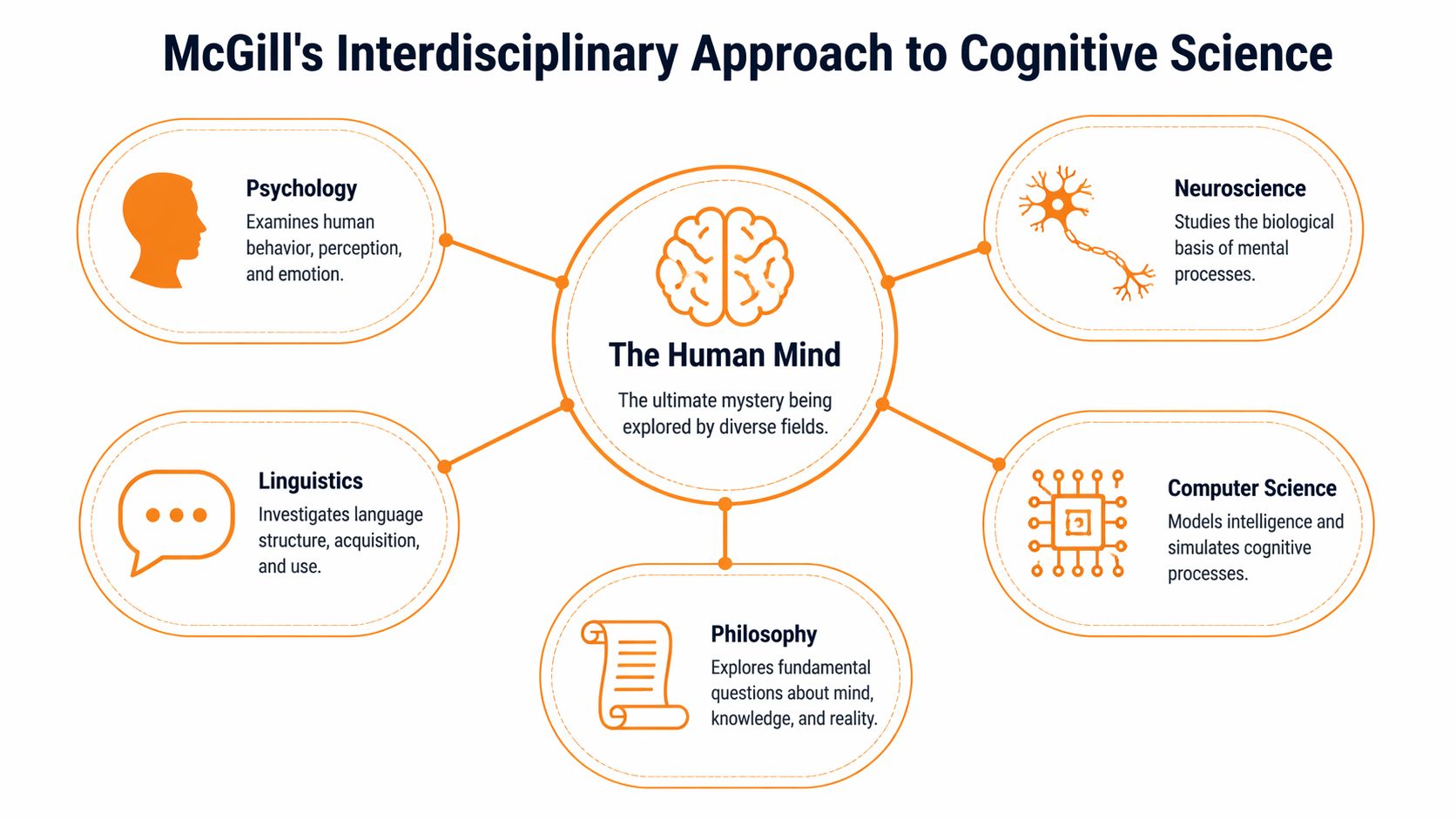
The five pillars at McGill
At McGill, cognitive science is built around psychology, neuroscience, linguistics, computer science, and philosophy. Each field asks a different kind of question. Together, they give you a more accurate picture of how minds work.
Memory is a useful example.
Psychology studies how memory appears in behaviour. What helps people remember, and what leads to errors or forgetting?
Neuroscience examines the brain systems that support memory and how those systems change with injury, development, or aging.
Linguistics looks at how language affects encoding, meaning, and retrieval.
Computer science creates models of learning, categorisation, and decision-making.
Philosophy tests the concepts underneath the research. What counts as remembering? What is a mental representation?
A good way to read this structure is to picture a toolkit on a workbench. You would not use a microscope to write code, and you would not use a programming model to settle a philosophical definition. McGill trains students to choose the right tool for the question, then combine tools when the question is bigger than any one method.
Why this matters in practice
That design becomes useful very quickly. A student interested in reading difficulties might combine psychology courses on perception, linguistics courses on language structure, and computational methods for pattern recognition. A student interested in cognitive aging might pair neuroscience with statistics and experimental design, then connect that training to clinical questions about assessment and decline.
This is one reason McGill stands out for students who want work that travels well outside the classroom. The same interdisciplinary habits that help in a lab also matter in hospitals, education, user-experience research, and health technology. If you are curious about the clinical side, it helps to understand how cognitive assessment works in practice, especially if you can see yourself working with patient data, educational screening, or digital cognitive tools.
That applied path is becoming easier to see across the field. Research in cognition does not stop at theory or publication. It often leads to assessment methods, rehabilitation strategies, and digital platforms used in real settings. Companies such as Orange Neurosciences reflect that shift by turning ideas about attention, memory, and measurement into tools with clinical and technological use.
Practical rule: If you like comparing biological, computational, and human-centred explanations, and you do not mind that the answers sometimes come from different places, McGill’s approach will probably fit you well.
Navigating the Program Structure and Requirements
At this stage, many students get stuck. They understand the subject, but the program options feel like university shorthand.
The simplest way to think about McGill’s structure is this: the Minor gives you a defined introduction, the Major gives you substantial depth with flexibility, and the Honours route is for students who want stronger academic intensity and often a clearer research trajectory.
The options at a glance
Attribute | Minor in Cognitive Science | Major in Cognitive Science | Honours in Cognitive Science |
|---|---|---|---|
Overall purpose | Complements another main area of study | Main undergraduate pathway with interdisciplinary depth | Stronger research-oriented pathway with higher academic expectations |
Credit load | 24 credits | 54 credits | 60 credits |
Breadth across disciplines | Yes | Yes | Yes |
Stream specialisation | Limited compared with Major or Honours | Requires a primary stream with deeper focus | Requires a primary stream with deeper focus |
Best fit for | Students pairing cognitive science with another field | Students who want cognitive science as a central academic identity | Students considering advanced research or graduate study |
Academic standard | Standard program expectations | Standard program expectations | Requires minimum overall GPA of 3.3 and B+ (3.3) or better in required courses |
What the Major looks like
The Major is often the best fit for students who want cognitive science to be their main field but still want room to shape it around their interests.
McGill describes the Major as 54 credits, with students completing core work across the field while building depth in one area. The structure includes 18 credits in a major stream and 12 additional credits across streams, with 15 credits at the 400-500 level, as outlined on McGill’s cognitive science future students page.
In everyday terms, that means you won’t drift through the program sampling a little of everything with no anchor. You choose a main stream, then build outwards. It’s like choosing a home base before exploring the rest of the map.
What makes Honours different
The Honours option is more than “the same program but harder.” It signals that McGill expects stronger sustained performance and quantitative readiness.
The Honours Cognitive Science program is 60 credits and requires a minimum overall GPA of 3.3 plus a B+ (3.3) or better in key courses. It also mandates foundational statistics training through courses such as PSYC 204, according to the McGill Cognitive Science Resource Guide.
That statistics requirement matters more than many applicants realise. Cognitive science isn’t just about clever ideas. You need to interpret data, understand variation, and evaluate evidence. In PSYC 204, students encounter topics such as measures of central tendency and variability and tests of significance. Those are the tools behind research claims in psychology and neuroscience.
How to choose the right path
Here’s a practical way to decide.
Choose the Minor if you already have another main field and want cognitive science to sharpen it. This works well for students in psychology, computer science, linguistics, or philosophy.
Choose the Major if you want a flexible but serious interdisciplinary degree that can support several career directions.
Choose Honours if you’re motivated by advanced research, graduate school, or you know you work well under tighter academic expectations.
Don’t pick Honours because it sounds impressive. Pick it because you want the pace, the standards, and the research preparation that come with it.
Where students get confused
The most common misunderstanding is thinking “interdisciplinary” means “unstructured.” At McGill, it doesn’t.
The program is carefully organised. In the B.A. & Sc. structure described in McGill materials, students balance work in Arts and Science, complete core cognitive science training, and then build an academic profile that’s broad enough to connect ideas but focused enough to mean something. That’s a difficult balance to design, and McGill has done it intentionally.
A useful mental model is this: cognitive science mcgill gives you a shared foundation, then asks you to develop one area of fluency and several areas of literacy. That combination is one reason graduates can move between research, technology, education, and health-related environments.
Inside McGill's Leading Cognitive Science Research Labs
The best way to understand McGill’s research culture is to stop thinking about “labs” as mysterious places only graduate students enter.
At McGill, undergraduates can move into research through formal course pathways and supervised projects. The doorway matters. Programs often claim to value research, but students need a practical route in. McGill has one.
How students enter research
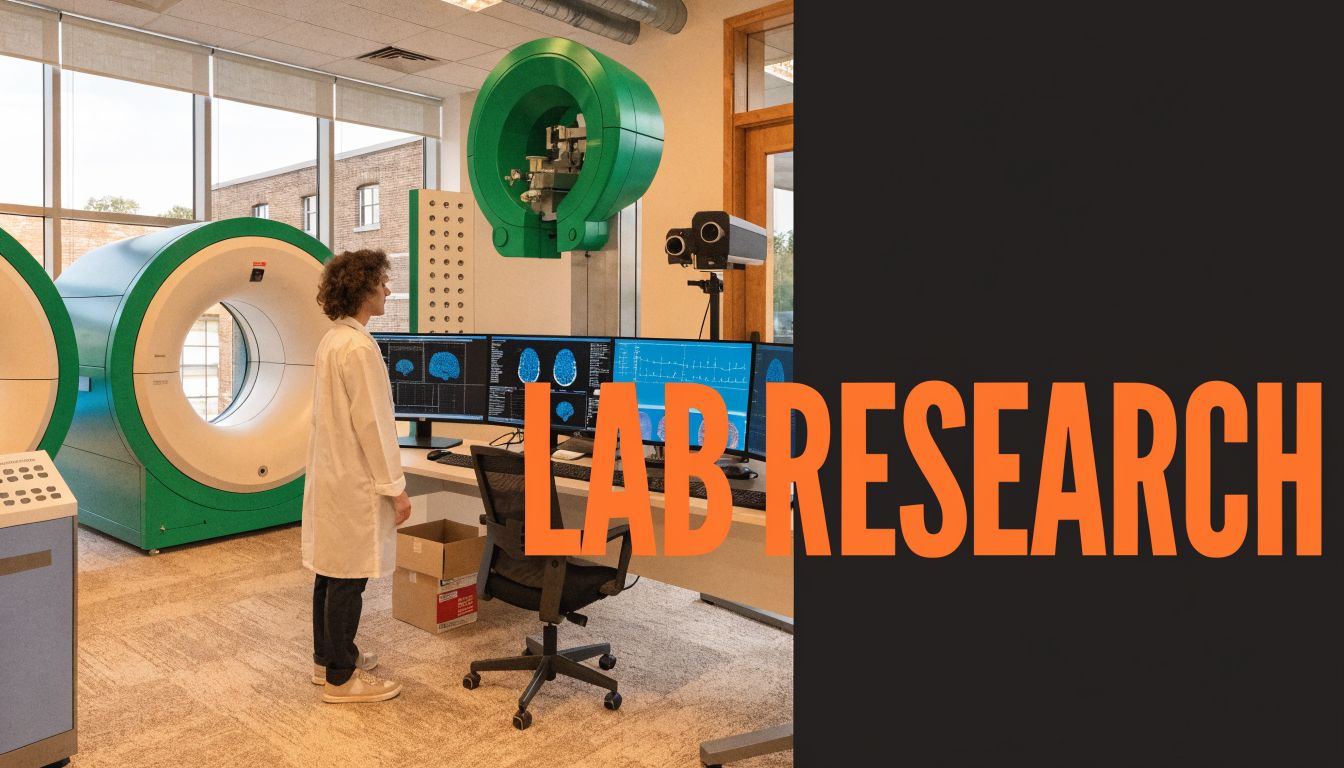
Students can join projects through COGS 401/444, engaging in work on topics such as neuroplasticity and brain-behaviour relationships in labs including the Laboratory for Attention and Social Cognition, which uses EEG and response times to generate neural benchmarks, as described on McGill’s cognitive science research page.
That sentence packs in a lot, so let’s unpack it.
COGS 401/444 gives students a structured route into research rather than forcing them to cold-email without context.
EEG lets researchers examine electrical activity associated with attention and related processes.
Response time data may sound simple, but it can reveal a great deal about how quickly and accurately people process information.
A student in one of these projects might spend part of the week reading papers, another part helping run participants, and another cleaning or interpreting data. That mix is useful because it teaches how research operates, not just how it looks in polished journal articles.
What the research feels like
One lab might examine attentional selection. Another might look at language acquisition. Another might focus on psychosis, computational cognition, or relationships between brain systems and behaviour.
This variety matters because prospective students often say, “I’m interested in the brain,” when what they really mean could be one of several very different interests. They might care about clinical disorders, machine learning models, educational outcomes, social cognition, or language processing. McGill’s ecosystem gives them room to test that interest against real methods.
A good research fit isn’t only about the topic. It’s also about whether you enjoy the method. Some students love EEG. Others prefer experiments, interviews, coding, or modelling.
Practical ways to prepare before you apply to a lab
You don’t need to arrive as an expert. You do need to show that you’re teachable and specific.
Here are stronger signals than “I’m passionate about the brain”:
Read recent lab descriptions carefully Learn what the lab studies. “Attention in social settings” is much better than “anything neuroscience related.”
Match your skills accurately
If you’ve coded, say so. If you’ve done careful writing, participant work, or note-taking, that can matter too.Show method curiosity
Mention why a tool interests you. EEG, behavioural tasks, computational models, and language analysis each involve different habits of mind.Write a focused email
Keep it short. Mention one project feature that caught your attention and one reason you’d be useful.
In some projects, especially those involving interviews or mixed-method work, students also discover that data collection creates a documentation burden. If you’re exploring human-subject research more broadly, this overview of qualitative research transcription is worth reading because it clarifies one of the most time-consuming parts of research workflow.
McGill’s broader research culture also creates opportunities for external and cross-institutional conversation. For readers interested in how academic partnerships can be formalised around cognitive science and neuroscience, this note on a research collaboration MOU in cognitive innovation offers a useful example of how university-industry relationships can begin.
From Lab to Life Career Paths and Postgraduate Success
A second-year student sits down to choose next term’s courses and asks a practical question: where can this degree lead?
That is the right time to ask it.
Students who start early usually make better choices about electives, lab work, internships, and postgraduate plans. Cognitive science at McGill works like a toolkit rather than a narrow job track. The value comes from how you combine its parts. One student may build toward clinical research. Another may move toward product design, AI, or language technology. A third may discover that the best fit is graduate study in psychology, neuroscience, speech-language fields, education, or human-computer interaction.

How different streams translate into work
Your concentration influences the kinds of problems you learn to solve.
A computer science-focused student often develops strength in modelling, data, interface logic, and system design. That background can lead to AI-related roles, human-computer interaction, user research, or product work in teams building tools that respond to attention, language, or learning needs.
A neuroscience-focused student usually spends more time with brain-behaviour relationships, experimental methods, and clinical questions. That can support later training in medicine, neuropsychology-related paths, rehabilitation research, or lab-based graduate study.
A linguistics-focused student often becomes skilled at analysing language structure, meaning, and use. Those habits are useful in speech technology, language research, education, and natural language processing.
The degree does not assign you one profession. It trains you to notice the right variables before a team spends time solving the wrong problem.
That flexibility is especially useful in care and technology settings, where employers increasingly need people who can connect theory, evidence, and implementation. McGill’s interdisciplinary model fits well with work on digital mental health, cognitive assessment tools, adaptive learning systems, and clinically informed software. That is also where companies developing applied neurotechnology, including Orange Neurosciences, become relevant to students and researchers who want to see how ideas from class or lab can turn into usable tools.
Skills employers and graduate programs notice
A transcript shows what you studied. Your methods, judgment, and communication show what you can do.
The strongest candidates often stand out in four areas:
Analytical thinking
You learn to compare competing explanations and ask which one fits the evidence best.Quantitative literacy
Statistics and research design help you evaluate claims carefully and handle data with discipline.Interdisciplinary communication
Cognitive science students often learn how to speak with coders, clinicians, educators, and researchers without losing precision.Problem framing Before offering solutions, you learn to define what kind of cognitive problem is present.
That last skill is easy to underestimate. In applied settings, poor problem framing wastes money, time, and patient attention.
Real-world examples of where that matters
Suppose a team is building a digital reading support tool. A cognitive science graduate can help separate questions about phonological processing, attention, working memory, visual load, and interface design. Those are not small distinctions. They affect what the tool measures, how it adapts, and whether it helps the intended user.
Now shift to a clinical setting. A practitioner may need a concise way to organise concerns about memory, attention, executive function, or developmental patterns before deciding on referral, monitoring, or next-step assessment. Someone trained in cognitive science can contribute by connecting research concepts to practical decision-making. For a clear example of that applied style, these clinical knowledge summaries for cognitive and neurodevelopmental care show how evidence can be structured for real use.
This is one of the most useful ways to think about postgraduate success. Many McGill students do not choose between “academic” and “applied” work as if they are separate worlds. They build profiles that can speak to both.
Students who do well after graduation usually present a coherent direction. Their courses, projects, and research experience point toward a clear set of questions.
A useful planning habit
By second year, try to finish this sentence in one line: “I’m interested in using cognitive science to work on ______.”
Keep it simple. It might be children’s language development, clinical assessment, adaptive learning tools, brain injury research, mental health technology, or human-AI interaction.
Your answer will probably change, and that is normal. The point is not to predict your whole career. The point is to give yourself a working draft so you can choose opportunities that build toward something visible.
Students who can explain their direction clearly usually write stronger applications, make better contact with supervisors, and spot the difference between a course that is merely interesting and one that is strategically useful.
Fostering Collaboration in Cognitive Health and Research
McGill’s strongest contribution to cognitive science may be this: it doesn’t treat academic knowledge and real-world intervention as separate worlds.
That’s especially important in cognitive health, where many of the hardest problems demand collaboration between universities, clinicians, technology teams, and care settings. A university can generate strong ideas and rigorous methods. A clinical or digital partner can help test whether those ideas remain useful when they leave the lab. Patients and communities benefit when that bridge is built carefully.
Why collaboration matters
In cognitive health, isolated expertise only gets you partway.
A neuroscientist may understand a mechanism. A clinician may understand functional impact. A technologist may understand scale and workflow. An educator may understand how attention or language difficulties show up in daily learning. If those groups don’t talk to each other, the result is usually fragmented care or research that never becomes usable.
McGill’s environment makes collaboration plausible because its cognitive science culture is already interdisciplinary. People are used to crossing methods, departments, and vocabularies. That doesn’t guarantee effective partnerships, but it creates the right starting conditions.
A case study that shows what’s possible
A strong example comes from a McGill-led clinical trial at The Neuro in Montreal. In that study, online brain training restored cholinergic function in older adults to levels seen in people 10 years younger, providing the first human evidence of such an effect, according to McGill’s report on the study.
This matters for two reasons.
First, it shows that digital cognitive intervention can be studied seriously. Not as a vague wellness claim, but as a research question tied to a defined biological system. Second, it gives collaborators a more concrete picture of what “digital brain health” can look like when a strong research institution leads the work.
The value of that result isn’t just that one intervention worked in one context. The deeper lesson is methodological. McGill researchers connected intervention, measurement, and biological interpretation. That’s the kind of design future collaborations should aim for.
When a university and applied partner work well together, the best outcome isn’t a flashy tool. It’s a better question, measured properly, in a real population.
What good partnerships usually include
Researchers, clinicians, and industry teams often rush to the exciting part. The platform. The protocol. The product. The pilot.
The more durable collaborations usually begin somewhere less glamorous:
A narrow research question
For example, attention, memory, processing speed, or training adherence in a defined group.Clear ethical boundaries
Especially important when work involves children, older adults, or cognitively vulnerable populations.Operational realism
Can the assessment fit inside a clinic workflow, a school setting, or a rehabilitation programme?Shared interpretation standards
Everyone involved needs to agree on what the outputs mean and what they do not mean.
That last point is often neglected. In cognitive health, data can be useful without being diagnostic. Research tools and scalable assessments can support triage, benchmarking, follow-up, or referral decisions without replacing formal clinical evaluation.
Where McGill collaborators may fit
For a prospective collaborator, cognitive science mcgill offers several possible points of entry.
A research group may need help validating digital tasks against behavioural or neural markers. A clinical team may want a university partner for an ethically designed study. A technology team may need advisors who understand cognition beyond surface-level UX language. McGill’s mix of behavioural science, neuroscience, computation, and language work makes those conversations richer.
If you’re exploring collaboration, start small and specific. Don’t email with “We want to innovate in brain health.” Email with a tight proposal, a clear population, and one measurable question. That’s the kind of message researchers can work with.
A Practical Guide to Your McGill Application
Most strong applications don’t try to sound impressive. They sound grounded.
For cognitive science mcgill, that means showing two things at once. You’re intellectually curious across disciplines, and you’re ready for the academic structure that keeps those disciplines connected.
Start with your academic fit
McGill expects applicants to be ready for quantitative and interdisciplinary study. Program materials describe prerequisites and foundational expectations across areas such as psychology, cognitive science, biology, mathematics and statistics, computer science, and neuroscience.
That doesn’t mean you need to have mastered every one of those fields before applying. It means you should be comfortable showing that you can handle structured academic work and that you’re not intimidated by evidence-based thinking.
A student who enjoys biology and maths but also writes well about language and behaviour can make a strong fit argument. So can a student with computing experience and serious interest in psychology or philosophy.
Build your application like a clear argument
A good application usually has this internal logic:
Why the mind interests you
Be specific. A broad statement like “I’ve always been fascinated by the brain” won’t carry much weight on its own.Why an interdisciplinary program fits you
Show that your interests naturally cross boundaries.Why McGill is the right environment
Connect your goals to the kind of structure and research culture McGill offers.How you’ve already explored the field
This can include coursework, reading, projects, coding, volunteering, writing, tutoring, or independent study.
What to include in your story
You do not need a formal lab placement to show readiness.
Useful experiences might include:
A school project where you compared human learning and machine learning
Volunteer work with children, older adults, or people with learning differences
Programming or data experience that shows you can think systematically
Writing or debate experience that shows comfort with abstract questions
Language study that sparked an interest in how meaning is structured and learned
The best personal statements usually sound like one real person thinking carefully, not a committee-approved version of ambition.
Common mistakes to avoid
Being too vague
Name the kinds of questions you want to study.Listing interests without connecting them
McGill wants students who can integrate fields, not just collect them.Ignoring the quantitative side
Cognitive science includes data, methods, and evidence. Don’t present yourself as interested only in ideas.Trying to force certainty
It’s fine if you’re still deciding between research, healthcare, AI, or education. Explain the pattern in your interests instead.
Before you submit anything, check the official McGill admissions and program pages for the latest application details, deadlines, and requirements. University information changes, and current guidance should always come from McGill directly.
If you’re unsure whether your profile fits, write down three things: the questions you care about, the subjects you do well in, and the environments where you like working. That simple exercise often reveals whether cognitive science is the right academic home.
Shaping the Future of Mind and Machine
The appeal of cognitive science mcgill is that it gives students more than a subject. It gives them a way of thinking.
You learn to move between behaviour and biology, between data and theory, between human experience and computational models. That matters whether you end up in a lab, a clinic, a classroom, a start-up, or graduate school.
It also matters, especially as tools built around language, prediction, and cognition are developing quickly. If you want a clearer non-technical overview of how AI systems fit into that conversation, this guide to large language models is a helpful companion read because it gives context for one part of the machine side of mind-and-machine work.
McGill stands out because it pairs intellectual breadth with real academic discipline. Students get a strong conceptual foundation, opportunities for research, and a structure that can support work in healthcare, AI, education, and cognitive health innovation.
If you’re drawn to this field, take the next practical step. Read McGill’s official program pages closely. Compare the Minor, Major, and Honours routes. Identify the questions that keep pulling your attention back.
If you’re also curious about applied cognitive tools outside the university setting, this guide to brain training apps and how to evaluate them adds a useful practical lens.
The right program doesn’t just answer your current interests. It gives you better questions for the next stage of your work.
If you’re exploring brain health from the clinical, educational, or research side, Orange Neurosciences offers practical tools for rapid cognitive assessment, targeted training, and ethically structured cognition research support. Visit the website or contact the team by email to see how their platform can support evidence-informed care, collaboration, or pilot projects.
Orange Neurosciences' Cognitive Skills Assessments (CSA) are intended as an aid for assessing the cognitive well-being of an individual. In a clinical setting, the CSA results (when interpreted by a qualified healthcare provider) may be used as an aid in determining whether further cognitive evaluation is needed. Orange Neurosciences' brain training programs are designed to promote and encourage overall cognitive health. Orange Neurosciences does not offer any medical diagnosis or treatment of any medical disease or condition. Orange Neurosciences products may also be used for research purposes for any range of cognition-related assessments. If used for research purposes, all use of the product must comply with the appropriate human subjects' procedures as they exist within the researcher's institution and will be the researcher's responsibility. All such human subject protections shall be under the provisions of all applicable sections of the Code of Federal Regulations.


© 2026 by Orange Neurosciences Corporation