Your Guide to Cognitive Ability Assessment in Modern Practice
Jan 23, 2026
A cognitive ability assessment is a structured way to measure a person's mental toolkit—how they reason, solve problems, and remember things. It provides objective data on the unique way an individual learns, thinks, and processes the world around them. This guide offers actionable insights and practical examples to help you understand and apply these powerful tools.
Demystifying the Cognitive Ability Assessment
It helps to think of a cognitive ability assessment less like a school test and more like a diagnostic scan for a car's engine. A mechanic doesn't just see if the car runs; they plug it into a computer to analyze everything from fuel injection to ignition timing. This detailed report shows exactly how each part is performing, highlighting both strengths and areas that might need a tune-up.
In the same way, a cognitive ability assessment goes far beyond a simple pass-or-fail score. It gives us a detailed map of an individual's core "mental engines." But instead of measuring horsepower, it measures the efficiency of crucial functions like memory, attention, and problem-solving. This approach helps clinicians and families finally understand the how and why behind a person's learning style and behaviour.
More Than Just a Score
The real goal isn't to get a number but to build a complete profile of cognitive strengths and areas that need support. This detailed picture is the key to creating personalized strategies that actually work. For example, if an assessment reveals a student has brilliant visual-spatial skills but struggles to express their thoughts verbally, an educator has an actionable insight. A practical next step would be to introduce tools like graphic organizers or mind maps to help the student structure their ideas visually before writing them down, bridging that communication gap.
A cognitive profile helps translate abstract challenges into actionable insights. It shows us how to leverage a person's natural strengths to build up their areas of weakness, creating a more effective and encouraging path to growth.
Many standardized tests, like those people prepare for with dedicated ACT Prep services, are common examples of cognitive assessments in an academic setting. But in a clinical environment, the focus shifts. We're not just looking at academic readiness; we're trying to understand the underlying mechanics of how a person's mind works.
An Empowering First Step
This detailed understanding gives clinicians and caregivers objective data, moving them past subjective observations or frustrating trial-and-error. The key benefits are clear:
Pinpointing Specific Challenges: It identifies the root cause of difficulties. For example, instead of just saying a child is "inattentive," an assessment can differentiate between a problem with sustained attention (losing focus over time) and selective attention (being easily distracted).
Highlighting Hidden Strengths: It often uncovers talents that can be used to compensate for weaker areas, which helps build confidence. Actionable insight: A child struggling with reading might have superior auditory memory, so using audiobooks can become a key learning strategy.
Informing Targeted Interventions: It provides the evidence needed to create personalized care plans. Instead of a generic approach, you can recommend specific working memory exercises or visual aids based on the data.
Ultimately, a cognitive ability assessment offers a clear, actionable starting point. It's the first step toward building support systems that are truly in sync with how an individual's brain operates. For those who want to dig deeper into how this compares with other evaluations, our guide on what is neuropsychological assessment is a great next step.
Exploring the Six Core Cognitive Domains
To really get a handle on what a cognitive ability assessment measures, we first need to look at the brain's core functions. Think of these as the fundamental pillars holding up everything we think and do, from solving a complex puzzle to just crossing a busy street.
These six domains aren't just abstract concepts for a textbook; they're the mental tools we rely on every single day. Getting to know them is the crucial first step in making sense of assessment results and turning that data into real, meaningful action.
Executive Function: The Brain's Project Manager
Executive function is like the CEO or project manager of your brain. It’s a bundle of high-level mental skills that includes working memory, flexible thinking, and self-control. These are the abilities that let us plan, organise, focus our attention, and juggle multiple tasks without dropping the ball.
A practical example: Planning a family dinner. You have to decide on a menu (planning), shop for ingredients (organising), cook several dishes at once (task management), and adapt if something starts to burn (problem-solving). When your executive functions are sharp, these complex activities feel manageable. If you want to dive deeper, our guide on how to improve executive function offers practical strategies.
Memory: Recalling Information on Demand
Memory isn't a single filing cabinet; it's a sophisticated system for storing and retrieving information. For simplicity, we can break it down into two main types we use constantly.
Short-Term Memory: This is your brain’s sticky note. It holds a small amount of information for a very brief time—like remembering a phone number just long enough to dial it.
Long-Term Memory: This is the brain's massive library. It holds everything from the muscle memory needed to ride a bike to cherished memories from childhood holidays. It’s how we build our knowledge and expertise over a lifetime.
Attention: The Mental Spotlight
Attention is our ability to zero in on one thing while tuning out distractions. It’s like a mental spotlight we can aim and focus. A practical example: A strong attentional system allows a child to listen to their teacher in a buzzing classroom or helps an adult concentrate on a report despite the constant ping of email notifications.
A good cognitive assessment can measure different kinds of attention, like sustained attention (holding focus over time) and selective attention (filtering out distractions). This helps pinpoint exactly where the challenge lies—is it an issue of endurance or filtering?
This diagram gives a great visual breakdown of how these key cognitive skills are all connected.
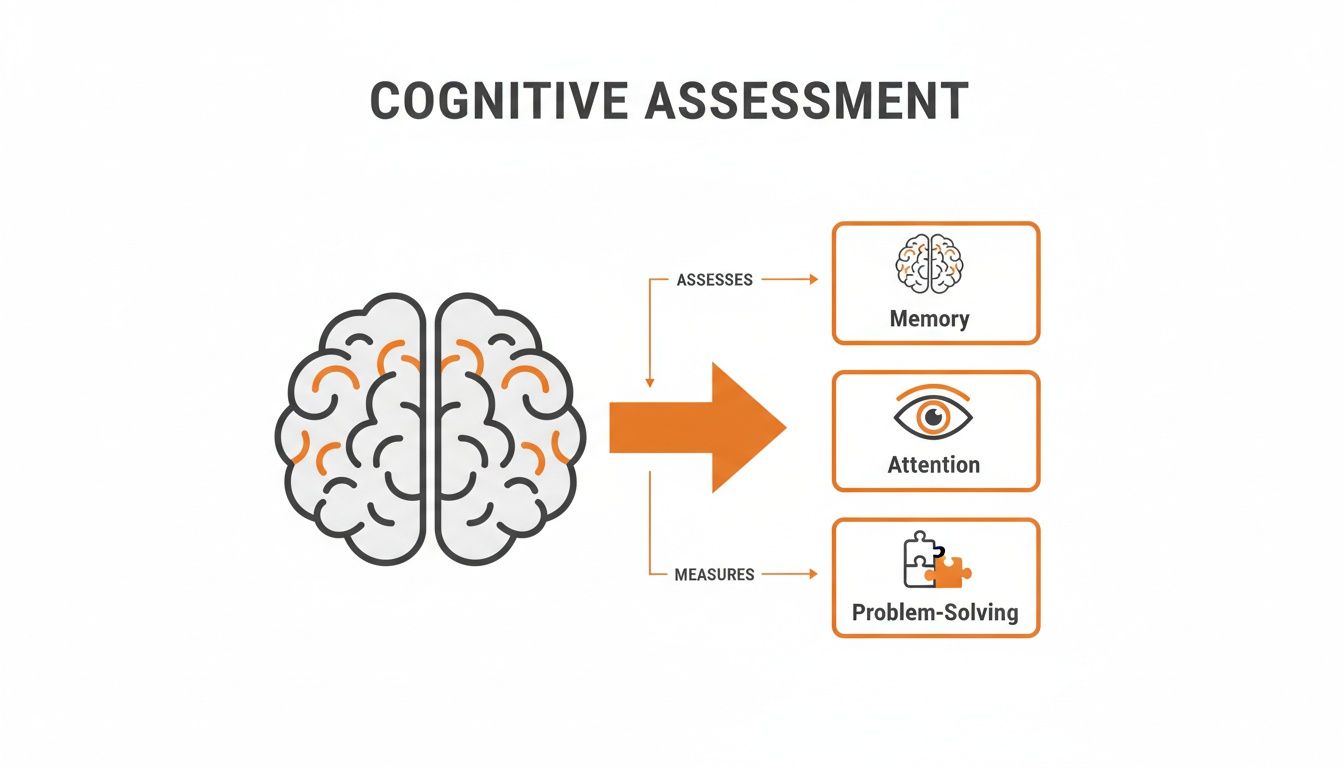
As the illustration shows, an assessment isn't just measuring one isolated skill. It's evaluating how foundational abilities like memory, attention, and problem-solving all work together as a team.
To give you a clearer picture, here’s a quick summary of the six pillars of cognitive function we've discussed, along with what they do and how you see them in action every day.
The Six Pillars of Cognitive Function
Cognitive Domain | Core Function | Everyday Example |
|---|---|---|
Executive Function | Planning, organising, and managing tasks. | Following a recipe to cook a meal with multiple steps. |
Memory | Storing and retrieving information. | Recalling a friend's birthday or remembering directions to a new place. |
Attention | Focusing on specific information while ignoring distractions. | Reading a book in a noisy café. |
Processing Speed | The time it takes to perceive and respond to information. | Quickly hitting the brakes when a car stops suddenly in front of you. |
Perception | Interpreting and organising sensory information. | Recognising a familiar face in a crowd or identifying a song on the radio. |
Eye-Hand Coordination | Syncing visual information with physical movement. | Catching a ball, typing on a keyboard, or writing with a pen. |
These six domains work together, and a detailed assessment helps us understand the unique cognitive profile of an individual, showing both their strengths and areas that might need a bit more support.
The Final Three Pillars of Cognition
Beyond the "big three" of executive function, memory, and attention, three other domains are vital for a complete cognitive profile. These skills often operate in the background, but they are absolutely essential for how we interact with the world around us.
Understanding the full spectrum of cognitive domains is crucial. About half of all individuals who take a comprehensive cognitive assessment show a significant discrepancy between one ability and another, highlighting the importance of a detailed profile over a single score.
These abilities are:
Processing Speed: This is how quickly your brain can take in information, make sense of it, and respond. It’s not about how smart you are, but how efficient your mental processing is. A perfect real-world example is a driver seeing a traffic light turn yellow and instantly deciding whether to stop or proceed safely.
Perception: This involves making sense of what you see, hear, and feel. Visual perception, for instance, helps you recognise a friend's face in a crowd or understand the layout of a room at a glance. Auditory perception lets you pick out a specific voice in a noisy restaurant.
Eye-Hand Coordination: This is the seamless teamwork between your eyes and your hands. It's the skill that allows you to catch a ball, write legibly, or thread a needle—a direct link between what you perceive and what you physically do.
Each of these six domains provides a vital piece of the puzzle. A thorough cognitive ability assessment measures them all to create a detailed, nuanced picture of an individual's mental landscape. This clarity moves us beyond guesswork and toward effective, personalized strategies for support.
How Cognitive Assessments Actually Work
Cognitive assessments have come a long way from the old days of pen-and-paper tests. For decades, those traditional, time-consuming methods were all we had. They were foundational, shaping our understanding of brain function, but they had some serious drawbacks.
These tests could take hours to complete, and the scoring often relied heavily on a clinician’s personal interpretation. This created bottlenecks, delaying critical support and making the whole process feel like a chore for the patient—especially for kids.
The Shift to Digital and Gamified Assessments
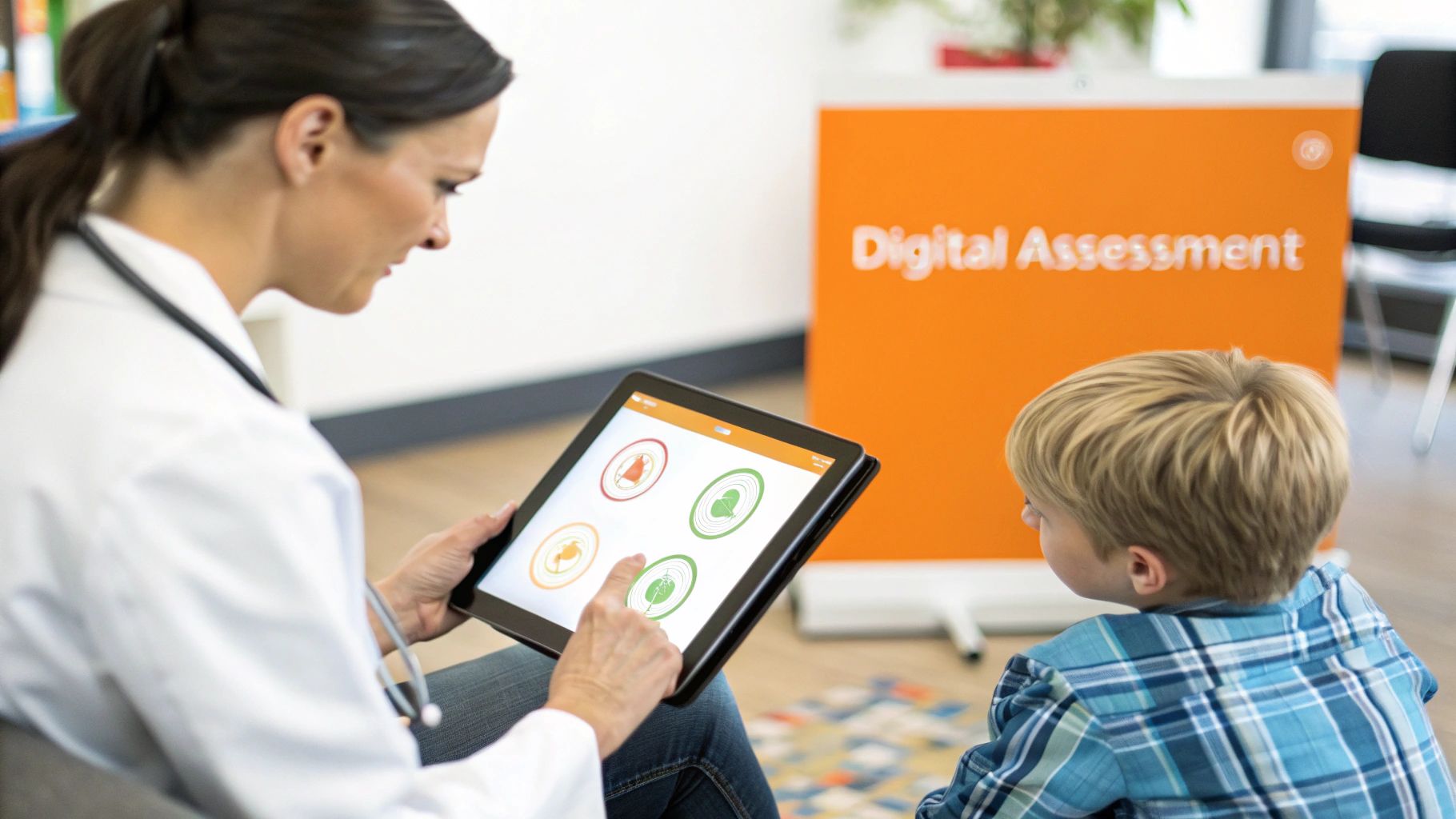
Thankfully, digital platforms have completely changed the game. By moving assessments onto tablets and computers, we've tackled many of those old challenges, making the process faster, more objective, and a lot more engaging.
This move to digital brought a powerful tool into the mix: gamification. Instead of asking a child to grind through worksheet-style tasks, a gamified assessment frames challenges as fun, interactive activities. This isn't just about making it fun; it’s a smart way to get better data.
When an assessment feels like a game, children are more likely to stay engaged and perform at their best. This heightened focus reduces frustration and test anxiety, leading to a more accurate and authentic measure of their true cognitive abilities.
This approach ensures the results reflect a person's actual skills, not just how bored or tired they are. A well-designed digital assessment can capture subtle performance details that are simply impossible to track with a pencil.
The Power of AI-Powered Analytics
The real breakthrough, though, is the integration of artificial intelligence (AI). While the user sees an engaging game, a powerful data-processing engine is working behind the scenes. It analyzes thousands of data points in real-time, from response times measured in milliseconds to the tiny patterns in how someone solves a problem.
This technology allows clinicians to get a comprehensive, objective cognitive profile in under 30 minutes. You can't overstate the impact of that speed. It takes a process that used to span multiple hours and turns it into a quick, efficient screening that delivers immediate insights.
This efficiency is fuelling incredible growth. The U.S. Neurocognitive Assessment and Rehabilitation Market hit USD 2.94 billion in 2023 and is expected to more than double to USD 6.16 billion by 2032. Cognitive assessments are the driving force here, holding a 56.20% share of the market because they're so vital for early detection of conditions like ADHD and traumatic brain injury.
Unlocking Benefits for Clinicians and Patients
For healthcare providers, this evolution means a smoother workflow and sharper decision-making. Instead of waiting days for a report, clinicians receive automated results and real-time support, allowing them to figure out the next steps right away.
Here are just a few of the practical benefits modern assessment platforms offer:
Accelerated Care Planning: Quick results cut down on long waits, letting clinicians create and start personalized intervention plans much faster.
Objective, Data-Driven Insights: AI analysis gets rid of subjective scoring, giving you consistent, reliable data that makes it easier to track progress accurately over time.
Reduced Administrative Burden: With automated reporting, clinical time is freed up. Professionals can spend more time on patient care and less on paperwork.
Enhanced Patient Experience: The engaging, game-like format makes the assessment less stressful for everyone, which improves cooperation and the quality of the data.
Ultimately, the move to digital and AI-powered assessments is about removing friction from the system. It cuts delays, delivers deeper insights, and empowers clinicians to make better-informed decisions, faster. To see how these tools work as a preliminary check, you might be interested in our guide on the cognitive screening test online.
Putting Assessment Results into Action
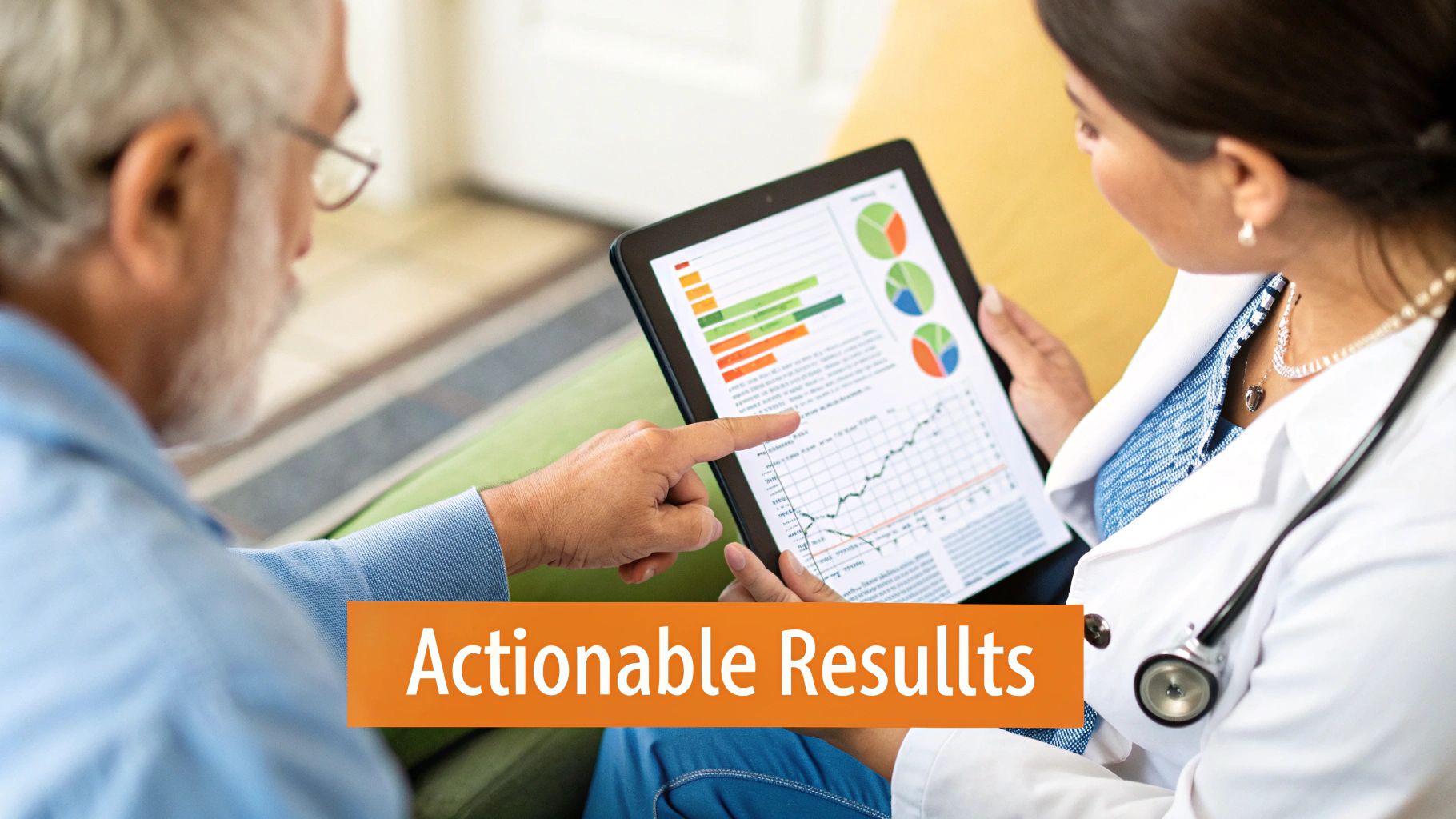
A cognitive ability assessment is only as good as the action that follows. The report itself isn’t the finish line; it’s the starting block for creating truly personalized and effective interventions. The real magic happens when clinicians, educators, and families use that data to build targeted support plans, measure outcomes objectively, and track progress without any guesswork.
This is where we move from just observing a problem to actively solving it. Instead of a trial-and-error approach, the data from a solid cognitive assessment gives us a clear roadmap. It shines a light on an individual's unique profile of strengths and weaknesses, paving the way for strategies tailored to how they actually think and learn.
From Data to Decisions in Paediatric Care
Think about a developmental paediatrician working with a young child who is having a tough time in school. The teacher says they have attention issues, but what does that really mean? Is it a problem with staying focused for long periods, or is the child simply overwhelmed by distractions? A detailed cognitive ability assessment can cut through the fog.
If the results point to a specific weakness in selective attention but also reveal strong visual-spatial skills, the intervention plan suddenly becomes crystal clear. Instead of a generic "let's improve focus" plan, the team can roll out precise, targeted strategies.
Classroom Adjustments: An actionable step is to move the child to a seat with fewer visual distractions, away from a busy window or hallway.
Targeted Tools: Using visual aids like graphic organizers can play to their strengths, helping them structure their thoughts and compensate for attention challenges.
Therapeutic Activities: The paediatrician can recommend specific programs designed to strengthen the underlying attention networks, turning a weakness into a skill that can be developed. To learn more about these options, you can explore our approach to cognitive therapies.
This data-driven method replaces ambiguity with precision, leading to support that works faster and more effectively.
Tracking Recovery After a Neurological Event
Now, let's picture a neurologist helping a patient recover from a stroke. Cognitive recovery can be a slow, often frustrating journey, and hearing "I'm feeling a bit better" isn't enough to guide effective rehabilitation. What you really need are objective benchmarks.
A modern cognitive assessment provides exactly that. By running regular, brief assessments, the neurologist can track changes in specific domains like processing speed and executive function with incredible accuracy. This allows the rehabilitation plan to be adjusted in real time.
A cognitive assessment provides the objective data needed to map the recovery journey. It shows what is working, what isn't, and where to focus therapeutic efforts, empowering both the clinician and the patient with a clear view of progress.
For example, if progress on memory recall stalls, the therapy can be tweaked to introduce new mnemonic strategies. If processing speed is on the upswing, the difficulty of cognitive exercises can be increased to keep the momentum going. This constant feedback loop ensures therapy stays challenging but achievable, maximizing the chances of a successful recovery.
Applications in Senior Care and Research
The power of cognitive assessments doesn't stop with individual clinical cases; they are making a huge impact in broader healthcare and academic settings. In senior care, for instance, these tools are invaluable for spotting the early signs of cognitive decline. Regular screenings can pick up on subtle changes in memory or executive function long before they become obvious in daily life, allowing for much earlier intervention.
It's not just about memory; understanding the role of cognitive factors in fall prevention is also crucial, as assessments can flag risks related to perception and reaction time.
This proactive approach is changing the game in a rapidly growing market. North America, in fact, dominated the Cognitive Assessment and Training in Healthcare Market, which hit USD 2.58 billion. The healthcare sector was the biggest player with a 47.7% share, and in rehabilitation centres, 37.5% of assessments are now used to track the impact of treatment. For senior communities, the ability to scale this technology has led to incredible benefits, with some reporting cost reductions as high as 30% in reassessments.
This kind of objective data is also vital for academic researchers conducting ethical studies on cognition. By providing reliable metrics, these assessments help push forward our collective understanding of the human brain. Ultimately, the true strength of a cognitive ability assessment lies in its versatility—it translates complex brain functions into actionable data that can be used everywhere from a personal care plan to large-scale research.
Integrating Modern Assessments into Your Practice
Bringing a modern cognitive ability assessment tool into your practice isn't just a tech upgrade; it's a strategic move that pays off in both efficiency and better patient outcomes. The key is to start small, let your team build confidence, and clearly communicate the value to everyone involved.
Right off the bat, let's tackle the common worries. Practitioners often ask about the initial cost, the time needed for training, and how patients will react. But leading platforms today are designed to be affordable and surprisingly intuitive, often requiring very little training to get going. The change for patients is almost always a welcome one—engaging, game-like formats are far less intimidating than old-school pencil-and-paper tests.
Starting a Pilot Program
Instead of trying to overhaul everything at once, think about launching a pilot program. This gives your team a chance to get comfortable with the new technology in a low-pressure setting. A practical approach is to test the platform with a specific patient group, such as new ADHD evaluations or post-concussion follow-ups. This lets staff learn the ropes and see the benefits firsthand without disrupting your entire practice.
A great pilot program should focus on a few key goals:
Seamless Integration: Make sure the assessment tool plays nicely with your existing systems, like your electronic health records (EHRs).
Workflow Efficiency: Track the time saved with streamlined administration and automated reporting.
Patient Feedback: Collect input from patients and their families. How did they find the new format? What was their experience like?
This focused approach helps build enthusiasm internally and gives you solid data to justify a practice-wide rollout.
Communicating the Benefits Clearly
Explaining the "why" behind the change is crucial for both your team and your patients. For your staff, frame it as a powerful tool that cuts down on administrative busywork and delivers faster, more reliable data to back up their clinical expertise.
For patients and their families, it's all about a better care experience. An actionable script might sound like: "We're using a new tool that helps us see exactly where your cognitive strengths are and where you might need support. It's quick, engaging, and gives us the information we need to create a care plan that’s truly personalized for you."
These modern tools are designed to augment, not replace, clinical judgment. They provide a reliable stream of objective data that empowers professionals to make better-informed decisions, turning subjective observations into measurable insights.
This builds trust and positions the assessment as a collaborative step toward better health outcomes. Explore our solutions to see how these tools are designed for easy adoption.
The Impact of a Future-Ready Practice
Adopting modern assessment tools is about more than just a workflow update—it’s about future-proofing your practice. The world of brain health is moving fast, and data-driven methods are quickly becoming the standard of care. North America is leading the charge, commanding a 38.7% share of the global Cognitive Assessment and Training Market.
For clinics, this translates into real-world benefits. Diagnostic delays can be slashed by up to 40%, which not only cuts costs but enables much faster, more effective interventions.
By bringing these tools into your clinic, you’re aligning your practice with the forefront of digital neuropsychiatry. It's a strategic shift that leads to quicker, better-informed care plans and cements your reputation as a leader in efficient, evidence-based cognitive healthcare.
Where Cognitive Assessment Goes from Here
If this guide has shown you anything, it’s that cognitive ability assessments are no longer the slow, cumbersome processes they used to be. They’ve evolved into dynamic, accessible tools that empower proactive brain health management, moving far beyond the traditional methods that often created bottlenecks in care.
We've walked through the core cognitive domains and explored how to apply assessment data in the real world. Now, the focus shifts to weaving these modern digital tools directly into your workflow, creating a more responsive and effective model of care for everyone involved.
It's All About the Data
The future of cognitive health lies in using objective data to build truly personalized interventions. By quickly identifying an individual’s unique profile of cognitive strengths and weaknesses, clinicians can finally move past the guesswork and develop targeted support plans right from day one.
This data-driven approach also makes tracking progress over time incredibly precise and efficient. It gives you a clear, measurable way to see if an intervention is actually working, allowing for real-time adjustments that lead to better outcomes.
The core principle is simple: provide the right support, at the right time, based on reliable evidence. Modern assessments make this a reality by turning complex cognitive functions into actionable insights for superior care.
Your Next Step Toward Better Cognitive Care
The journey toward better brain health outcomes starts with adopting tools that deliver speed, precision, and clarity. When you replace subjective observation with objective metrics, you empower yourself, your patients, and their families with a clear path forward. It’s a strategic shift that’s key to delivering faster, better-informed care plans and building a more efficient practice.
If you’re ready to see firsthand how AI-powered, evidence-based cognitive assessments can help you remove ambiguity and deliver a higher standard of care, we invite you to take the next step.
Visit the Orange Neurosciences website to request a personalized demo and discover how our platform can fit into your workflow. You can also subscribe to our newsletter for the latest insights in the world of cognitive health.
Your Questions, Answered
Stepping into the world of cognitive ability assessments can bring up a few questions. We get it. Here are some clear, straightforward answers to the most common queries we hear from clinicians, educators, and families just like yours.
How Long Does a Modern Cognitive Assessment Take?
Gone are the days of spending hours on traditional neuropsychological evaluations. Thanks to modern, AI-powered platforms, we've dramatically cut that time. A comprehensive assessment that profiles key areas like attention, memory, and executive function can now be wrapped up in under 30 minutes.
This speed means clinicians get immediate, objective data to inform their decisions, without the long, anxious wait for results.
Is a Cognitive Assessment a Diagnostic Tool?
That's a great question, and the answer is no. A cognitive ability assessment isn't a standalone diagnostic tool. Think of it more as a powerful support instrument that gives you a detailed, objective profile of an individual's cognitive strengths and areas that might need a bit more support.
This data is incredibly valuable for healthcare professionals. It helps them decide if a full diagnostic evaluation is needed and adds a critical piece to the overall clinical picture, but it doesn't provide a diagnosis on its own.
Think of it like an advanced screening tool. It hands you a highly detailed map of cognitive function, highlighting areas that might need a deeper, more specialized investigation by a qualified professional.
Making this distinction is really important for setting the right expectations with patients and their families from the get-go.
Are These Assessments Suitable for Children?
Absolutely. In fact, many modern platforms are specifically designed with kids in mind, using a fun, game-based experience. This approach is fantastic for keeping a child’s attention and motivation high, which naturally leads to more reliable and accurate results.
For instance, a task measuring processing speed might feel more like a fun reaction game than a test. This makes the whole process less intimidating and gives developmental pediatricians and educators the crucial insights they need into a child's development without causing any extra stress.
How Can a Clinic Integrate These Assessments into Its Workflow?
Leading platforms are built for a seamless fit. They are usually cloud-based, work well with existing electronic health record (EHR) systems, and have intuitive interfaces that your staff can pick up with minimal training.
Most providers also offer dedicated support to make the transition smooth. The goal is to enhance your existing workflow, not force a complete overhaul, allowing your practice to quickly start benefiting from faster assessments and automated reporting.
Ready to see how a modern cognitive ability assessment can make a real difference in your practice? Visit Orange Neurosciences to request a demo and discover how our AI-powered platform delivers precise, actionable insights in minutes.
Orange Neurosciences' Cognitive Skills Assessments (CSA) are intended as an aid for assessing the cognitive well-being of an individual. In a clinical setting, the CSA results (when interpreted by a qualified healthcare provider) may be used as an aid in determining whether further cognitive evaluation is needed. Orange Neurosciences' brain training programs are designed to promote and encourage overall cognitive health. Orange Neurosciences does not offer any medical diagnosis or treatment of any medical disease or condition. Orange Neurosciences products may also be used for research purposes for any range of cognition-related assessments. If used for research purposes, all use of the product must comply with the appropriate human subjects' procedures as they exist within the researcher's institution and will be the researcher's responsibility. All such human subject protections shall be under the provisions of all applicable sections of the Code of Federal Regulations.


© 2026 by Orange Neurosciences Corporation