Your Guide to the WIAT Achievement Test
Oct 31, 2025
The Wechsler Individual Achievement Test, or WIAT, is a specialized tool used by psychologists and educators to get a clear picture of someone's academic skills. Think of it less like a report card and more like a detailed 'academic check-up.' It gives a snapshot of an individual’s strengths and weaknesses in fundamental areas like reading, math, writing, and even oral language.
Demystifying the WIAT Achievement Test
Ever wondered why a bright, engaging child just can't seem to get their ideas down on paper? Or why a student who loves math class struggles to read a simple paragraph? These are the kinds of questions that keep parents and teachers up at night, and the WIAT achievement test is one of the best tools we have to find the answers.
Instead of just spitting out a pass-or-fail score, the WIAT creates a detailed map of a student’s academic profile. It looks past rote memorization to assess the core skills that make learning possible. This helps turn a vague concern like, "they're just not keeping up," into a clear, actionable diagnosis, which is the first step toward creating real, effective support.
What Is the Purpose of the WIAT?
The main reason for using the WIAT is to get a truly deep and accurate understanding of how an individual is functioning academically. It’s not about ranking kids against each other. It’s about pinpointing exactly where they shine and where they need a little extra help. This level of diagnostic clarity is invaluable for a few key reasons:
Identifying Learning Disabilities: The test is a cornerstone for diagnosing conditions like dyslexia or dysgraphia. It provides objective data showing a significant gap between a student's cognitive potential and their actual academic performance in a specific area.
Guiding Educational Planning: The data from a WIAT assessment provides the solid evidence needed to build an Individualized Education Program (IEP). For example, if a student struggles with math problem-solving, their IEP can include a specific, targeted goal like, "The student will use a step-by-step checklist to solve multi-step word problems with 80% accuracy."
Informing Instructional Strategies: A teacher can take the results and tailor their classroom approach. A student with fantastic listening comprehension but weak reading skills might get a huge boost from using audiobooks for social studies texts or receiving verbal instructions for assignments.
To provide a quick overview, here's a look at the WIAT's core features.
WIAT At a Glance Key Information
Feature | Description |
|---|---|
Test Name | Wechsler Individual Achievement Test (WIAT) |
Primary Use | Assessing academic achievement across multiple domains. |
Age Range | Suitable for individuals aged 4 to 50+. |
Administration | Conducted one-on-one by a trained professional. |
Key Areas Assessed | Reading, Writing, Mathematics, Oral Language. |
Primary Goal | To identify learning disabilities and inform educational planning. |
This table shows just how comprehensive the WIAT is, offering a versatile tool for understanding academic performance at almost any age.
From Concern to Clarity: An Example
Let’s imagine a third-grader named Leo. He's a brilliant storyteller, captivating his friends with imaginative tales, but he finds it incredibly difficult to spell or write a complete sentence. His parents and teacher are worried but can't quite put their finger on the problem.
A school psychologist administers the WIAT. The results are eye-opening: Leo’s oral language skills are well above average for his age, but his scores for written expression and spelling are significantly lower.
This isn't just a case of being a "messy writer." The WIAT data provides objective evidence of a significant gap between his verbal ability and his writing skills, strongly suggesting a specific learning disability like dysgraphia.
Suddenly, the team isn't guessing anymore. Armed with this actionable insight, they can implement a structured writing program, introduce assistive technology like speech-to-text software, and set realistic goals based on Leo's unique learning profile. The WIAT is one of many important cognitive assessments that can transform a general concern into a targeted plan, truly lighting the way for a student's success.
A Practical Look at the WIAT Subtests
To really get a feel for the wiat achievement test, we have to go beyond the abstract and see what a student actually does. The test isn't one big, scary exam. Think of it more like a collection of smaller, focused tasks called subtests. Each one is a specialized tool, designed to measure a specific piece of the academic puzzle.
These subtests are grouped into four main areas: Reading, Math, Written Language, and Oral Language. By looking at what's involved in each, we can see how the WIAT builds a detailed profile of a student's skills, showing not just what they know, but how they think.
Deconstructing the Reading Composites
Reading is so much more than just knowing words. The WIAT breaks this complex skill down into its core parts to pinpoint exactly where a student shines and where they might be struggling.
Take the Word Reading subtest. It's pretty straightforward—the student reads a list of words that get harder and harder. But the real insight often comes from the Pseudoword Decoding subtest. Here, a student has to read made-up, nonsense words like “plim” or “freb.”
A practical example: A student might breeze through "Word Reading" by recognizing sight words but stumble on "Pseudoword Decoding." This is a huge clue. It suggests they rely on memorization, not on sounding out words. This insight tells teachers to focus on foundational phonics skills. This is an actionable insight because it takes memorisation completely out of the picture. The student must apply their knowledge of phonics—how letters and sounds connect—to figure it out.
For a deeper dive into reading assessments, you can check out our guide on the Test of Reading Comprehension.
Diving Into Math and Written Language
Just like with reading, the math and writing sections of the WIAT are built to uncover the thinking processes behind a student's answers. They look at everything from basic skills to more advanced, higher-order reasoning.
The Numerical Operations subtest might give a student a series of pen-and-paper calculations (like 45 + 19 or 12 x 8) to check their computational accuracy. But the Math Problem Solving subtest kicks it up a notch by putting math into a real-world context.
A student might be asked: "If you buy a toy for $5.75 and pay with a $10 bill, how much change should you get back?" This doesn't just test calculation. It tests their ability to understand language, figure out the right operation, and apply logic to solve the problem.
The Written Language section works in a similar way, examining everything from the nuts and bolts of spelling to the art of crafting an argument.
Spelling: This subtest assesses how well a student can spell words spoken by the examiner, which tells us about their knowledge of spelling rules and phonetic patterns.
Sentence Composition: Here, students have to combine or build sentences to express ideas, showing their command of grammar and sentence structure.
Essay Composition: Given a topic, the student writes a short essay. This is a great way to measure their ability to organise thoughts, build on an idea, and use vocabulary effectively.
Understanding Oral Language Skills
The Oral Language composite is a crucial part of the WIAT because strong verbal abilities are the foundation for almost all learning. These subtests check how well a student understands and uses spoken language.
In the Listening Comprehension subtest, the examiner might read a short story aloud and then ask the student questions about it. For example, after a story about a trip to the zoo, a question might be "Why was the monkey feeling sad?" This tests not just memory, but the ability to make inferences.
On the flip side, the Oral Expression subtest looks at how well a student can put their own thoughts into words. They might be asked to describe a picture or explain what a word means. This gives us a window into their vocabulary, how they structure sentences, and their overall ability to communicate clearly.
This infographic really helps tie it all together, showing the goal of combining these different insights.
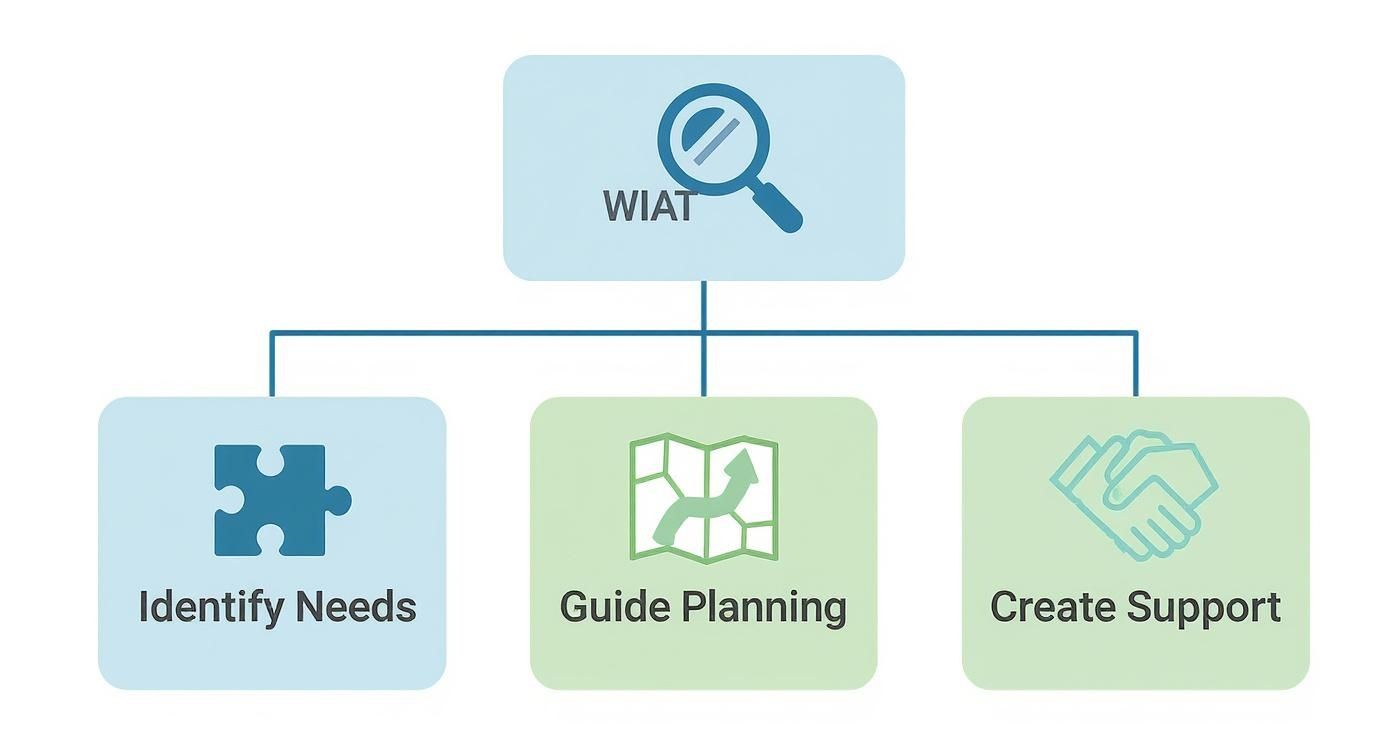
As the diagram illustrates, the WIAT acts as a diagnostic tool. It helps identify specific needs, which then directly informs educational planning and the creation of effective support strategies for the student.
By breaking down academic performance into these concrete, measurable skills, the WIAT gives educators and parents a clear, actionable roadmap. It moves past vague observations to deliver precise data—the kind you need to create support that truly makes a difference.
How the WIAT Is Administered for Accurate Results
The power of a WIAT achievement test doesn’t just come from its well-crafted subtests. The real secret to its reliability lies in the strict, standardized way it’s administered. This isn't a quiz a classroom teacher or parent can give. It takes a trained professional—like a school psychologist or an educational diagnostician—to make sure the results are both valid and reliable.
This level of expertise is non-negotiable. The examiner does far more than just read questions from a booklet. Their training covers creating a specific environment, following precise protocols, and, just as importantly, building a positive rapport with the student. This human element is absolutely key to getting a clear picture of a student's true abilities.
Creating the Optimal Testing Environment
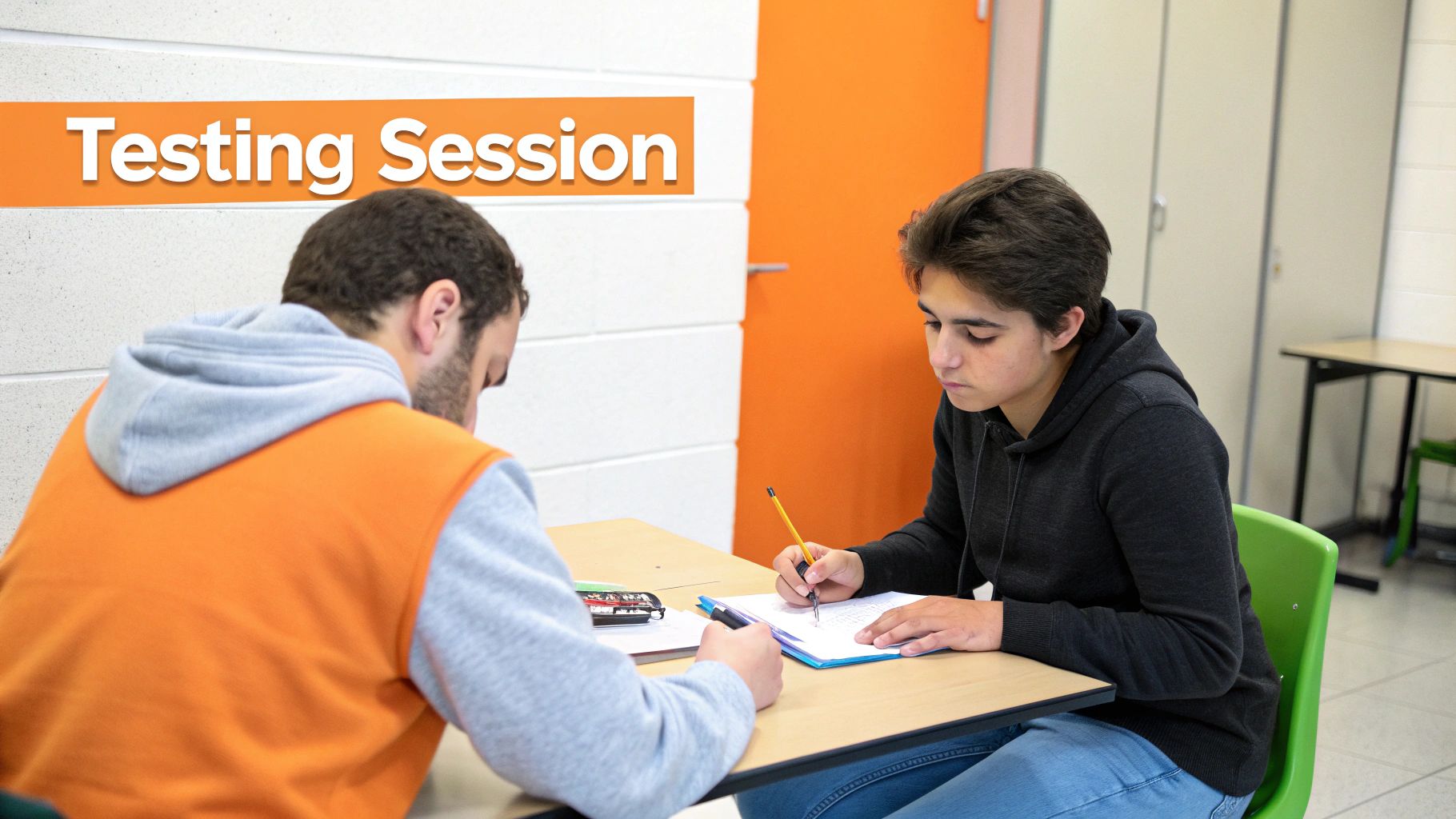
Picture a student, let's call her Maya, coming in for her assessment. The entire process is designed from the ground up to be as comfortable and low-stress as possible. The test is always given one-on-one in a quiet room, far from the distractions of a buzzing classroom or a noisy hallway.
Before any testing begins, the examiner's first job is to help Maya feel at ease. They might start with a friendly chat about her favorite video game or book before ever opening the test materials. This supportive atmosphere helps dial down test anxiety, ensuring that what we see on the day is a reflection of Maya's skills, not her nerves.
The whole point of standardized administration is to control for outside variables. By making sure every student takes the test under similar, ideal conditions, we can be confident the scores reflect their academic skills, not environmental factors like noise or pressure.
This careful setup is what transforms the WIAT from a simple test into a powerful diagnostic tool. It isolates and measures academic abilities in a controlled setting, giving everyone a clear and unbiased picture.
A Look Inside a Typical Session
A WIAT administration is a dynamic, interactive process, not a stiff, monotonous exam. The examiner thoughtfully arranges the subtests to keep the student engaged and prevent burnout.
For example, they might start with an engaging oral task like Listening Comprehension before shifting to a more demanding writing task. This variety keeps things fresh and helps the student stay focused. All the while, the examiner offers encouragement while sticking rigidly to the standardized instructions for every single subtest.
Rapport Building: The session kicks off by creating a positive, comfortable connection.
Clear Instructions: The examiner gives exact, scripted directions for each task.
Pacing and Breaks: The test moves at the student's pace, with breaks offered whenever needed.
Observation: The professional is also watching how the student tackles problems—do they rush, reread questions, or use their finger to track words? These observations provide valuable insights that scores alone can't capture.
While the WIAT is a top-tier tool, it's not the only one in the toolbox. The Woodcock-Johnson Tests of Achievement, for example, are commonly used in California to assess academic skills for special education evaluations. These norm-referenced tests compare a student's performance to their peers, helping teams figure out who is eligible for support. You can explore a reference document from the LAUSD to see how different assessments are used in practice. Understanding the wider world of cognitive assessment online can provide a fuller context for how these tools help students.
By blending a supportive environment with strict scientific protocol, the WIAT administration ensures the final report is a true reflection of a student's abilities. It lays the groundwork for creating a truly effective plan for support and intervention. For a deeper look into the results and what they mean for your child, please reach out to our team via our website or email.
Making Sense of Your WIAT Score Report
Getting a multi-page report from a WIAT achievement test can feel a bit like trying to read a foreign language. It’s packed with tables, charts, and terms like "standard score" and "percentile rank" that just aren’t part of our everyday vocabulary. But hidden in that data is a powerful story about your child's unique learning profile.
Think of this section as your personal translator. We’ll break down the most important parts of the WIAT score report, turning complex statistics into clear, meaningful insights. The goal is to empower you to see past the numbers and understand the real story they tell about a student's academic strengths and where they might need a little extra support.
Decoding the Core Numbers
First things first, let's get comfortable with the main types of scores you'll see. These numbers are just different ways of looking at the same performance, with each one offering a unique perspective. It’s like describing the weather: you could use the temperature, the humidity, or the wind speed—all are correct, but they each tell you something different.
Standard Score (SS): This is the headline number. The average score is always set to 100, with a standard deviation of 15. This means a score anywhere between 85 and 115 is considered solidly within the average range for their age.
Percentile Rank (%ile): This one is all about comparison. It shows how a student’s performance stacks up against their peers. A percentile rank of 60 means the student scored as well as or better than 60% of other students in their specific age group.
Age/Grade Equivalents: These scores compare a student's performance to the average performance of students in other grades or age groups. While they seem simple, it's best to approach them with a bit of caution, as they don't capture the full picture of a student's abilities.
Getting a handle on these key metrics is the foundation for interpreting the entire WIAT report and seeing the bigger picture.
Putting Scores into a Real-World Context
Let's make this real. Imagine a 10-year-old student named Sarah gets her WIAT report back. Her score on the Math Problem Solving subtest is a Standard Score of 82.
On its own, 82 doesn't mean much. But when we translate it, a clearer picture emerges. A Standard Score of 82 falls into the low-average range, just below the mean of 100. This score corresponds to a Percentile Rank of 12, which tells us Sarah scored higher than only 12% of her 10-year-old peers on this specific task.
This doesn't mean Sarah is "bad at math." It tells us something incredibly specific: she finds it harder than her peers to apply math concepts to solve word problems. This insight is gold for her teachers. Now, they can provide actionable support, like teaching her to highlight keywords in word problems or use a graphic organizer to break down the steps needed to find a solution.
This is where the WIAT shines. It provides the kind of diagnostic detail that allows for truly targeted support, moving beyond generic help to address the precise skill that needs reinforcement.
Looking for Patterns and Discrepancies
The real magic of the WIAT achievement test happens when you start connecting the dots between scores. A skilled psychologist or educator doesn't see a list of isolated numbers; they see a connected profile. They hunt for significant differences, or discrepancies, between various skill areas.
For instance, what if a student has a very high Oral Language score but a very low Written Expression score? That discrepancy is a massive clue. It suggests the student is great at thinking of ideas and talking about them, but struggles to get those same thoughts down on paper. This could point toward a learning disability like dysgraphia. This insight is actionable because it leads to specific interventions, such as using speech-to-text software or focusing on sentence-building exercises.
By analyzing these patterns, the report transforms from a simple evaluation into a diagnostic roadmap, pointing the way toward effective and personalized educational strategies. To discuss your child's specific score report and get actionable advice, feel free to reach out to our team via our website or by email for a personalized consultation.
Turning WIAT Results into Actionable Steps
A WIAT achievement test report isn't the end of the story—far from it. Think of it as the opening chapter of a strategic plan, providing the raw materials for real, practical support. The focus immediately shifts from, "What did they score?" to a much more important question: "Okay, what do we do next?"
This is where the numbers on a page transform into a clear roadmap. It's about translating those diagnostic insights into meaningful, supportive actions that address a student's unique learning profile, both at school and at home.
From Report to Roadmap in an Educational Setting
In a school, WIAT results are often the catalyst for creating or fine-tuning an Individualized Education Program (IEP). The data offers the objective evidence needed to set meaningful, measurable goals that get right to the heart of a student's challenges.
Let's imagine a student scores significantly below average on the 'Essay Composition' subtest. This is much more than a generic note about "weak writing." It's a specific data point that can guide a highly targeted IEP goal.
The Problem: The WIAT data shows the student struggles with organizing their thoughts, using varied sentence structures, and sticking to a central idea when writing.
The Actionable Goal: Armed with this information, the IEP team can set a clear goal: "By the end of the semester, the student will write a five-sentence paragraph that includes a topic sentence, three supporting details, and a conclusion, with 80% accuracy across three different writing samples."
The Intervention: This specific goal then dictates the support plan. The student might start using graphic organizers to map out ideas, work on sentence-combining exercises, and receive explicit instruction on paragraph structure. This is a practical, step-by-step approach directly informed by the test results.
To really get the most out of these results, schools should weave them into a broader strategy of data-driven decision making. This approach ensures that individual student data helps to inform and improve larger instructional practices for everyone.
Clinical Applications for Diagnosis and Intervention
In a clinical setting, psychologists use WIAT results alongside other cognitive assessments to diagnose specific learning disabilities. Identifying dyslexia is a classic example of this process in action. The key is often a significant gap between a student's overall cognitive ability (often measured with an IQ test) and their scores on the WIAT’s reading subtests.
When a bright, capable student scores unexpectedly low in areas like Pseudoword Decoding or Reading Comprehension, it provides strong evidence for a diagnosis of dyslexia. This confirmation is the key that unlocks access to specialized, evidence-based interventions like Orton-Gillingham or other structured literacy programs.
The results also help illuminate co-occurring conditions. For example, some research highlights how attention can impact academic achievement. One study found that adults with a childhood history of ADHD scored at a 7th-grade level in arithmetic, while their peers without ADHD scored at a high school level. A WIAT can help a clinician separate what might be a pure learning challenge from difficulties that stem from attention issues.
Understanding the root cause is everything. Sometimes, struggles with focus and organization are symptoms of deeper executive function difficulties. To learn more about this, check out our guide on how to improve executive function.
Your child’s WIAT report is a powerful tool. Contact our specialists via our website to learn how we can help you interpret the results and build an effective action plan.
How the WIAT Connects to School Curriculum
It’s a question I hear all the time from parents: does the WIAT achievement test actually have anything to do with what my child is learning in their classroom? It’s a great question, and the short answer is yes, but not in the way you might think. The WIAT doesn’t quiz your child on last week’s history lesson or a specific science chapter.
Instead, it measures the foundational academic skills they need to access and succeed with that curriculum in the first place.
Think of it like building a house. The school curriculum is the architectural blueprint—the detailed plan for the finished structure. The WIAT isn’t inspecting the finished house to see if it matches the blueprint. It’s testing the quality of the raw materials: the strength of the concrete foundation (reading comprehension), the integrity of the wooden frames (numerical operations), and the quality of the wiring (written expression). If the foundation is weak, the whole house is at risk, no matter how brilliant the blueprint is.
Pinpointing the "Why" Behind School Performance
This is where the WIAT becomes so powerful. It gives us the "why" behind what you're seeing on a report card. A student might be getting poor marks on their provincially mandated math tests, but that’s just the symptom. The WIAT helps us diagnose the root cause.
Let’s say a student consistently bombs tests with word problems. A practical analysis using WIAT subtests can untangle the reason:
Numerical Operations Score is Low: The student struggles with basic calculation. The actionable step is to practice math facts and computation skills.
Reading Comprehension Score is Low: They can do the math but can't understand what the question is asking. The actionable step is to work on reading and vocabulary skills in a math context.
Both scores are fine: The issue might be with executive functions like working memory or planning. The actionable step is to teach strategies for breaking down problems into smaller steps.
By pinpointing the exact skill deficit, we can stop throwing generic "math help" at the problem and start providing targeted, effective support that actually works.
Aligning with Modern Educational Standards
Of course, educational standards are constantly evolving. Schools are always working to ensure their assessments truly connect to what’s being taught in the classroom. This is a core principle in modern education.
For instance, when California adopted new academic standards, a major focus was placed on aligning assessments with classroom learning. You can read more from the California Department of Education about that process.
The WIAT acts as a bridge. It connects broad curriculum goals, like those found in the Common Core, to an individual student’s unique learning profile. While a provincial or state test might tell you if a student is meeting the standard, the WIAT tells you why they are—or are not—getting there.
To really grasp this, it helps to understand the bigger picture of educational assessment. Exploring discussions on Common Core Standards and state testing frameworks can shed light on how different types of tests work together to support student learning.
Ultimately, the WIAT achievement test provides the deep diagnostic data we need to make sure every student has the foundational skills to thrive within their school's curriculum. If you’re ready to translate these kinds of insights into a concrete action plan for your child, reach out to our team through our website. We're here to help.
Common Questions About the WIAT
When you're looking into academic assessments, a lot of questions can pop up. For parents and educators trying to get a handle on the WIAT achievement test, a few practical concerns always seem to rise to the top. Getting clear, direct answers is the best way to demystify the process and ease any worries you might have.
Let's dive into the most common questions we hear and give you the straightforward information you need to feel prepared.
How Long Does the Full WIAT Test Take?
The honest answer? It depends. The total time for a WIAT administration can vary quite a bit based on the student's age and which subtests are needed for their evaluation.
For a younger child in the early elementary years, the whole process might wrap up in 45 to 60 minutes. For an older student who needs a more comprehensive look at their skills, the testing could last for two hours or even longer.
To get the most accurate results, examiners almost never do it all in one go. They break the test into multiple sessions so the student doesn't get worn out. This practical approach helps maintain focus and ensures the child can perform at their best without feeling overwhelmed.
How Can My Child Prepare for the WIAT?
This is the big one, and the answer usually brings a sigh of relief. The best way to prepare for the WIAT achievement test has nothing to do with cramming, flashcards, or last-minute drills. The test isn't designed to see what facts a child memorized last night; it's meant to measure skills they've developed over years.
Here are some practical, actionable steps to create a calm and positive mindset:
Prioritize Rest: A full night of sleep before the assessment is non-negotiable. A tired brain can't show what it truly knows.
Eat a Healthy Meal: A good breakfast or lunch provides the fuel needed for focus and sustained energy.
Frame it Positively: Explain that this isn't a pass-or-fail school test. Use simple language: "This is just a way for us to see what's easy for you and what's a little tricky, so we can help you better in school." This reduces anxiety and helps them do their best.
A relaxed, supported child is always going to give a more accurate picture of their true abilities.
How Often Is the WIAT Administered?
You can expect a full WIAT evaluation to be a periodic check-in, not an annual event. Typically, a comprehensive assessment like this is recommended every two to three years.
There's a good reason for this timing. It allows enough time for educators and specialists to put support strategies in place based on the first assessment and then measure real, meaningful progress. This makes it an actionable tool for long-term planning. The WIAT is often a key part of initial special education evaluations and the required triennial reviews, which help track a student's development and adjust their learning plan as they grow.
Understanding your child's cognitive profile is the first step toward unlocking their full potential. At Orange Neurosciences, we provide precise cognitive data to help you and your child's support team make better-informed decisions. Explore our evidence-based tools at https://orangeneurosciences.ca or email us to discuss how we can create a personalized action plan based on your child's needs.

Orange Neurosciences' Cognitive Skills Assessments (CSA) are intended as an aid for assessing the cognitive well-being of an individual. In a clinical setting, the CSA results (when interpreted by a qualified healthcare provider) may be used as an aid in determining whether further cognitive evaluation is needed. Orange Neurosciences' brain training programs are designed to promote and encourage overall cognitive health. Orange Neurosciences does not offer any medical diagnosis or treatment of any medical disease or condition. Orange Neurosciences products may also be used for research purposes for any range of cognition-related assessments. If used for research purposes, all use of the product must comply with the appropriate human subjects' procedures as they exist within the researcher's institution and will be the researcher's responsibility. All such human subject protections shall be under the provisions of all applicable sections of the Code of Federal Regulations.


© 2026 by Orange Neurosciences Corporation