Assessment for Learning Disability: A Practical Guide to Gaining Clarity and Support
Dec 7, 2025
When you hear "assessment for learning disability," it’s easy to think of a test of intelligence, but it’s really about understanding how an individual learns. The goal is to create a detailed map of a person's cognitive strengths and challenges, which leads to a clear diagnosis and an actionable roadmap for support.
Unlocking Potential Through a Learning Disability Assessment
The idea of an "assessment" can feel intimidating. Let's reframe that. It's less like a final exam and more like a diagnostic check for a car's engine. A mechanic isn’t judging the car; they’re figuring out exactly what it needs to run at its best.
Similarly, an assessment for a learning disability gives you a detailed profile of a person’s unique cognitive wiring. It moves past the frustration of guesswork, replacing vague concerns like "my child is struggling with reading" with precise, actionable information. The goal is to find the root of academic difficulties and create a clear path forward.
What an Assessment Aims to Achieve
A comprehensive assessment is the first real step toward getting meaningful support. It’s designed to turn confusion into a well-defined plan by serving several key purposes:
Pinpoint Specific Challenges: It identifies the exact cognitive processes affecting learning. For example, it can distinguish between a problem with phonological processing (classic in dyslexia) and one with visual-spatial reasoning (often seen in dyscalculia).
Highlight Hidden Strengths: Assessments don't just find challenges; they often uncover incredible strengths—like superior creative thinking or problem-solving skills—that can be leveraged in a learning strategy.
Provide a Formal Diagnosis: A formal diagnosis is often the key that unlocks access to support systems like an IEP and accommodations in school, university, or the workplace.
Guide Personalized Interventions: The results are used to create targeted, actionable strategies, from specialized teaching methods to the use of assistive technology.
At its core, an assessment is about fairness. It’s not about giving someone an unfair advantage. It’s about providing the right tools to level the playing field, making sure every learner has a real opportunity to show what they know.
From Assessment to Action: A Practical Example
The journey usually starts with persistent learning struggles. The assessment itself involves a series of standardized tests given by a qualified professional, like a psychologist. For a closer look at one of the most in-depth evaluation types, check out our guide on what is a neuropsychological assessment. After testing, the results are analyzed to create a complete learning profile, which is then used to craft specific recommendations.
Here’s a practical example: Imagine a bright high school student who excels in class discussions but consistently fails written exams. An assessment reveals the issue isn't a lack of knowledge, but a slow processing speed.
The Actionable Insight: The report recommends providing extra time on tests.
The Result: With this simple accommodation, the student can now demonstrate their understanding without being penalized by their processing speed. This small change makes a world of difference.
Ultimately, the process gives individuals, parents, and educators the knowledge they need to turn challenges into opportunities for growth. To learn more about how our assessments can create a clear path forward for you, visit our website or send us an email to schedule a consultation.
Key Signs an Assessment May Be Needed
That nagging feeling that something isn’t clicking is often the first sign that an assessment might be needed. It’s usually not one big event, but a pattern of struggles that doesn't improve with time or extra help. The key is to look past a one-off bad test score and see the bigger picture.
These signs can appear differently depending on age and environment, but they typically fall into academic, cognitive, and behavioural categories. Knowing what to look for makes it clearer when it’s time to seek professional insight.
Academic and Cognitive Patterns to Watch For
Academic struggles are often the easiest to spot. We’re not talking about a lack of effort; we’re talking about a frustrating gap between what a person should be able to do and what they’re actually achieving.
Here are some practical examples of what this looks like:
A young child who can’t grasp rhyming or letter sounds, falling noticeably behind peers in pre-reading skills. This could be an early sign of a phonological processing issue.
A grade-schooler who reads a paragraph aloud perfectly but, a minute later, can’t tell you what it was about. This could point to problems with working memory or reading comprehension, which a formal test of reading comprehension can help pinpoint.
A high school student who is brilliant in discussions but whose essays are a jumbled mess of ideas and grammar mistakes, no matter how many times they're taught the rules. This may indicate dysgraphia or an executive function disorder.
A university student who feels swamped during lectures, unable to take useful notes because the information comes too fast to process. This points to a possible processing speed deficit.
These hurdles are usually tied to deeper challenges in cognitive processing, such as memory, attention, organization, or processing speed. It’s not an intelligence issue; it’s about the efficiency of the mental "wiring" used for learning.
Behavioural and Emotional Side Effects
The constant battle to keep up takes a huge emotional toll. These signs are just as critical as academic ones but are often misread as a bad attitude or laziness.
A child who avoids homework isn't necessarily lazy. Their resistance is often a coping mechanism for the deep-seated frustration that comes from feeling like they can't succeed, no matter how hard they try.
Keep an eye out for these actionable signs:
Chronic Frustration: Frequent meltdowns over schoolwork.
School Avoidance: Complaining about stomach aches or headaches on school mornings.
Low Self-Esteem: Saying things like, "I'm dumb," or "I can't do anything right."
Disorganization: A perpetually messy backpack, lost assignments, or an inability to manage deadlines, even with reminders.
It’s also important to know about conditions that can go hand-in-hand with learning disabilities. For example, understanding the signs of Sensory Processing Disorder can lead to a more complete and insightful assessment.
When these challenges aren't identified, the consequences can be devastating. Research in the Caribbean region shows that children with disabilities are 49% more likely to have never gone to school and 42% less likely to have basic reading and math skills. This isn't just a statistic; it's a call to action for better assessment. You can dive deeper into this in a report from DevTech Systems.
If these examples sound familiar, it might be time to pursue a formal assessment for a learning disability. An evaluation provides clarity, turning guesswork into a solid plan. If you'd like to talk through your concerns, send us an email—our team is here to help guide you.
Comparing Types of Learning Disability Assessments
Not all evaluations are the same. Choosing the right assessment for a learning disability is like deciding between a general check-up and seeing a heart specialist—each serves a vital purpose. Understanding the differences between screening tools, psychoeducational evaluations, and neuropsychological assessments is the first step toward getting the most effective support.
This choice matters. In Trinidad and Tobago, for example, a serious gap exists where only 68% of children with disabilities go to school, compared to 93% of their peers without disabilities. An accurate assessment is one of the most powerful tools for closing this gap, because it pinpoints needs and unlocks the right help. You can learn more about these statistics through the Central Statistical Office.
Screening Tools: The First Look
Think of a screening as a quick check-in, like the vision test at school. It won’t diagnose a problem, but it’s brilliant at flagging individuals who might need a closer look. Screeners are brief, low-cost, and can often be done by teachers or special education staff. Their main job is to identify "at-risk" students, acting as an essential first filter.
Here’s a practical example: A second-grade teacher uses a quick reading fluency screener. One student, who is otherwise bright, scores far below the benchmark. The screener doesn't say why, but it provides the actionable insight that a more detailed evaluation is needed.
Psychoeducational Evaluations: The Comprehensive Blueprint
This is the most common type of in-depth assessment for a learning disability used to diagnose conditions like dyslexia, dysgraphia, or dyscalculia. Conducted by a registered psychologist, it’s a deep-dive diagnostic on the "engine" of learning.
It provides a detailed blueprint by measuring two key areas:
Cognitive Abilities: This covers IQ, memory, attention, and processing speed to answer the question, "What is this person's potential to learn?"
Academic Achievement: Using standardized tests, this measures real-world skills in reading, writing, and math. For instance, a test like the WIAT achievement test can zero in on specific weak spots, like decoding phonetic sounds.
The psychologist then compares cognitive ability scores to academic achievement scores. A significant gap between potential (IQ) and performance (academic skills) is the classic indicator of a specific learning disability.
Neuropsychological Assessments: The Specialist Consultation
If a psychoeducational evaluation is the deep-dive, a neuropsychological assessment is the specialist consultation. It's recommended when learning challenges are complex or co-occur with conditions like ADHD, a traumatic brain injury, or autism.
A clinical neuropsychologist goes even deeper to examine specific brain functions, such as:
Executive functions (planning, organization, self-control)
Visual-spatial and visual-motor skills
Language processing
Memory and learning patterns
A neuropsychological assessment provides a more detailed "why." It doesn't just tell you that a student struggles with math; it can explain precisely how their executive functioning challenges make it hard to organize the steps needed to solve a multi-step problem.
This table breaks down the three approaches, giving you an actionable way to see which path might be right.
Comparison of Learning Disability Assessment Types
This table compares the key features of screening, psychoeducational, and neuropsychological assessments to help you understand which evaluation is right for your needs.
Feature | Screening Assessment | Psychoeducational Assessment | Neuropsychological Assessment |
|---|---|---|---|
Purpose | To identify at-risk individuals quickly. | To diagnose specific learning disabilities. | To investigate complex learning profiles and brain-behaviour relationships. |
Who Conducts It | Teachers, special educators. | Registered Psychologists (School or Clinical). | Clinical Neuropsychologists. |
What It Answers | "Does this person need a closer look?" | "Is there a learning disability? If so, what is it?" | "Why is learning difficult? How do specific brain functions impact learning?" |
Typical Outcome | Recommendation for further evaluation. | Formal diagnosis (e.g., Dyslexia) and an IEP. | Detailed diagnostic profile and highly targeted intervention strategies. |
Understanding these differences empowers you to ask the right questions and ensure you get an evaluation that provides clear, actionable answers. If you’re not sure where to begin, visit our website to learn how we can help guide you toward the most appropriate assessment path.
How the Assessment Process Works Step by Step
Embarking on an assessment for a learning disability can feel like heading into uncharted territory. It helps to have a map. This step-by-step guide breaks down the process so you know exactly what to expect, from the first call to the final report.
Each phase is designed to build a complete picture of an individual's unique learning profile. Understanding this workflow helps you feel prepared and in control, turning uncertainty into empowerment.
Phase 1: Initial Consultation and Intake
It all starts with an initial consultation. This is your chance to speak with the psychologist, share your concerns, and ask questions. Think of it as a two-way conversation to determine if a full assessment is the right next step. From there, you'll schedule a detailed intake interview to discuss the individual's developmental, medical, social, and academic history.
Actionable Tip: Come to the intake interview prepared. Gathering these documents beforehand makes the process much smoother:
Past report cards and teacher feedback.
Any previous assessment or screening results.
Relevant medical records from other specialists.
Phase 2: The Testing Sessions
This is the core of the assessment, usually spread across one or two sessions in a quiet, one-on-one setting. The psychologist will lead the individual through a series of engaging, standardized tests that measure a wide range of cognitive and academic skills.
It's important to prepare your child in a positive way. Frame it not as a "test" they can pass or fail, but as an activity to help everyone understand how their brain works best.
What to tell your child: "We're going to do some brain games and puzzles. The goal isn't to get a perfect score, but to show the psychologist all the amazing ways you think."
Ensuring your child is well-rested and has had a good breakfast can make a world of difference. Breaks are built in, and a variety of tasks—from hands-on puzzles to verbal questions—are used to keep things interesting. To get a better sense of the tools involved, you can learn more about our cognitive assessments and the objective data they provide.
Phase 3: Scoring, Analysis, and Report Writing
Once testing is done, the psychologist begins the detailed work of scoring and interpretation. This is the most time-intensive part of the process. They aren't just looking at final scores; they are meticulously analyzing patterns of strengths and weaknesses across all tests. This analysis involves comparing performance to standardized norms and weaving together test data with the background information and their own observations to form a diagnostic impression.
Phase 4: The Feedback Meeting and Final Report
The last step is the feedback meeting, where the psychologist walks you through the comprehensive report in clear, understandable language. They will connect the test scores to the real-world challenges you've observed. This meeting is your time to ask questions and get a concrete action plan.
Actionable Questions to Ask During Feedback:
What are the three most important findings from the assessment?
Can you give me a practical example of how this affects my child at school?
What are the top three recommendations we should focus on first?
How can we best share this information with their teacher?
This process is designed to arm you with the answers and tools needed to support yourself or your child effectively. If you have questions about getting started, contact our team to learn how we can guide you.
How to Understand Your Assessment Report
Getting a comprehensive assessment report can feel like someone just handed you a dense, technical manual. But learning to read it is the first step to unlocking its power.
Think of the report as a detailed user guide for a unique learner. It's designed to translate all the data from the assessment for learning disability into a clear story about an individual's cognitive profile, showing exactly where the challenges are and where their strengths shine.
This graphic shows the typical journey of an assessment, from the first chat to gather information, right through to the final feedback session where the report is explained.
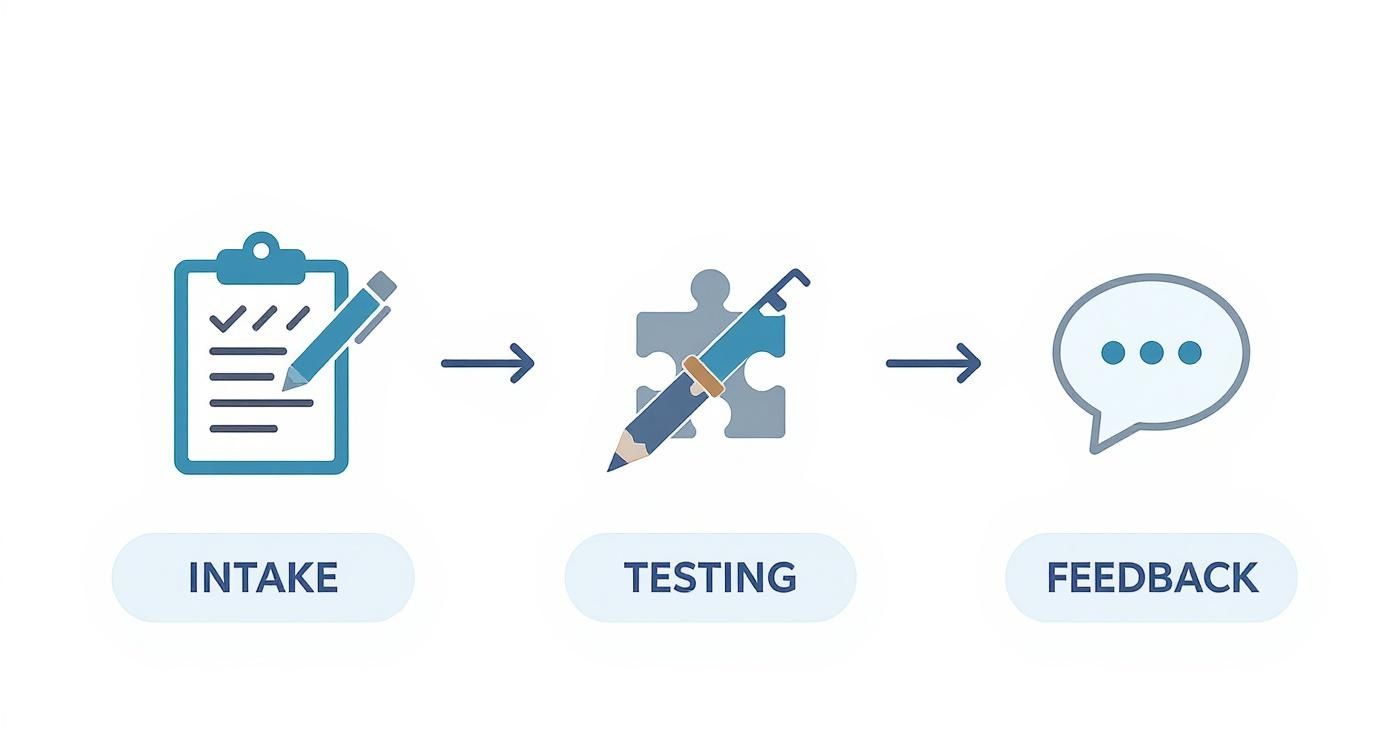
Each step builds a complete picture so the final report is both thorough and actionable.
Breaking Down the Key Sections
A good psychoeducational report tells a story. Each section builds on the last, creating a narrative that leads to the final diagnosis and recommendations.
Background History: This is where the story begins. It summarizes developmental, medical, family, and school history, providing crucial context.
Behavioural Observations: How did the person act during testing? This section gives qualitative colour commentary on effort, attention, and frustration tolerance.
Test Results and Interpretation: This is the core, where you'll find tables of scores. It can look intimidating, but the key is understanding what the numbers mean.
Scores are almost always shown as standard scores (where 100 is the average) and percentiles (which compare performance to same-aged peers). A percentile of 50 means the individual scored better than 50% of their peers—right in the middle.
Connecting Data to a Diagnosis: A Practical Example
A psychologist’s expertise is in connecting the dots. They look for patterns and significant gaps between scores that point to a diagnosis.
Fictional Student Profile: Leo, Age 10 Leo is a bright, chatty 10-year-old who struggles with reading and spelling.
Background: Teachers say he avoids reading aloud and his writing has many spelling mistakes.
Observations: During testing, Leo was engaged but got frustrated with tasks involving sounding out nonsense words.
Key Test Scores:
Cognitive Ability (IQ): Standard Score of 115 (84th percentile) – High-average intellectual potential.
Reading Fluency: Standard Score of 82 (12th percentile) – Reads much slower than his peers.
Phonological Processing: Standard Score of 79 (8th percentile) – A major weakness in hearing and manipulating language sounds.
Reading Comprehension: Standard Score of 95 (37th percentile) – Understands what he reads, but it takes him much longer.
In Leo's case, the psychologist sees a clear pattern: a huge gap between his high IQ and his very low scores in phonological processing and reading speed. This specific profile—strong intelligence paired with a core deficit in phonological skills—is the classic hallmark of Dyslexia.
The final parts of the report, the Summary and Diagnosis and the Recommendations, will state this diagnosis plainly and then lay out a list of practical, actionable steps. For Leo, this would include specialized reading instruction (phonics), extra time on tests, and access to audiobooks.
Understanding your report is the first step toward powerful advocacy. If you need help interpreting your results or want to explore what comes next, please reach out to our team via email.
Turning Your Diagnosis into Actionable Support
An assessment report isn't the final chapter; it's the starting line. The diagnosis is a powerful tool, giving you a clear direction for targeted support that can genuinely change a person's learning journey. This is where you turn insight into meaningful action.
The recommendations section is your roadmap. It lays out specific accommodations and interventions tied directly to the assessment findings.
From Findings to Practical Solutions
Every recommendation should connect back to a challenge uncovered during the assessment. The goal is to build a bridge between a cognitive weakness and a practical solution.
Here are some actionable examples:
Finding: Slow Processing Speed
Actionable Support: Get extended time (1.5x or 2x) on tests and assignments. This levels the playing field, giving the brain the time it needs to show what it truly knows.
Finding: Deficit in Phonological Processing (a hallmark of Dyslexia)
Actionable Support: Use text-to-speech software and audiobooks. This allows a student to learn through listening, bypassing the mechanical hurdle of decoding written words.
Finding: Weakness in Executive Functioning (organization and planning)
Actionable Support: Use graphic organizers, digital calendars with reminders, and break down large projects into smaller chunks. These strategies provide external structure. For more ideas, our guide on how to improve executive function offers great strategies.
Building Your Support Plan
With your report, the next step is to make these supports official. In the school system, this is usually done through an Individualized Education Plan (IEP). An IEP is a legal document mapping out a student’s learning goals and the services the school will provide.
An assessment report is the evidence you need to build a strong IEP. It replaces guesswork with data, ensuring the plan is tailored to the student's unique learning profile.
To get a better handle on what to ask for, it’s helpful to look at some concrete examples of Individualized Education Plans (IEPs). These can help you visualize a comprehensive plan and give you the language to advocate effectively.
For post-secondary students or employees, the process involves working with the institution's disability resource centre or HR department. The assessment report serves as the official documentation needed to secure legally protected accommodations.
Becoming a confident advocate for yourself or your child is the final, crucial piece. It means understanding the report, knowing your rights, and clearly communicating what's needed. It’s about ensuring an accommodation is put into practice in a way that truly supports learning.
This new understanding is your most powerful asset, empowering you to move forward with a clear, actionable plan.
Your Questions About Learning Assessments, Answered
Stepping into the world of learning disability assessments can feel overwhelming. We’ve put together clear answers to the questions we hear most often to give you the confidence you need to take the next step.
How Much Does a Private Learning Disability Assessment Cost?
A private psychoeducational assessment cost can vary based on location and complexity, but generally ranges from $2,000 to $5,000. While public schools provide assessments at no charge, waitlists can be long.
Actionable Insight: Check your private health insurance plan. Many policies cover a portion of the fee for services from a registered psychologist. Call your provider directly to confirm your coverage for psychological services before you book an assessment.
What Is the Difference Between a Learning and Intellectual Disability?
This is a critical distinction. A learning disability impacts a specific area of learning (like reading or math) in someone with average or above-average intelligence. It's a gap between potential and achievement.
An intellectual disability, on the other hand, involves broader challenges with general intellectual functions (reasoning, problem-solving) and adaptive behaviours (everyday living skills). A proper assessment for learning disability is the only way to get an accurate diagnosis, and the support strategies for each are completely different.
How Long Is a Learning Disability Assessment Valid For?
How long an assessment report stays "current" depends on its use.
For students in the K-12 system needing an Individualized Education Plan (IEP), an assessment is typically considered valid for two to three years. This ensures the support plan is based on current needs.
For post-secondary schools, an assessment done within the last three to five years is usually required to grant accommodations. However, some universities may require an updated adult assessment if the original was done when the student was much younger.
Actionable Tip: Always check directly with the specific school, university, or workplace to confirm their documentation requirements before you begin the process.
Ready to move from questions to clarity? Orange Neurosciences offers objective, AI-powered cognitive profiling that provides the insights needed to guide your next steps. Our tools give educators and clinicians precise, actionable data to make better-informed decisions. Find out how we can support your assessment journey at https://orangeneurosciences.ca or email us to discuss your needs.
Orange Neurosciences' Cognitive Skills Assessments (CSA) are intended as an aid for assessing the cognitive well-being of an individual. In a clinical setting, the CSA results (when interpreted by a qualified healthcare provider) may be used as an aid in determining whether further cognitive evaluation is needed. Orange Neurosciences' brain training programs are designed to promote and encourage overall cognitive health. Orange Neurosciences does not offer any medical diagnosis or treatment of any medical disease or condition. Orange Neurosciences products may also be used for research purposes for any range of cognition-related assessments. If used for research purposes, all use of the product must comply with the appropriate human subjects' procedures as they exist within the researcher's institution and will be the researcher's responsibility. All such human subject protections shall be under the provisions of all applicable sections of the Code of Federal Regulations.


© 2026 by Orange Neurosciences Corporation