A Parent's Guide to Assessment for Learning Disabilities
Dec 19, 2025
When you hear the term assessment for learning disabilities, it’s easy to imagine a single, high-stakes test. But that’s not the reality at all. It's actually a comprehensive evaluation led by a qualified professional, like a psychologist, to map out a person’s unique learning profile. Think of it less as a test and more as a detailed investigation to get actionable answers.
This deep dive into cognitive and academic skills is how we identify specific challenges like dyslexia or dysgraphia. Ultimately, the process is the key to unlocking an official diagnosis and securing the right support and accommodations at school.
Understanding the Path to a Learning Disability Diagnosis
It’s a familiar story for many parents and teachers. A child tries their hardest and receives quality instruction, but they still consistently struggle with reading, writing, or math. This situation often leaves everyone feeling a mix of concern and confusion. An assessment for learning disabilities is designed to turn that uncertainty into a clear, actionable path forward.
You can think of it as creating a detailed map of a child’s brain. It shows you where the learning superhighways are and where there might be a few roadblocks slowing things down. The main goal is to get to the root cause of the learning challenges, moving beyond simple observation to gather objective data on how a child processes information.
A proper assessment helps answer those critical questions weighing on your mind:
Does my child have a specific learning disability like dyslexia (reading), dysgraphia (writing), or dyscalculia (math)?
What are their unique cognitive strengths and where are the weaknesses?
What specific supports or interventions will actually help them succeed?
From Initial Concern to Empowered Action
The journey usually starts with a nagging concern and, with the right steps, ends with an empowered plan for support. The process isn't always linear, but it generally follows a clear progression from noticing a problem to finding a solution.
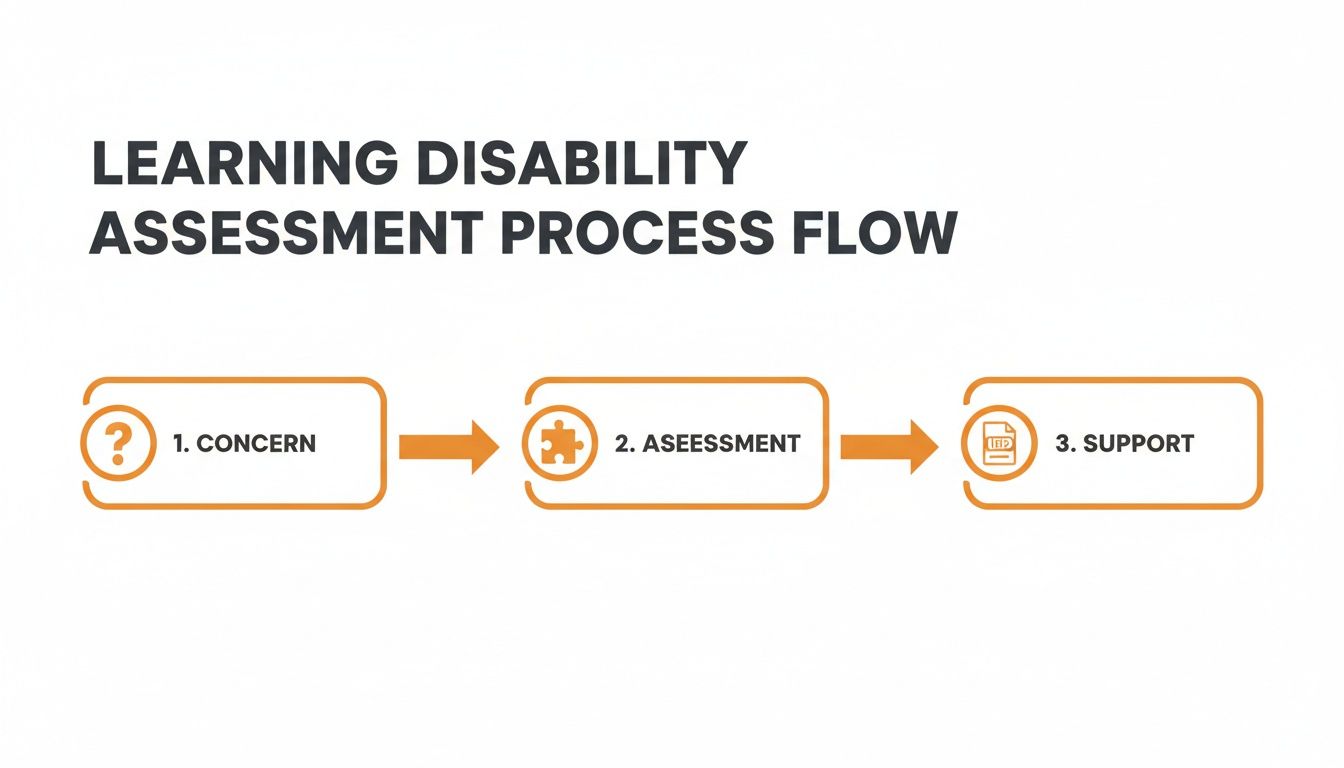
As you can see, a formal assessment is the critical bridge between recognizing a struggle and implementing effective, tailored solutions like an Individual Education Plan (IEP).
In Canada, this process is well-established and directly tied to educational services. Across the provinces, data shows that between 2% and 5% of students receive a formal diagnosis, which is what drives access to specialized programming. To give a recent example, during the 2022–2023 school year in Ontario, approximately 4.1% of students were identified with a learning disability and received support through an IEP.
Navigating this world also means understanding the professionals involved. Knowing the differences between a counsellor and a psychologist, for instance, ensures you connect with the right expert for a diagnostic assessment.
For a closer look at what these evaluations actually measure, our guide on what is cognitive assessment breaks down the core components.
The table below gives a quick overview of what to expect as you move through the assessment process.
The Learning Disability Assessment Journey at a Glance
Stage | What It Involves | Key Outcome |
|---|---|---|
Initial Concern & Data Gathering | Parents, teachers, and the student notice persistent academic struggles. Actionable Insight: Start a folder with work samples, report cards, and notes from teachers. | A documented history of the learning challenges and the interventions that have already been tried. |
Referral for Formal Assessment | The school psychologist is engaged, or a referral is made to a private psychologist. This stage includes intake interviews with parents and teachers to gather developmental and academic history. | A formal assessment plan is created, outlining which tests and measures will be used to investigate the concerns. |
Comprehensive Evaluation | The psychologist administers a series of standardized tests measuring cognitive abilities (like memory and processing speed) and academic skills (reading, writing, math). | Objective data that creates a complete picture of the student's cognitive and academic profile. |
Analysis & Diagnosis | The psychologist analyzes all the data—from test scores to observations and history—to identify patterns. They determine if the student's profile meets the criteria for a specific learning disability. | A diagnostic decision is made, and the student's specific areas of strength and need are identified. |
Feedback & Reporting | A detailed report is written explaining the findings, diagnosis, and evidence-based recommendations for school and home. The psychologist meets with the family (and often the school) to discuss the results. | A clear understanding of the diagnosis and a roadmap for targeted interventions and accommodations. |
Implementation & Support | If a learning disability is identified, the results are used to develop an Individual Education Plan (IEP) or 504 Plan, outlining specific supports, accommodations, and goals for the student at school. | The student begins receiving the necessary support to access the curriculum and demonstrate their learning. |
This journey can feel daunting, but each step is designed to bring more clarity and provide the targeted help a child needs to thrive.
If you are just starting this journey and need guidance on where to begin, our team can help. Email us or book a call to discuss your concerns and learn how our tools can provide initial insights into your child’s cognitive profile.
Screening vs. A Full Psychoeducational Evaluation
When you first suspect your child might have a learning disability, the path forward can seem overwhelming and full of confusing terms. You’ll probably hear two phrases pop up again and again: screening and psychoeducational evaluation. Knowing the difference is your first, most critical step.
Let's use an analogy. A screening is like taking a quick temperature check. It’s a fast, simple way to see if a fever—or in this case, a potential learning challenge—is even there. It flags a risk, but it can't tell you what’s causing it.
A full psychoeducational evaluation, on the other hand, is the complete diagnostic workup with a specialist. It’s a deep, thorough investigation to uncover the root cause of that fever, leading to a clear diagnosis and a detailed plan for what to do next.
What a Screening Can and Cannot Tell You
A screening is often the starting point, usually done right at school. It’s a brief, informal process using quick tasks to identify students who might be at risk for academic struggles. These tools are built for speed and efficiency, not for a deep dive.
A screener will never give you a diagnosis. Its only job is to cast a wide net and catch any students who might need a closer look.
Practical Examples of Screening Tasks:
Rapid Naming: A student might be asked to name a series of letters, numbers, or objects as fast as they can. This little task screens for processing speed issues, which are often tied to reading difficulties.
Phonological Awareness: Can a child identify rhyming words? Can they clap out the syllables in a word like "butterfly"? This checks for the foundational skills everyone needs to learn to read.
Basic Math Facts: A quick worksheet of simple addition or subtraction problems, timed for one minute, can flag potential signs of dyscalculia.
Actionable Insight: If a school screening flags a concern, your next step is to request a meeting with the teacher and the school's special education resource teacher to discuss the results and plan for a more comprehensive evaluation.
In fact, Canadian data reveals a gap between suspected issues and formal diagnoses. The 2017 Canadian Survey on Disability found that about 3.2% of Canadians over 15 reported having a learning disability. Yet, studies estimate that anywhere from 5–15% of children show significant learning challenges, though not all end up with a formal designation.
The Deep Dive of a Full Psychoeducational Evaluation
If a screening raises a red flag, the next step is a comprehensive psychoeducational evaluation. This is the only way to get a formal diagnosis. This in-depth process, always conducted by a registered psychologist, is carefully tailored to your child's specific areas of concern.
Unlike a screening, a full evaluation doesn't just ask if there's a problem. It works to understand why the problem exists and how it's impacting your child's learning.
This evaluation is about building a complete profile of your child as a learner. It identifies not only their challenges but also their unique cognitive strengths, which are essential for creating an effective support plan.
This thorough assessment pulls together several key pieces:
Clinical Interviews: The psychologist will have detailed conversations with you, your child's teachers, and your child to gather a full history—developmental, medical, and academic.
Behavioural Observations: During testing, the psychologist carefully observes how your child approaches tasks, their attention span, and their problem-solving strategies.
Standardized Testing: This is the heart of the evaluation. It involves a battery of validated tests to measure specific cognitive abilities and academic skills. These tools are far more detailed than screeners, often including various online cognitive tests to pinpoint strengths and weaknesses.
A screening might tell you a child is struggling with reading. But a full evaluation can tell you why—is it a phonological processing deficit, a working memory challenge, or slow processing speed? Getting to that level of detail is absolutely critical for developing targeted interventions that actually work.
What’s Inside a Psychoeducational Assessment?
Thinking about a psychoeducational assessment can feel a bit intimidating, but its goal is actually quite simple: to draw a detailed map of how a person learns. It’s like a full diagnostic workup for a high-performance engine. To really understand how it runs, you have to check all the parts—its speed, its fuel efficiency, and how every component works together.
This kind of evaluation digs much deeper than school marks to get at the core cognitive processes that make learning happen. It's a structured investigation that uses standardized, objective tools to find specific areas of strength and get to the root cause of any learning challenges.
Measuring the Brain's Engine: Cognitive Ability Tests
The first major piece of the assessment looks at cognitive abilities. This isn't about what a child has learned, but how their brain is wired to learn in the first place. It’s a look under the hood at the mental machinery we use for thinking, reasoning, and solving problems.
Widely used tests, such as the Wechsler Intelligence Scale for Children (WISC-V), give us a window into several key areas. A psychologist will examine things like verbal comprehension (the ability to understand and use language) and visual-spatial skills (making sense of what we see).
Other critical functions that get measured include:
Working Memory: This is like the brain’s temporary sticky note. Practical Example: A child with weak working memory might forget the last part of a multi-step instruction like, "Put your book away, get your lunchbox, and line up at the door" by the time they've completed the first step.
Processing Speed: This measures how quickly someone can take in simple, visual information and respond accurately. Think of it as the brain's raw processing power.
Even if a child is incredibly bright and motivated, weaknesses in these areas can create major roadblocks to learning. Pinpointing them is a vital step in seeing the whole picture.
Evaluating Academic Skills: Achievement Tests
If cognitive tests look at the engine's potential, then academic achievement tests measure what that engine has actually produced. These tests see what a student has learned in subjects like reading, writing, and math compared to their peers.
Psychologists use standardized tools like the Wechsler Individual Achievement Test (WIAT) to get a clear reading on specific skills. For example, the reading portion will break things down into phonetic decoding (sounding out words), reading fluency (speed and accuracy), and comprehension (understanding the text). If you’d like to learn more about this tool, we have a helpful overview in our guide to the WIAT achievement test.
The goal is to spot any major gaps between a student’s cognitive potential and their actual academic performance. This kind of discrepancy is often a key sign of a specific learning disability.
Exploring Other Critical Learning Functions
A truly thorough assessment doesn't stop there. It also dives into other specialized functions that are absolutely essential for success in the classroom.
These extra puzzle pieces help build a more complete and nuanced profile of a student. In fact, a good psychoeducational evaluation often uses what’s known as a mixed methods research design, which combines hard data from tests with qualitative information from things like observations and interviews.
The real power of an assessment comes from connecting the dots. It’s not about a single low score, but about understanding the pattern of strengths and weaknesses across all measures to identify the true nature of the learning challenge.
Key areas that are often explored include:
Language Processing: How the brain makes sense of spoken and written language, which is fundamental for reading and listening in class.
Visual-Motor Integration: The ability to coordinate what you see with your physical movements—a skill that's critical for handwriting.
Executive Functions: These are the brain's self-management skills. Think of them as the CEO of the brain, responsible for planning, organizing, starting tasks, and staying focused.
Practical Example: A student with weak executive functions might be brilliant but constantly lose homework, struggle to plan a big project, and have a backpack that looks like a disaster zone. This isn’t laziness; it’s a real challenge with the brain’s organizational system. Identifying this is the key to providing the right support.
A good psychoeducational assessment will use a variety of well-established tools to get this complete picture. Here’s a quick look at some common tests and what they tell us.
Common Assessment Tools and What They Measure
Test Category | Example Test | What It Measures (Explained Simply) |
|---|---|---|
Cognitive/IQ | WISC-V, WAIS-IV, WPPSI-IV | The brain’s "hardware"—how a person reasons, solves problems, and learns new things. It measures intellectual potential. |
Academic Achievement | WIAT-4, KTEA-3 | What a student has actually learned in school. It checks their skills in reading, writing, and math against their peers. |
Memory | WMS-IV, NEPSY-II | How well the brain stores and retrieves information. It looks at both short-term (working) and long-term memory. |
Executive Functioning | BRIEF-2, D-KEFS | The brain's "CEO"—skills like planning, organizing, staying focused, and managing time. |
Visual-Motor Skills | Beery VMI | The connection between the eyes and the hands. This is crucial for tasks like handwriting and copying from the board. |
Phonological Processing | CTOPP-2 | How the brain processes the sounds in language. This is a foundational skill for learning to read. |
By piecing together the results from these different areas, a psychologist can build a detailed and incredibly useful profile of a learner. This profile is what ultimately leads to a diagnosis and, more importantly, a practical plan for targeted and effective support.
If you have concerns about your child’s learning, understanding what these assessments measure is the first step toward finding answers. The team at Orange Neurosciences can help you figure out the best next steps. Visit our website to get in touch.
Making Sense of Your Child's Assessment Results
Getting a psychoeducational assessment report can feel like someone just handed you the technical schematics for a spaceship. It’s often a dense document, sometimes dozens of pages long, packed with charts, scores, and professional jargon that can make your head spin.
But before you feel overwhelmed, remember what this report really is. It’s not just a collection of data; it's a detailed map of your child’s learning brain. It shows you exactly which parts of their cognitive engine are firing on all cylinders and which parts need a specific tune-up.
Your job now is to turn that map into a practical, real-world action plan. Let’s walk through how to read the key sections so you can feel confident and ready for the next steps.
Understanding the Numbers: Standard Scores and Percentiles
The heart of the report is usually a series of tables filled with numbers. It can look intimidating, but you really only need to focus on two key types of scores: standard scores and percentiles.
Think of a standard score as a way to see how your child performed on a specific task compared to a large, representative group of their peers. For most of these tests, the average score is set right at 100. Anything between 85 and 115 is generally considered the average range.
Percentiles make this even easier to picture. A percentile rank tells you the percentage of kids the same age that your child scored higher than.
Practical Example: If your child scores at the 25th percentile on a reading test, it means they performed better than 25% of their peers. A score at the 50th percentile is right in the middle of the pack—perfectly average.
Actionable Insight: Look for the patterns. A child might have sky-high scores in verbal reasoning (a real cognitive strength) but very low scores in phonological processing, which is a red flag for reading challenges like dyslexia. This pattern is what informs the diagnosis. If that's a specific concern, you may find our guide on understanding dyslexia in Canada helpful.
From Data to Diagnosis
After laying out all the test scores, the report pulls everything together in the summary and diagnostic impression section. This is where the psychologist connects the dots—linking the background history, their observations during testing, and all that data to explain why your child is struggling.
A diagnosis isn't just a label; it's an explanation. It should give you a clear picture of the learning disability and how it specifically affects your child's ability to keep up and succeed in a standard classroom.
The most powerful part of the report is the recommendations section. This is your action plan, outlining specific, evidence-based strategies, accommodations, and interventions tailored to your child's unique learning profile.
This section is pure gold. It’s the part you’ll take to the school to start the conversation about building a strong and effective Individual Education Plan (IEP).
Questions to Ask at Your Feedback Meeting
The feedback meeting with the psychologist is your chance to get clarity. Don't ever hesitate to ask questions until you feel you have a firm grasp of the findings.
Here’s a checklist of great questions to bring along:
Can you explain my child's main strengths? How can we leverage those to help with their challenges?
What does this look like in a real classroom on a Monday morning?
Of all these recommendations, which one or two are the most critical to start with right away?
How do you suggest we explain these results to our child in a way that feels positive and empowering?
Did you see any signs of other co-occurring conditions, like ADHD or anxiety, that we should be looking out for?
What's the best way to partner with the school to get these recommendations into an IEP?
Acting on these results is time-sensitive. Research consistently shows that the sooner kids get help after an assessment, the better they do. One study found that students who received support within 3 months of a referral made much bigger gains in reading than those who had to wait longer.
When you view the assessment report as a guide instead of a final judgment, you can turn all that complex data into your most powerful tool for advocacy. If you need help interpreting your child's results or figuring out what to do next, contact our team at Orange Neurosciences. We can help you translate that report into a clear roadmap for success.
Putting the Diagnosis Into Action
Getting a diagnosis from an assessment for learning disabilities is a huge moment, but it’s really the start of a new chapter, not the end of the story. Think of the comprehensive report you receive as a detailed instruction manual for your child's unique brain. The real work starts now—translating those expert findings into practical, meaningful support that makes a difference every single day.
This is all about proactive partnership. You are now your child’s most informed advocate, armed with objective data and a clear path forward. The next step is to team up with your child's school to build the support systems that will let them truly shine.
Building an Effective Individual Education Plan
The main tool for putting the report’s recommendations to work at school is the Individual Education Plan, or IEP. This is a legally binding document that spells out the specific special education services, goals, and accommodations a student will get. Your job is to work with the school’s team—the special education teacher, classroom teacher, and administrators—to make sure the IEP is strong, specific, and directly tackles the needs identified in the assessment.
Actionable Insight: Bring the assessment report to the IEP meeting and go straight to the recommendations section. Ask the team, "How can we implement recommendation #1, #2, and #3 in the classroom?" This focuses the conversation on concrete actions.
Examples of Powerful Accommodations
Accommodations aren't about making schoolwork easier; they’re about removing barriers so your child can access the curriculum and show what they actually know. They level the playing field. The assessment report will suggest specific accommodations, and these should be written right into the IEP.
Here are a few practical examples for common learning disabilities:
For Dyslexia (Reading-Based): A child with slow reading fluency might get extra time on tests and assignments. To work around the decoding challenge, they could be given audiobooks or have access to speech-to-text software that reads digital text aloud.
For Dysgraphia (Writing-Based): If handwriting is a slow and exhausting process, accommodations could include using a keyboard for all written work. The student might also be given teacher's notes to cut down on frantic copying from the board.
For Executive Function Challenges: A student who struggles with organization might have an IEP goal for using a planner, with daily check-ins from a teacher. They could also benefit from having large projects broken down into smaller, manageable steps. If you're looking to support these skills, exploring strategies on how to improve executive function can be incredibly helpful at home and at school.
These kinds of targeted supports are essential. They ensure a child isn’t held back by their disability but is instead given the tools they need to succeed.
Monitoring Progress and Keeping the Plan Alive
An IEP isn't a "set it and forget it" document. It's a living plan that should change as your child grows and their needs evolve. Your role as an advocate continues long after that first IEP meeting is done.
An effective IEP is a dynamic tool, not a static document filed away. Regular monitoring and communication are crucial to ensure the accommodations are working and the goals are being met.
Schedule regular check-ins with your child’s teachers. Keep an open line of communication. If you see your child is still struggling despite the supports, or if they’ve met their goals and are ready for new ones, you have the right to request an IEP review meeting at any time.
Actionable Tips for Monitoring Your Child's Progress
Review Work Samples: Look at homework and tests. Are the accommodations being used?
Talk to Your Child: Ask them how they feel about the support. Do they find the tools helpful?
Check in with Teachers: A quick email asking "How did the extra time work out on the last test?" can give you valuable insight.
Track the Data: Keep an eye on report cards and progress reports to see if the IEP goals are leading to real academic growth.
A diagnosis is the key that unlocks the door to support. By taking an active, informed, and collaborative role, you can make sure that what’s on paper translates into real-world success for your child.
Building a strong support network is just as important. Connecting with other parents and trusted professionals can offer invaluable guidance. If you're ready to discuss your child's specific needs and want help turning an assessment into an action plan, we invite you to book a free consultation with our team at Orange Neurosciences today.
Your Questions Answered: Navigating Learning Disability Assessments
Trying to find the right learning supports for your child can feel overwhelming, and it's natural to have a lot of practical questions. As a parent, you need clear, direct answers to make the best decisions. This section tackles the most common questions we hear from families across Canada about the assessment for learning disabilities process.
Let's turn that confusion into confidence by diving into the specifics.
How Much Does a Private Assessment Cost?
This is often the first question on a parent's mind. In Canada, a private psychoeducational assessment typically costs between $2,500 and $4,000. It's a significant investment, and it's important to know that these assessments are not usually covered by provincial health plans like OHIP or AHCIP.
There can be a silver lining, though. Many extended health benefit plans offered through employers do provide partial or even full coverage for psychological services.
Actionable Insight: Before booking anything, call your benefits provider. Ask them specifically about coverage for "psychological services" or a "psychoeducational assessment." Knowing your coverage limits upfront will prevent any surprises down the road.
Some university psychology clinics or community agencies might offer assessments on a sliding scale based on income, but be aware that these options often come with very long waiting lists.
School Assessment vs. Private Assessment
Understanding the difference between a school-based assessment and a private one is key to making an informed choice. The two paths have different goals and operate on very different timelines.
School Assessment: This is done through the school board at no cost to you. Its primary goal is to figure out if a student qualifies for special education services within that specific school system. The biggest hurdle here is time—waitlists can sometimes stretch for more than a year.
Private Assessment: While this is an out-of-pocket expense, it's almost always much faster, often getting done within a few weeks. You'll also typically receive a more detailed diagnostic picture, which is incredibly useful when you're advocating for your child.
You can take a private report to the school to build a strong, evidence-based case for an Individual Education Plan (IEP). School boards are accustomed to receiving these external reports and generally accept their findings and recommendations.
What If the School Says No to an Assessment?
It's incredibly frustrating when you see your child struggling, but the school doesn't agree that an assessment is needed. If you're in this spot, don't give up. The trick is to move beyond general concerns and start presenting documented evidence.
Actionable Insight: Start a file. Keep specific, dated examples of your child’s struggles—maybe a photo of a homework assignment that took hours, an email from a teacher about their concerns, or your own notes about their frustration. Once you have this documentation, request a formal meeting with the school’s support team to present your evidence.
If the school still refuses, remember that you always have the right to seek a private assessment for learning disabilities. A private report gives you the objective data and expert recommendations needed to advocate effectively. It can be just the tool you need to secure the right support when the school's process isn't working.
How Long Is an Assessment Considered Valid?
Think of a comprehensive psychoeducational assessment as a snapshot of your child's learning profile at a specific moment. For the purpose of educational planning, it's generally considered current and valid for about two to three years.
The actual diagnosis of a lifelong learning disability like dyslexia won’t expire. What does change is the child. As they mature and face new academic demands, the specific recommendations for accommodations will likely need to be updated.
Practical Example: A student's accommodation for extra time in Grade 4 might evolve by Grade 10 to include using a laptop for in-class essays and assistive technology for research projects. An updated assessment ensures the supports match their current needs.
For instance, schools and post-secondary institutions often ask for an updated assessment during key transitions—like moving from elementary to high school, or from high school to university. This just ensures that the supports being put in place are still the right fit for the new environment.
Understanding the assessment process is the first, most crucial step toward getting your child the support they need to truly thrive. We know the journey can feel complicated, but you don't have to walk it alone. The team at Orange Neurosciences can provide the tools and guidance to help you understand your child's cognitive profile and map out what to do next.
Book a free consultation with our team at Orange Neurosciences today.
Orange Neurosciences' Cognitive Skills Assessments (CSA) are intended as an aid for assessing the cognitive well-being of an individual. In a clinical setting, the CSA results (when interpreted by a qualified healthcare provider) may be used as an aid in determining whether further cognitive evaluation is needed. Orange Neurosciences' brain training programs are designed to promote and encourage overall cognitive health. Orange Neurosciences does not offer any medical diagnosis or treatment of any medical disease or condition. Orange Neurosciences products may also be used for research purposes for any range of cognition-related assessments. If used for research purposes, all use of the product must comply with the appropriate human subjects' procedures as they exist within the researcher's institution and will be the researcher's responsibility. All such human subject protections shall be under the provisions of all applicable sections of the Code of Federal Regulations.


© 2026 by Orange Neurosciences Corporation