Quotient Intellectuel Test Explained
A parent leaves a school meeting with a familiar question: why does a child who speaks thoughtfully struggle with timed work, while another who performs well in class forgets instructions almost immediately? A family doctor may face a similar problem when an older patient reports memory changes, or when a rehabilitation team needs to know whether attention and processing speed are improving. In each situation, a quotient intellectuel test can offer useful information, but only when people understand what the score represents, how it was obtained, and what it cannot prove.
In Canada, interpretation also depends on practical details that consumer explanations often overlook. The norms used to calculate the score, the language of administration, the person's cultural and disability context, and the difference between a rapid screen and a full psychologist-led evaluation can all change what a result means.
Understanding the Quotient Intellectuel Test
A family might request a quotient intellectuel test because a child appears bright but inconsistent. The child solves complex puzzles at home, yet takes longer to read instructions at school. A clinician might instead request cognitive assessment after a concussion, during rehabilitation, or when an adult notices changes in memory and concentration. In both cases, the purpose isn't to award a permanent label. It's to identify how the person processes information.
A properly selected assessment can examine areas such as reasoning, working memory, processing speed, verbal understanding, and visual or nonverbal problem-solving. The result is more useful as a cognitive profile than as a single number. For example, a child may show strong reasoning alongside weaker processing speed. That pattern could suggest a need for extra time or different classroom instructions, rather than a broad conclusion about intelligence.
The same principle applies in adult care. Someone recovering from a neurological event may perform adequately on a general screen but still have difficulty switching between tasks or retaining spoken information. A more detailed profile helps the care team identify practical targets and decide whether a specialist assessment is appropriate.
A score is evidence, not identity
A quotient intellectuel test compares performance with a carefully selected reference group. It can support educational planning, clinical formulation, rehabilitation decisions, or workplace accommodations, but it doesn't measure every form of ability. Motivation, fatigue, hearing, vision, language familiarity, anxiety, and the testing environment can affect performance.
A report should therefore answer more than “What is the IQ?” It should describe strengths, vulnerabilities, confidence in the findings, and practical implications. Parents and providers can use this guide to cognitive assessment to build a broader understanding before deciding what type of evaluation is needed.
Canada has also learned that these tools can shape systems, not only individual care. Toronto's mental testing program began in 1919, Ontario's Department of Education secured the exclusive right to conduct intelligence testing in 1923, and Ontario schools later used an IQ of 50 as a public-school eligibility cut-off that remained in place into the 1950s (historical Canadian evidence). By the 1920s, intelligence testing had also become standard curriculum at the Ontario College of Education. That history matters because it shows why scores have long influenced classification, school access, and institutional placement.
Practical rule: Ask what decision the assessment is meant to inform before asking which score is “normal.”
Major Standardized Instruments and Scoring
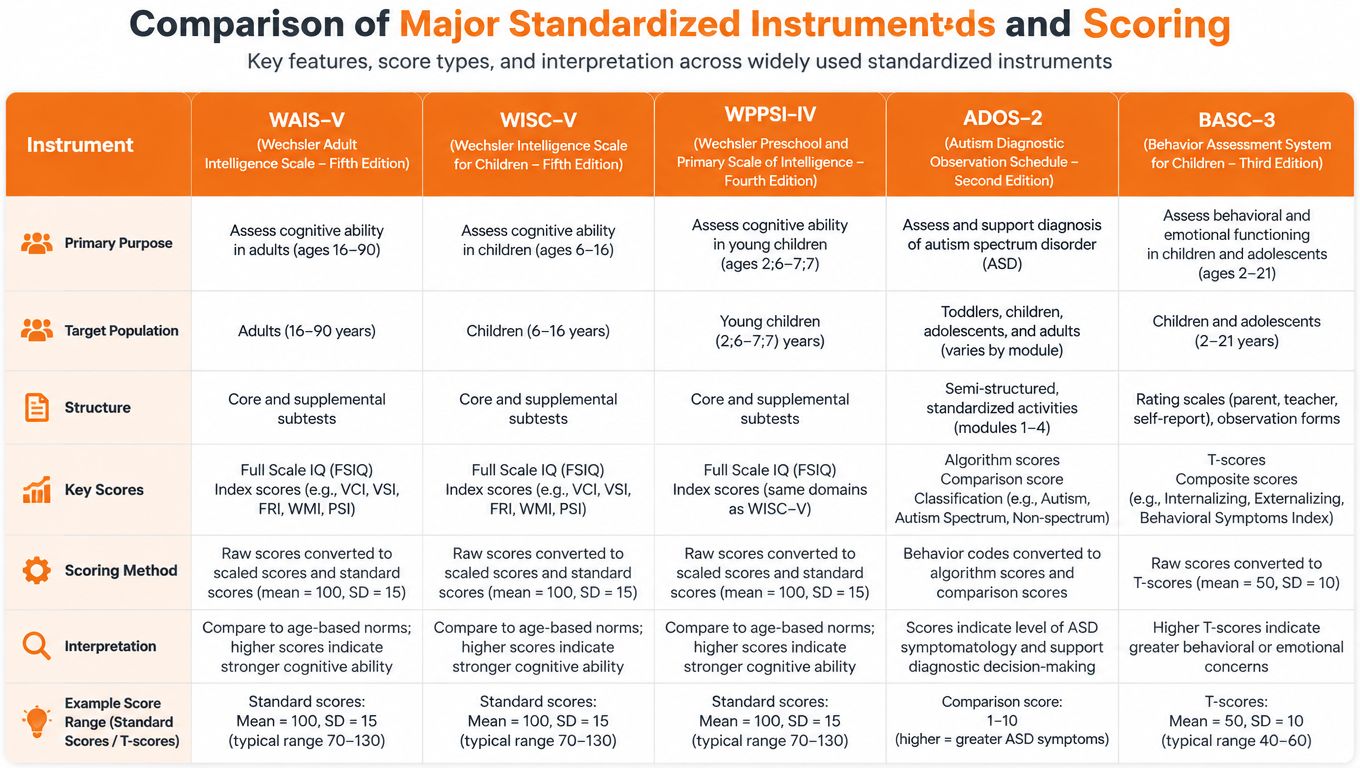
Psychologists don't use one universal quotient intellectuel test. They select an instrument according to the person's age, referral question, language, sensory needs, and the level of detail required.
Different tools answer different questions
The Wechsler scales, including the WISC for children and the WAIS for adults, are often chosen when a clinician needs a broad profile. They combine several subtests and can show whether a person's verbal reasoning, working memory, processing speed, and perceptual reasoning are relatively balanced or uneven. That detail can be valuable when school support, disability documentation, or neurological care depends on understanding a pattern rather than a total score.
The Stanford-Binet also examines multiple cognitive domains and can be used across a broad age range. A psychologist may consider it when the referral question calls for a different structure or when the test's age coverage fits the client particularly well.
Raven's Progressive Matrices focuses on visual pattern reasoning and reduces the amount of spoken language required. A clinician might consider a nonverbal measure for a child who is learning English, an adult whose expressive language has changed, or a person whose language background makes verbal comparison less defensible. That doesn't make Raven's a complete substitute for every full evaluation. It makes it a potentially useful component when language could obscure reasoning ability. Orange's educational resource on the Raven Progressive Matrices test provides further context on this type of assessment.
How raw performance becomes a report
A person first earns raw scores, such as the number of items completed correctly or the quality of responses on a task. The test publisher then uses normative tables to convert those raw results into standard scores, index scores, and sometimes percentile ranks. The conversion accounts for the person's age and the reference population used by the instrument.
A percentile isn't the same as a percentage correct. It indicates how the person's performance compares with the norm group. A report may also include confidence intervals, which remind readers that every observed score contains some measurement uncertainty.
Parents should look for the following details:
Instrument and edition: Confirm which test was administered and whether it was appropriate for the referral question.
Normative reference: Ask whether Canadian, U.S., or another regional norm set was used.
Profile shape: Review differences between index scores instead of relying only on the Full Scale IQ.
Clinical meaning: Ask how the findings relate to school, work, daily living, or rehabilitation goals.
A thoughtful interpretation connects test behaviour to life circumstances. It doesn't treat a standard score as a complete description of a person.
The Critical Impact of Canadian Norms
Many people assume that an IQ score has the same meaning everywhere. It doesn't. The score depends partly on the normative reference group, meaning the population whose performance was used to establish the comparison tables.
Canadian data make this issue concrete. In the first large, representative Canadian WISC-III study published in the mid-1990s, Canadian children averaged 104.51 Full Scale IQ points when scored with U.S. norms. The overall difference between Canadian and U.S. samples was 3.34 Full Scale points, 1.94 verbal points, and 4.96 performance points (Canadian norming analysis). These findings don't mean that one child's ability changed. They show that the comparison framework changed the reported result.
Later Canadian standardization work showed the same interpretive concern for adults. A Canadian WAIS-IV standardization sample of 681 adults reported mean scores of 104.5 before correction and 102.0 after correction. Earlier WAIS-III Canadian samples of 548 and 542 participants produced means of 103.2/103.6 and 102.4/102.8, depending on the row reported in the analysis (Canadian adult norming data).
Why borderline results need careful review
A small numerical difference can matter when a score sits near a clinical, educational, or service threshold. In a published comparison of WAIS-IV scoring systems, Canadian norms produced lower standard scores for the same raw performance than U.S. norms. In a mixed clinical sample, 61% of cases dropped by one classification band when scored with Canadian rather than American norms (Canadian WAIS-IV comparison).
That result has a direct practical implication. A person could cross a classification boundary because the practitioner selected a different normative reference, not because the person's underlying ability suddenly changed. This is particularly important when a result may affect school placement, eligibility, diagnostic formulation, or access to support.
Questions Canadian families can ask
Before accepting an interpretation, ask the psychologist:
Which norms were used, and why were they selected?
Are the norms Canadian, provincial, U.S., or international?
Would a different norm set change the classification?
Does the overall score conceal meaningful variation between abilities?
What additional information supports the recommendation?
Resources such as the Canadian Cognitive Abilities Test guide can help families understand why local calibration matters. A responsible report should make the reference group visible, especially when the result is close to a decision threshold.
Navigating Language, Culture, and Fairness
A test can be technically consistent and still be unfair for a particular examinee. A newcomer who understands a reasoning problem but is still learning the test language may lose points on vocabulary, instructions, or response speed. A bilingual child may express an idea more easily in one language than another. A person with dyslexia, hearing loss, autism, ADHD, or a motor disability may need the clinician to separate the target cognitive ability from the demands of the task.
The central question is: what exactly caused the performance? If a verbal task measures language familiarity more than reasoning, a low result may not reflect the person's reasoning capacity. If a timed task requires fine motor speed, it may underestimate someone whose processing is sound but whose hand movement is slower.
Language should be part of the design
Canadian bilingual and multilingual assessment guidance recommends evaluating cognitive-linguistic functioning in both languages when appropriate and pairing verbal measures with nonverbal measures to reduce construct-irrelevant language bias (Canadian WISC-IV guidance). The clinician may need information about the person's first language, education, immigration history, literacy, and the language used at home and school.
Alberta Health Services recommends using an interpreter and a tool designed for multilingual use when a client isn't proficient in English. Its guidance notes that some screening tools are available in 14 languages, that administration can take about 15 minutes, and that assessment is ideally completed in the client's first language with interpreter support (Alberta cognitive screening guidance).
A practical example is a clinic serving a newcomer patient. The team can identify the preferred language before the appointment, book a trained interpreter, and choose tasks that don't rely exclusively on English vocabulary. That preparation doesn't remove every cultural influence, but it reduces the risk of confusing language access with cognitive impairment.
Reliability and fairness belong together
The Canadian WISC-IV sample included 1,100 children. Its split-half internal consistency ranged from .78 to .88, and test-retest correlations were in the .80s to .90s over a 2 to 6 week interval (Canadian WISC-IV evidence). These findings indicate strong psychometric stability when local norms and appropriate procedures are used. They don't eliminate the need for clinical judgement.
A reliable test can measure the wrong thing reliably if the language, culture, disability, or task demands aren't considered.
Ask for an assessment plan that explains how language and access needs will be handled. The language of assessment resource can help families and providers prepare questions about bilingual administration, nonverbal measures, and how much confidence to place in a single score.
Choosing Between Rapid Screening and Full Evaluation
A rapid cognitive screen and a full evaluation serve different purposes. The first helps a team decide whether concern warrants follow-up. The second investigates a broader pattern, places findings in personal and medical context, and supports more complex decisions.
Cognitive Assessment Decision Matrix
Assessment Type | Best Used For | Time Required | Administrator |
|---|---|---|---|
Rapid cognitive screen | First-pass identification of possible memory, attention, or thinking concerns | A brief appointment; the MoCA has a 10-minute administration time (Alzheimer Society of Canada) | Trained healthcare professional |
Multilingual cognitive screen | Early review when the client isn't proficient in English | Some tools take about 15 minutes and are available in 14 languages (Alberta Health Services) | Trained clinician, with interpreter support when needed |
Full psychologist-led assessment | School placement, disability documentation, complex developmental questions, or unclear screening findings | A detailed diagnostic process can extend to a couple of hours, including history-taking and possible multidisciplinary input (University of Waterloo) | Registered psychologist or appropriately qualified specialist |
Neuropsychological evaluation | Detailed analysis of memory, attention, executive function, language, and related abilities after neurological or developmental concerns | Set by the referral question and test battery | Registered psychologist or neuropsychologist |
The MoCA is one concrete example of a first-pass tool. Alzheimer Society of Canada lists it as a 10-minute tool, with a 10-minute administration time and a cut-off range of ≤25/30 that may indicate the need for further evaluation (dementia screening guidance). A result below that range doesn't diagnose dementia. It tells the clinician to gather more information.
A simple decision process
Start with the decision. If the question is “Should we investigate this concern further?” a screen may be suitable. If the question is “Why is this person struggling, and what support should be provided?” a full evaluation is more likely to be necessary.
Check the context. Sudden change, neurological symptoms, functional decline, school placement disputes, or significant language and developmental complexity call for more than a quick score.
Plan the follow-up before testing. A screen is useful only when someone knows what happens afterward. The next step might be medical review, referral to a registered psychologist, a language-sensitive assessment, or rehabilitation planning.
Professional IQ testing must be administered and interpreted by a registered psychologist, and provincial coverage may apply only when the assessment is medically necessary (Canadian access guidance). Families should ask about qualifications, scope, wait times, and payment before booking.
Augmenting Care with AI Cognitive Assessment
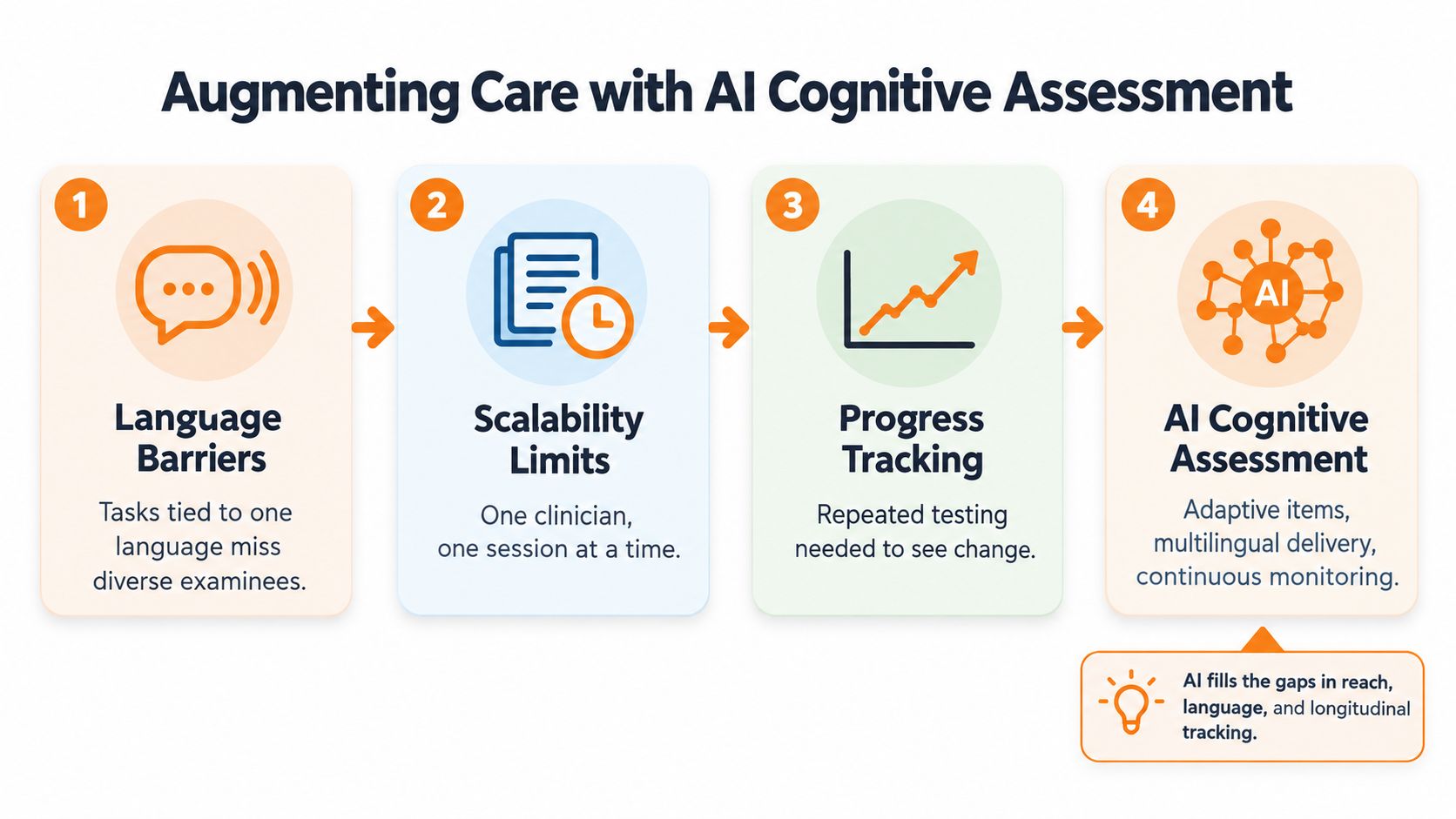
Traditional assessment offers depth, but access can be difficult. A clinician may have limited appointment capacity, a school may need an early indication of support needs, and a rehabilitation team may want repeat measurements without repeating an entire specialist battery. Digital tools can help with triage and monitoring, provided teams use them within clear clinical boundaries.
Compare the workflow, not just the test
A psychologist-led evaluation can provide detailed observation, clinical interviewing, and nuanced interpretation. It remains essential when a diagnosis, formal accommodation, or high-stakes placement decision depends on a complete understanding of the person.
An AI-supported cognitive assessment can provide a structured profile across areas such as attention, memory, executive function, perception, and processing speed. It can also support multilingual delivery, repeat evaluation, and reporting over time. Orange Neurosciences describes Cognitive Skills Assessments as producing individualized profiles in under 30 minutes, with decision support, reassessment workflows, and progress tracking (cognitive assessment tools).
The distinction is important. A rapid digital profile may help a clinic identify a priority area, decide whether referral is warranted, or monitor change during rehabilitation. It shouldn't be presented as a replacement for a registered psychologist when the referral question requires diagnosis or formal psychometric interpretation.
Where digital tools fit best
A rehabilitation team could use repeat cognitive measures to compare attention, memory, and processing speed during recovery. A school support team could use an early profile to organise questions for a later full assessment. A family could use a supervised screen to clarify whether a conversation with a healthcare provider is warranted, rather than treating an online result as a diagnosis.
The same operational thinking that helps teams boost productivity in engineering can improve cognitive-care workflows. Staff can define who administers the screen, how results are reviewed, when a referral is triggered, and where follow-up information is recorded.
A Canadian health-technology review describes objective cognitive testing as a way to compare performance with a normative database, generate scores for separate cognitive functions, and track recovery over time (Canadian rehabilitation review). For example, a patient's attention may improve while processing speed remains weak. Serial results can help the rehabilitation team adjust therapy targets instead of relying on a single impression.
Ethical Boundaries and Practical Next Steps
A quotient intellectuel test can clarify patterns, but it can also cause harm when people treat it as a verdict. A score doesn't determine a child's worth, predict every academic outcome, or capture creativity, judgement, emotional insight, persistence, or practical skill. It also shouldn't be used alone to diagnose a medical or developmental condition.
The ethical standard is straightforward: use the least intensive tool that can answer the immediate question, then escalate when the evidence or stakes require it. A rapid screen can identify concern. A full evaluation can explain complexity. Neither should be interpreted without attention to language, culture, disability, health, education, and everyday functioning.
A practical checklist
Define the concern: Write down what has changed or what decision needs support. “Low IQ” is not a referral question. “My child understands lessons but cannot complete timed written work” is more useful.
Choose the right level: Use a brief screen for initial triage when appropriate. Seek a registered psychologist for formal interpretation, complex developmental questions, or high-stakes decisions.
Check the conditions: Confirm the test language, interpreter plan, sensory accommodations, normative reference, and whether fatigue or illness could affect performance.
Read the profile: Ask which abilities are stronger or weaker, how confident the practitioner is, and what practical recommendations follow.
Plan support: Rehabilitation may include targeted exercises and repeat measurement. Digital cognitive therapies can support ongoing practice, but they don't replace medical care or psychological assessment.
Document change: Record symptoms, daily examples, school or work impact, and follow-up results so clinicians can evaluate progress over time.
Families should also separate reassurance from certainty. A normal brief screen may reduce immediate concern, but persistent functional problems still deserve attention. Conversely, a low screening result may reflect language, hearing, vision, education, fatigue, or test familiarity and should lead to thoughtful follow-up rather than a rushed label.
The most useful assessment is the one that improves the next decision. That might mean arranging a psychologist-led evaluation, selecting a multilingual tool, referring to a memory clinic, adjusting classroom supports, or beginning structured cognitive rehabilitation. Clear scope protects the person being assessed and helps providers use technology responsibly.
Orange Neurosciences offers AI-powered cognitive assessment and digital therapy tools that create individualized cognitive profiles, support multilingual delivery, and enable reassessment for progress monitoring. Visit Orange Neurosciences to explore a supervised cognitive health check or learn how its tools can fit into clinical, educational, rehabilitation, or family support workflows.
Orange Neurosciences' Cognitive Skills Assessments (CSA) are intended as an aid for assessing the cognitive well-being of an individual. In a clinical setting, the CSA results (when interpreted by a qualified healthcare provider) may be used as an aid in determining whether further cognitive evaluation is needed. Orange Neurosciences' brain training programs are designed to promote and encourage overall cognitive health. Orange Neurosciences does not offer any medical diagnosis or treatment of any medical disease or condition. Orange Neurosciences products may also be used for research purposes for any range of cognition-related assessments. If used for research purposes, all use of the product must comply with the appropriate human subjects' procedures as they exist within the researcher's institution and will be the researcher's responsibility. All such human subject protections shall be under the provisions of all applicable sections of the Code of Federal Regulations.


© 2026 by Orange Neurosciences Corporation