8 Examples of Operant Conditioning in Daily Life

You're buckling a seatbelt to stop a chime, praising a child who just finished a reading task, or removing tablet time after homework is skipped. Each moment feels like a simple consequence, but they're not the same process, and using the words reward, punishment, and consequence interchangeably hides what's changing behaviour.
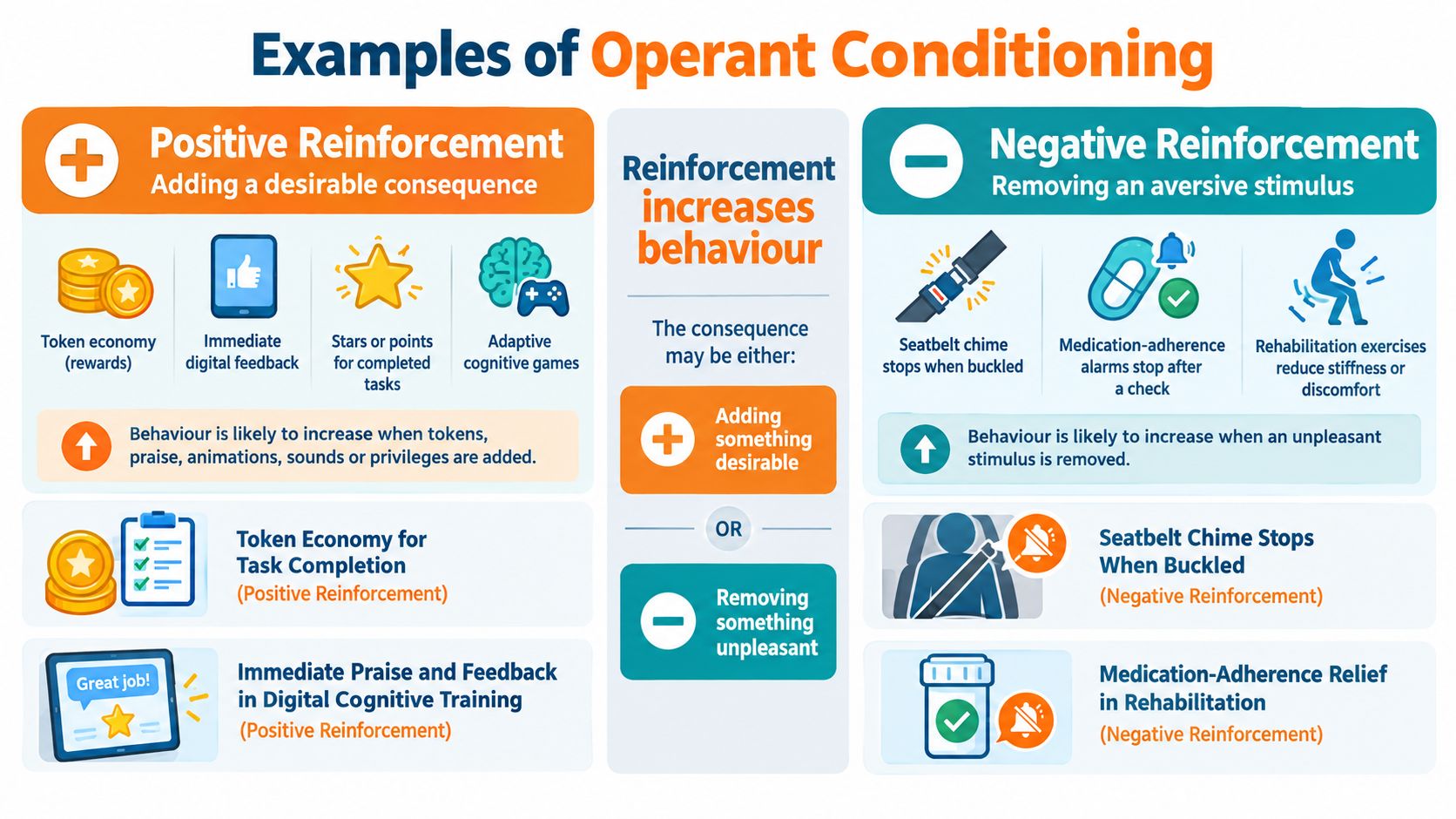
The useful distinctions are plain. Reinforcement increases behaviour, punishment decreases behaviour, positive adds a consequence, and negative removes one. A consequence only counts as reinforcement if the behaviour happens more often afterwards, not because an adult intended it to be rewarding.
A Quick Way to Read Any Example
Identify the observable behaviour first, then name what happens immediately afterward. Next, check whether that behaviour rises or falls over repeated opportunities, and ask whether you're seeing durable learning or short term avoidance. That check matters at home as much as in a clinic, and it's the same discipline behind strong parenting behavior strategies.
The eight examples of operant conditioning below are organized by function, not by how familiar they sound. That way you can see the mechanism, the trade off, and what to do differently when a consequence isn't working.
1. Token Economy for Task Completion (Positive Reinforcement)
A child earns a star for each completed ReadON™ session and trades 10 stars for 15 minutes of preferred play. The star itself has no value until it reliably predicts something the child wants, so it becomes a conditioned reinforcer that bridges the gap between finishing the task now and earning the backup reward later.
The same logic scales up. A rehabilitation patient earns points for completing daily attention exercises and exchanges them for a choice of activity. Ayllon and Azrin's psychiatric hospital token economies increased self care and ward participation by making each target behaviour observable and payable in tokens.
California's school based PBIS guidance makes the mechanics explicit. After teaching a criterion such as beginning work promptly, a classroom can deliver one token immediately when a student meets it, with tokens later exchanged for a preferred privilege, as described in California PBIS reinforcement guidance on token economies and group contingencies. If the target behaviour doesn't increase, the token isn't functioning as a reinforcer, whatever you intended.
Make the System Measurable
Define the target precisely: Use a criterion such as completes five minutes of memory training with no prompts, not a vague goal like tries harder.
Choose backup rewards the learner wants: Update them regularly, because a stale menu kills the contingency.
Pair tokens with praise: You're building a social reinforcer that can survive after tokens are faded.
Log it beside skill data: Use progress tracking reports to record token data alongside cognitive scores, and explore how that fits cognitive remediation therapy planning.
At Camarillo State Hospital, tokens contingent on self care, social, and work behaviours were exchanged for individualized privileges, and after two years only four of the original 140 chronic, regressed patients had not progressed sufficiently for community placement, as reported in the Camarillo State Hospital token economy program report. Treat that as a historical program report, not a modern effectiveness estimate. The lasting lesson is architecture, individualize the reinforcer, define the behaviour, and track generalization, not just token counts.
2. Immediate Praise and Feedback in Digital Cognitive Training (Positive Reinforcement)
Timing does most of the work here. A child correctly identifies a target in an attention game, hears a chime within a second, sees a points bonus, and advances to a slightly harder level. That immediate, specific consequence strengthens the exact response that produced it, which is why adaptive, game based therapy such as ReadON™ is a natural home for positive reinforcement.
An older adult in a senior community receives a progress graphic after completing a weekly attention exercise. A student advances to a new level after several consecutive correct responses. In each case, the feedback tells the learner what worked, not just that something worked.

Classroom data show why specificity matters. In a California Central Valley study, teachers used verbal praise and tangible rewards for participation, task completion, and on task conduct, and disruptive behaviour declined from 54.07% to 36.70% across class periods, as documented in the Central Valley classroom reinforcement study. That's a localized result, not a statewide estimate, but it shows reinforcement operationalized and measured rather than assumed.
Practical rule: If your praise could apply to any task, it isn't teaching anything. Name the behaviour, deliver it immediately, and record whether that behaviour increases.
Move gradually from continuous to intermittent reinforcement as the skill stabilizes, so persistence doesn't depend on a reward every trial. Watch for reward seeking that replaces skill practice, and redirect attention to the task itself. If you're comparing tools, review how feedback, difficulty adjustment, and reporting work together in brain training apps designed for structured cognitive practice, then visit the Orange Neurosciences website to see how adaptive therapy fits your program.
3. Seatbelt Chime Stops When Buckled (Negative Reinforcement)
You fasten the belt and the irritating chime stops. Nothing pleasant was added. Something unpleasant was removed, and buckling becomes more likely next time, which is negative reinforcement by definition.
People routinely mislabel this as punishment because the word negative sounds bad. It isn't about badness, it's about subtraction. Negative reinforcement increases behaviour, punishment decreases it, and confusing the two leads families and teams to design the opposite contingency from the one they wanted.

A patient in rehabilitation stops a repetitive reminder alarm by completing a medication check. Skinner's escape experiments showed the same structure, rats pressed a lever to end an unpleasant noise or mild shock. The behaviour is strengthened by escape, which works, but it teaches avoidance of discomfort rather than attraction to the goal.
Keep Escape Based Systems Humane
Keep the stimulus mild and brief: It should be clearly connected to the target behaviour and end the moment the response occurs.
Remove it immediately: Delayed removal weakens the link and mainly builds frustration.
Pair it with positive reinforcement: Praise or progress feedback after buckling, checking, or completing the task gives the learner a reason beyond relief.
Canadian animal welfare guidance offers a useful caution that transfers well. The BC SPCA states aversive methods can change behaviour but may also produce fear, distress, and weaker bonds, without evidence they outperform reward based methods, in its position statement on animal training and aversive methods. Short term compliance isn't proof of durable learning. Visit the Orange Neurosciences website to explore how structured, low stress assessments can reduce the anxiety that often accompanies testing.
4. Medication-Adherence Relief in Rehabilitation (Negative Reinforcement)
Relief is a powerful teacher in rehabilitation, and it operates. A stroke survivor completes hand exercises, notices looser fingers afterward, and practices more the next day. The removal of stiffness strengthens the exercise habit, even though nobody handed out a reward.
A patient with chronic neck tension completes posture routines that reduce discomfort. Another follows a structured cognitive warm up that lowers mental fatigue before therapy, making the harder session feel more manageable. In each case, adherence improves when the person feels a tangible benefit soon after the effort.

Clinicians can design for this deliberately, provided it's safe and consistent with the treatment plan. End a session with an activity likely to produce noticeable relief, then make the link visible. Track both the exercise completed and the patient's rated comfort level, so the person sees the pattern in their own data rather than relying on your encouragement alone.
Set realistic expectations at the same time. Relief is often partial, and patients who expect complete relief may quit a program that is helping. Record small, repeatable gains in comfort, range, or mental clarity, and review them at reassessment so the reinforcement comes from documented progress as well as sensation.
Relief explains why people repeat a routine. Measurement explains whether that routine is building a skill that lasts when relief fluctuates.
Visit the Orange Neurosciences website to see how reassessment workflows can document progress over time and support adherence discussions. When behaviour is driven mainly by escape from discomfort, adding positive feedback for effort and accuracy protects motivation on days when relief is modest.
5. Speeding Fine as Consequence (Positive Punishment)
A driver speeds, receives a fine, and becomes less likely to speed again. An unpleasant consequence was added after the behaviour, so this is positive punishment. It can suppress behaviour quickly, which is exactly why it's overused and often misunderstood.
Suppression isn't instruction. A fine doesn't teach route planning, time management, or attention to speed, and a child who touches a hot stove learns avoidance from pain, not a taught alternative. In a lab setting, extra written work after repeated unsafe behaviour may stop the act, but it does nothing for the underlying attention or executive function need unless someone teaches and reinforces the safe routine.
Use It Rarely and Pair It With Teaching
Teach the replacement: Reinforce the appropriate alternative at a higher rate than you correct the unwanted behaviour.
Apply it immediately and consistently: Delayed, unpredictable consequences mainly produce resentment and evasion.
Use the least intrusive option: Document what you used, why, and whether the behaviour decreased.
California guidance on reinforcement stresses identifying what a learner obtains through challenging behaviour and selecting a consequence that competes with that payoff, as set out in California Positive Environments guidance on reinforcement and replacement behaviour. A student who throws materials to escape difficult work can be taught to hand over a break card, with a brief break delivered immediately when the card is used. If break card use doesn't increase, the break isn't functioning as reinforcement yet.
Visit the Orange Neurosciences website to learn how cognitive profiles can help identify needs behind challenging behaviour, and read more on behavioural interventions compared with a developmental perspective in autism support. Punishment without that analysis is just pressure.
6. Immediate Verbal Correction in Classrooms (Positive Punishment)
A student calls out. The teacher says, immediately, please raise your hand next time, and interruptions fall. When a brief correction reduces the behaviour that preceded it, it's functioning as positive punishment, however gentle it sounds.
The trap is attention. For a student seeking peer or adult attention, a public correction can be reinforcing, and calling out increases. That's why corrections work best when they're private, brief, and surrounded by frequent, specific praise for hand raising and other appropriate contributions.
A caregiver in a senior community gently redirects a resident who interrupts group activities. A therapist corrects a child who skips steps in a cognitive exercise, models the correct sequence, and praises the next accurate attempt. The correction marks the error, the model and praise build the replacement.
Keep corrections private and short: Long explanations during disruption often reward the disruption.
Praise the alternative more often: Your ratio tells the learner where success is available.
Use consistent language across staff: Shared wording reduces negotiation and makes data comparable across settings.
Consistency is a systems problem, not a willpower problem, which is why teams benefit from shared routines in classroom management best practices. A California State University, Northridge evaluation of a juvenile detention token economy made the same point operationally, defining targets such as class attendance, personal hygiene, room organization, and respectful communication, as detailed in the CSUN evaluation of a juvenile detention token economy. Vague expectations produce vague corrections. Visit the Orange Neurosciences website to explore how cognitive profiles can support consistent, individualized classroom and care plans.
7. Loss of Screen Time for Homework Non-Completion (Negative Punishment)
Homework isn't done, so tablet access is removed that evening. A desirable stimulus was taken away after the behaviour, aiming to make non completion less likely. That's negative punishment, and it's generally gentler than adding something unpleasant, but gentler doesn't mean automatically effective.
It works only when the child values what was removed, understands the rule in advance, and knows exactly how to earn the privilege back. A child loses 30 minutes of tablet time after skipping an assignment, a student loses a preferred classroom activity after not completing work, and a teen loses phone privileges after missing agreed study time. In each case, the path back matters as much as the loss.

Write the rule down, apply it the same day, and pair it with positive reinforcement for completed work. Removing screen time all week for one missed assignment usually teaches hopelessness, not planning. Families do better with effective behavior modification strategies that make the earning route as clear as the losing route.
Check for a Skill Gap First
If homework avoidance reflects attention, working memory, or executive function difficulties, punishment alone won't build the missing skill. Break the task into observable steps, reinforce starting and completing each step, and track completion across opportunities. Guidance on executive function coaching for planning and follow through can help you structure that support. Visit the Orange Neurosciences website for resources on progress tracked routines that help families and educators plan around attention and executive function.
8. Response Cost in Token Economies (Negative Punishment)
Response cost removes something already earned. A rehabilitation patient loses 5 points for arriving late, a student loses a token for disruptive behaviour during group work, and a care home resident loses a small point reward after refusing a scheduled activity without notice. Because the tokens were already theirs, the loss registers, and the unwanted behaviour becomes less likely.
That strength is also the risk. Large or frequent losses can drain the account, and a learner with nothing left to lose has no reason to re engage. Keep amounts small and proportionate, always provide a clear way to earn points back through appropriate behaviour, and document each loss so you can review patterns by time, setting, and task during progress meetings.
Design check: A token system should leave the learner in profit for appropriate behaviour. If deductions dominate your data, you've built a punishment system with token branding.
Schedules shape whether gains persist. California's Recovery Incentives Program pays $10 for the first stimulant negative sample, increases by $1.50 after consecutive negative tests, and specifies an annual maximum of $599, as outlined in California's Recovery Incentives Program contingency management guidance. The escalation, reset, and maintenance rules are published in advance, so participants know exactly what produces reinforcement and what happens after a missed target.
Historical token research warns about abrupt withdrawal. In a correctional token economy studied over 420 days with an average daily census of 22 inmates, remedial education performance ceased completely after the token economy ended, as reported in the applied behaviour analysis token economy technical report. Fade deliberately, test maintenance, and thin reinforcement gradually. Visit the Orange Neurosciences website to learn how progress tracking and reassessment reports can help you monitor token economy outcomes over time.
Comparison of 8 Operant Conditioning Examples
Example | Operant Principle | Implementation Complexity | Resource Requirements | Expected Outcome | Ideal Use Case and Key Advantage |
|---|---|---|---|---|---|
Token economy for task completion | Positive reinforcement: tokens are added for desired behaviour | Moderate; define behaviours, rewards, and tracking rules | Tokens or points, valued rewards, and consistent staff or caregiver follow-through | Increases target behaviours and makes progress measurable | Classrooms, rehabilitation, or home routines; bridges effort and delayed rewards |
Immediate praise and feedback in digital training | Positive reinforcement: immediate, specific feedback follows a correct response | Low to moderate; feedback and task difficulty need to be calibrated | Digital training platform; animations, sounds, or progress feedback | Encourages engagement and repeated practice | Cognitive training; scales feedback across users and adapts to performance |
Seatbelt chime stops when buckled | Negative reinforcement: an unpleasant sound ends after the desired action | Low; link the sound clearly to buckling | Chime system and functioning seatbelt sensor | Increases seatbelt use by providing immediate relief | Vehicle safety; creates a clear action-to-relief link |
Rehabilitation exercise reduces discomfort | Negative reinforcement: discomfort decreases after the exercise | Moderate; exercises require clinical oversight and monitoring | Clinician guidance and comfort or exercise tracking | May increase exercise adherence when patients experience relief | Physical rehabilitation; connects practice with a tangible benefit |
Speeding fine | Positive punishment: an unpleasant consequence is added after speeding | Moderate; enforcement and consistent application are needed | Monitoring, legal enforcement, and fine administration | May reduce speeding, but does not teach a safer alternative by itself | Road safety; provides a clear consequence for a dangerous behaviour |
Immediate verbal correction in the classroom | Positive punishment: a brief correction follows disruptive behaviour | Low; staff need consistent, calm responses | Minimal materials; shared expectations among educators | May reduce interruptions and clarify expectations | Classroom management; quick, low-intensity response that can be paired with praise |
Loss of screen time for incomplete homework | Negative punishment: a valued privilege is removed after non-completion | Low to moderate; rules and restoration conditions must be clear | Caregiver or educator follow-through and agreed privilege limits | May reduce missed homework, but does not teach completion skills by itself | Home or school routines; avoids adding an aversive stimulus |
Response cost in a token economy | Negative punishment: previously earned tokens or points are removed | Moderate; rules, tracking, and recovery opportunities are needed | Existing token system and accurate record-keeping | May reduce unwanted behaviour while maintaining a reinforcement system | Structured clinical or classroom programmes; provides a measurable consequence within a broader reward system |
Make Every Consequence More Intentional
Start with a decision framework you can run in a classroom, clinic, rehab gym, or kitchen. Define the observable behaviour in words two people could score the same way. Identify what follows it immediately, determine whether that consequence makes the behaviour more or less likely, and choose the least intrusive effective intervention that changes the odds in the direction you want.
Reinforcement should be specific, timely, and individualized. Praise that names the behaviour, tokens exchanged for preferred activities, and progress feedback delivered right after a correct response all work because the learner can connect action to outcome. If the behaviour doesn't increase, don't argue with the data. Change the reinforcer, shorten the delay, or make the target easier to achieve, then measure again.
Punishment needs a higher bar. Keep it rare, proportionate, and ethically reviewed, and pair it with an explicitly taught alternative that's reinforced more often than the unwanted behaviour is corrected. Ask the harder question that four quadrant diagrams skip: does this consequence increase performance while reducing motivation, trust, or wellbeing? If it does, you're buying compliance at a price that usually shows up later as avoidance, dependence on prompts, or behaviour that only works in one setting.
Durability is the true test. Genuine learning transfers across people and places and survives after reinforcement is thinned, while temporary compliance collapses when the reward, chime, or threat disappears. Canadian guidance on reinforcement and punishment emphasizes that distinction between producing a response and building lasting change, as explained in the open textbook chapter on changing behaviour through reinforcement and punishment. Plan fading from the start, probe maintenance, and check generalization instead of assuming it.
For schools, clinics, rehab teams, and care homes, combine behavioural data with structured progress tracking and periodic reassessment rather than relying on impressions. Record percentage of opportunities meeting the criterion, review patterns by setting and time of day, and adjust difficulty or consequences when performance improves. That turns examples of operant conditioning from textbook labels into auditable practice.
Visit Orange Neurosciences for information about cognitive assessments, adaptive digital therapy, and reporting workflows that help teams connect behavioural interventions with measurable cognitive progress. Use the contact option on the website for guidance relevant to your setting, whether you're supporting attention and executive function in a classroom, adherence in rehabilitation, or engagement in a senior community. Bring your target behaviour, your current consequence, and your data, and build the next version deliberately.
Orange Neurosciences offers AI powered cognitive assessments, individualized profiles, and ReadON™ adaptive digital therapy that help schools, clinics, and families link reinforcement plans to measurable progress in attention, memory, and executive function. Visit Orange Neurosciences to explore assessment and progress tracking options for your setting and contact the team for guidance on putting them to work.

Orange Neurosciences' Cognitive Skills Assessments (CSA) are intended as an aid for assessing the cognitive well-being of an individual. In a clinical setting, the CSA results (when interpreted by a qualified healthcare provider) may be used as an aid in determining whether further cognitive evaluation is needed. Orange Neurosciences' brain training programs are designed to promote and encourage overall cognitive health. Orange Neurosciences does not offer any medical diagnosis or treatment of any medical disease or condition. Orange Neurosciences products may also be used for research purposes for any range of cognition-related assessments. If used for research purposes, all use of the product must comply with the appropriate human subjects' procedures as they exist within the researcher's institution and will be the researcher's responsibility. All such human subject protections shall be under the provisions of all applicable sections of the Code of Federal Regulations.


© 2026 by Orange Neurosciences Corporation