Your Guide to Standardized Testing Ontario in 2026
Mar 2, 2026

Standardized testing in Ontario, all managed by the Education Quality and Accountability Office (EQAO), acts like a big-picture health check for our school system. These province-wide assessments are rolled out at key grade levels to see how well students are grasping the core skills in reading, writing, and math, as laid out in the Ontario curriculum.
A Parent's Guide to Standardized Testing in Ontario
If you're an Ontario parent, you've definitely heard the term "EQAO." For many, it brings up a tangle of questions and maybe even a bit of stress. It’s easy to get the impression that these tests are a high-stakes final verdict on your child's academic future, but that's not really what they're for.
Think of it less like a final exam for your kid and more like a routine check-up for the entire education system. A doctor checks vital signs to get a read on a patient's overall health; in the same way, the province uses EQAO data to see how well its curriculum and teaching methods are working across the board.
Why Do We Even Have These Tests?
At its core, standardized testing in Ontario is about accountability and making sure every student in a publicly funded school gets a quality education. The results give different groups important answers to big questions:
For the Province: Are students across Ontario actually learning the critical skills they’re supposed to be? Where are the gaps in the system?
For School Boards: How are our schools doing compared to others? Which schools or programs might need more funding or a helping hand?
For Educators: Are my teaching strategies landing? What are the specific areas where my students seem to hit a wall year after year?
Practical Example: Imagine a school sees its Grade 3 math scores dip for three years in a row. That's a clear, actionable signal. It tells administrators that it's time to dig deeper, prompting them to invest in new math resources or offer specialized training for teachers on different instructional methods.
It's so important to remember that EQAO scores were designed to give insights about groups. They're a snapshot in time—never meant to be the single, defining measure of one child's intelligence, effort, or potential.
This is a critical distinction. An EQAO score can tell you what a student struggled with on test day—say, multi-step word problems. What it can't tell you is why. Was it just an off day? Test anxiety kicking in? Or is there a deeper, underlying challenge with how that child processes information?
Actionable Insight: If your child's score is low, don't jump to conclusions about their ability. Use it as a conversation starter with their teacher. Ask, "The EQAO report shows a struggle with organizing ideas in writing. Is this something you see in class, and what strategies can we use at home to help?" For parents and educators who want to understand a student's unique learning profile on a deeper level, learning about what cognitive assessment entails can open the door to a much more complete and helpful picture.
A Practical Breakdown of EQAO Assessments
If you're an educator or parent in Ontario, navigating the world of standardized testing can feel like trying to learn a new language, full of acronyms and shifting schedules. It helps to think of each EQAO assessment not as a surprise pop quiz, but as a carefully placed checkpoint. Let's break down what these provincial tests are so you know exactly what to expect.
These assessments have been a fixture in Ontario's public schools for a long time. Since 1996, EQAO has run annual tests in reading, writing, and math at key grade levels, though interruptions from things like labour disputes and the pandemic have sometimes broken that cycle. Recent data continues to show some real areas of concern; for instance, EQAO’s 2024–2025 results revealed that Grade 3 math proficiency sits at just 64%. That means over a third of our youngest students aren't meeting the provincial standard as the system works through its post-pandemic recovery. If you're interested in the history and the data behind these trends, this detailed research paper on standardized testing offers a deeper dive.
To get a clearer picture of the testing landscape, it helps to see everything laid out. Here’s a simple table summarizing the main EQAO assessments your child or student will encounter.
EQAO Standardized Test Schedule in Ontario
Assessment Name | Grade Level | Subjects Assessed | Typical Administration Window |
|---|---|---|---|
Primary Division Assessment | Grade 3 | Reading, Writing, and Math | May – June |
Junior Division Assessment | Grade 6 | Reading, Writing, and Math | May – June |
Grade 9 Math Assessment | Grade 9 | De-streamed Mathematics | January (Semester 1) / June (Semester 2) |
Ontario Secondary School Literacy Test (OSSLT) | Grade 10 | Reading and Writing (Literacy) | Throughout the school year |
As you can see, the tests are timed to provide snapshots of student learning at critical transition points—from primary to junior, junior to intermediate, and into the high school years. Let’s look at what each one involves.
The Primary and Junior Division Assessments (Grades 3 and 6)
For elementary students, the first big encounters with province-wide testing happen in Grade 3 and again in Grade 6. These tests focus on the absolute fundamentals: reading, writing, and mathematics.
Think of them as a broad-stroke painting of a student’s skills at a particular moment. They're now administered digitally, which is a smart move—it gets students comfortable with the kind of computer-based testing they'll see throughout their education.
What It Looks Like: The tests are broken up into several sessions spread across a window in late spring, usually May and June. The questions are a mix of multiple-choice and open-response items, where students need to write out their answers and explain their thinking.
Practical Example (Grade 3 Math): A student might see a picture of a piggy bank with a handful of coins and be asked to add them up. But then, a follow-up question might ask them to explain how they got their answer, such as "I made groups of ten." This checks both their calculation skill and their ability to communicate their reasoning.
Practical Example (Grade 6 Reading): A student might read a short, non-fiction piece about the water cycle. The questions that follow will push them to find the main idea and pinpoint specific details that support it. This is all about seeing if they can truly comprehend and analyze what they read. For parents wanting to dig deeper into reading skills, our guide on the Test of Reading Comprehension offers some fantastic insights.
The Grade 9 Math Assessment
As students make the big jump to high school, the Grade 9 math assessment serves as a crucial milestone. It’s specifically designed to see how well they've grasped the concepts from the Grade 9 de-streamed math curriculum.
This test is so important because it’s an early flag. The results can show which students might need a bit of extra help to build a strong foundation for the tougher math courses in Grades 10, 11, and 12.
This assessment is also done digitally and happens near the end of each semester. Students taking math in the first semester write it in January, while second-semester students write it in June. It covers all the key areas, like Number Sense, Algebra, and Geometry.
The Ontario Secondary School Literacy Test (OSSLT)
The Ontario Secondary School Literacy Test (OSSLT) is probably the most famous EQAO test of them all, mainly because it's a graduation requirement. Students typically write it in Grade 10, and it's designed to measure whether they have the basic reading and writing skills they’ll need not just for school, but for work and life in general.
What It Tests: The OSSLT isn't about academic jargon; it’s about real-world literacy. Students will be asked to do things like read news reports, pull information from graphs, and write a clear, well-argued opinion piece.
Practical Example: A classic task is the "News Report." Students get a headline and a picture of a made-up event—like a community garden opening—and have to write a summary answering the key "who, what, where, when, and why" questions. It’s a great test of how quickly and accurately they can pull out and synthesize important information.
Actionable Insight: If a student doesn't pass on their first try, don't panic. The immediate action is to connect with the school's guidance counsellor. They will outline the two clear paths forward: rewriting the test at the next opportunity or enrolling in the Ontario Secondary School Literacy Course (OSSLC) to meet the graduation requirement.
How to Decode Your Child's EQAO Results
Getting your child's EQAO results can feel like being handed a complex puzzle. What do all these numbers and levels really mean for their learning? Let's break down the Individual Student Report (ISR) in simple, practical terms so you can see the story behind the scores.
First, it’s important to clear up a common misconception: the levels on an EQAO report are not the same as traditional letter grades. A better way to think of them is like a performance review.
The provincial standard, Level 3, doesn't mean a "C" or a bare pass. It means your child has a solid grasp of the curriculum concepts and is on track. Think of it as "Meets Expectations"—they are well-prepared to take on the challenges of the next grade.
A Level 4, then, means their performance exceeds the standard. On the other hand, Levels 1 and 2 suggest a child isn't quite meeting the standard yet and could probably use some more support to get there.
Making Sense of the Individual Student Report
When you open up the report, you’ll see scores broken down by subject: reading, writing, and math. For each one, the report gives you an overall achievement level. But the real gold is in the details—the report also offers more specific feedback on different skills within each subject.
This is where you can find truly actionable insights.
Practical Example: Imagine your child scored a Level 2 in Grade 6 writing. Instead of just seeing that as a low score, a closer look might show they did really well with "developing a main idea" but struggled with "organizing information." This tells you the issue isn't a lack of ideas, but a need to work on structuring those ideas with paragraphs and transition words. That’s a specific skill you can practice at home.
This kind of detail turns the report from a simple score into a genuinely useful guide. For those who want to dig even deeper, understanding basic statistical concepts, like a five-number summary, can help you see where your child's results fit into the bigger picture.
This infographic breaks down recent EQAO achievement levels by grade.
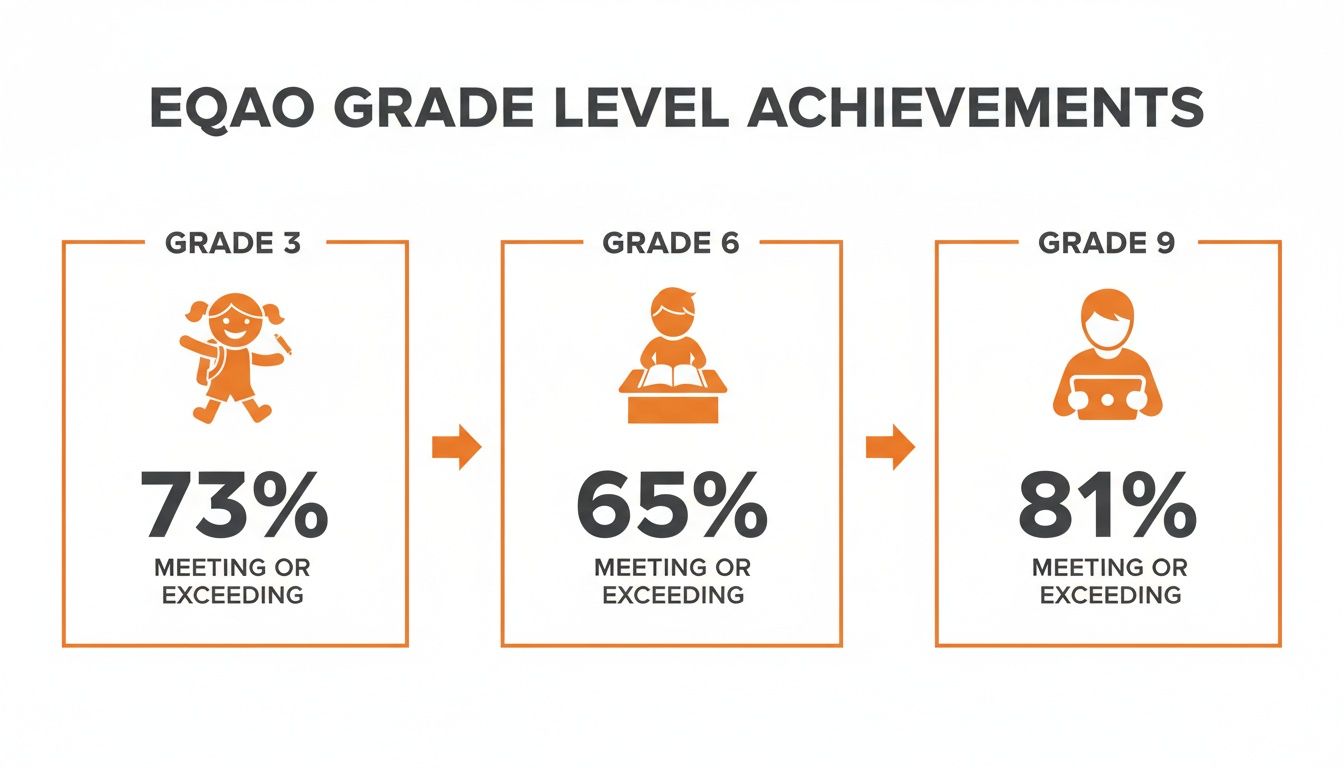
The data highlights how student performance shifts across these key grades, showing where students across the province are generally meeting or exceeding the bar.
Connecting the Dots: From One Score to the Bigger Picture
While your child's score is a single data point, it’s part of a much larger story. When combined with thousands of others, these results help paint a picture of the health of Ontario's education system. Sometimes, an individual struggle might actually reflect a wider, systemic challenge.
The math results from recent years, for instance, have raised some serious flags. In the 2024-25 school year, a staggering 49% of Grade 6 students failed to meet the provincial standard in math. Even in Grade 9, where 58% met the standard, that still means over four in ten students are falling behind.
These widespread gaps have understandably prompted a review by the education minister to see how these tests align with what’s happening in the classroom and how the data can be used to improve things for everyone.
Actionable Insight: Here are your next steps after reviewing the EQAO report:
Celebrate the Strengths: Always start by acknowledging what your child did well. This builds their confidence. Say, "Look how well you did on understanding what you read! That's fantastic."
Pinpoint Specific Gaps: Focus on the detailed feedback. Is the issue with understanding questions, organizing thoughts, or applying certain math concepts? Get specific.
Talk to the Teacher: Book a meeting with your child’s teacher. Bring the report and ask: "The ISR mentions difficulty with organizing ideas. What does this look like in the classroom, and what's one thing we could work on at home to support their progress?"
When a score points to a consistent struggle over time, it might signal an underlying cognitive challenge. EQAO tests are great at showing what a student is having trouble with, but they can't tell you why. If these results, combined with classroom performance, suggest a potential learning disability, our guide on the assessment process for learning disabilities can offer some valuable next steps.
Ensuring Fair Testing With Accommodations
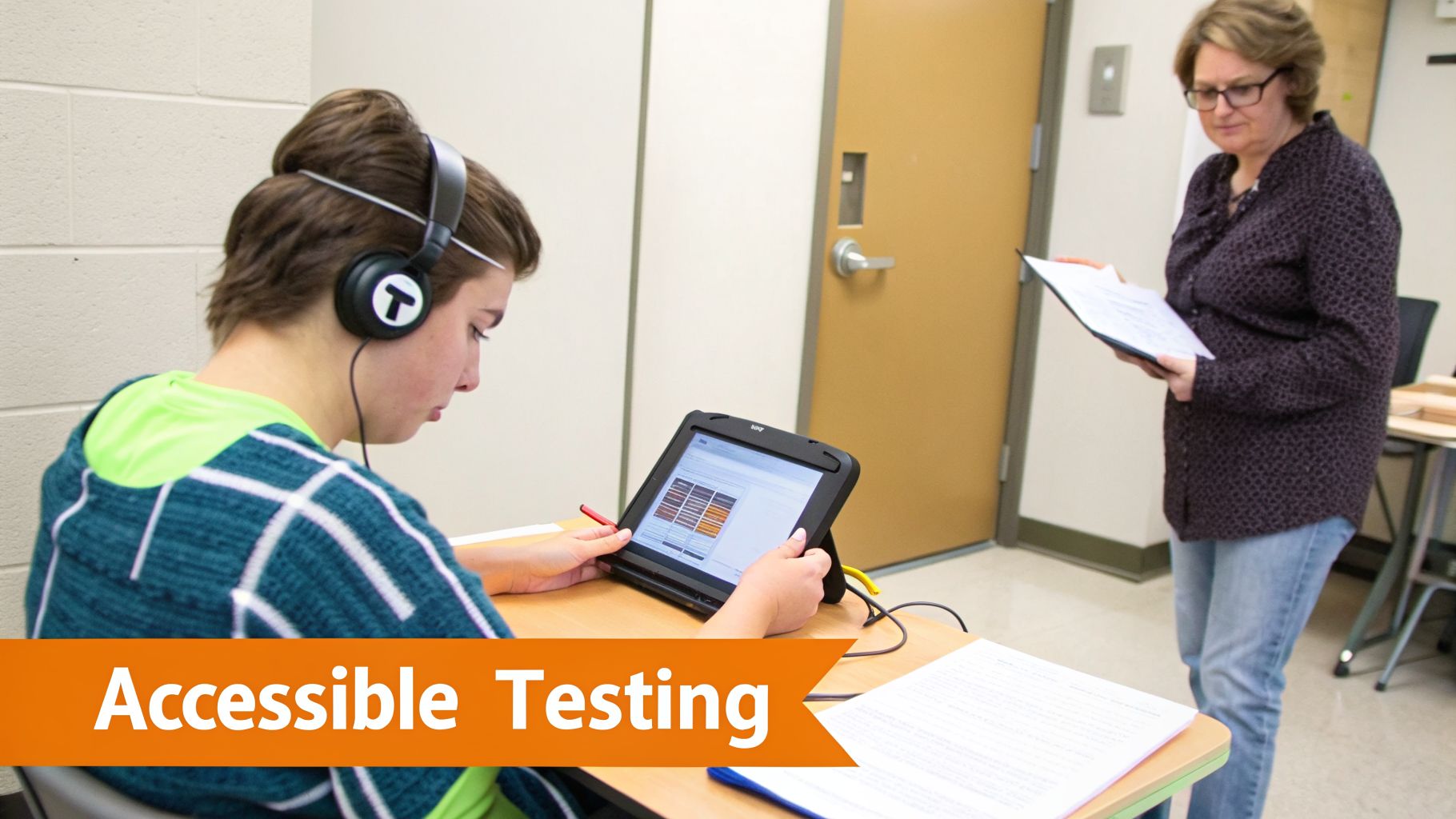
Standardized testing is meant to take a broad snapshot of how the entire Ontario education system is performing. But a fair snapshot means recognizing that not every student is starting from the same spot. For students with special education needs or those learning English (ELLs), a test without any support can be more of a barrier than an accurate measure of what they know. That’s where accommodations come into play.
Think of accommodations as a ramp for a wheelchair user. The ramp doesn't change the destination; it just creates an accessible path. In the same way, testing accommodations are about levelling the playing field, not giving anyone an unfair advantage. They remove obstacles tied to a student's specific disability or language barrier, which allows them to show what they can really do.
These supports are formally laid out in a student’s Individual Education Plan (IEP) or determined by the school for ELLs. Making sure these are ready to go for EQAO tests is a critical step for any parent or educator advocating for their student.
Common EQAO Accommodations In Action
Accommodations aren't a one-size-fits-all solution; they’re carefully matched to a student’s individual needs. They can be as simple as changing the test environment or as advanced as using specific assistive technologies. The most important thing is that the support directly addresses a documented need.
Here are a few practical examples of what that looks like during EQAO testing:
Extra Time: A student with a processing speed deficit might get 1.5 times the standard time to work through passages and organize their thoughts. This prevents their processing challenge from getting in the way of showing their comprehension skills.
Quiet Setting: For a student with attention difficulties or anxiety, taking the test in a separate, quiet room can make a world of difference by minimizing distractions and helping them focus.
Verbatim Scribing: If a student has a condition like dysgraphia that makes writing difficult, a scribe can type their spoken answers word-for-word. This way, their ideas are being assessed, not their penmanship.
Assistive Technology: A student with a reading disability could use text-to-speech software to have the test questions read aloud. This lets them focus on understanding the content, not struggling to decode the words on the page.
Actionable Insight: Don't wait until May to think about accommodations. As a parent, your action item is to email your child's teacher or special education resource teacher in early spring. A simple note like, "Hi, I'm just checking in to confirm that [Student's Name]'s IEP accommodations, especially the use of text-to-speech software, will be set up for the upcoming EQAO tests" ensures everyone is prepared.
The Limits Of Accommodation
Accommodations are absolutely vital for fair access, but we have to be honest about what the data tells us. Even with these supports, students with special education needs and ELLs often post lower success rates on Ontario’s standardized tests. It’s a clear signal that accommodations are a necessary first step, but they may not be the whole solution.
The numbers are pretty sobering. On the Ontario Secondary School Literacy Test (OSSLT), for example, only 50% of students with special education needs pass on their first try. The pass rate is even lower for English Language Learners, at just 38%. These gaps point to a deeper issue that needs our attention.
What this data really shows is that while an accommodation like extra time helps a student get through test day, it doesn't fix the root cause of their learning struggle. It's a temporary support, not a permanent solution. For students who consistently struggle, this is a sign that they need more personalized, foundational interventions that go beyond just test-day help.
This is precisely where objective cognitive assessment tools can add tremendous value. They help pinpoint the specific cognitive functions—like working memory or processing speed—that are at the heart of a learning challenge. This shifts the conversation from just managing a test to building a targeted plan for genuine skill development. For more ideas on supporting students through assessments, check out our article on empowering neurodiverse learners during exams.
Moving From Test Scores To Targeted Action

When that EQAO report finally lands in your child’s backpack, it’s easy to see it as the final word on their academic performance. But that perspective misses the point entirely. A score from any standardized testing in Ontario isn't a final diagnosis; it's a starting signal—a signpost pointing you where to look next.
If a student's score is concerning, the natural reflex is often to pile on more homework or extra practice sheets. But this approach usually just treats the symptom, not the root cause. Real, lasting progress comes from digging deeper to understand the 'why' behind the struggle, which means going beyond the test score itself and into the cognitive mechanics of how that child learns.
The Problem With Just Practicing More
Let's imagine a student named Maya. Her Grade 6 EQAO results come back showing a Level 2 in mathematics, with her report highlighting struggles in multi-step problems. Her parents, wanting to help, hire a tutor who drills her on similar math problems for hours every week.
After a few months, Maya gets a little better at solving those specific types of problems, but she still freezes up when she sees a new or unfamiliar math concept. The tutoring was a temporary patch, but it didn't fix the underlying issue. Why not? Because the problem wasn't a lack of math practice; it was an underlying cognitive weakness.
This scenario is incredibly common. The EQAO test told everyone what Maya struggled with (multi-step problems), but it couldn’t reveal why. The "why" could be a number of things:
Weak Working Memory: She might have trouble holding multiple pieces of information in her mind at once, making it nearly impossible to track the steps in a long equation.
Slow Processing Speed: Maybe she takes longer to decode the question and pull the right math rules from her memory, causing her to feel overwhelmed or run out of time.
Poor Executive Function: It could be a struggle with planning, organizing, and sequencing the steps needed to find a solution in the first place.
Just throwing more equations at her is like trying to fix a car's sputtering engine by giving it a car wash. It might look a bit shinier on the outside, but it does nothing to address the mechanical failure happening under the hood.
Shifting From Score To Insight
To build a truly effective action plan, educators, clinicians, and parents need better tools—tools that move beyond surface-level academic data. This is where objective cognitive assessment adds tremendous value. It’s the diagnostic lens that lets us see the cognitive machinery working behind the academic curtain.
A low test score tells you a student is struggling. A cognitive assessment tells you why they are struggling. This distinction is the critical first step toward creating a personalized action plan that drives real, sustainable improvement.
Let's go back to Maya. Instead of just more tutoring, a school psychologist or clinician could use a platform like Orange Neurosciences to get a clearer picture. A tool like our OrangeCheck can assess core cognitive functions in under 30 minutes.
The results might reveal that Maya's mathematical reasoning is actually quite strong, but her working memory is in the 15th percentile for her age. All of a sudden, the puzzle pieces click into place. Her difficulty with multi-step problems isn't a "math problem" at all—it's a "memory problem" that just happens to show up during math class.
Building A Targeted Action Plan
With this kind of objective data in hand, the path forward becomes precise and actionable. Instead of generic math drills, Maya’s support plan can now zero in on the root cause. This opens the door to several powerful strategies:
Targeted Cognitive Training: An educator could use a game-based therapy program like ReadON to specifically strengthen her working memory and executive functions in an engaging, low-stress environment.
Informed Classroom Strategies: Her teacher now has the insight to implement specific accommodations, like breaking down instructions into smaller chunks, providing visual aids, or letting her use checklists for multi-step tasks.
Specialized Referrals: The cognitive data provides the objective evidence needed to guide a referral for more specialized support, ensuring she gets the right help from the right professional without delay. When exploring outside help, it can also be useful to know how different centres operate. For parents looking at professional test preparation, understanding how efficiently providers manage their services using dedicated software for standardized test tutoring can help inform their choice.
This data-driven approach shifts the conversation from "Maya is bad at math" to "Maya needs support with her working memory." It’s a more accurate, more compassionate, and far more effective way to help a child grow. To learn more about this crucial cognitive area, our guide on how to improve executive function offers practical strategies.
By pairing the broad-strokes data from standardized testing in Ontario with precise cognitive insights, we can create a powerful, holistic system of support. The EQAO score starts the conversation, but it's the deeper cognitive understanding that actually builds the roadmap to success.
Your Top Questions About Ontario's Standardized Tests, Answered
As an educator or parent in Ontario, you've likely heard a lot about standardized testing. It's a topic that can feel complicated, but it doesn't have to be. Let's break down some of the most common questions we hear to give you clear, straightforward answers.
Can My Child Opt Out of EQAO Testing?
This is a big one. In Ontario's publicly funded school system, EQAO tests are considered mandatory. There isn't a formal "opt-out" form for parents to sign. The whole point is to collect data from all students to get a true, system-wide snapshot of how our schools are doing.
That said, a school principal can grant an exemption in very rare and specific situations, like a major medical issue that happens right during the testing period. These decisions are made on a case-by-case basis and are far from the norm.
How Does the School Actually Use My Child's EQAO Results?
Think of EQAO results as a wide-angle lens, not a microscope. Schools use this data to spot broad trends. Practical Example: A teacher might notice that for two years in a row, the EQAO data shows her Grade 6 class struggled with making inferences in reading. Her actionable insight is to incorporate more "reading between the lines" activities into her lessons next year. Your child's individual EQAO score will not show up on their report card or affect their grades.
At a higher level, school boards look at the combined results to make bigger decisions. This could mean allocating more resources to literacy, funding new professional development for teachers, or creating school-wide improvement plans. It’s a tool for reflection and planning on a large scale.
An EQAO score is a snapshot of how a student performed on one specific day, in a formal testing environment. A report card, on the other hand, tells the story of a student's learning over a whole term, reflecting everything from daily work and projects to classroom participation.
What if EQAO Scores Don't Match My Child's Report Card Grades?
It’s incredibly common for these two things not to line up perfectly, and it's usually not a reason to panic. A child who is a star in day-to-day classwork might get anxious during a high-stakes test, or maybe they just had an off day. That could easily lead to a lower EQAO score.
On the flip side, a student might be a great test-taker but struggle with consistent effort on daily assignments. Actionable Insight: If you see a mismatch, your action is to start a conversation. Email your child’s teacher with a specific, non-confrontational question: "Hi, I noticed [Student's Name]'s EQAO math score was lower than their report card grade. Can you give me some context on how they're doing in class overall? I'd love to understand their learning profile better."
Does My Child Need to Study or "Cram" for EQAO Tests?
EQAO tests are designed to measure what students have learned over the entire school year, based on the Ontario curriculum. Because of this, intense cramming sessions or special test-prep tutoring aren't necessary. The best preparation is simply consistent effort and engagement in the classroom all year long.
What is helpful is making sure your child feels comfortable with the online test format. This helps reduce test-day anxiety. Actionable Insight: Ask the teacher if the class will be doing a practice run with the EQAO online tools. You can also visit the EQAO website yourself to find sample tests. Walking your child through the tools for 20 minutes a week or two before the test can make them feel much more confident.
When standardized test results hint at a deeper, ongoing struggle, it might be a sign to look beyond just academics. Orange Neurosciences offers precise cognitive assessments that get to the root causes of learning challenges, transforming data into a clear plan of action. Visit orangeneurosciences.ca or email us to see how our evidence-based platform can deliver the insights your family or school has been looking for.

Orange Neurosciences' Cognitive Skills Assessments (CSA) are intended as an aid for assessing the cognitive well-being of an individual. In a clinical setting, the CSA results (when interpreted by a qualified healthcare provider) may be used as an aid in determining whether further cognitive evaluation is needed. Orange Neurosciences' brain training programs are designed to promote and encourage overall cognitive health. Orange Neurosciences does not offer any medical diagnosis or treatment of any medical disease or condition. Orange Neurosciences products may also be used for research purposes for any range of cognition-related assessments. If used for research purposes, all use of the product must comply with the appropriate human subjects' procedures as they exist within the researcher's institution and will be the researcher's responsibility. All such human subject protections shall be under the provisions of all applicable sections of the Code of Federal Regulations.


© 2026 by Orange Neurosciences Corporation