Best Speech Therapy Programs Ontario 2026 Guide
Apr 29, 2026
You’ve noticed your child isn’t keeping up with peers. Maybe they’re hard to understand, maybe words are coming slowly, or maybe school has started flagging concerns about attention, language, reading, or social communication. That first concern often turns into a late-night search for speech therapy programs ontario, and the options can feel fragmented fast.
Most families don’t need a giant directory. They need a short list of programs that make sense for their child’s age, geography, and level of complexity. They also need honest guidance about what happens when the right service has a waitlist, when public funding applies, and when a specialty clinic is the better fit.
Ontario’s system is under real pressure. The province has only 17.45 speech-language pathologists per 100,000 people, below the 26 per 100,000 benchmark referenced in TinyEYE’s summary of Ontario workforce projections. Families feel that shortage as delayed assessments, high caseloads, and uneven access depending on where they live.
This guide keeps it practical. It groups strong options by service model, explains who each program suits best, and points out the trade-offs that matter in real life. If you’re also trying to manage a hospital visit while coordinating appointments, Waymap’s hospital wayfinding guide is a useful extra layer of support.
1. Holland Bloorview Kids Rehabilitation Hospital
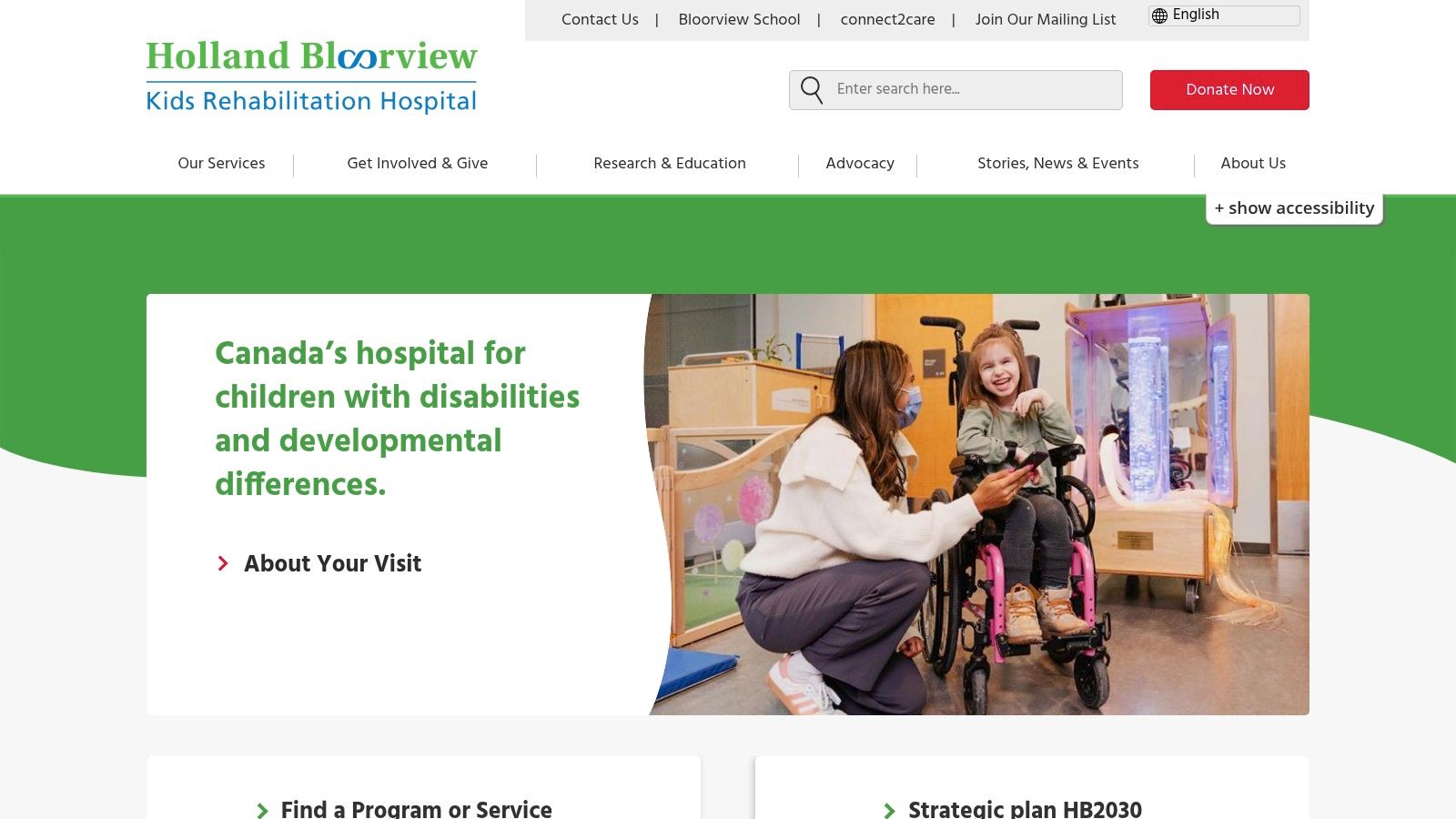
If your child has complex communication needs, Holland Bloorview is often one of the strongest names on the list. It isn’t the place I’d point every child with a mild articulation delay, but it is a serious option for children who need coordinated rehab, AAC support, or input from multiple professionals at once.
Its outpatient speech-language pathology pathways sit inside a broader paediatric rehabilitation setting. That matters when speech concerns are tied to cerebral palsy, autism, developmental disability, neuromotor conditions, feeding issues, or broader medical complexity. Families often do better in one integrated system than by trying to stitch together separate private referrals.
Who this is for
Holland Bloorview fits best for children who need more than speech sound practice alone.
Complex communication profiles: Children who need speech, language, motor, medical, and functional communication planning together.
AAC assessment needs: Families exploring communication devices, trials, training, and funding pathways.
Interdisciplinary care: Children already followed by rehab, developmental, or specialty paediatric teams.
Practical rule: If you’re asking whether your child needs a device, not just therapy, hospital-based AAC expertise is usually the right starting point.
A major strength is its recognised AAC service, including support connected to Ontario ADP pathways. That can save families a lot of confusion. Device decisions aren’t just about picking hardware. They involve access method, caregiver training, school carryover, and whether the child can use the system across settings.
What works and what doesn’t
What works well here is depth. SLPs can collaborate with occupational therapy, physiotherapy, psychology, and medicine in one setting. For a child with motor planning challenges and communication breakdowns, that’s much more useful than isolated weekly sessions.
The trade-off is access. Referral criteria apply, and wait times can happen. Holland Bloorview is also paediatric by design, so it won’t solve adult speech-language needs in the household.
A realistic scenario: a preschooler with limited verbal output, motor challenges, and inconsistent pointing often needs a broader communication plan than “wait and see.” A centre like Holland Bloorview Kids Rehabilitation Hospital is built for that level of complexity.
2. First Words – CHEO Preschool Speech & Language Program
When parents in Ottawa ask me where to start for a preschooler, I usually want to know one thing first. Is the child eligible for First Words? If the answer is yes, it should be high on the list because it’s publicly funded, built for early years, and easy for families to understand.
This program serves children from birth to junior-kindergarten entry and offers screening, assessment, parent coaching, and therapy. It also has bilingual service options in English and French, which is a meaningful advantage for many families in the region.
Who this is for
First Words is a strong match for families who need a clear early-intervention entry point rather than a specialist rehab hospital.
Preschool children: Best for birth to school entry when concerns are emerging early.
Families wanting public access first: It’s a sensible first stop before paying privately.
Bilingual households: English and French options reduce friction during assessment and coaching.
One thing I like here is the online communication checkup. Screeners don’t replace a full assessment, but they can help families organise concerns and move toward the right referral path. While you’re gathering information, some families also use Orange Neurosciences resources for parents and individuals to better understand attention, language-related learning concerns, and what kinds of follow-up questions to bring to an appointment.
Real trade-offs
The biggest advantage is that this is a no-cost preschool speech and language route funded through Ontario. That lowers the pressure on families who are already juggling daycare, work, and uncertainty.
The main limitation is geography. It’s for Ottawa and Renfrew County, so it’s excellent if you’re in catchment and irrelevant if you aren’t.
Don’t wait for speech to “sort itself out” if your child also struggles with following directions, play skills, or frustration during communication. Those patterns usually deserve a closer look.
Families can learn more directly through First Words at CHEO. If your child is in the right age range and region, this is one of the cleaner public pathways in Ontario.
3. KidsAbility – Speech & Language Therapy
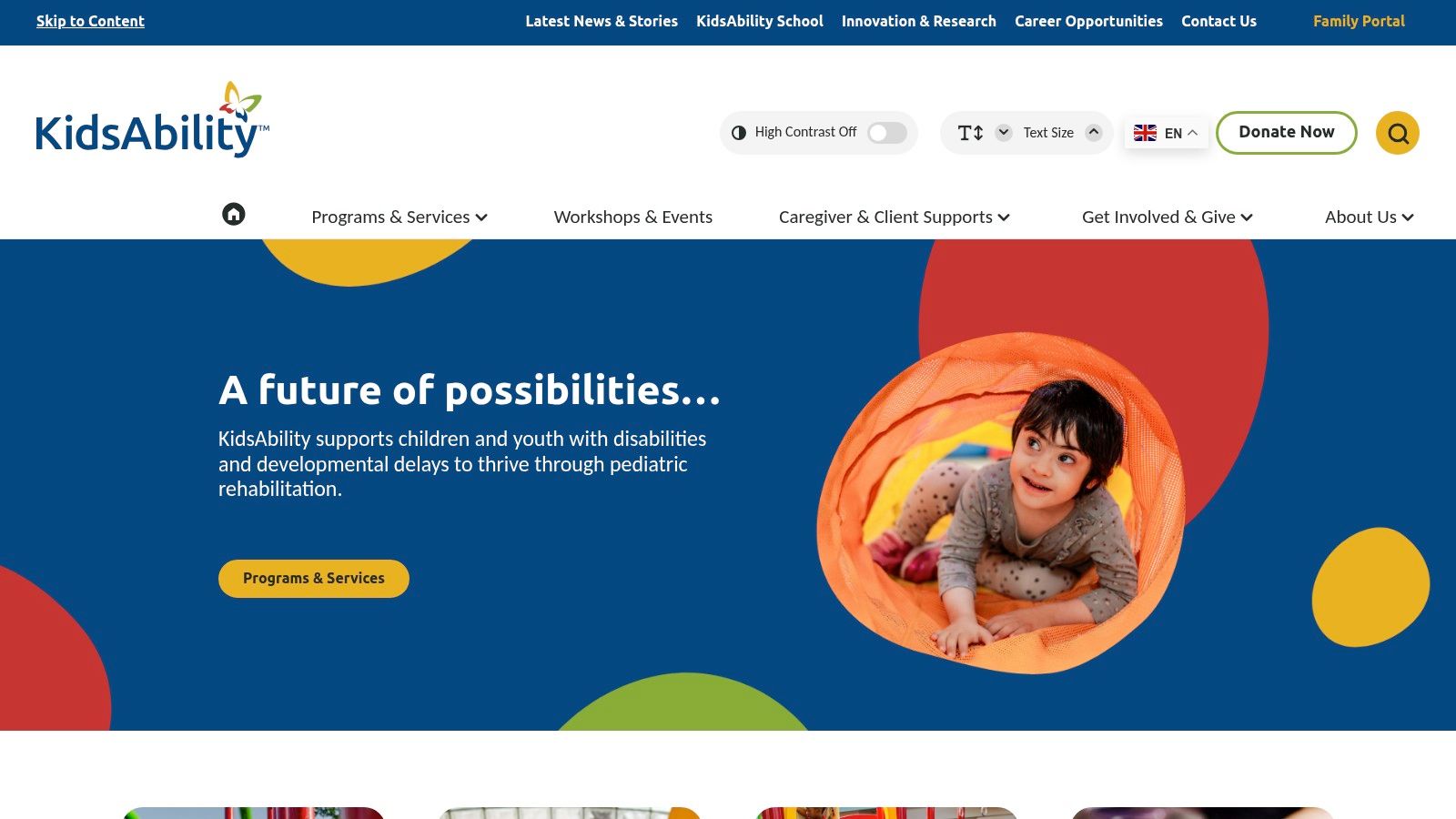
A family in Kitchener or Guelph may start with a simple concern. Their child is hard to understand, daycare reports frequent frustration, and school readiness suddenly feels less straightforward than expected. In that situation, KidsAbility is often a practical public route because support is not limited to one age range or one setting.
What makes this program useful is continuity. Early years speech and language services, school-based rehabilitation, virtual options, and access to a broader paediatric treatment centre can all matter when a child’s needs do not stay neatly in one box. I often see children who begin with delayed speech and later need help with classroom participation, attention during language tasks, or coordination between home and school. A service that can hold those pieces together reduces repeat storytelling for parents.
Who this is for
KidsAbility fits best for families in Waterloo Region, Cambridge, Guelph, and Wellington who want publicly funded support and a clearer path across developmental stages.
Young children who need parent coaching: This works well when the goal is to build communication into daily routines such as meals, play, books, and transitions.
School-aged children who need support linked to education settings: School-Based Rehabilitation Services can reduce the gaps that often happen between clinic recommendations and classroom reality.
Children with overlapping developmental needs: A treatment-centre model is helpful when speech concerns sit alongside motor, learning, behaviour, or social communication questions.
A common referral is a four-year-old with unclear speech, limited back-and-forth conversation, and frequent meltdowns when not understood. That child may need speech therapy, but the bigger question is whether there are broader communication or developmental factors shaping the picture. While waiting for formal services, some families use Orange Neurosciences cognitive assessments to organize what they are seeing at home. If social communication differences are also coming up, this guide to autistic and autism terminology can help parents prepare more precise questions for the assessment team.
Real trade-offs
The strength here is breadth. Families can access a public system that understands speech and language within the wider context of child development. That matters because children rarely present with one issue in isolation.
The limitations are real too. Eligibility depends on region, and wait times can be hard on families who need help now, not months from now. Parent coaching during the wait can still be useful, but it does not fully replace direct therapy when a child has significant speech intelligibility problems, complex language needs, or feeding concerns.
For families in catchment, KidsAbility Speech & Language Therapy is often one of the more practical places to start because it gives you a public entry point and room to build a longer-term plan if needs become more complex.
4. Grandview Kids – Speech-Language Pathology
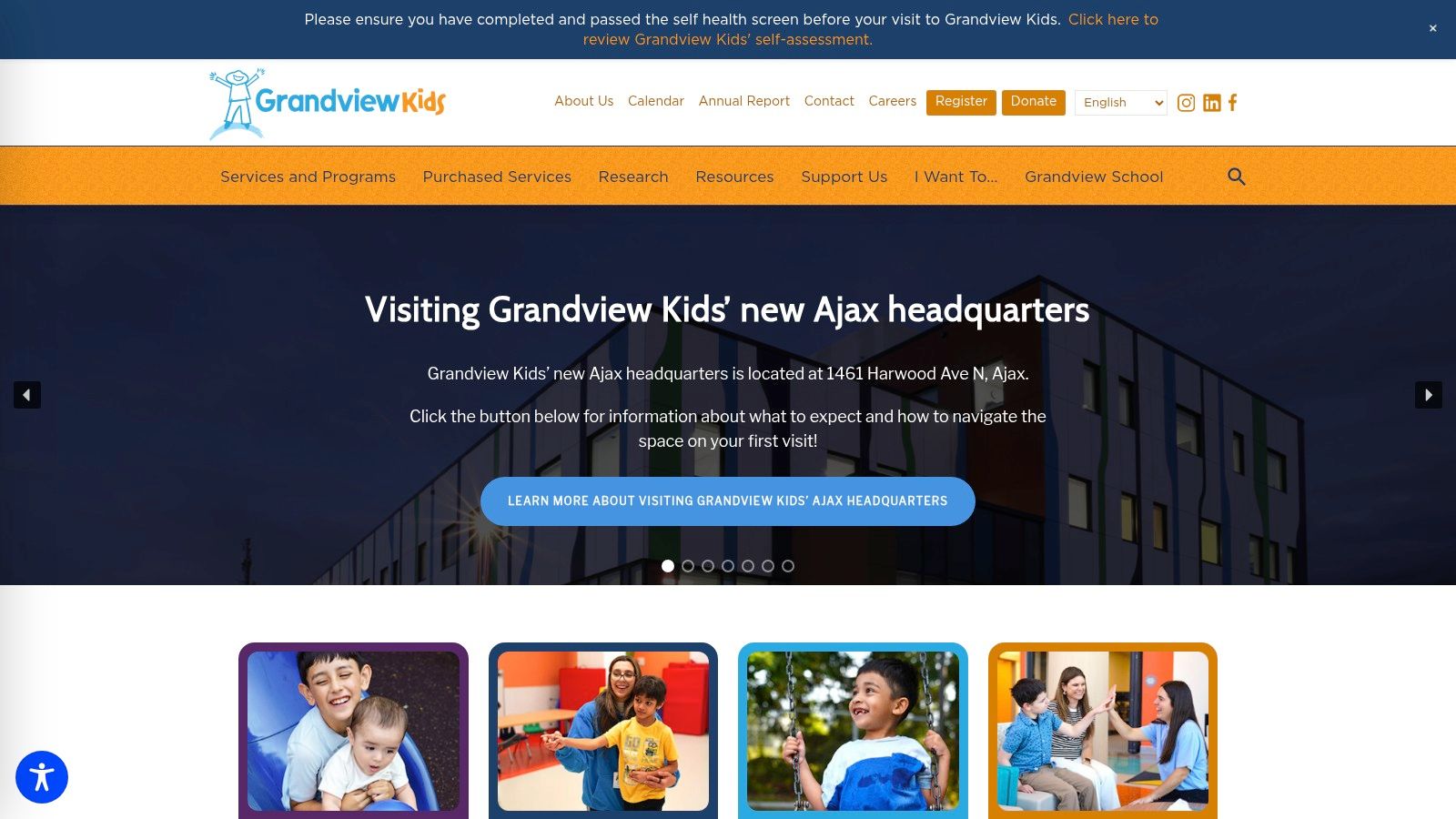
Grandview Kids is one of those programs that tends to work well because families can understand the pathway. In Durham Region, it plays a lead role in preschool speech and language access, and that kind of regional clarity makes a difference when parents are already overwhelmed.
The service mix is practical. Speech, language, and swallowing supports are available within a broader paediatric rehabilitation organisation, and parent coaching is part of the model. That’s especially helpful in the early years, when therapy should change what happens at home, not just what happens in a clinic room.
Who this is for
This is a strong fit for Durham families who want an early public route with room for broader rehab support if needed.
Preschool children in Durham Region: A sensible first referral for early identification.
Parents who want coaching: Families often need strategies they can use daily, not just periodic appointments.
Children with feeding or swallowing concerns alongside communication issues: Broader SLP scope can matter here.
A situation I see often is a child referred for “speech delay” who also shows rigid play, sensory differences, or social communication concerns. That doesn’t mean one diagnosis. It means the family needs a service that can sort out what belongs where. For some families learning about neurodevelopmental patterns during that process, Orange Neurosciences’ guide on autistic and autism-related support can help frame better questions before appointments.
Trade-offs that matter
Grandview’s biggest strength is local pathway clarity. Its biggest limitation is also local. If you’re outside Durham, it isn’t your route. Purchased service capacity can also be limited, and waitlists can still happen.
I’d rather see families use a clear regional intake than spend months calling unrelated clinics one by one. If your child is eligible, Grandview Kids Speech-Language Pathology is a strong, grounded entry point.
5. Ron Joyce Children’s Health Centre (McMaster) – Preschool Communication Services
Some families need a preschool program that feels close to real life. Not just a clinic office, but support that shows up in childcare settings, community hubs, and parent programs. That’s where Ron Joyce Children’s Health Centre’s Preschool Communication Services stands out.
The hospital connection through McMaster Children’s Hospital is useful for children whose speech and language concerns may sit beside broader developmental or medical questions. At the same time, the community delivery model keeps the service from feeling overly hospital-centred for families with more routine early communication needs.
Who this is for
This program suits Hamilton-area families with preschoolers who benefit from both hospital connection and community access.
Children aged 0 to 5: A good fit during the highest-yield intervention window.
Families who need flexible locations: Community sites such as EarlyON and childcare settings can reduce logistical stress.
Children with more layered referrals: Hospital integration helps when developmental concerns extend beyond speech alone.
A practical example is the child who looks very different across settings. At home they use some language, in childcare they fall behind group instructions, and parents are also worried about learning readiness. In that waiting period, some families gather broader baseline information using tools linked to assessments for learning disabilities, especially when school-readiness concerns are part of the picture.
What families should know before applying
The positives are clear. Assessment, group and individual treatment, parent programs, and community-based delivery all make this easier to access in day-to-day life than a purely centralised clinic.
The limitations are mostly logistical. Geographic eligibility applies, referral requirements matter, and some public program web information can be harder to understand than it should be. Still, Hamilton families should keep Hamilton Health Sciences and Ron Joyce Children’s Health Centre on their shortlist because the model is family-friendly and clinically connected.
6. Aphasia Institute – Pat Arato Aphasia Centre
A family often reaches this point after the hospital phase is over. Speech has changed, conversation breaks down, and everyone in the home is working hard but guessing. Adult families are often surprised by how quickly formal rehab can taper off, especially when the person still has major day-to-day communication needs.
The Aphasia Institute fills a very specific gap in Ontario. It focuses on adults with aphasia after stroke or brain injury, as well as people living with Primary Progressive Aphasia. That matters because adult communication rehab is rarely a straight line. The immediate goal is not only naming or word retrieval. It is being able to participate in real conversations, manage appointments, stay connected to family, and reduce isolation.
Who this is for
This program is usually the right fit for adults who need aphasia-specific support after discharge from hospital or outpatient rehab.
Adults with aphasia after stroke or brain injury: A strong option when conversation, participation, and everyday communication are the main concerns.
People with Primary Progressive Aphasia: Especially when families need education and practical communication strategies as needs change over time.
Spouses, adult children, and other communication partners: The Institute puts real emphasis on teaching the people around the client how to support successful interactions.
Families who need remote access: Virtual services can make follow-through more realistic when travel, fatigue, or distance are barriers.
One of the Institute’s strengths is its use of Supported Conversation for Adults with Aphasia. In practice, that means treatment extends beyond the individual. Families learn how to slow the pace, confirm meaning, repair breakdowns, and keep the person involved rather than speaking for them. I find this approach especially useful for households where everyone is trying to help, but the effort itself is creating more frustration.
What it does well and where it’s limited
Its value is clear. This is specialised adult communication rehab, delivered in a community model that recognises how aphasia affects relationships, confidence, and daily life after formal medical care ends. Group options and education can also help people who feel cut off after stroke.
The trade-off is fit. Families looking for frequent one-to-one therapy may find the model less intensive than a private clinic. Fees can apply, and intake may require an SLP report or referral, which can slow the process if records are incomplete. For some adults, especially those with attention, memory, or broader recovery questions after neurological injury, it also helps to review related neurorehabilitation services for cognitive and communication recovery while deciding what type of support to pursue first.
More information is available through the Aphasia Institute.
7. The Speech & Stuttering Institute
A parent may tell me, “My child can answer every question at home, but freezes the moment the class is watching.” In that situation, a general speech clinic is not always the best first stop. Stuttering treatment works best when the clinician can address speech patterns, anxiety, avoidance, family responses, and school participation together.
The Speech & Stuttering Institute is a long-standing not-for-profit centre in Toronto focused specifically on fluency. It serves children, teens, and adults, with both weekly and intensive options. That matters because stuttering rarely fits one template. A preschooler who is just starting to repeat sounds needs a different plan from a teen who is avoiding oral presentations or an adult who has spent years changing words to hide the stutter.
Who this is for
This program is usually a strong fit when fluency is the main concern and the family wants specialist care rather than broad speech-language support.
Young children who stutter: Especially when parents want direct coaching on how to respond at home and what signs to watch over time.
School-age children and teens: Useful when stuttering is affecting class participation, reading aloud, friendships, or confidence.
Adults who stutter: A good option for people who want targeted fluency therapy, counselling support, or a more structured program than a general clinic can offer.
Families who have already tried general speech therapy: Specialist assessment can help clarify whether the plan is targeting stuttering or only working around it.
One strength here is treatment range. The Institute offers recognized approaches such as Fluency Plus, Lidcombe, and Palin PCI. In practical terms, that gives clinicians more than one path. Some children need parent-led work at home. Some older clients need strategies for speaking in meetings, on the phone, or in interviews. Some need both speech restructuring and help reducing fear and avoidance.
There are trade-offs, and families should go in with clear expectations. Fees apply. Subsidies are not guaranteed. Travel into Toronto can be a barrier, especially for families managing school schedules, work hours, or siblings’ appointments. Telepractice may be available for some services, but not every program will be the right fit virtually.
Wait times can still be an issue in specialty care. As noted earlier, Ontario continues to face a supply-and-demand gap in speech-language services, and families often feel that pressure most in niche areas such as fluency. While you wait, it helps to gather useful information instead of sitting in limbo. Parents can keep a short log of when stuttering increases, whether the child is avoiding certain words or situations, and what teachers are noticing at school. That kind of detail makes the first assessment more productive.
For direct intake details, visit The Speech & Stuttering Institute.
7-Program Comparison: Speech Therapy in Ontario
Service | Implementation complexity | Resource requirements | Expected outcomes | Ideal use cases | Key advantages |
|---|---|---|---|---|---|
Holland Bloorview Kids Rehabilitation Hospital | High, multidisciplinary hospital pathways and AAC integration | Significant, specialized SLP/OT/PT teams, AAC devices, funding navigation (ADP) | Advanced AAC assessment, improved functional communication for complex paediatric cases | Children with complex multi‑diagnoses requiring comprehensive AAC assessment and device funding | Deep expertise in paediatric complex care; provincial AAC leader; publicly funded hospital services |
First Words – CHEO Preschool Speech & Language Program | Low–moderate, standardized screening and preschool program workflows | Low, publicly funded SLP services, bilingual staff, online screener | Early identification and improved preschool language skills; parent coaching | Preschoolers (birth–JK) in Ottawa/Renfrew needing free, bilingual early intervention | No‑cost publicly funded service, bilingual options, online communication screener |
KidsAbility – Speech & Language Therapy | Moderate, tiered early‑years model and school integration | Moderate, regional SLP teams, mixed virtual/in‑person delivery, school partnerships | Improved early communication and school‑based rehabilitation supports | Children in Waterloo/Guelph–Wellington/Cambridge across early years and school settings | Broad regional footprint, school‑based services, parent‑as‑partner approach |
Grandview Kids – Speech‑Language Pathology | Moderate, regional PSL leadership with centre and community delivery | Moderate, publicly funded SLPs, community programs, clear referral info | Early intervention outcomes and strengthened parent coaching | Preschoolers in Durham Region requiring PSL under Ontario program | Clear regional access pathways, focus on early identification and parent education |
Ron Joyce Children’s Health Centre (McMaster) – Preschool Communication Services | Moderate–high, hospital‑based service with community satellites and coordination | Moderate, hospital clinicians, community/EarlyON sites, some evening staffing | Accessible assessments/treatment for 0–5 and support for complex referrals | Hamilton‑area children (0–5) needing clinic or community PSL, including complex cases | Hospital integration for complex referrals, community satellites and evening hours for access |
Aphasia Institute – Pat Arato Aphasia Centre | Moderate, group‑based and training programs using SCA methodology | Moderate, specialist clinicians, virtual platforms; fees and intake requirements | Improved social participation and supported conversation skills for adults with aphasia | Adults with post‑stroke aphasia or PPA and their communication partners seeking group rehab and training | Specialized aphasia focus, province‑wide virtual reach, clinician and caregiver training in SCA |
The Speech & Stuttering Institute | Moderate–high, intensive and weekly evidence‑based fluency programs | Moderate, trained fluency clinicians, program fees, possible travel or telepractice | Measurable fluency improvements and clinician training outcomes | Children and adults with stuttering seeking intensive or structured long‑term treatment | Niche expertise in stuttering, multiple program formats, provincial training hub for clinicians |
Your Action Plan Navigating Waitlists, Funding and Next Steps
Finding the right service is only the first step. The harder part often comes next, when you learn that the best-fit program has a waitlist, your child doesn’t fall neatly into one stream, or you’re trying to decide whether to pursue public care, private care, or both.
Start by matching the program to the actual problem. A preschool language delay belongs in a public early-years pathway if one is available in your region. A child with suspected AAC needs, feeding issues, or complex developmental concerns usually needs a rehab hospital or treatment centre. A person with aphasia after stroke needs an adult communication program, not a generic children’s clinic just because it’s nearby.
Funding matters, but so does timing. Publicly funded Preschool Speech and Language programs are often the right first move for eligible young children. Private insurance benefits can help when families need faster support or more flexible scheduling. For some families, the best route is layered care. Join the public waitlist, then use targeted private sessions or guided home strategies to avoid losing momentum.
While you wait, gather useful information. Keep short notes on what your child can do easily, what breaks down, and in which settings. Record a few real examples. Can they follow one-step directions but not two-step? Do they communicate better in play than in conversation? Do meltdowns happen when language load increases? Specific patterns help future clinicians much more than “I’m just worried.”
This is also a good time to add objective baseline data. Orange Neurosciences’ OrangeCheck can give families and clinicians a rapid, evidence-based cognitive profile that supports better questions and more focused follow-up. It isn’t a diagnosis, and it shouldn’t replace a speech-language assessment, but it can make wait time productive by documenting attention, memory, executive function, processing, and related skills that often affect communication and learning.
That matters because speech concerns rarely live in isolation. A child who struggles to express themselves may also have attention weaknesses, processing speed differences, or broader learning vulnerabilities. A clinician who sees those patterns early can plan more intelligently.
Access challenges are also bigger in some parts of the province. One Ontario-focused market overview notes that speech therapy services in Canada reached USD 1,481.8 million in 2023 and are projected to grow to USD 2,675.5 million by 2030, with digital and home-based models gaining traction. That doesn’t solve local waitlists by itself, but it does reinforce what many families already know. Hybrid support, teletherapy, and digital tools are becoming part of practical care planning.
Waiting well is still action. Good notes, baseline data, and the right referral path can shorten the time from “concern” to meaningful treatment.
If you’re supporting a family, building a referral network, or trying to make sense of fragmented options, keep the process simple. Choose the best-fit regional or specialty program. Join the queue early. Use the waiting period to document strengths and concerns. Bring organised information to every intake. And if your team also needs operational support while coordinating care staff, Twizzlo for healthcare staff management is worth a look.
Ready to move from guesswork to clearer next steps? Visit Orange Neurosciences to see how data-driven cognitive insight can support speech, learning, and rehabilitation planning.
Orange Neurosciences helps families, clinicians, and rehab teams turn waiting time into useful clinical preparation. Explore Orange Neurosciences to access OrangeCheck, review child and adult cognitive support options, and connect with a platform built to support faster, more informed care planning.
Orange Neurosciences' Cognitive Skills Assessments (CSA) are intended as an aid for assessing the cognitive well-being of an individual. In a clinical setting, the CSA results (when interpreted by a qualified healthcare provider) may be used as an aid in determining whether further cognitive evaluation is needed. Orange Neurosciences' brain training programs are designed to promote and encourage overall cognitive health. Orange Neurosciences does not offer any medical diagnosis or treatment of any medical disease or condition. Orange Neurosciences products may also be used for research purposes for any range of cognition-related assessments. If used for research purposes, all use of the product must comply with the appropriate human subjects' procedures as they exist within the researcher's institution and will be the researcher's responsibility. All such human subject protections shall be under the provisions of all applicable sections of the Code of Federal Regulations.


© 2026 by Orange Neurosciences Corporation