Boosting Your Reaction Time for Peak Performance
Nov 26, 2025
Ever seen an Olympic sprinter explode off the blocks the very instant the starting gun fires? Or felt that jolt of adrenaline as you slam on the brakes to avoid a fender-bender? That split-second gap between seeing, hearing, or feeling something and physically responding to it is what we call human reaction time.
It’s far more than just how fast your muscles can move. At its core, reaction time is a direct measure of your nervous system's efficiency—a high-speed relay race from your senses to your brain and back out to your muscles. For most simple tasks, this entire process clocks in somewhere between 200 to 300 milliseconds.
What Really Happens During That Split-Second Delay?
Imagine you’re trying to catch a glass as it tips over on the counter. That seemingly instantaneous reflex is actually a complex, three-part journey unfolding at lightning speed within your nervous system.
Let's break down that journey. Understanding these distinct stages helps us see where bottlenecks can happen and, more importantly, what we can target to improve our responsiveness. Actionable Insight: By identifying if your delay is in perception, processing, or action, you can focus your training for maximum impact.
The Three Stages Of A Reaction
Perception: It all starts with your senses. Your eyes see the glass tipping, your ears register the sound of it sliding, or your skin feels the vibration. This is the starting line, where a sensory organ detects the initial stimulus and sends out an "alert" signal. Practical Example: A gamer sees an opponent appear on screen. This visual cue is the stimulus.
Processing: That alert signal doesn't travel directly to your muscles. First, it zips up to your brain. Here, your brain has to do some seriously fast work: identify the signal ("That's a falling glass!"), interpret its meaning ("It's going to smash!"), and decide what to do about it ("Catch it!"). This cognitive step is often the longest part of the journey and is a key element we look at during a professional cognitive assessment.
Action: Once the decision is made, your brain fires a command back down through the nervous system to the specific muscles needed for the job. This is the final leg of the relay—the physical execution of your decision as your hand lunges forward to grab the glass. Practical Example: The gamer’s brain sends a signal to their thumb to press the "fire" button.
This quick diagram shows how those pieces fit together, flowing from your eyes to your brain and down to your hand.
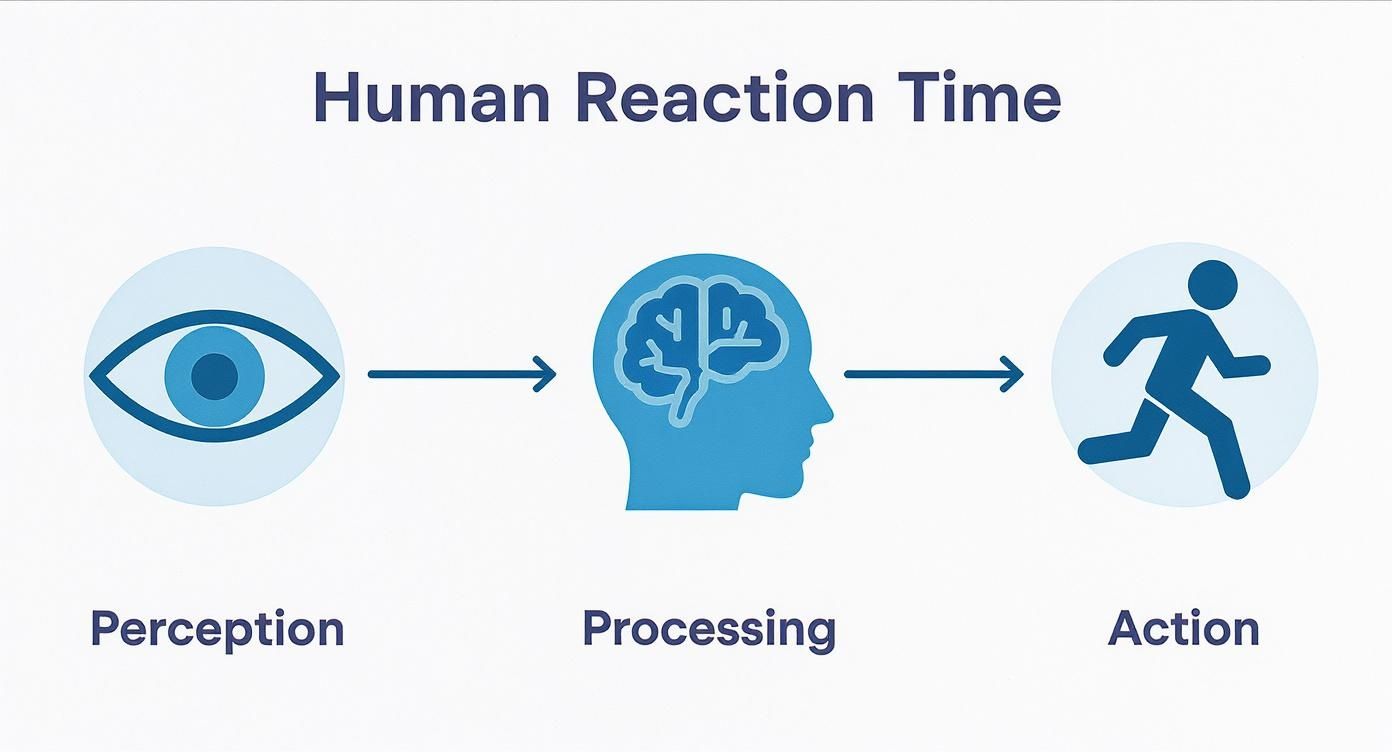
As you can see, the brain's processing speed is the critical hub in this entire sequence. It’s not just about being physically quick; it’s about being mentally sharp.
A common myth is that reaction time is all about physical speed. In reality, the bulk of that delay happens inside your skull while your brain processes the information and formulates a response.
Typical Human Reaction Times at a Glance
So, just how fast are we? Reaction times can vary quite a bit depending on what sense is being stimulated and how complex the task is. Here’s a quick look at some typical benchmarks.
Stimulus Type | Average Reaction Time (Milliseconds) |
|---|---|
Visual (sight) | 200 - 250 ms |
Auditory (sound) | 150 - 200 ms |
Tactile (touch) | 120 - 150 ms |
Simple Reaction | 200 - 300 ms |
Choice Reaction | 400 - 600 ms |
As the table shows, we tend to react fastest to touch and sound, while visual cues take just a fraction of a second longer for our brain to process. Adding a choice into the mix (like pressing the right button instead of just any button) significantly increases the time, highlighting the cognitive load involved.
What Do The Numbers Say?
Okay, so we have some general ranges, but what does the research show for the average person? One large-scale study gave us some solid benchmarks.
After testing over 1,400 participants, researchers found the mean simple reaction time for adults was around 230 milliseconds. Younger adults (aged 20–30) were a touch faster, averaging 217.9 ms, while older adults (aged 61–70) were slightly slower at 239.1 ms.
This shows a completely natural, gradual slowing as we age, giving us a reliable baseline to understand performance across our lifespan.
The Brain's High-Speed Neural Pathway
To really get a feel for the incredible speed of human reaction time, you have to follow the signal's journey from your senses all the way to your muscles. It’s a biological marvel, a high-speed network that frankly makes modern technology look a bit sluggish. This isn't just one wire; it’s a beautifully complex and highly organised pathway.
Practical Example: You're driving, and a deer suddenly leaps onto the road. Your foot slams the brake almost before you’ve consciously registered the danger. What actually happened in that split second? That reflex is the end result of a signal travelling at astonishing speeds through your nervous system—a journey we can break down into distinct, lightning-fast stages.
From Sensation To Action
It all starts the moment light from the deer hits your retina. This visual information is instantly translated into an electrical signal, the universal language of your entire nervous system. And just like that, a relay race has begun where every single millisecond counts.
This initial signal doesn't just wander aimlessly. It hurtles along the optic nerve, a bundle of more than a million nerve fibres, heading straight for the part of your brain dedicated to sight. Think of it as the main data cable connecting your eyes to your central processing unit.
The first stop is a small, central brain region called the thalamus. The thalamus acts like a hyper-efficient switchboard, receiving sensory information from your eyes, ears, and skin, and immediately directing it to the right processing centre.
The Brain's Processing Hub
From the thalamus, the visual signal is routed to the occipital lobe, tucked away at the very back of your brain. This is your visual cortex, the area responsible for making sense of what you're actually seeing. It’s here that the raw data of "light and shapes" is interpreted as "a deer on the road."
But just seeing the deer isn't enough to save you. Now the brain has to decide what to do about it. The signal is passed along to other brain regions, including the frontal lobe, which is in charge of decision-making and planning. If you're curious about how these different areas work together, our detailed guide on the lobes of the brain offers a deeper dive into this fascinating topic at https://www.orangeneurosciences.ca/guide/lobes-du-cerveau.
This is where the real magic of cognition happens. Your brain accesses memories of driving lessons, recognizes the immediate danger, and forms a plan in an instant: "Brake now!"
The entire decision-making process—from identifying the threat to choosing a response—happens in a fraction of a second. This cognitive step is where training and mental sharpness can make the biggest difference in the reaction time of a human.
Executing The Command
Once the decision is made, it's time to act. The frontal lobe shoots a new signal to the motor cortex, the brain's command centre for movement. This area maps out the exact muscle movements needed to press that brake pedal.
This command signal then barrels down the spinal cord, a true superhighway for neural traffic. It branches off at the lower back, zipping down the nerves in your leg until it reaches the muscles in your thigh and calf, instructing them to contract with power and precision.
This whole sequence—from eye to brain to foot—feels instantaneous. It perfectly illustrates how your nervous system is a coordinated network, fine-tuned for speed and survival. To really get the most out of this high-speed pathway, it’s essential to explore strategies for improving cognitive function.
Actionable Insight: Your reaction time isn't just about how fast your leg can move. It's a clear reflection of the health and efficiency of this entire neural pathway. To find out how to build a faster, more resilient cognitive engine, visit our website and see how our tools can help.
Simple vs Choice Reaction Time
Not all reactions are the same. When we talk about human reaction time, we're really looking at a whole spectrum of responses, from a basic knee-jerk reflex to a complex, split-second decision. The two big categories here are simple reaction time (SRT) and choice reaction time (CRT).
Getting a handle on this difference is key, because it helps us zero in on what part of our cognitive processing might need a tune-up. Are you slow off the mark, or are you slow to make a call? These are two very different problems.
Simple Reaction Time: The Pure Reflex
Simple reaction time is about as basic as it gets. It's the raw measurement of how long it takes you to respond to one predictable signal with one pre-planned action. There's no thinking or deciding involved—when you get the cue, you just go.
A 100-metre sprinter is the perfect real-world example. They're coiled in the blocks, waiting for a single, expected stimulus: the sound of the starting gun. Their task isn't to decide what to do, but simply to explode forward the instant they hear it.
Let's break it down:
The Stimulus: A single, expected event (like a light turning on).
The Response: A single, predetermined action (like pressing a button).
This kind of test purely measures the raw speed of your neural superhighway—how fast a signal can travel from your senses to your muscles with minimal detours in the brain.
Choice Reaction Time: The Cognitive Challenge
This is where things get more interesting and a lot more like real life. Choice reaction time brings multiple possible signals into play, with each one requiring a different response. This adds a crucial layer of cognitive work—decision-making—to the process.
Practical Example: Imagine a video game where you have to press the 'A' button for red enemies and the 'B' button for blue ones. Your brain has to do a lot more than just see something pop up on the screen. It has to:
Identify the Stimulus: Is that enemy red or blue?
Select the Correct Response: Based on the colour, which button do I need?
Execute the Action: Press the right button, and fast.
Choice reaction time isn't just about reflex; it's a direct measure of your decision-making speed. This extra mental step is why CRT is usually 150-200 milliseconds slower than SRT.
This kind of processing is happening all around us, all the time. A quarterback has to scan the field, identify an open receiver from several options, and make a throw before getting sacked. A driver at a busy intersection processes traffic lights, pedestrians, and other cars to decide whether to brake, accelerate, or turn. It's even at play when you're sorting laundry—identifying a T-shirt's colour and tossing it into the right basket.
Why The Difference Matters For Improvement
Actionable Insight: Understanding the gap between your SRT and CRT is vital if you want to get better. If your simple reaction time is sluggish, the issue might be in your basic neural processing speed or even your sensory sharpness.
But if your SRT is lightning-fast and your CRT is lagging way behind, the bottleneck isn't your reflexes—it's your decision-making. This is where specialized tools, like those used in an auditory processing test, can give you some incredible insights.
By figuring out whether the delay is in the "go" signal or the "decide, then go" signal, you can focus your training where it will actually make a difference. For most of us, improving choice reaction time delivers a much bigger payoff in the real world, boosting everything from our performance in sports to our safety on the road.
Key Factors That Influence Your Reaction Speed
Ever notice how some days you feel razor-sharp, catching a falling glass without a second thought, while other days you feel like you’re moving through mud? Your reaction time isn't some fixed number etched in stone. It’s a dynamic, living metric that shifts daily, shaped by your biology, your lifestyle, and even the room you're in.
Understanding these variables is the first step to actually improving your cognitive performance. After all, you can’t fix what you don’t understand. A whole host of things, from your physical fitness to your mental state, can hit the gas or the brakes on your reflexes. This is something explored in depth in elite athlete training, where every millisecond counts and every influencing factor is put under the microscope.
Let's break down the key internal and external factors that can give you a competitive edge—or slow you down.
Age and Biological Factors
It’s a simple biological fact: our reaction times are typically at their peak in our early 20s and then gradually begin to slow down as the years go by. This isn't a personal failure; it's just a natural part of aging as our neural pathways become a little less efficient over time. Gender can also play a small role, but the differences are usually minimal and depend heavily on the specific task.
But here’s the good news: this decline isn't set in stone. Staying active—both physically and mentally—can do wonders to preserve your processing speed well into your later years. Think of it as regularly tuning up your brain's internal wiring.
A large-scale study confirmed this in a real-world setting, showing that younger folks (ages 11–20) clocked in with an average reaction time of 220 milliseconds. In contrast, older adults (ages 51–60) averaged a slower 280 milliseconds. This highlights a direct link between our habits and how quickly our brain can process information at different stages of life.
Lifestyle Choices: Your Brain's Fuel and Recovery
The habits you practice every day have a massive, direct impact on your cognitive speed. These are the things you have the most control over, and even small tweaks can lead to big improvements.
Sleep Quality: Think of sleep as your brain's nightly maintenance crew. Skimp on it, and you’ll notice your attention wandering, your decisions slowing, and your reflexes feeling dull. Practical Example: A well-rested gamer will always outplay their sleep-deprived self, not because their hands are faster, but because their brain is firing on all cylinders.
Physical Fitness: Regular exercise is one of the most powerful things you can do for your cognitive speed. Getting your heart rate up increases blood flow to the brain, encourages the growth of new neural connections, and sharpens overall cognitive function. Practical Example: A fit tennis player doesn't just have stronger muscles; their brain is also better conditioned to react instantly to the ball.
Nutrition and Hydration: Your brain is a high-performance engine that needs premium fuel. Good nutrition provides the energy it needs to run efficiently. On the flip side, even mild dehydration can quickly bring on brain fog and slow down your processing. Practical Example: That mid-afternoon slump at your desk? It’s not just in your body; your reaction time to emails and tasks is taking a hit, too.
Actionable Insight: Your reaction speed is a direct reflection of your overall well-being. Prioritizing 7-9 hours of sleep, staying active, and fueling your body correctly are non-negotiable for maintaining sharp reflexes.
Mental State and Environmental Factors
Your state of mind in any given moment can also sharpen or dull your reaction time. It’s no surprise that a calm, focused mind can process information much more effectively than one that’s stressed out, distracted, or just plain tired.
This is where mental focus becomes an essential skill. Every distraction, whether it's a noisy office or your own internal anxiety, is competing for your brain's limited bandwidth. To learn some practical ways to sharpen your mental clarity, check out our guide on how to improve focus and concentration.
To help you see how these pieces fit together, here’s a quick look at the major influencers on your reaction time.
Key Influencers on Your Reaction Time
The table below offers a comparative look at how different factors can either enhance or impair human reaction time, providing actionable insights for improvement.
Factor | Potential Impact (Positive/Negative) | Practical Example |
|---|---|---|
Sleep | Positive: Enhances attention & processing | 7-9 hours of quality sleep sharpens reflexes for driving. |
Negative: Slows decision-making | Sleep deprivation leads to sluggish responses in sports. | |
Exercise | Positive: Boosts brain blood flow & function | Regular cardio keeps neural pathways efficient for daily tasks. |
Negative: Sedentary lifestyle impairs speed | Lack of activity can slow cognitive processing at work. | |
Hydration | Positive: Supports optimal brain function | Drinking enough water prevents cognitive fog during exams. |
Negative: Dehydration slows processing | Even mild dehydration can dull your reaction time while gaming. | |
Age | Negative: Natural decline over decades | Slower neural transmission in later years affects driving. |
Positive (Mitigation): Active lifestyle | Mental/physical activity can preserve speed for hobbies. | |
Stress | Negative: Diverts cognitive resources | Anxiety and worry create mental "noise" in conversations. |
Positive (Mitigation): Mindfulness/Focus | A calm mind reacts faster and more accurately in emergencies. |
Ultimately, your reaction time is a complex dance between all these factors. By understanding which levers to pull—whether it’s getting more sleep, staying hydrated, or managing your stress—you can start to systematically fine-tune your cognitive performance.
How to Measure and Systematically Improve Your Reaction Time
Knowing what shapes the reaction time of a human is one thing. Actually making it faster is a whole different ball game. The journey to a quicker, more responsive brain starts with one crucial step: getting an accurate baseline. If you don’t know where you’re starting, you can't possibly track your progress or figure out what’s actually working.
You don’t need a fancy lab to get a reliable measurement, either. Modern digital tools can give you a precise and consistent look at your cognitive speed, providing a clear picture of where you stand right now. This number is your foundation—everything you do next will build on it.
Finding Your Baseline the Right Way
First things first, you need to measure your reaction time in a controlled way. Sure, a quick online test can give you a snapshot, but for a real understanding, a more structured assessment is the way to go. This is where tools designed specifically for cognitive analysis really shine by offering a much deeper look into your processing speed.
A proper assessment has to be repeatable and consistent so you can accurately track changes over time. It’s all about creating a benchmark you can trust, one that will guide you as you start working to sharpen your reflexes.
Platforms like Orange Neurosciences, for instance, provide a structured approach to this initial evaluation, moving well beyond simple online games to give clinicians and individuals a detailed cognitive profile. The key here is that a comprehensive measurement lays a solid foundation for any training program that follows.
Building a Faster Brain: Practical Strategies
Once you have your baseline, the real work begins. Improving your reaction time isn’t about a single magic trick; it’s a systematic process that combines both physical conditioning and direct cognitive training. These methods work in tandem to strengthen the entire neural pathway, from the moment you perceive something to the moment you act.
Let's dig into some of the most effective, evidence-based strategies you can weave into your daily routine to start seeing real improvements.
Physical Drills for Neural Efficiency
Physical activity is one of the most powerful ways to boost brain function. Exercises that demand agility, coordination, and quick decisions are especially good for your reaction time because they force your brain and body to talk to each other more efficiently.
Agility Ladder Drills: Weaving your feet through an agility ladder forces your brain into a series of rapid-fire decisions about foot placement, directly training your neuromuscular response system.
Ball Drop Exercises: Have a friend stand in front of you and drop a tennis ball without warning. Your job is to snatch it as fast as you can. This simple drill hones your visual tracking and motor response speed.
Plyometrics: Think box jumps and burpees. These exercises train your muscles to generate maximum force in minimum time, which translates directly to a faster physical response once your brain gives the order.
These activities aren't just about building muscle; they're about forging stronger, faster connections between your mind and body. Many of these drills are also fantastic for coordination, a topic we explore more in our guide on eye-hand coordination exercises.
Targeted Cognitive Training
While physical drills are crucial, direct cognitive training hones the processing side of the reaction time equation. These exercises zero in on the brain's ability to spot a stimulus, make a decision, and trigger a response more quickly. This is where digital tools can be a game-changer.
Actionable Insight: The biggest gains in reaction speed often come from making the brain's processing more efficient—that is, shortening the time it takes to make a decision—rather than just speeding up the physical movement.
Platforms like Orange Neurosciences are built on this very principle, providing structured, game-based interventions that work. The ReadON program, for example, uses engaging exercises to target and strengthen the specific neural pathways responsible for cognitive speed and accuracy.
This kind of structured training offers a few key advantages:
Personalized Difficulty: The system adapts to how you're doing, making sure you’re always challenged but never overwhelmed.
Consistent Measurement: It tracks your progress with every session, giving you real-time data on how much you’re improving.
Targeted Intervention: The exercises are scientifically designed to work on the specific cognitive skills that directly contribute to faster reaction times.
By combining consistent physical activity with dedicated cognitive training, you create a powerful synergy. You aren't just testing your speed; you are actively building a faster, more resilient, and more efficient cognitive engine.
Why a Faster Reaction Time Matters in Your Daily Life
We've unpacked the complex brain pathways and the different things that can affect human reaction time, but let's get down to what really counts: why does any of this matter? It’s more than just a number on a test. Those tiny fractions of a second are where the science meets the real world. A quick reaction time isn't a special skill for athletes—it's a core cognitive ability that shapes your safety, your performance, and your quality of life every single day.
Think about it. From the most ordinary moments to the most critical ones, your ability to react quickly is always at play. Whether you're driving your car, playing a weekend sport, or just trying to weave through a busy sidewalk, your brain is constantly running a loop: see, process, act.
The Milliseconds That Make All the Difference
In so many situations, the line between a good outcome and a bad one is measured in milliseconds. This is where a sharp, well-practised reaction time gives you a real-world edge.
On the Road: The car in front of you slams on its brakes. The time it takes for your brain to register the red lights and tell your foot to hit the pedal is everything. Even a delay of 100 milliseconds can mean your car travels several extra metres before it even starts to slow down. That’s the difference between a close call and a collision.
In Sports: A soccer goalie has about 400 milliseconds from the moment a penalty kick is taken until the ball crosses the goal line. A split-second reaction is the only thing standing between a dramatic save and letting in a goal. In baseball, a batter has even less time—under half a second—to decide if a fastball is worth swinging at.
At Home: It’s not just about high-stakes situations. Catching your phone before it smashes on the floor, snatching your hand back from a hot stove, or catching your balance when you trip—these are all reflexes that save you from injury and everyday frustrations.
It's a Marker of Your Cognitive Health
Beyond these practical benefits, your reaction time is also a powerful window into your overall brain health. Clinicians and researchers often use it as a sensitive, easy-to-measure indicator of cognitive function. When reaction speeds start to consistently slow down, it can be an early sign of other issues, from simple fatigue and cognitive decline to more serious neurological conditions.
Actionable Insight: Monitoring your reaction time isn't just for improving performance—it’s about being proactive with your brain health. Noticing a real change can give you valuable information to bring to a healthcare professional.
This same principle applies in high-pressure jobs where every second counts. Take emergency services, for example. In California, studies have looked at how quickly emergency responders can make decisions. One analysis found that ambulance patient offload times averaged 42.8 minutes. While many factors are involved, it highlights just how critical rapid processing is throughout the entire chain of critical care. You can read more in the full study on emergency response efficiency.
Take Charge of Your Cognitive Performance
Realizing how much reaction time impacts your life is the first step. The next is to do something about it. Taking the time to measure and train this vital skill is one of the best investments you can make in your daily performance and long-term cognitive well-being. It’s about giving yourself the tools to be safer, sharper, and more resilient in everything you do.
Ready to go from knowing to doing? See how Orange Neurosciences provides the tools to accurately track your cognitive speed and build a real plan for improvement. Visit our website to learn how OrangeCheck and ReadON can help you tap into your full potential.
Frequently Asked Questions
As we dive into the world of human reaction time, a few key questions usually pop up. We've gathered some of the most common ones here to give you clear, practical answers that connect the science to your own life and goals.
What Is Considered a Good Reaction Time?
For a simple reaction time test, a typical adult will land somewhere between 200 to 250 milliseconds (ms). That’s a solid baseline. Elite athletes, for comparison, often dip below 200 ms, which is truly exceptional.
But here’s the thing: a single "good" number can be a bit of a trap. Reacting to a starter pistol is one thing; deciding which way to swerve your car to avoid an obstacle is another entirely. The best benchmark isn't just a raw score, but your own consistency and how you improve over time.
Can I Permanently Improve My Reaction Time?
Absolutely. With consistent, focused effort, you can make lasting improvements to your reaction time. Think of it like building muscle at the gym—the more you train those specific neural pathways, the faster and more efficient they become.
This kind of improvement really comes down to two things:
Targeted Cognitive Training: Directly strengthening your brain's processing speed with exercises like those found in Orange Neurosciences' ReadON program.
Healthy Lifestyle Habits: Getting enough sleep, staying physically active, and eating well. These habits provide the essential foundation your brain needs to perform at its peak.
While everyone has a natural limit, most of us have plenty of room to sharpen our baseline performance with the right practice.
Does Reaction Time Get Worse with Age?
Generally speaking, yes. The reaction time of a human is usually at its fastest in our early 20s. After that, there's a gradual, natural decline as subtle changes occur in our brain and nervous system over the decades.
But this slow-down isn't a foregone conclusion. An active lifestyle—both mentally and physically—is a powerful way to push back. By regularly challenging your brain and body, you can help preserve cognitive function and keep your reflexes sharp long into your later years. Consistent assessment and training are the keys to staying ahead of the curve.
Ready to stop guessing and start measuring? The first real step toward a faster, sharper mind is getting a clear picture of where you stand today. At Orange Neurosciences, we provide the tools to get an objective look at your processing speed and build a plan for genuine improvement.
Discover how our evidence-based platform can guide you on your journey to peak cognitive performance. Explore Orange Neurosciences' solutions today.
Orange Neurosciences' Cognitive Skills Assessments (CSA) are intended as an aid for assessing the cognitive well-being of an individual. In a clinical setting, the CSA results (when interpreted by a qualified healthcare provider) may be used as an aid in determining whether further cognitive evaluation is needed. Orange Neurosciences' brain training programs are designed to promote and encourage overall cognitive health. Orange Neurosciences does not offer any medical diagnosis or treatment of any medical disease or condition. Orange Neurosciences products may also be used for research purposes for any range of cognition-related assessments. If used for research purposes, all use of the product must comply with the appropriate human subjects' procedures as they exist within the researcher's institution and will be the researcher's responsibility. All such human subject protections shall be under the provisions of all applicable sections of the Code of Federal Regulations.


© 2026 by Orange Neurosciences Corporation