A Parent's Guide to Unlocking Potential with OT for Autism
Mar 19, 2026
When parents first hear the term “occupational therapy,” their minds often jump straight to jobs and employment. It’s an understandable connection, but in the world of childhood development, an “occupation” is simply any meaningful activity that fills a child’s day.
For a child, these occupations are the very building blocks of life: playing with friends, learning at school, and taking care of themselves. Occupational therapy (OT) for autism helps children build the skills they need to succeed in these essential daily activities.
Think of an occupational therapist as a personal coach for your child, one who understands their unique way of seeing and interacting with the world. They design fun, practical drills and activities that help your child navigate their day with more confidence and independence. For example, if a child struggles with handwriting, an OT might use fun games with clay or therapy putty to build hand strength, turning a frustrating task into a playful one.
What Is OT for Autism and How Does It Help My Child?

At its heart, occupational therapy is about participation. An OT first takes the time to identify your child’s individual strengths and the specific challenges holding them back. From there, they create a personalized plan that feels more like play than work.
This approach uses engaging, play-based activities to build crucial life skills from the ground up. It’s one of many practical strategies for supporting children with autism that can make a world of difference for families.
Primary Goals of OT for Autism
The ultimate goal of OT for autism is to empower your child to engage as fully as possible in their daily life. This is done by focusing on a few key areas where they might need extra support, providing actionable ways to improve.
Improving Sensory Processing: Many autistic children experience the world with heightened or dulled senses. A clothing tag might feel unbearable, a crowded room might sound deafening, or they might need to spin and jump to feel grounded. OTs provide practical strategies, like creating a "sensory diet" that includes jumping on a trampoline before school to help them focus in class.
Building Motor Skills: This includes the small, precise movements (fine motor skills) needed for writing or buttoning a shirt, as well as the larger movements (gross motor skills) used for running and climbing. An OT might use therapy putty to strengthen hand muscles or create an obstacle course to improve coordination. A practical takeaway for home could be playing with Lego or stringing beads to boost fine motor control.
Fostering Independence in Daily Living: These are the Activities of Daily Living (ADLs) we all do—getting dressed, brushing teeth, and using utensils. An OT can make these routines less stressful by breaking them into smaller steps, perhaps using a visual schedule with pictures to guide a child through their morning. This is an actionable tool you can create and use at home immediately.
Developing Social and Play Skills: Learning how to share, take turns, and read social cues can be tough. OT provides a safe, supportive space where children can learn these skills through structured games and guided interactions with peers. An OT might use a simple board game to practice waiting for one's turn, a skill that translates directly to the playground.
Ultimately, OT empowers your child by making complex tasks feel manageable. To learn more about the profession and how it functions, check out our comprehensive guide on occupational therapy in Canada.
Signs Your Child Might Benefit from OT
As a parent, you have an unparalleled window into your child's world. You see the little quirks, the big feelings, and the daily hurdles that others might easily miss. These moments are often more than just phases; they can be important clues that a bit of extra support, like occupational therapy for autism, could open up a world of new possibilities.
Spotting these signs isn't about looking for problems. It’s about truly understanding what your child needs to feel comfortable, confident, and successful in their own skin. So often, what looks like a "behavioural issue" is actually a sign of a sensory challenge or a skills gap that a great OT can help bridge.
This is more relevant than ever as early identification becomes more widespread. Take California, where diagnosis rates have climbed significantly. In the San Diego area, for instance, nearly 7% of 8-year-old boys had an ASD diagnosis in 2020. That figure is 45% higher than in any other state monitored by the CDC, a direct result of universal screening programs that catch developmental differences earlier.
Sensory Processing Indicators
Sensory sensitivities are a hallmark for many autistic children and are one of the most common reasons a family seeks out an OT assessment. These signs often appear as powerful, sometimes confusing, reactions to the world around them.
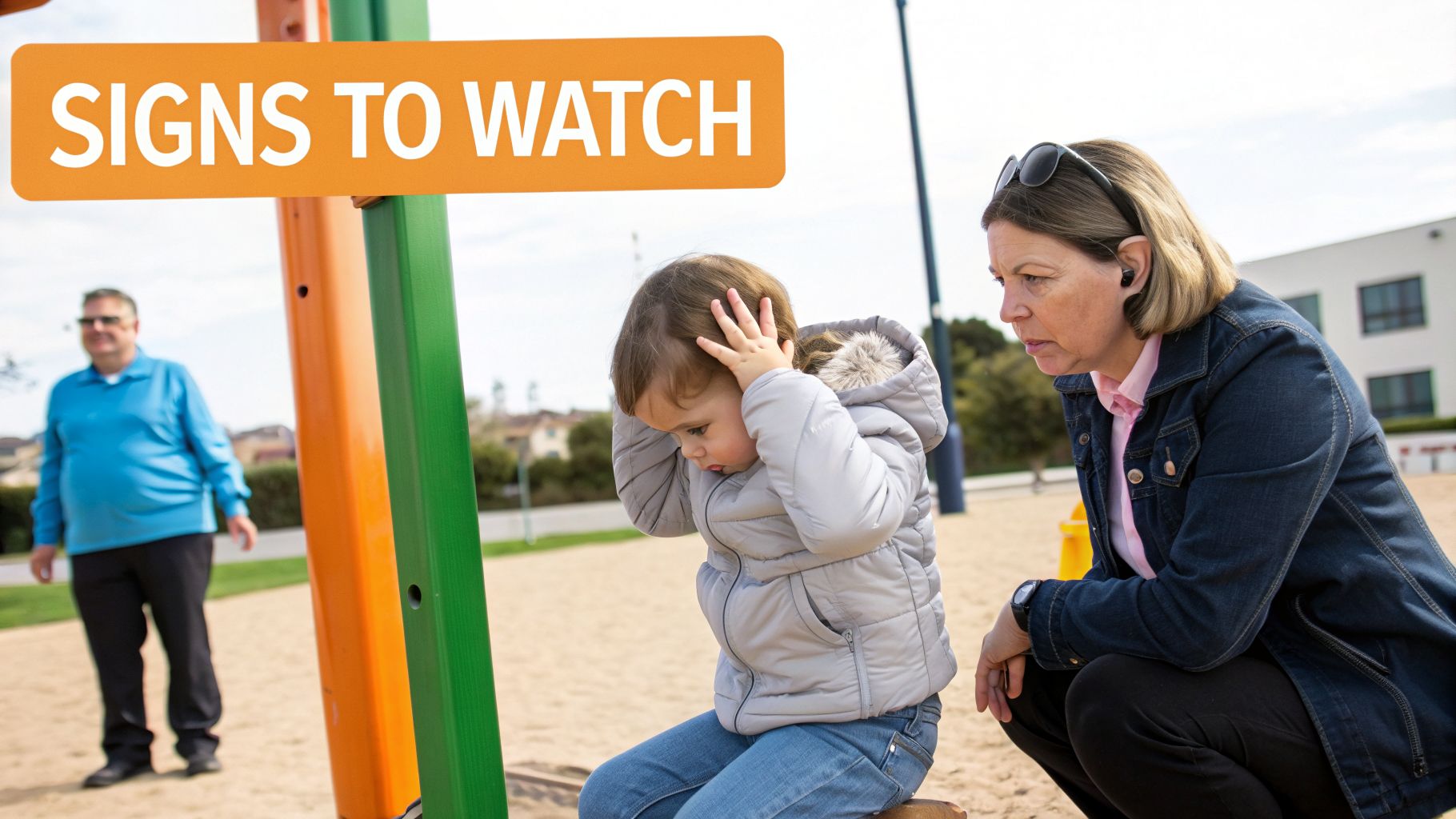
Over-sensitivity: Does your child find the tag on their shirt absolutely unbearable? Do they complain that normal lights are blindingly bright or cover their ears in a bustling playground? Maybe they refuse foods with certain textures, like anything "mushy" or "slimy." Actionable Insight: If meals are a struggle, try introducing a new food by just having it on the plate first, without any pressure to eat it. This slowly desensitizes the reaction.
Under-sensitivity: On the flip side, some children seem to crave intense sensory input just to feel centered. They might constantly touch everything and everyone, spin in circles until they're dizzy, or have a surprisingly high tolerance for pain. Practical Example: If your child constantly seeks movement, you could schedule "movement breaks" every 30 minutes, like doing 10 jumping jacks or wall push-ups.
Sometimes it can be tough to distinguish between sensory challenges unique to autism and other related conditions. If you're navigating this, our article on the diagnostic dilemma between Autism (ASD) and Sensory Processing Disorder (SPD)-or-sensory-processing-disorder-(spd)-a-diagnostic-dilemma) might offer some clarity.
Motor Skill and Daily Living Challenges
Difficulties with motor skills can ripple out and affect nearly everything a child does, from colouring and writing at school to getting dressed in the morning. These struggles can be a huge source of frustration for a child, but they are exactly the kinds of practical areas where an OT can make a real difference.
An occupational therapist sees these challenges not as failures, but as opportunities to build skills. They can turn the struggle with a zipper into a fun, rewarding game that strengthens fine motor control, or transform a messy, stressful mealtime into a positive sensory experience.
Think about whether any of these scenarios sound familiar with your child:
Fine Motor Difficulties: Struggling with tasks that require hand-eye coordination, like holding a crayon correctly, using scissors, buttoning up a coat, or finally mastering shoelaces. Practical Example: Practice using tweezers to pick up small items like pompoms and place them in a container. This fun game directly builds the pincer grasp needed for writing and buttoning.
Gross Motor Clumsiness: Seems to frequently bump into furniture, has a tough time with balance and coordination, or avoids activities like catching a ball or climbing the jungle gym. Actionable Insight: Create a simple obstacle course at home with pillows to climb over and tape on the floor to walk along. This turns your living room into a fun therapy space.
Daily Routine Resistance: Pushes back hard against everyday routines like brushing teeth, getting dressed, or taking a bath. This resistance is often rooted in sensory discomfort or trouble sequencing the steps involved.
If you're nodding along, it doesn't mean anything is "wrong." It's simply an indication that your child might flourish with the kind of personalized "life skills coaching" that occupational therapy provides.
Key OT Interventions and How They Work
When you hear “occupational therapy for autism,” it’s easy to picture a single, rigid program. But that couldn’t be further from the truth. A great OT is part detective, part coach, and part playmate, using a whole toolbox of evidence-based strategies tailored to your child's unique world.
These interventions often look and feel just like play. That’s the magic of it. While your child is having fun, they’re actually building critical new neural pathways and skills for life. Let's pull back the curtain on some of the most common and effective methods OTs use to help children thrive.
Sensory Integration and the Sensory Diet
One of the absolute cornerstones of OT for autism is Sensory Integration (SI) Therapy. At its heart, this approach is all about helping a child’s brain learn to process and react to sensory information in a more organized way. Imagine a radio dial that’s slightly off-station, producing static; SI therapy helps your child tune into the right frequency, so sights, sounds, and touches are no longer so overwhelming or, in some cases, under-stimulating.
A key part of this is creating a "sensory diet." No, it has nothing to do with food! It’s a carefully personalized schedule of sensory activities designed to meet your child’s needs throughout the day. This helps them stay regulated, calm, and ready to engage.
A sensory diet provides the right kind of sensory input at the right times. It's a proactive strategy to regulate the nervous system, preventing sensory meltdowns or shutdowns before they even start.
Here’s what that might look like in real life:
For a child who needs calming input: The OT might suggest using a weighted lap pad for 15-20 minutes during homework. That gentle, deep pressure can feel incredibly grounding.
For a child who needs to "wake up": A session might kick off with five minutes of jumping on a mini-trampoline to get the body alert and ready for learning.
For an oral sensory seeker: Scheduling chewy toys or crunchy snacks like carrots or pretzels before a task that requires focus can satisfy that need and help them concentrate.
Developing Fine and Gross Motor Skills
Motor skills are another huge piece of the puzzle. OTs have a knack for turning skill-building into play, targeting both the small and large muscle groups that kids need for everyday tasks.
Fine Motor Skills are all about the small, intricate movements of the hands and fingers.
Example: Forget boring handwriting drills. An OT might have a child play with therapy putty, asking them to squish and pull it to find tiny beads hidden inside. This is a blast for the child, but it’s also a powerful way to strengthen the exact muscles needed to hold a pencil properly and write without getting tired.
Gross Motor Skills involve the large muscle groups we use for whole-body movement like running, jumping, and balancing.
Example: An OT might create a colourful obstacle course right in the therapy room. To the child, it’s a grand adventure. But as they walk a line on the floor, crawl through a soft tunnel, and climb over a mountain of pillows, they are seriously improving their balance, coordination, and core strength.
To help clarify how these interventions connect to specific skills, here’s a quick breakdown:
Common OT Interventions and Their Target Skills
This table shows how different therapeutic activities are strategically used to build essential skills, translating therapy goals into practical, real-world abilities.
Intervention Type | Target Skill Area | Practical Example |
|---|---|---|
Sensory Integration | Sensory Processing & Regulation | Using a therapy swing to provide calming vestibular input, helping a child feel more organized and less overwhelmed in a busy classroom. |
Fine Motor Activities | Hand Strength & Dexterity | Playing with interlocking blocks or stringing beads to improve the pincer grasp needed for buttoning a shirt or using zippers. |
Gross Motor Activities | Balance, Coordination & Body Awareness | Playing "animal walks" (like bear crawls or crab walks) to build core strength and improve the ability to navigate a crowded hallway without bumping into others. |
ADL Training | Self-Care & Independence | Creating and following a picture-based chart for the morning routine (get dressed, eat breakfast, brush teeth) to reduce prompting and build autonomy. |
Social Skills Groups | Turn-Taking, Cooperation & Communication | Playing a simple board game where children have to work together, share pieces, and communicate their next move to a partner. |
Each of these activities is a building block, helping children assemble the skills they need for greater confidence and independence in all areas of their life.
Fostering Social Skills and Daily Independence
An OT’s work doesn't stop with motor and sensory skills. They also play a huge role in fostering social participation and mastering Activities of Daily Living (ADLs)—those everyday routines we all do.
Play is an incredible teacher for social skills. OTs often use games to help children practice communication, teamwork, and navigating social rules in a low-pressure setting. Cooperative games, where everyone works together toward a common goal, are fantastic for this. For any family wanting to build on this at home, checking out some of the best cooperative board games for families is a wonderful way to practice these skills while having fun together.
When it comes to ADLs, OTs are masters of practical solutions. If a child finds the morning rush chaotic and stressful, an OT might create a simple visual schedule with pictures showing each step. This simple tool can remove the anxiety from the routine, giving the child the power to manage the steps on their own.
By weaving these interventions together, OT for autism creates a powerful, supportive framework for building confidence and independence, one small success at a time.
What to Expect from the OT Evaluation and Therapy Process
Stepping into the world of occupational therapy can feel a bit like you've been handed a map to a new country. It can seem overwhelming. So let's break down what the process actually looks like, from that very first meeting all the way to celebrating those real-world wins. This is a journey you take with the therapist, and your family's voice is the most important one in the room.
The first step is always the initial evaluation. Don't picture a cold, clinical exam. Most of the time, this is a carefully structured, play-based session. The occupational therapist wants to see your child in their element, using fun and engaging activities to get a true sense of their skills.
While your child is happily squishing therapy putty or navigating a mini obstacle course, the OT is gathering incredibly important information. They’re observing motor skills, how your child responds to sensory input, and the way they approach a new or tricky task. This is then paired with a detailed conversation with you, the parent, to truly understand your biggest concerns and your child’s history.
Setting Meaningful, Collaborative Goals
After that initial assessment, the OT will sit down with you to map out a therapy plan. This isn’t a situation where a professional just hands you a list of goals. It's a true partnership. You are the expert on your child, and what matters to your family is what takes centre stage.
The goals we set are always tied to tangible, real-life outcomes. They’re not abstract concepts. They might look something like this:
Specific Task: "Ben will be able to button his own coat independently before school."
Sensory Goal: "Chloe will tolerate toothbrushing for two minutes without distress."
Social Aim: "Liam will participate in a turn-taking game with a peer for five minutes."
A typical therapy session often feels more like a trip to the ultimate playroom than a medical appointment. Every single activity is chosen with a purpose—to build specific skills in a way that’s fun and genuinely motivating for your child.
This graphic breaks down the core areas that OT interventions often focus on.
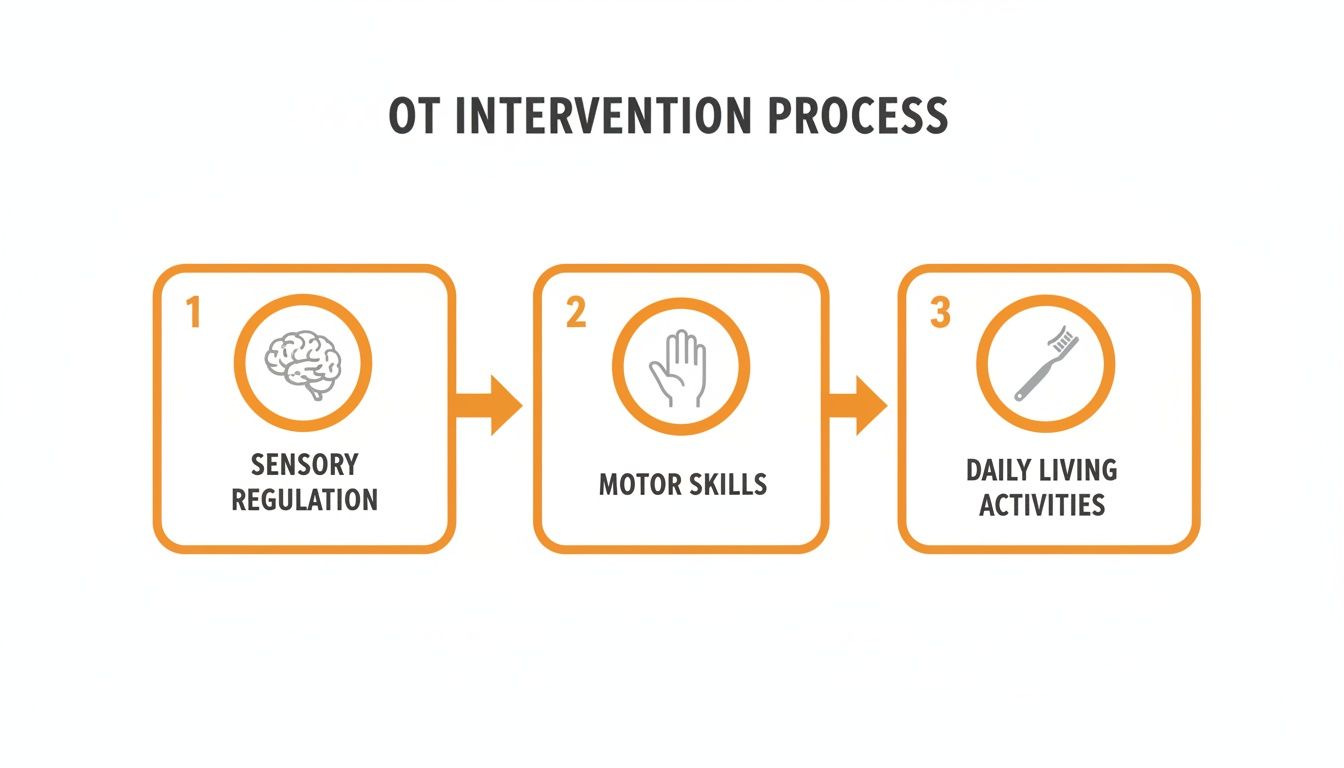
As you can see, the process is designed to build on foundational skills, like sensory regulation, which then unlocks the ability to tackle more complex challenges in motor skills and daily activities.
Measuring Progress and Coordinating Care
Progress in OT for autism isn’t just about checking boxes on a clinical report. It’s measured in the small but powerful victories that make a huge difference in your family’s day-to-day life. It’s your child trying a new food without a battle, joining a game at the park, or getting through the morning routine with a little less stress for everyone.
Your occupational therapist becomes a key member of your child’s support team. They act as a vital link, coordinating care and sharing strategies with teachers, speech therapists, and other clinicians to ensure everyone is working together towards the same goals.
This teamwork is what creates consistency for your child, whether they are at home, at school, or out in the community. By understanding how the evaluation and therapy process is structured, you can walk in feeling more confident and prepared. To get an even more detailed look at what a formal assessment covers, you can learn more in our detailed guide on occupational therapy assessments.
Finding the Right OT Provider for Your Family
Taking that first step to find an occupational therapist can feel like a mountain to climb, but knowing where to look makes all the difference. Your search for the right OT for autism support often starts with the trusted professionals who already know your child's story.
The best place to begin is by talking with your child's paediatrician or developmental specialist. They can give you direct referrals to OTs they know and trust, often people who are already part of your healthcare network. This is easily one of the most reliable ways to get connected with a great, qualified professional.
Where to Look for an OT
Beyond your doctor's office, there are a few other excellent places to find the perfect provider for your family. Think of it as building your own team of experts.
Professional Directories: The websites for national and provincial OT associations, like the Canadian Association of Occupational Therapists (CAOT), have searchable directories. You can filter by location and specialty—like "paediatrics" or "autism"—to find experts right in your community.
Parent Support Groups: Never, ever underestimate the power of community. Local and online parent groups are absolute goldmines for firsthand recommendations. Parents are usually more than happy to share their real-world experiences with different therapists and clinics.
School Recommendations: If your child is school-aged, their resource teacher or counsellor probably has a list of OTs they’ve worked with before. This is especially helpful for finding therapists who already understand how the school system works.
Navigating Costs and Access to Care
Once you have a few names, the next big step is figuring out the logistics. Dealing with insurance and funding can seem like a maze, but you do have options. Many private insurance plans cover a portion of OT services, so the first thing you should do is check your benefits package.
The growing need for services means that waitlists can be long. This reality underscores the importance of finding efficient and accessible care options to support your family without delay.
The demand for autism services is absolutely surging. In California, for example, the Department of Developmental Services saw its autism caseload skyrocket by 156% over a single decade. For the first time ever, in 2024, autism became the majority diagnosis, making up 51% of the total population they serve. You can read more about these trends in the official DDS legislative report. This isn't just a local issue; it highlights a widespread, urgent need for timely support.
With that reality in mind, it's wise to explore every option available. If it’s within your budget, private pay can sometimes shorten your wait time significantly. Telehealth has also become an invaluable alternative, offering flexible access to OT for autism right from the comfort of your home. If you're facing long waitlists or want to supplement traditional therapy, contact us or visit our website to see how digital solutions can provide immediate support.
For more practical guidance and local resources, be sure to explore our comprehensive Autism Resource Centre.
Using Modern Tools to Measure and Enhance OT Progress

For a long time, tracking progress in occupational therapy relied heavily on a therapist’s observations and a family's gut feeling. While incredibly valuable, this approach can sometimes feel subjective. What if we could add a layer of hard data to that expert intuition?
That's exactly what's happening now. Technology is bringing a new level of clarity to OT, replacing some of the guesswork with objective measurements. This shift gives therapists powerful new insights and provides families with a much clearer picture of their child’s journey.
Imagine getting a precise, AI-powered map of a child's cognitive skills in less than 30 minutes. This isn't science fiction; it’s a powerful starting point for crafting therapy plans that are truly built for the individual child.
The Power of Objective Data
With modern assessment tools, therapists can finally move beyond observation alone. They can use measurable, repeatable data to guide their work, helping them not just track progress but also pinpoint the root causes of a child's challenges.
Here’s what that looks like in practice:
Establishing a Clear Baseline: Before therapy even begins, a quick, game-based assessment can map out a child’s cognitive strengths and areas needing support, like attention, memory, and coordination. This gives you a clear starting point.
Personalising Therapy with Precision: Armed with this detailed profile, a therapist can design interventions that target the exact skills that will make the biggest difference in a child’s daily life. For instance, if data shows a weakness in visual tracking, therapy will include specific games to strengthen it.
Tracking Real-Time Growth: As a child engages in therapy—both in-session and at home—the system collects performance data. This shows concrete, measurable improvement over time and helps the therapist fine-tune their strategies along the way. You get to see tangible proof of their hard work paying off.
This objective approach is absolutely vital when we think about long-term outcomes. The challenges for autistic individuals don’t just disappear in adulthood; in fact, nearly 25% find themselves at home without regular daytime activities. Orange Neurosciences helps tackle this by providing real-time cognitive assessments that enable personalised therapy tracking, with the goal of boosting functional independence and social success for life.
Integrating Game-Based Tools
Platforms like Orange Neurosciences supplement traditional therapy with engaging, child-friendly activities. Digital tools make skill-building feel less like work and more like play, all while capturing invaluable data behind the scenes. You can read more about how a digital therapy platform supports neurodiverse learners in our related article.
These tools don’t replace the therapist; they enhance their abilities. By providing objective metrics, they free up therapists to focus on what they do best: building relationships and guiding children toward their goals.
When you can see the data, you can see the growth. It’s that simple. Visit our website to see how these tools work and discover how objective data can empower your therapy team and show you the real, measurable progress your child is making.
Common Questions About OT for Autism
As you start exploring what occupational therapy can mean for your child, it's completely normal to have a lot of questions. Getting clear, straightforward answers is the first step toward feeling confident and ready to support your child on this new path. Here are a few of the most common questions we hear from parents.
How Long Will My Child Need Occupational Therapy?
This is one of the first questions on every parent's mind, and the honest answer is: it’s different for every child. The length of OT for autism isn't a set timeline; it's tailored entirely to your child's unique goals, the challenges they're working through, and how they progress.
Some kids might just need a few months of focused support to nail a specific skill, like finally mastering shoelaces. Others will benefit from longer-term therapy, building foundational skills over several years as their needs evolve. Your OT will be your partner in this, regularly reviewing your child's progress and adjusting the plan as they grow.
What Is the Difference Between OT and Physical Therapy?
It's easy to get OT and Physical Therapy (PT) mixed up, as they both play such vital roles and often work together. The simplest way to think about it is to look at the kinds of movements they focus on.
Physical Therapy zeroes in on the body’s “big” movements—what we call gross motor skills. This includes walking, running, balance, and building overall strength and coordination. Occupational Therapy, on the other hand, is all about the skills needed for daily "occupations" or activities. This covers everything from fine motor skills like writing, to processing sensory information, learning self-care routines, and engaging in social play.
Often, a child will see both an OT and a PT, who will collaborate to provide support for the whole child.
How Can I Support My Child's OT Goals at Home?
Your involvement at home is probably the single most powerful way to help your child succeed. Think of your OT as a coach who will equip you with specific activities and strategies that you can weave into your everyday life.
This isn't about adding more "work" to your day. It’s about turning daily routines into learning opportunities. This might look like:
Incorporating sensory activities that your OT recommends, like making a trip to the swings at the park part of your after-school routine. This can help with regulation before homework.
Using visual aids, such as a picture schedule, to help make morning or bedtime routines feel less overwhelming. This gives your child a predictable structure they can follow independently.
Practicing motor skills through fun, engaging games with things like therapy putty or building blocks. Even helping you cook (like stirring or kneading dough) can build hand strength.
The real magic happens when you integrate these strategies so naturally that it just feels like part of your family's rhythm. For more ideas and support, don't hesitate to reach out to our team via email or explore the resources on our website.
At Orange Neurosciences, we believe in empowering therapists and families with objective data to see and celebrate every step of progress. Our AI-powered tools provide a clear cognitive baseline and track growth over time, helping to create more personalized and effective therapy plans. Discover how we can support your child's journey by visiting us at https://orangeneurosciences.ca.

Orange Neurosciences' Cognitive Skills Assessments (CSA) are intended as an aid for assessing the cognitive well-being of an individual. In a clinical setting, the CSA results (when interpreted by a qualified healthcare provider) may be used as an aid in determining whether further cognitive evaluation is needed. Orange Neurosciences' brain training programs are designed to promote and encourage overall cognitive health. Orange Neurosciences does not offer any medical diagnosis or treatment of any medical disease or condition. Orange Neurosciences products may also be used for research purposes for any range of cognition-related assessments. If used for research purposes, all use of the product must comply with the appropriate human subjects' procedures as they exist within the researcher's institution and will be the researcher's responsibility. All such human subject protections shall be under the provisions of all applicable sections of the Code of Federal Regulations.


© 2026 by Orange Neurosciences Corporation