A Parent's Guide to Learning Disability Assessment
Dec 1, 2025
Hearing that your child might need a learning disability assessment can be a heavy moment, but it’s actually the first real step toward clarity and support.
It's helpful to think of it not as a test of how smart someone is, but as a process of creating a detailed 'learning blueprint.' This blueprint maps out an individual's unique cognitive strengths and challenges, giving everyone—parents, teachers, and the student—the exact specifications needed to build a solid foundation for academic success and self-confidence.
Demystifying the Learning Disability Assessment

So, what exactly is it? A learning disability assessment is a comprehensive evaluation run by qualified professionals to see if a person has a specific learning disability. It’s a journey of discovery, one that’s designed to turn anxiety into a clear path forward. The goal is simple: to empower individuals with the knowledge and tools they need to truly thrive.
This process is a cornerstone of our educational systems. In California alone, the special education system supports over 800,000 children and youth. Learning disabilities, along with speech/language impairments and autism, are the most common reasons kids are enrolled. In fact, they accounted for nearly three-quarters of all students receiving special education services back in 2020.
The Purpose Behind the Process
At its heart, an assessment is all about pinpointing the why behind academic or developmental struggles. It’s about getting past guesswork and hunches and gathering objective data. This detailed evaluation provides the kind of insights that are crucial for creating support strategies that actually work.
To do this, the assessment looks at several key areas of a person's functioning:
Cognitive Abilities: This involves looking at skills like memory, reasoning, and how quickly someone processes information.
Academic Achievement: Here, we measure performance in core subjects like reading, writing, and mathematics.
Processing Skills: This dives into how the brain handles and makes sense of what it sees and hears.
Social-Emotional Functioning: We also need to understand how learning challenges might be affecting a person's emotional well-being and social interactions.
Practical Example: Imagine a bright student who can explain complex science concepts verbally but consistently fails written tests. An assessment might reveal strong verbal skills but a significant weakness in working memory, making it hard to organize thoughts on paper. The actionable insight? Provide a graphic organizer or allow for oral responses on tests.
This type of evaluation is a specific tool within a much broader field. To get a better sense of how experts map out brain function in general, you can explore our complete guide on what is a neuropsychological assessment. It offers a detailed look at the methods used to connect our cognitive processes to our everyday behaviour.
Recognizing Early Signs That Warrant an Assessment

It’s rarely a single big event that signals a potential learning difference. More often, it's the small, persistent struggles that a child just can't seem to overcome. Catching these early signs is the most important first step toward getting them the right support.
A timely learning disability assessment can open up a whole new understanding of a child’s needs, long before those challenges become ingrained habits or a source of deep frustration.
These clues can look very different depending on a child's age. What might be a minor quirk in one child could be part of a bigger pattern in another. The real key is to watch for consistent behaviours over time, especially when you compare them to their peers.
Signs in Preschool and Early Elementary
During these foundational years, certain developmental milestones are crucial. When a child has trouble with these, it can be an early flag that a closer look is needed.
Language and Sound Awareness: A preschooler might consistently struggle to hear rhymes (like 'cat' and 'hat') or have a really hard time remembering the letters in their own name, long after their friends have it down. It can also show up as difficulty following simple, multi-step directions.
Early Academic Skills: In kindergarten or Grade 1, a child may have significant trouble connecting letters to their sounds. For example, they might sing the alphabet song perfectly but can't tell you what sound the letter 'B' makes when they see it in a word.
Motor Skills: For some kids, the first signs are physical. This could be unusually messy handwriting (a potential sign of dysgraphia) or just seeming much clumsier than other kids their age.
These early challenges aren't about a child not trying hard enough. They often point to fundamental differences in how their brain is processing information. Spotting patterns, like a consistent issue with sounds and letters, is particularly telling. To learn more about how these specific reading difficulties are identified, take a look at our guide on dyslexia in Canada, which dives into one of the most common learning disabilities.
Cues in Later Elementary and Middle School
As schoolwork gets harder, the signs of a learning disability often become more obvious. The little coping strategies that might have worked in the early grades just don't hold up when the curriculum gets more complex.
A learning disability is a gap between potential and performance. A child might be bright, curious, and articulate but unable to translate that intelligence into expected academic results on paper. An assessment helps explain why this gap exists.
At this stage, you might start noticing specific academic or organizational challenges:
Reading and Comprehension: A student might read a paragraph out loud without any issues but then be completely unable to tell you what it was about. They may also read very slowly, often losing their place or skipping words.
Mathematics (Dyscalculia): Beyond simple counting, a child might struggle to memorize basic math facts, like the times tables. Concepts like fractions or telling time on an analogue clock can feel impossible for them to grasp.
Written Expression: Writing can become a major battle. A student might take an incredibly long time to write a single paragraph, wrestle with spelling and grammar, or have trouble organizing their thoughts into a logical flow.
Indicators in High School and Beyond
For teenagers and young adults, the signs often shift towards issues with executive functions—those critical mental skills for planning, organizing, and managing yourself.
The pressure to handle long-term projects and abstract thinking can really bring these struggles to the surface. A high school student might have fantastic ideas for an essay but be totally unable to create an outline or structure their arguments. They might also be terrible at managing their time, constantly underestimating how long assignments will take.
Recognizing these signs isn't about putting a label on a child; it's about understanding them. If you see a consistent pattern of these challenges, it might be time to consider a formal learning disability assessment.
Actionable Insight: If these signs sound familiar, start a log. Note specific examples, dates, and the context. This documentation is invaluable when you talk to teachers or request an assessment. To discuss your observations with an expert, email us to book a preliminary chat.
What a Comprehensive Assessment Actually Measures
If you pull back the curtain on a learning disability assessment, you won't find a single, all-knowing test. Instead, you'll see a collection of specialized tools working together to build a complete learning blueprint for a student.
Think of it like a mechanic running a full diagnostic on a car. They don’t just pop the hood and check the engine. They inspect the electrical system, the transmission, and the brakes to get a clear picture of how every part functions as a whole.
This kind of psychoeducational evaluation is all about gathering objective data from several key areas. Each component provides another piece of the puzzle, explaining not just what a student struggles with, but why. This deeper understanding is the bedrock for creating support strategies that genuinely work.
Cognitive Abilities and Processing Speed
The first big piece is cognitive testing. This measures how a person's brain takes in and processes information. It’s like checking a computer’s hardware—its processor (CPU) and its short-term memory (RAM). This isn't about slapping an "intelligence" label on someone.
Instead, it zooms in on specific, crucial skills:
Verbal Comprehension: The ability to understand and work with language-based information.
Visual-Spatial Reasoning: The skill of making sense of visual information and seeing how objects relate to one another.
Fluid Reasoning: The capacity to tackle brand-new problems without relying on things you already know.
Working Memory: The mental juggling act of holding and using information for a short time, like remembering a phone number just long enough to dial it.
Processing Speed: How quickly and accurately someone can scan and make sense of simple information.
A cornerstone tool for this is the Wechsler Intelligence Scale for Children (WISC-V). By looking at these different cognitive areas, an assessor can pinpoint specific processing weaknesses that might be throwing a wrench in the learning process. To get a better handle on this, you can learn more about what a cognitive assessment entails and how it maps out brain function.
This visual from the WISC-V's Wikipedia page is a great example of how different subtests come together to form a full-scale IQ score.
What this shows is that a final "score" is really a composite of many distinct cognitive abilities. It’s a powerful reminder that a single number never tells the whole story.
Academic Achievement and Skill Gaps
While cognitive tests explore potential, academic achievement tests measure what a student can do right now. This part of the learning disability assessment compares a student's reading, writing, and math skills to others at the same grade level. It answers the fundamental question, "Where is this student, academically speaking?"
Standardized tools like the Wechsler Individual Achievement Test (WIAT) or the Woodcock-Johnson Tests of Achievement are used to find specific areas of difficulty.
Practical Example: A student might score in the average range for cognitive ability but well below average in reading fluency. This gap—the discrepancy between their potential (cognitive ability) and their performance (academic skill)—is a classic sign of a specific learning disability like dyslexia. This finding provides the evidence needed to advocate for specialized reading instruction.
Language, Motor, and Social-Emotional Functioning
A truly thorough assessment looks beyond just cognition and academics. It also explores other critical areas that contribute to a student's ability to thrive in the classroom and beyond.
Language Processing: This evaluates how well a student understands and uses both spoken and written language—a skill that's fundamental to every subject.
Fine Motor Skills: An assessment may include tasks to measure coordination and dexterity, which is especially important if there are concerns about handwriting (dysgraphia).
Social-Emotional and Behavioural Functioning: Questionnaires and screeners filled out by parents, teachers, and the student themselves can identify emotional or behavioural challenges, such as anxiety or attention issues (ADHD), that might co-exist with or even worsen learning difficulties.
To make sense of the different tools and their purposes, here’s a quick overview of some commonly used assessments.
Commonly Used Assessment Tools and What They Measure
Assessment Tool (Example) | Area of Evaluation | Actionable Insight It Provides |
|---|---|---|
WISC-V | Cognitive Abilities | Reveals strengths and weaknesses in reasoning, memory, and processing speed, guiding which teaching methods will be most effective. |
WIAT-III | Academic Achievement | Pinpoints exact skill deficits in reading, writing, or math, showing teachers precisely where to target interventions. |
CELF-5 | Language Processing | Identifies issues with understanding or using language, leading to targeted speech-language therapy goals. |
Beery VMI | Visual-Motor Skills | Highlights hand-eye coordination issues, justifying the use of occupational therapy or assistive technology like a keyboard. |
BASC-3 | Social-Emotional | Uncovers underlying anxiety or attention issues that impact learning, suggesting counselling or classroom behaviour supports. |
By putting all these pieces together, the final report offers a detailed, multi-faceted profile of a student's unique learning style. This isn't about getting a label; it's about getting a roadmap. It shines a light on their strengths to build upon and their challenges to support, paving the way for more effective and compassionate educational strategies.
If you believe an evaluation could help uncover your child's learning blueprint, visit our website to explore our services. Our team can help you navigate the next steps toward gaining the clarity your family deserves.
Navigating the Assessment Process Step by Step
Understanding the journey of a learning disability assessment can feel overwhelming, but knowing what’s coming can turn a confusing experience into a manageable one. When you know what to expect at each stage, you can be a more proactive and confident advocate for your child.
The whole process is designed to be methodical, making sure all the necessary puzzle pieces are on the table before any big decisions are made. It's truly a collaborative effort between you, the school, and a team of specialists.
Kicking Off the Process: The Referral
The journey starts with a referral—a formal written request for an assessment. This is the first official step, and it can be started by a few key people:
A Parent or Guardian: You have the right to request an assessment at any time if you think your child has a disability that's getting in the way of their education. Always, always put this request in writing.
A Teacher or School Staff Member: If a teacher notices a student is consistently struggling with schoolwork or behaviour, they can recommend an evaluation.
The Student: Sometimes, older students are their own best advocates and can ask for an evaluation themselves.
Once the school gets that written request, the clock starts ticking. They must respond, usually by giving you an "Assessment Plan" to review and approve.
The Assessment Plan and Timeline
Think of the Assessment Plan as the roadmap for the entire evaluation. It’s a critical document that details exactly which tests and procedures will be used to get a clear picture of your child's needs.
Before any testing can legally begin, you have to provide informed consent by signing this plan. This is your chance to ask questions and make sure the evaluation is going to be thorough.
In many regions, the school district has a strict deadline. For example, in California, they have 60 calendar days from the moment you sign the consent form to finish the assessment and schedule a meeting to go over the results. This period usually pauses for major school holidays.
During these 60 days, a team of professionals—like a school psychologist, special education teacher, or speech and language pathologist—will work with your child. They'll use the tests outlined in the plan to build a complete profile of how your child learns.
Actionable Tip: Don't just sign the Assessment Plan. Ask questions like, "Will this plan assess for executive functioning?" or "Can you include a classroom observation?" This ensures the evaluation is comprehensive from the start.
This visual breaks down the core areas that are typically looked at during an assessment.
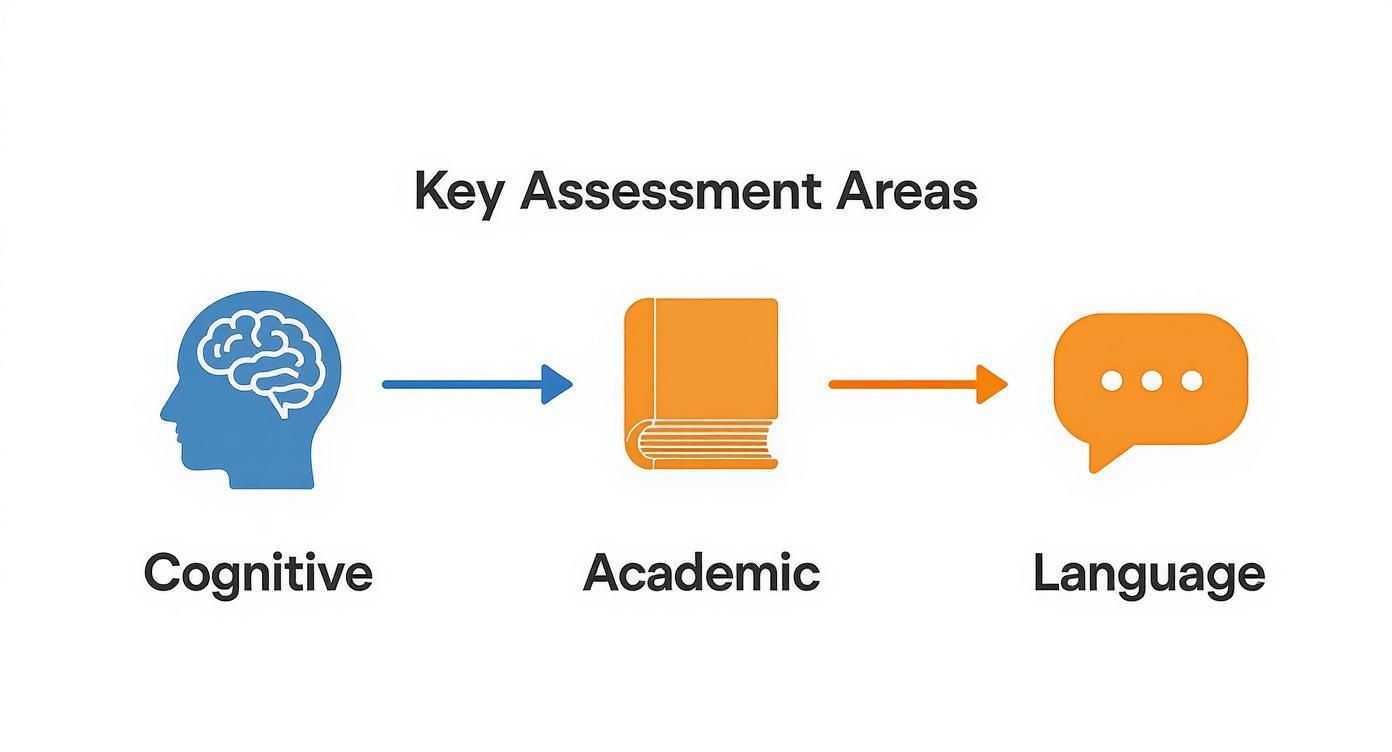
As you can see, a good evaluation looks at how a child thinks, how they're doing in school, and how they communicate, all to create a holistic profile.
The IEP Meeting and Understanding the Results
The whole assessment process leads up to the Individualized Education Program (IEP) meeting. This is where everyone comes together to share the findings and figure out if your child qualifies for special education services.
You are a crucial member of this team. The meeting will bring you together with your child’s teacher, a school administrator, the specialists who did the testing, and anyone else who knows your child well.
The team will walk you through the assessment report, which might be filled with terms like "standard scores" and "percentile ranks." Don't let the jargon intimidate you. A standard score of 100 is usually average, and a percentile rank of 50 means a student did better than 50% of their peers. Knowing these basics helps you understand how your child's skills compare to others their age.
The stakes are high because the right support can completely change a student's educational path. Data from the California Department of Education in 2015-2016 showed that only 35.9% of students with significant disabilities graduated with a standard diploma.
Getting through these steps requires clear communication and a good grasp of the workflow. To see how our structured approach brings clarity to complex cases, you can explore how we work. It's also helpful to understand how procedures differ by region; for a look at the various routes and expectations in the UK, you can consult this guide on autism and ADHD diagnosis pathways in the UK.
Turning Assessment Results into Actionable Support
A completed learning disability assessment report is a powerful document, but its real value comes alive when you translate that data into a practical plan for success. This is the moment a paper blueprint becomes a supportive structure, helping a student build real confidence and skills. The findings from the assessment directly inform the creation of formal support plans that can change how a child experiences school every single day.
This step is all about bridging the gap between a student's potential and their actual classroom performance. The need for this is stark. The 2021-22 CAASPP results showed that only 16% of students with a reported disability in California met English language arts standards, a sharp contrast to the 47% of the general student population. If you want to dig deeper, you can read the full analysis of California assessment results.
From Findings to Formal Plans
The assessment results are the foundation for two main types of support plans you’ll encounter in the educational system: the Individualized Education Program (IEP) and the 504 Plan.
An IEP provides specialized instruction and related services for students who qualify under one of 13 specific disability categories. A 504 Plan, on the other hand, provides accommodations for students whose disabilities substantially limit one or more major life activities but who might not need specialized instruction.
The key is to translate the report's clinical language into actionable classroom strategies.
Practical Example: An assessment flags a significant weakness in processing speed. The actionable insight is to request accommodations like extended time on tests and providing class notes ahead of time. This isn't about giving an unfair advantage; it's about levelling the playing field so the student can show what they truly know.
Accommodations vs. Modifications: What’s the Difference?
It's absolutely essential to understand the difference between accommodations and modifications. They serve very different purposes, and mixing them up can mean a student doesn't get the right kind of support.
Accommodations change how a student learns the material. They remove barriers so the student can access the same curriculum as their peers.
Modifications change what a student is expected to learn. They adjust the curriculum itself because the standard material is too advanced.
Let’s look at how this plays out in a real classroom.
Support Type | Scenario | What It Looks Like in Practice |
|---|---|---|
Accommodation | A student with dyslexia is assigned a grade-level novel. | They listen to the audiobook version while following along. The content is identical, but the method of access is different. |
Modification | A student with an intellectual disability is in the same class. | They're assigned a shorter, simpler book on the same theme. Here, the content and expectations have been changed. |
Evidence-Based Strategies for Common Challenges
A good assessment report doesn’t just identify a learning disability; it recommends specific, evidence-based interventions. The whole point is to match the strategy directly to the challenge revealed in the assessment data.
Here are a few targeted strategies for common learning disabilities:
For Dyslexia: A diagnosis highlighting phonological processing deficits points directly toward structured literacy programs. Methods like Orton-Gillingham teach reading and spelling in a systematic, explicit, and multisensory way that just plain works.
For Dysgraphia: If an assessment shows a student is really struggling with the physical act of writing, assistive technology can be a game-changer. Using speech-to-text software lets them get their ideas out without being held back by handwriting.
For Dyscalculia: When a student has trouble with number sense, support needs to get concrete. Using visual and hands-on math tools like Cuisenaire rods or fraction tiles helps them build a mental picture of abstract concepts.
Once you have clear assessment results, the next step is finding and implementing the right support. There are many essential SEN resources to support special education needs available to help guide this process. The most successful plans always come from collaboration between parents, teachers, and specialists working together as a team.
For personalized guidance on translating your child's assessment into an effective support plan, visit our website to schedule a consultation.
The Role of Technology in Modern Assessments
The world of learning disability assessment is changing fast, and technology is leading the charge. Digital tools and AI are making evaluations more precise and efficient than ever before. We're moving beyond the limits of pen-and-paper methods to get a much deeper, clearer look into a student’s cognitive profile.
This shift brings some massive benefits. Digital platforms, for instance, deliver tasks in a perfectly uniform way. This boosts standardization, cuts down on the chance for human error, and makes sure every single person gets a fair and consistent evaluation. That consistency is everything when it comes to gathering reliable data.
Enhancing Precision and Speed
One of the biggest real-world wins with technology is speed. Digital assessments can turn around results much faster than traditional methods, which is a huge deal. It shortens that stressful waiting period between spotting a potential issue and actually getting a support plan in place. That means less anxiety for families and faster access to help for students.
But it’s not just about speed; it’s about depth. AI algorithms can pick up on subtle patterns in a person's responses—things a human observer might easily miss.
Practical Example: An AI-powered assessment doesn't just see if a math problem was answered correctly. It might analyze the hesitation time before an answer, the specific pattern of errors (e.g., always mixing up '6' and '9'), or even track eye movements to see where a student gets stuck. This provides rich, actionable data for a targeted intervention plan.
A Powerful Ally, Not a Replacement
It's really important to put these advancements into perspective. Technology is here to supplement, not replace, the vital expertise of a qualified psychologist or educational specialist. There is simply no substitute for human insight.
The final interpretation of the data, factoring in emotional and environmental influences, and creating a compassionate, holistic plan—that all requires a human touch. Digital tools are a powerful co-pilot for clinicians, feeding them objective data that sharpens their professional judgment. It's this blend of advanced tech and expert analysis that leads to a truly comprehensive and effective assessment.
The goal is to get the best of both worlds:
Objective Data: Gained from standardized, tech-driven tasks that measure cognitive functions with incredible precision.
Expert Interpretation: Provided by a clinician who can synthesize the data, observe the individual, and understand their unique life context.
Actionable Insights: Resulting in a support strategy that is well-rounded, effective, and tailored to the person.
By weaving objective data collection together with clinical expertise, we can build a far more complete picture of a learner's needs. To see how our platform is making this happen, you can explore the details of our solution for cognitive assessment and therapy and discover how it empowers clinicians and families.
Your Questions About the Assessment Process, Answered
Deciding to pursue a learning disability assessment is a big step, and it naturally comes with a lot of questions. We’ve heard just about all of them from parents and educators over the years. Here are some straightforward answers to the most common ones we get.
School vs. Private Evaluations: What’s the Difference?
One of the first hurdles is figuring out where to get the assessment: through your child’s school or from a private psychologist? There’s no single right answer, as both routes have their pros and cons.
School Evaluations: These are done at no cost to your family, which is a major plus. Their main purpose is to see if your child qualifies for special education services under the law. The focus is squarely on whether a disability is getting in the way of their learning at school.
Private Evaluations: These have a cost, but they often paint a much broader and more detailed picture. A private psychologist can look into other things that might be going on, like ADHD or anxiety, and isn't limited to just what's happening in the classroom.
Actionable Insight: If your primary goal is to get an IEP or 504 Plan in place at school, the school's evaluation is the most direct route. If you want a comprehensive diagnostic picture that includes co-occurring conditions and provides recommendations for home and therapy, a private evaluation may be a better investment.
How Much Does a Private Assessment Cost?
The price tag for a private psychoeducational or neuropsychological evaluation really depends on where you are and how complex the assessment needs to be. In most parts of Canada, you can expect the cost to fall somewhere between $2,500 and $4,000, sometimes more.
It’s always a good idea to ask for a clear breakdown of what that fee covers. It should include the initial meeting, all the testing sessions, the time it takes to score and interpret everything, a detailed written report, and a feedback session where you go over the results and next steps. Don't forget to check your extended health insurance—some plans will cover a portion of psychological services.
Preparing Your Child and Easing Their Nerves
The idea of being "tested" can make anyone anxious, let alone a child. The best thing you can do is frame it in a positive, low-stakes way to help them feel comfortable.
Practical Tip: Tell your child, "We're going to meet someone who is a 'brain detective.' Their job is to figure out how your unique brain learns best. You'll get to do some fun things like puzzles, building with blocks, and answering questions. It's not a test with a pass or fail grade—it’s just a way for us to understand your amazing mind better."
Make sure your child gets a good night’s sleep before any testing day and starts with a healthy breakfast. Let them know it's totally okay to ask for a break if they get tired. The whole point is to get a true picture of their abilities, and that only happens when they feel supported and at ease.
Understanding how your child thinks and learns is the key to unlocking their true potential. The clear, objective data from a learning disability assessment takes the guesswork out of the equation and gives you a roadmap for providing the right support. If you’re ready for that kind of clarity, Orange Neurosciences has advanced, evidence-based tools that can help.
See how our AI-powered platform delivers precise cognitive insights to guide effective interventions. Visit us at https://orangeneurosciences.ca or email us to find out how we can support your journey.
Orange Neurosciences' Cognitive Skills Assessments (CSA) are intended as an aid for assessing the cognitive well-being of an individual. In a clinical setting, the CSA results (when interpreted by a qualified healthcare provider) may be used as an aid in determining whether further cognitive evaluation is needed. Orange Neurosciences' brain training programs are designed to promote and encourage overall cognitive health. Orange Neurosciences does not offer any medical diagnosis or treatment of any medical disease or condition. Orange Neurosciences products may also be used for research purposes for any range of cognition-related assessments. If used for research purposes, all use of the product must comply with the appropriate human subjects' procedures as they exist within the researcher's institution and will be the researcher's responsibility. All such human subject protections shall be under the provisions of all applicable sections of the Code of Federal Regulations.


© 2026 by Orange Neurosciences Corporation