Is Sudoku Good For The Brain: Expert Insights
Apr 21, 2026

Some readers are asking this for themselves. Others are asking because a parent keeps a puzzle book on the kitchen table, or because a patient insists Sudoku is their “brain training”. Clinicians hear it in another form: if someone enjoys Sudoku and sticks with it, does that make it useful enough to include in care?
The short answer is yes, with limits. Sudoku does engage cognitive systems that matter for attention, working memory, and executive control. It can be a practical, low-cost activity that fits into daily life. But it isn't magic, it isn't a stand-alone treatment, and it doesn't automatically transfer into every real-world skill.
The Familiar Grid A Morning Ritual or a Brain-Boosting Tool
A common scene is easy to recognise. Coffee is still hot. The paper is folded to the puzzle page. Someone fills one square, pauses, scans a row, then erases a guess and starts again. That small routine feels calming because it asks the mind to do one thing at a time.

That’s why the question is sudoku good for the brain keeps coming up. People can feel that it requires focus. They notice satisfaction when the grid finally clicks. Parents see a child concentrating longer than usual. Therapists may notice that a reluctant client will engage with a puzzle more readily than with a worksheet.
Still, feeling mentally busy isn't the same as getting a meaningful cognitive benefit. Some activities are enjoyable but narrow. Others train one skill while leaving everyday functioning unchanged. Sudoku sits somewhere in the middle. It is more than a time-filler, but less than a complete brain health strategy.
For older adults especially, it often becomes part of a broader routine of mental stimulation. That’s one reason guides on brain games for seniors resonate with families and care teams looking for practical, low-barrier activities.
Sudoku is most useful when you treat it as structured cognitive engagement, not as a promise that one puzzle a day will prevent decline.
In practice, the right question isn't just “does it help?” It’s “what exactly does it exercise, for whom, and under what conditions?” Those distinctions matter if you’re advising a patient, planning a classroom support strategy, or deciding whether a daily puzzle habit is worth keeping.
The Cognitive Workout Behind the Numbers
Sudoku looks simple. Fill a grid without repeating numbers in a row, column, or box. But the task load is richer than it appears, which is why it works as a kind of mental gym.
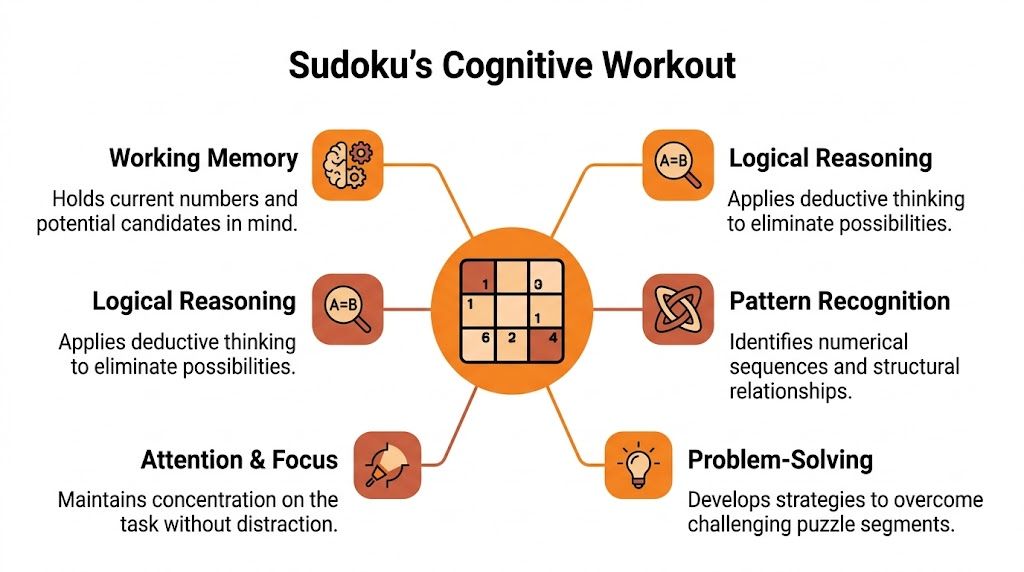
Working memory and attention in real time
When someone scans the grid and thinks, “this 6 can’t go here or here, so it must go there,” they’re using working memory. They have to hold several possibilities in mind long enough to compare them. That’s different from simple recall. It’s active mental juggling.
Sudoku also leans heavily on sustained attention. The solver has to stay with the problem, resist distraction, and keep track of what has already been checked. If attention slips, errors multiply quickly.
A practical example from clinic life: a patient with mild executive inefficiency may start well, then lose track of candidate numbers and repeat a scan they already completed. The puzzle reveals not just whether they can solve it, but how they organise their approach.
Executive function is the real engine
The deeper demand is executive function. That includes planning, shifting strategy, monitoring mistakes, and inhibiting impulsive moves. A person may need to abandon one line of reasoning and try another. That mental flexibility is exactly why Sudoku appeals to clinicians who care about reasoning processes, not just right answers.
Key demands inside a single puzzle include:
Rule maintenance. The solver must keep row, column, and box constraints active at the same time.
Error monitoring. They need to catch inconsistencies before they spread.
Logical sequencing. One correct placement changes the whole grid, so order matters.
Frustration tolerance. Many people hit a dead end and have to persist without guessing.
These are closely related to the kinds of problem-solving skills that matter outside puzzles too, especially when children and adults learn to pause, test options, and revise a plan rather than react impulsively.
Practical rule: If a puzzle is so easy that the person fills boxes automatically, the cognitive load is low. If it is so hard that they guess, the training value also drops.
For readers who want a broader framework, this overview of cognitive function is useful because Sudoku doesn’t train “the brain” as one single thing. It places demand on a specific cluster of skills, mainly attention, working memory, visual scanning, and executive control.
That distinction matters. A child who struggles with reading fluency may enjoy Sudoku and still need direct language support. An older adult who solves puzzles well may still have difficulty with medication management. Sudoku can exercise important cognitive muscles, but it doesn’t replace targeted assessment or intervention.
What Scientific Evidence Reveals About Sudoku's Impact
A parent brings in a bright 12-year-old who loves Sudoku but still struggles to organize schoolwork. An older adult completes puzzles every morning yet misses medication doses twice a week. Those cases capture the research problem well. Sudoku can recruit meaningful cognitive systems without producing broad, automatic gains in everyday function.
What neuroimaging shows
A 2026 systematic review of six neuroimaging studies found that Sudoku solving consistently activated frontoparietal networks, including the dorsolateral prefrontal cortex and parietal regions associated with executive control and visuospatial working memory. Some studies in the review also suggested involvement of monitoring and memory-related systems.
Clinically, that pattern makes sense. Sudoku asks the brain to hold rules in mind, compare options, inhibit impulsive placements, and update choices after each correct entry. Those demands overlap with the domains many of us measure in cognitive evaluations and target in treatment planning.
The review also drew a clear boundary. The studies were few, used different methods, and do not justify strong claims about long-term clinical benefit from Sudoku alone. Brain activation shows task engagement. It does not show transfer to school performance, medication management, or independent living.
That distinction matters when building structured cognitive therapy plans. A task can be useful because it loads specific systems, even when it is not a stand-alone intervention.
What observational research suggests
Long-term population studies are more encouraging than definitive. Earlier research has linked regular number and word puzzle participation with stronger performance on some cognitive measures in adults, especially in areas tied to reasoning and memory. The practical takeaway is modest but useful. People who keep doing mentally demanding activities often perform better on testing, but those studies cannot tell us whether the puzzle caused the difference.
In practice, several competing explanations are always on the table. Regular puzzle solvers may have higher baseline cognitive ability, more education, better health habits, or more structured daily routines. Clinicians should read those findings as supportive, not conclusive.
What this means for care decisions
For therapists, physicians, educators, and families, the evidence supports a middle position.
Sudoku is a reasonable cognitive exercise because it repeatedly engages attention, working memory, and executive control under clear rules. It is low cost, easy to repeat, and acceptable to many patients who would resist more formal drill-based tasks. Adherence is a real advantage.
At the same time, the evidence does not support using Sudoku as a proxy for overall brain health. A child can be strong at Sudoku and still need direct support for language, planning, or academic fluency. An adult can perform well on puzzles and still show decline in functional skills. If the goal is clinical decision-making, progress should be tracked with structured observation and formal tools rather than puzzle performance alone.
Integrating Sudoku into Clinical and Educational Settings
Sudoku works best in practice when it is used as a tool, not as a treatment identity. In other words, the puzzle is the activity. The therapeutic value comes from how a clinician, educator, or support worker selects it, grades it, observes it, and links it to a broader goal.

Where Sudoku can fit
A functional Near-Infrared Spectroscopy study on Sudoku demonstrated significant prefrontal cortex activation during Sudoku tasks. The study supports its use in cognitive remediation contexts for prefrontal cortex-related neuropsychiatric disorders, including schizophrenia, where reasoning deficits and executive dysfunction are common.
That doesn’t mean every patient with executive dysfunction should be handed a puzzle book. It means Sudoku can serve as a structured activity that loads the very systems many clinicians are trying to observe or support.
Examples from practice are straightforward:
In rehabilitation. A therapist might use easier grids first to establish rule-following and scanning, then increase difficulty as the patient shows better persistence and error monitoring.
In school support. A student who avoids lengthy language tasks may tolerate Sudoku as a way to practise sustained attention and controlled responding.
In senior care. Group Sudoku sessions can provide mentally engaging activity for residents who dislike digital tasks or formal drills.
How to use it ethically
Sudoku is most helpful when the professional defines a target behaviour before the puzzle starts. Are you watching planning? Speed? self-correction? frustration tolerance? Without that, the session can drift into generic entertainment.
A useful structure looks like this:
Choose the level carefully. Start with a puzzle that requires thought but doesn’t trigger immediate shutdown.
Observe process, not just completion. Does the person scan systematically, verbalise logic, or guess when stuck?
Prompt strategically. A well-timed cue such as “check the column again” is more informative than giving the answer.
Debrief after the task. Ask what strategy worked, where they got stuck, and what they would try next time.
A puzzle becomes clinically meaningful when you can describe the cognitive behaviour it elicited.
For teams building structured plans, it helps to place Sudoku alongside other cognitive therapies rather than above them. It may support work on attention, planning, or self-monitoring. It won't replace direct intervention for language, mood regulation, social communication, or academic skill gaps.
That balance matters for concerned parents too. If a child enjoys Sudoku, that’s useful. Keep it. But if the concern is dyslexia, ADHD-related impairment, or academic underperformance, the puzzle should sit beside targeted supports, not in place of them.
Practical Guidance for an Effective Sudoku Habit
A parent hands a child a Sudoku book at breakfast. A clinician suggests a puzzle for home practice after school. An older adult works through one with morning coffee. The activity looks the same in each case, but the goal should not be. A useful Sudoku habit starts with a clear reason for doing it, then matches the puzzle difficulty, session length, and follow-up to that reason.
For home use, the target may be sustained attention or frustration tolerance. In clinic, it may be working memory, error monitoring, or strategy use. In school support, it may be persistence with rule-based tasks. That is the difference between a pleasant routine and a trackable intervention.
Match the puzzle to the person
The best puzzle level is one that forces active reasoning without tipping the person into random guessing. If the grid is solved almost automatically, you are rehearsing comfort. If the person stalls for long stretches or starts placing numbers impulsively, the task is too hard for that day.
I usually suggest a simple rule. The person should spend most of the session explaining or testing logic, not fishing for answers.
A practical routine looks like this:
Start small and repeatable. Ten to fifteen minutes, three or four times a week, is easier to sustain than an ambitious daily plan that fades after a few days.
Use the same time of day when possible. That makes it easier to compare performance across sessions because fatigue and routine are more stable.
Stop while effort is still organised. Pushing far past mental fatigue often trains guessing, irritability, or avoidance.
Increase difficulty only when strategy stays visible. Move up when the person can explain why a number fits, not just finish quickly.
Record one or two observations after each session. Time taken, number of prompts, and how often the person self-corrected are often enough.
That last point matters more than many families expect. If you never track anything, it is hard to tell whether the habit is strengthening attention and reasoning or becoming another pastime.
For readers who want to pair Sudoku with more direct strategies for short-term attention and mental holding, this guide on how to improve working memory fits well alongside puzzle practice.
What improvement actually looks like
Do not look only at completion speed. Fast solving can reflect genuine improvement, but it can also reflect easy puzzle selection or familiar patterns. Process measures are more informative.
Useful signs include:
More systematic scanning
Fewer impulsive placements
Better use of verbal or written strategy
More self-correction before outside help
Less frustration when the first approach fails
These are the kinds of changes clinicians can observe in session and parents can notice at home. They also map better onto structured cognitive tracking. If you use a tool such as Orange Neurosciences for broader assessment, Sudoku can function as a low-cost practice task between formal checkpoints, while the assessment platform helps clarify whether gains are staying inside the puzzle or showing up in related domains.
Build a varied cognitive routine
Sudoku is strongest when it is part of a broader plan. It trains structured, rule-bound reasoning well. It does much less for language formulation, social judgment, fine motor coordination, or flexible thinking in messy real-world contexts.
Activity | Primary Cognitive Domains | Key Benefit |
|---|---|---|
Sudoku | Working memory, logical reasoning, sustained attention, visual scanning | Structured rule-based problem solving |
Reading | Language comprehension, memory, attention | Builds knowledge and supports verbal processing |
Learning a musical instrument | Attention, sequencing, motor planning, auditory processing | Combines cognitive load with sensory-motor learning |
Socialising | Language, perspective-taking, memory, emotional regulation | Challenges flexible thinking in unpredictable settings |
Strategy board games | Planning, inhibition, working memory, social reasoning | Adds adaptation to another person’s moves |
A good weekly routine mixes these demands. If a child already spends most cognitive leisure time on solitary logic tasks, adding reading aloud, cooperative games, or music practice may round out development better than just adding more Sudoku.
Sudoku can earn a place in a brain health routine. It just works best when the habit is specific, observable, and connected to a wider care plan.
The Limits of the Puzzle: Understanding Brain Training
A parent sees a child finish a hard Sudoku before breakfast and wonders whether that progress will carry into the classroom. A clinician hears an older patient say, “I do puzzles every day, so my memory should be fine.” Both reactions are understandable. Both need a more careful answer.
Sudoku has real cognitive value, but the brain training market often overstates what that value means outside the grid. In clinic, the main error I see is overgeneralisation. Getting faster or more accurate at Sudoku shows improved performance on a rule-bound task. It does not automatically mean better organisation, better school writing, safer driving, or stronger day-to-day problem solving.
Clinicians usually describe this gap as far transfer. The question is whether practice on one task improves performance in a different setting with different demands. That can happen in narrow ways, but it is less common and less dramatic than marketing claims suggest.
What Sudoku does not guarantee
Strong Sudoku performance can coexist with everyday difficulties. A person may complete advanced puzzles and still miss appointments, lose track of multistep instructions, or struggle to plan a school project. Real life places heavier demands on emotional control, language, time pressure, self-monitoring, and adaptation to changing conditions.
Brief exposure is also unlikely to produce a measurable instant effect. A 2025 UAlbany study involving 200 students found no immediate improvement in attention span after a single 10-minute Sudoku session compared with a control group. That finding fits what many of us see in practice. One short puzzle may increase engagement. It should not be presented as a rapid cognitive intervention.
This matters for treatment planning. If a child needs better classroom follow-through, or an adult needs stronger medication management, Sudoku may be a useful exercise within the plan. It is not the outcome measure.
A more clinically useful way to frame it
Sudoku works best as one structured task inside a broader cognitive care routine. It can support sustained attention, working memory, error monitoring, and persistence. Those are worthwhile targets. The practical question is whether gains stay confined to the puzzle or show up in related domains that matter for school, work, or independent living.
That is why pairing puzzle practice with observation and formal tracking is more useful than relying on enthusiasm alone. In a clinic or school setting, Sudoku can be assigned with a specific goal, such as reducing impulsive errors or increasing time on task, then compared with performance on other measures. If families or professionals want guided digital options alongside paper puzzles, a review of brain training apps for different cognitive goals can help them choose tools that match the person rather than the marketing.
A balanced brain health plan still needs other ingredients:
Physical activity to support vascular and overall brain health
Sleep protection because tired brains encode and regulate poorly
Social interaction to challenge flexible thinking in real time
Meaningful learning such as reading, music, or skill building
Targeted assessment to determine whether practice is changing anything beyond the trained task
Sudoku deserves a place in that mix. It does not deserve exaggerated claims.
So, is sudoku good for the brain? Yes, in specific ways. The clinically responsible answer is narrower and more useful. It strengthens certain cognitive operations, and its benefits make the most sense when they are integrated into a wider, measurable plan.
From Puzzle Grid to Precision Cognitive Care
A parent brings in a child who loves Sudoku and asks a fair question: does this mean attention is getting better, or has the child improved specifically at Sudoku? Clinicians hear versions of that question all the time. The same issue comes up with adults in rehabilitation and older patients trying to stay cognitively active.
Sudoku earns a place in care because it asks the brain to hold rules in mind, inhibit quick but incorrect responses, scan for patterns, and update choices as new information appears. Those are real cognitive operations. They overlap with domains clinicians already assess, including attention, working memory, and executive control. That makes the puzzle more than a pastime, but it does not make it a stand-alone treatment.
The practical value comes from how it is used.
In clinic, school, or home programs, Sudoku works best as a structured task tied to a defined goal. A therapist might use it to observe error monitoring and frustration tolerance. A school psychologist might assign a short puzzle block to watch sustained attention and pace. A parent might notice whether a child is learning to slow down, check work, and persist through difficulty rather than guessing.
Those observations become more useful when they are paired with measurement. Orange Neurosciences gives clinicians, educators, families, and individuals a way to track attention, memory, executive function, processing speed, and related skills with data that can be reviewed over time. Sudoku can be part of the exercise plan. Orange helps show whether the broader cognitive profile is changing, staying flat, or pointing to a need for a different intervention.
That distinction matters. Better puzzle performance may reflect practice, stronger strategy use, or genuine improvement in underlying skills. Sometimes it reflects all three. Without structured tracking, it is easy to overread progress or miss areas that still need direct support.
Used this way, Sudoku shifts from a pleasant habit to a clinically relevant tool within a larger care plan. That is the most defensible answer to the question. Yes, Sudoku can be good for the brain, especially when it is connected to clear goals, real-world observation, and objective cognitive assessment.
Orange Neurosciences' Cognitive Skills Assessments (CSA) are intended as an aid for assessing the cognitive well-being of an individual. In a clinical setting, the CSA results (when interpreted by a qualified healthcare provider) may be used as an aid in determining whether further cognitive evaluation is needed. Orange Neurosciences' brain training programs are designed to promote and encourage overall cognitive health. Orange Neurosciences does not offer any medical diagnosis or treatment of any medical disease or condition. Orange Neurosciences products may also be used for research purposes for any range of cognition-related assessments. If used for research purposes, all use of the product must comply with the appropriate human subjects' procedures as they exist within the researcher's institution and will be the researcher's responsibility. All such human subject protections shall be under the provisions of all applicable sections of the Code of Federal Regulations.


© 2026 by Orange Neurosciences Corporation