A Practical Guide to Client Centered Care in Healthcare
Feb 23, 2026
Client-centered care is a simple, yet profound, shift in perspective. It’s an approach to healthcare that places the individual—and their unique values, goals, and preferences—at the very heart of every decision. Instead of a one-size-fits-all plan, care is co-created with the client, transforming them from a passive recipient into an active partner in their own health journey.
What Is Client-Centered Care and Why It Matters Now

Think of the old-school medical model as a monologue where a clinician delivers a set of instructions. Client-centered care, on the other hand, is a dialogue. It’s a collaborative framework built on a foundation of respect, empathy, and shared decision-making. This isn't just about being polite; it’s a fundamental change in the power dynamic between a provider and the person they're helping.
This approach speaks directly to a growing need in modern healthcare, especially for people managing complex or chronic conditions. People today expect more than just prescriptions; they want to be heard, understood, and involved in their own care. This model honours that by treating each person as a whole, taking into account their life circumstances, their cultural background, and what "health" truly means to them.
Moving Beyond the Diagnosis
In a more traditional setting, care often revolves around a single diagnosis. A client-centered approach, however, focuses on what matters most to the individual, which might extend far beyond their medical chart. We're seeing more and more research showing that when people feel their personal priorities are understood and respected, the quality of care improves dramatically.
Just look at the practical difference:
Traditional Approach: A therapist tells a stroke survivor they must complete 60 minutes of repetitive arm exercises every single day to regain mobility. The person, feeling overwhelmed and unmotivated, does them inconsistently, if at all.
Client-Centered Approach: The therapist starts by asking, "What is one activity you truly miss doing?" The survivor says they miss gardening. The therapist then designs exercises that mimic the motions of gardening, making therapy meaningful and directly tying it to the client's personal goal.
This simple change in perspective makes all the difference. The focus shifts from merely treating a condition to helping a person get back to their desired quality of life.
The Urgent Need for a New Model
The healthcare landscape is getting more complex. People, particularly older adults with multiple chronic conditions, often face intricate treatment plans that can feel burdensome and disconnected from their daily lives. The traditional, disease-focused model can sometimes lead to unintended negative outcomes and care that just doesn't align with a person's goals.
Client-centered care re-aligns healthcare decision-making around what matters to the individual, not just their list of medical problems. It ensures that every treatment decision supports the outcomes patients value most, restoring the focus of care to the whole person rather than the diagnosis.
This model is absolutely essential for building trust and making sure treatments are both effective and sustainable. By fostering a genuine partnership, clinicians can improve engagement, increase treatment adherence, and achieve far better long-term health outcomes. It also creates a more consistent and connected patient experience, which is a key component of what's known as continuity of care in healthcare.
Ultimately, client-centered care creates a system where healthcare fits into the person's life, not the other way around.
The Foundational Pillars of Client Centred Care
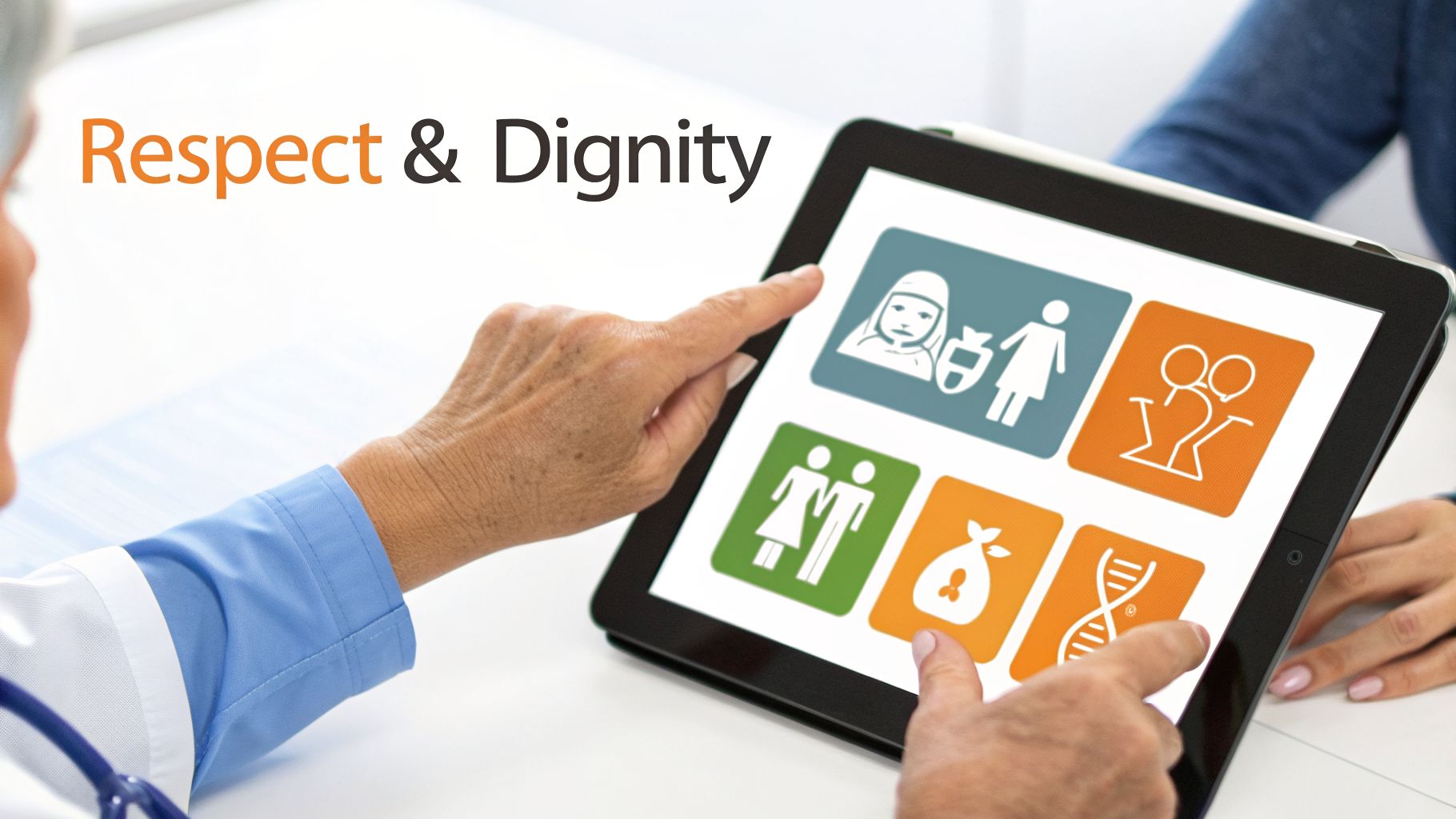
To really get what client centred care is all about, we have to look past the theory and see how its core principles work in the real world. These aren't just abstract ideas; they're the practical, everyday actions that turn a clinical appointment into a genuine partnership.
Think of them as the essential building blocks for trust, collaboration, and—most importantly—better health outcomes.
Each pillar marks a fundamental shift away from the traditional, top-down model where the provider is the sole expert. Instead, these principles create a framework where care is built with the client, honouring the fact that they are the true expert in their own life. This isn't just a trend; it reflects a deep, system-wide commitment to more humane and effective healthcare.
Respect and Dignity
At its heart, this is about seeing the whole person, not just a collection of symptoms or a diagnosis. It means actively listening to and honouring their individual values, cultural background, beliefs, and life experiences. True respect is so much more than simple courtesy; it shapes every single part of the care plan.
A key part of this involves getting a deep understanding of the patient's experience, often through practices like customer journey mapping. This helps clinicians see the entire care process from the client’s perspective, pinpointing moments of stress or confusion that could be made better.
Here’s a practical example: Imagine a clinician conducting a cognitive assessment for an elderly Indigenous client. Instead of jumping into a standard memory test that might feel culturally out of place, the clinician takes the time to learn about their community’s storytelling traditions. They then adapt the assessment to include elements of narrative recall, making the process more comfortable, respectful, and ultimately, more accurate.
Information Sharing
Client centred care simply can't work without open, honest, and accessible communication. This pillar is all about sharing complete and unbiased information with clients and their families in a way they can actually understand. The goal is to empower them to be full participants in their care, and that means demystifying complex medical information.
It’s about levelling the playing field. When a client truly understands their condition, the treatment options, and the potential outcomes, they can make informed choices that line up with their personal values and goals.
"True partnership in healthcare begins when information flows freely in both directions. It’s not about telling a client what to do; it’s about providing them with the clarity they need to decide what is right for them."
Participation and Collaboration
These two ideas are deeply connected and are the most hands-on parts of the client centred model. Participation means encouraging clients and their families to take part in decision-making at whatever level they feel comfortable with. Collaboration takes it a step further, positioning the clinician, the client, and their family as a single, unified team working toward a shared goal.
This collaborative spirit is becoming a major priority across the country. An analysis of 54 Canadian healthcare organizations found that a staggering 98% included at least one aspect of person-centred care in their mission statements. Even more telling, co-designing care was a key feature for 56% of them.
Participation in Action: A family is involved in setting the goals for their child's cognitive therapy. Instead of the therapist dictating all the targets, they ask the parents and child, "What's the one thing you wish was easier at school?" The answer—remembering homework assignments—becomes the central goal of the therapy plan.
Collaboration in Action: A neurologist, a school counsellor, and a speech therapist all use a shared digital platform to monitor a student's progress. When the neurologist adjusts a medication, the counsellor can immediately see if there are behavioural changes in the classroom, enabling a truly integrated and responsive care strategy.
Putting Client Centred Principles into Practice
It's one thing to understand the principles, but it's another to see how they change the day-to-day reality of care. This table breaks down what that shift looks like in a practical sense.
Core Principle | Traditional Approach | Client Centred Action |
|---|---|---|
Respect & Dignity | The clinician is the sole expert; the client's life context is secondary. | The clinician sees the client as the expert on their own life and co-creates the care plan. |
Information Sharing | Information is delivered in complex medical terms, flowing one way (provider to client). | Information is shared openly and in plain language, inviting questions and ensuring understanding. |
Participation | The client is a passive recipient of a pre-determined treatment plan. | The client is invited to help set goals and make decisions about their care at every stage. |
Collaboration | Care providers work in separate silos, rarely communicating with each other. | All providers, the client, and their family work as a cohesive team with shared goals. |
By moving from the traditional column to the client centred one, we build the trust and engagement that are absolutely essential for effective care.
To see how our platform is designed to facilitate this collaborative, client-first approach, you can explore how we work with clinicians and clients.
The Tangible Benefits for Patients and Providers
Moving to a client-centred care model isn't just a nice idea; it creates clear, measurable wins for everyone involved. It's a powerful approach that boosts the quality of care for clients while making healthcare organizations stronger and more efficient.
When clients truly feel seen, heard, and respected as partners in their own health, their entire experience changes. This goes way beyond just feeling satisfied—it translates into real health improvements, especially for those managing long-term cognitive or chronic conditions.
A Better Experience for Clients
Right away, the biggest benefit for an individual is a stronger sense of control and empowerment. Instead of being a passive recipient of instructions, the client helps create their own health journey. This partnership builds a foundation of trust and dramatically changes how they engage with their care plan.
The positive outcomes for clients are clear:
Improved Treatment Adherence: When a care plan is built around a client's own goals and lifestyle, they're far more likely to stick with it. It feels less like a chore and more like a path to a future they helped design.
Higher Satisfaction Rates: It's simple—clients who feel their values are respected and their voices are heard report much higher levels of satisfaction. This positive feeling builds lasting trust and loyalty.
Enhanced Health Outcomes: Better adherence and deeper engagement naturally lead to better clinical results. When you co-create solutions, the care just works better and is more sustainable over the long haul.
This feeling of partnership and easy access is what most people consider high-quality care. In Canada, 42% of people said immediate access to a provider was the most crucial part of quality healthcare, a number much higher than the global average. When you combine that access with a truly collaborative relationship, it can even lead to lower overall care costs. You can discover more about Canadian patient expectations here.
A Stronger Organisation for Providers
The benefits of client-centred care ripple out well beyond the individual, creating a more resilient and effective system for healthcare providers. By focusing on collaboration and open communication, organizations can tackle many of the operational and cultural headaches they face every day.
A client-centred approach transforms the provider-patient relationship from something transactional to something relational. This shift not only improves care but also creates a more rewarding and sustainable professional environment, reducing burnout and fostering a culture of mutual respect.
This model strengthens the very foundation of a practice. The benefits for providers and their organizations are just as compelling:
Reduced Staff Burnout: Dealing with frustrated or non-adherent clients day in and day out is emotionally draining. Building meaningful, collaborative relationships is far more rewarding for clinicians and leads to greater job satisfaction and less staff turnover.
Improved Operational Efficiency: Clear, open communication cuts down on misunderstandings, missed appointments, and endless follow-up calls. When everyone is on the same page, the entire workflow runs smoother.
Increased Client Loyalty and Reputation: Happy clients who feel genuinely cared for become your best advocates. That positive word-of-mouth is priceless for building a strong reputation and attracting new clients.
For healthcare providers thinking about putting these strategies into practice, it helps to see how this collaborative mindset can be woven into every part of their work. You can learn more about our approach for healthcare providers and see how technology can support this shift.
By truly prioritizing the client’s perspective, healthcare organizations don't just improve patient outcomes—they build a more efficient, reputable, and fulfilling environment for everyone.
A Practical Framework for Implementation
Knowing the theory behind client-centred care is one thing, but actually putting it into practice? That’s where the real work begins. The good news is that shifting to this model doesn’t have to be a massive, overnight overhaul. It’s a journey, and like any journey, it starts with a clear roadmap.
We’ve broken it down into four manageable stages, each one building on the last. Think of it as a practical guide to move from abstract ideas to concrete actions, creating a system that genuinely places clients at the very heart of their care.
The impact of this journey is powerful. As you can see below, a client-centred approach doesn't just feel better—it leads to better outcomes. It improves everything from medication adherence to overall satisfaction, ultimately building the kind of trust that creates lasting loyalty.
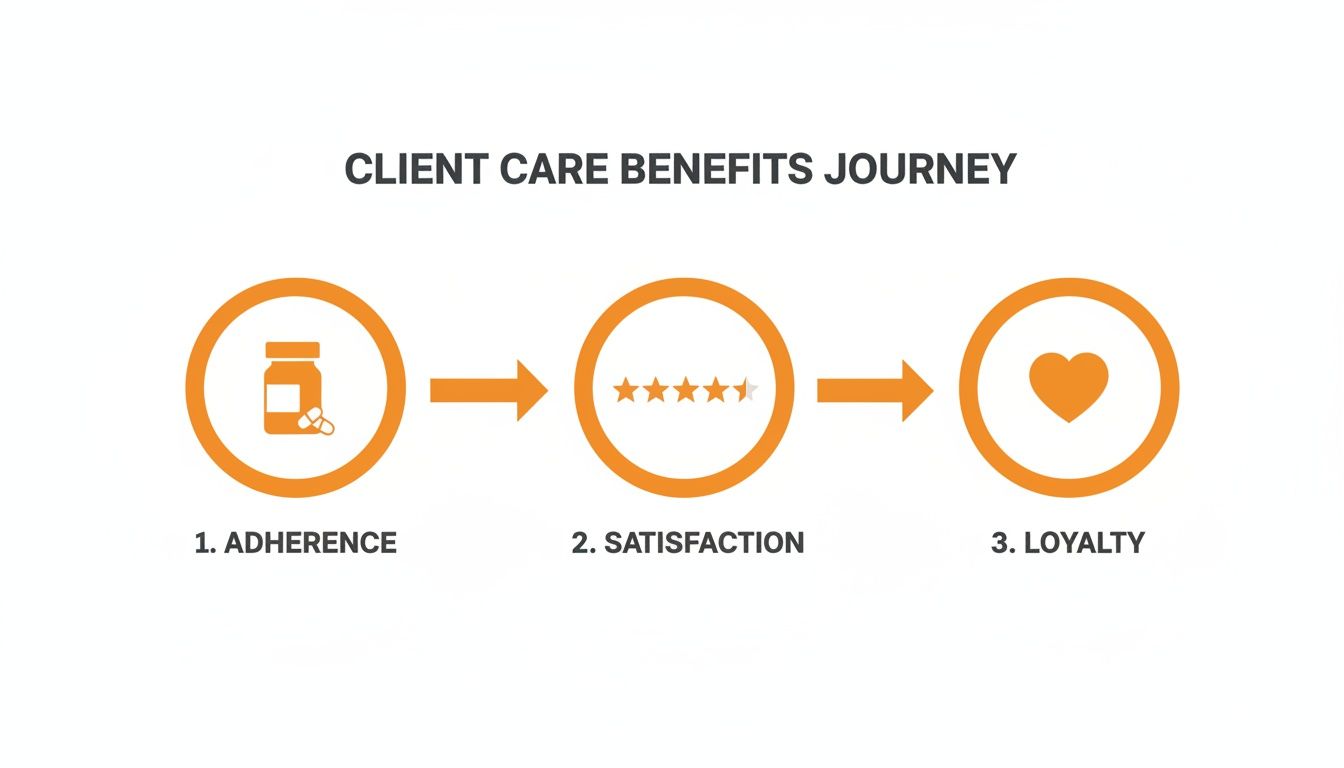
Each benefit in this chain directly feeds the next, creating a positive cycle of engagement and results.
Stage 1: Assess Your Starting Point
Before you can chart a new course, you need to know exactly where you're standing. This first stage is all about honest self-assessment. Start by walking through your current processes from the client’s point of view. What does their experience really look like, from the first phone call to their ongoing treatment?
Gathering candid feedback is absolutely critical here. Here's an actionable way to start:
Anonymous Surveys: Ask direct questions. Actionable Insight: Use a simple 1-5 scale: "How involved do you feel in decisions about your care?" and an open-ended question: "What is one thing we could do to make you feel more like a partner in your health journey?"
Focus Groups: Bring small groups of clients together for a guided conversation. This is often where you’ll uncover the deeper, unspoken frustrations and opportunities.
One-on-One Interviews: Sit down with a few clients and just listen. Let them tell you about their journey in their own words.
The goal is to pinpoint the gaps between what you think you’re delivering and what clients are actually experiencing. Where do they feel like a passenger instead of a partner? This initial assessment becomes the foundation for every change you make.
Stage 2: Build a Collaborative Culture
Client-centred care isn't a checklist; it’s a mindset. For it to work, every single person on your team—from the front desk to the senior clinicians—needs to be on board. This stage is all about fostering a true culture of partnership.
Your training needs to go beyond just new procedures. Actionable Insight: Dedicate 30 minutes in your next team meeting to role-play. Have one person act as a client who is hesitant about a treatment plan and have another practice using empathetic language ("I hear your concern. Let's walk through the pros and cons together.") instead of just repeating instructions. Host workshops on shared decision-making, giving your clinicians practical frameworks for presenting options clearly, helping them guide clients to choices that align with their life goals, not just their clinical ones.
This cultural shift is non-negotiable. Without genuine buy-in from your entire team, even the most perfectly designed systems will fail to deliver.
Stage 3: Integrate Client Voices
Once you have a culture that’s ready and willing to listen, the next step is to build formal pathways for the client’s voice to influence how you operate. This goes way beyond a suggestion box. It's about active collaboration.
Consider establishing a patient and family advisory council (PFAC) to give you ongoing, real-world input on everything from policies to clinic hours. Actionable Insight: Don't have time for a full council? Start small. The next time you redesign an intake form or patient handout, email it to 3-5 trusted clients and ask for their honest feedback on clarity and tone. You'll get invaluable insights in less than a week.
This isn't just a nice idea—it’s a growing movement. A comprehensive study identified 19 distinct patient-centred care initiatives across Canada, many of which involved patients in redesigning the very processes meant to serve them.
True integration means client feedback isn't just collected—it's used to drive meaningful change. When clients see their suggestions lead to real improvements, trust deepens and the partnership becomes stronger.
Stage 4: Leverage Technology for Personalization
In this final stage, technology becomes the great enabler. It’s what makes truly personalized, client-centred care scalable and efficient. Instead of relying on subjective impressions, modern platforms can give you objective data to build collaborative care plans on solid ground.
Of course, a modern, client-centred approach also includes how you connect with and support patients online. A strong patient-centric digital marketing strategy for healthcare ensures your digital front door is as welcoming and helpful as your physical one.
This is where platforms like Orange Neurosciences come in. Our rapid cognitive assessments, for example, can generate a clear, objective cognitive profile in under 30 minutes. This data completely changes the conversation. It allows you to sit down with a client and co-create therapy goals based on tangible evidence of their unique strengths and weaknesses. The dialogue shifts from, "I think you should..." to, "The data shows this area needs focus, so let's decide together how to tackle it."
By using technology to get precise insights, you can tailor interventions with far more confidence and track progress in a way everyone can see and understand. You can learn more about how our solution supports data-driven, personalized care plans.
How Technology Scales Client-Centred Cognitive Care
Putting a truly client-centred care model into practice runs into one major roadblock: scalability. The principles are solid, but traditional methods, especially in cognitive health, can be slow, subjective, and a real headache to standardize across a clinic or organization. This is where technology comes in—not to replace the human connection, but to act as the engine that makes personalized care a practical reality for everyone.
Think about the old way of doing things. Traditional cognitive assessments often meant pen-and-paper tests and a clinician’s observations. The whole process was sluggish, leading to frustrating waits for clients and making it tough to get a clear, objective starting point. Technology completely flips that script, giving us precise, data-driven insights, and fast.
From Subjective to Objective Insights
The real power of technology in this space is its ability to turn complex cognitive functions into clear, measurable data. This shift lets clinicians move past educated guesses and build their care plans on a foundation of solid evidence.
AI-powered platforms can map out a full, objective cognitive profile in a fraction of the time it used to take. Imagine getting detailed data across key domains in under 30 minutes. That kind of speed and precision changes the entire dynamic of the first consultation.
Attention and Focus: We can now quantify a client's ability to stay on task.
Memory: We can assess both short-term and working memory using standardized metrics.
Executive Function: We can measure crucial skills like planning, problem-solving, and mental flexibility.
This kind of data visualization gives clinicians and clients an immediate, at-a-glance understanding of a person's cognitive profile.

A dashboard like this instantly shows where a client's strengths are and which areas need a bit more support, making for a much more focused and productive conversation from day one.
Enabling Data-Driven Conversations
When you have objective data in hand, the conversation with a client immediately becomes more collaborative and transparent. Instead of a clinician just stating their opinion, they can pull up the results and work with the client to create a plan that actually means something to them.
Practical Example: A clinician shows a client a data chart from their assessment. "See this dip here in working memory? This might be why you've been struggling to follow multi-step recipes, which I know you love to do. Let's set a goal to improve this by 15% over the next month. We can use these specific brain games to target it. How does that sound?" This is the bedrock of modern client-centred care.
Technology doesn't get in the way of the therapeutic relationship; it makes it stronger. By doing the heavy lifting of data collection and analysis, it frees up clinicians to focus on what they do best—building trust, setting shared goals, and providing empathetic support.
Real-Time Adjustments and Progress Tracking
A care plan carved in stone at the start of treatment is rarely useful for long. A client's needs change, and their plan has to change with them. Technology makes this ongoing adjustment process simple and effective.
For example, game-based digital therapies have assessment built right in. Platforms like ReadON can track a user's performance as they go, providing a constant stream of data on their progress. If a client is acing one area but struggling in another, the system can automatically tweak the difficulty.
This real-time feedback loop is invaluable. It helps clinicians to:
Monitor Progress Visibly: Show clients clear charts and graphs of their improvement, which is a huge motivator.
Make Timely Interventions: Spot plateaus or setbacks right away and adjust the therapy before the client gets discouraged.
Demonstrate Efficacy: Use hard data to show clients, their families, and even insurance providers the tangible results of the care being provided.
By using these tools, you can ensure that your care isn't just client-centred at the beginning but stays responsive and personalized through the entire journey. For those curious about how these tools work, you can explore our guide on finding a reliable online cognitive assessment.
Ready to Get Started with Client-Centred Care?
Making the move to client-centred care is one of the most important shifts a modern practice can make. It’s about more than just treating symptoms; it’s about building a real partnership with the person in front of you, focused on their unique goals, their values, and what they want for their life.
When you get this right, you build trust, see better follow-through on care plans, and achieve results that actually stick—for both your clients and your organisation.
The journey starts with small, deliberate steps that signal a bigger shift in your mindset. You're building a culture where the client's voice truly guides every decision, turning them from a passive recipient of care into an active partner in their own success. This is what strengthens the therapeutic relationship and, ultimately, delivers a higher standard of care.
Your First Three Actionable Steps
Ready to take the leap? Here’s a simple, actionable checklist you can start implementing tomorrow.
Ask "What Matters Most?" in Every First Session. Before you even touch a clinical assessment, make this the first question you ask. When you understand a client's core priorities from the get-go, you can frame the entire care plan around what’s genuinely meaningful to them. For example: A client with memory issues might say, "What matters most is being able to read a bedtime story to my grandchild without losing my place." That becomes your anchor for the entire care plan.
Schedule a 15-Minute Team Huddle on One Client Story. Get your team together and spend just 15 minutes talking through one client's journey. The goal? Figure out how you can better align your services with their personal goals, not just their clinical diagnosis. Actionable Insight: End the huddle by defining one concrete action the team will take for that client this week.
Review and Rework One Piece of Communication. Grab one of your email templates, an intake form, or even a brochure. Rework it to use simpler, more empathetic language. Practical Example: Change "The patient must adhere to the prescribed regimen" to "To get the best results, we recommend..." The aim is to speak with the client, not at them.
True client-centred care isn't a final destination. It's an ongoing commitment to seeing the whole person, not just the condition. When you combine deep empathy with objective data, you create an incredibly powerful framework for success.
This model isn't just an ideal; it's entirely achievable, and the right tools can help you scale it. At Orange Neurosciences, we provide the objective data needed to build these truly collaborative and effective cognitive care plans.
See for yourself how our platform can support your practice. Request a demo of Orange Neurosciences today and discover a better way to measure what matters.
Have Questions? We Have Answers.
Making the move to a more client-centred model naturally brings up a few questions. We've gathered some of the most common ones here to give you straightforward answers and practical guidance as you think about bringing this approach into your practice.
Isn't This Just Good Customer Service?
That's a great question, and it's easy to see why people might think that. While they both lead to a better experience, they’re fundamentally different. Good customer service is about being polite and efficient—it’s more of a transaction.
Client-centred care, on the other hand, is a clinical philosophy. It’s a complete shift in the power dynamic. Practical Example: Good customer service is remembering a client’s name. Client-centered care is remembering their goal is to coach their son’s soccer team and designing their physical therapy to help them get back on the field. The focus is on their life, not just the service you provide.
Do We Need to Overhaul Our Entire Practice to Do This?
Not at all. You don't need to flip a switch and change everything overnight. The journey toward client-centred care can start with small, totally manageable steps.
Actionable Insight: Start with the first five minutes of every appointment. Dedicate that time exclusively to asking the client about their progress, concerns, and goals before you dive into your clinical agenda. This simple habit shift signals a major change in approach without changing any of your formal processes. From there, you can phase in new tools, like an objective assessment platform, when the time is right.
How Do We Actually Measure if This is Working?
Measuring success is about looking at both the hard data and the human stories. You need both to see the full picture.
Success in client-centred care is a combination of hard numbers and human stories. It's about tracking improved clinical outcomes while also listening to how a client’s quality of life has genuinely changed for the better.
On the quantitative side, you can track metrics like:
Adherence rates to treatment plans
Client satisfaction scores, like the Net Promoter Score (NPS)
Objective clinical outcomes and progress data
But don't stop there. The qualitative feedback is where you'll find the richest insights. Sit down for client interviews or host focus groups to truly understand their experience. And when you can pair those stories with objective data showing cognitive improvements, you have a powerful way to demonstrate the real-world impact of your personalized care.
At Orange Neurosciences, we provide the objective data needed to build collaborative and effective care plans that are truly client-centred.
Orange Neurosciences' Cognitive Skills Assessments (CSA) are intended as an aid for assessing the cognitive well-being of an individual. In a clinical setting, the CSA results (when interpreted by a qualified healthcare provider) may be used as an aid in determining whether further cognitive evaluation is needed. Orange Neurosciences' brain training programs are designed to promote and encourage overall cognitive health. Orange Neurosciences does not offer any medical diagnosis or treatment of any medical disease or condition. Orange Neurosciences products may also be used for research purposes for any range of cognition-related assessments. If used for research purposes, all use of the product must comply with the appropriate human subjects' procedures as they exist within the researcher's institution and will be the researcher's responsibility. All such human subject protections shall be under the provisions of all applicable sections of the Code of Federal Regulations.


© 2026 by Orange Neurosciences Corporation