Understanding the Autism Spectrum Quotient A Practical Guide for Clinicians
Jan 27, 2026
The Autism Spectrum Quotient, often called the AQ, is a questionnaire people can fill out themselves. It's designed to get a sense of the autistic traits an adult with average intelligence might have.
It’s important to see the AQ as a screening tool—it is absolutely not a diagnostic instrument. Think of it as a first glance, giving a measurable snapshot of where someone might fall on the broad spectrum of neurodiversity. For a clinician, this initial data provides a practical starting point for a deeper conversation.
What Is the Autism Spectrum Quotient

The AQ was developed by Simon Baron-Cohen and his team at the Cambridge Autism Research Centre. Their goal was to create a quick way to quantify traits associated with autism in adults. The whole idea is built on the understanding that these traits aren't just an "on or off" switch; they exist on a continuum across the entire population. Autistic individuals simply fall at one end of that spectrum.
Imagine the AQ as a preliminary map of a person's cognitive and social landscape. It won't show you every single detail, but it does an excellent job of highlighting key areas that might be worth exploring more deeply. For a clinician, that initial map is an incredibly useful place to start. For example, if the map highlights a potential challenge in "communication," your next step is to ask specific, targeted questions about their conversational experiences.
For a clearer picture, here's a quick summary of the AQ's core features.
Autism Spectrum Quotient (AQ) At A Glance
Characteristic | Description |
|---|---|
Purpose | A self-report screening tool to measure autistic traits in adults. |
Target Audience | Adults with average or higher intelligence. |
Format | 50-item questionnaire with forced-choice answers. |
Scoring | Total score ranges from 0 to 50. |
Key Areas Measured | Social Skills, Communication, Attention to Detail, Attention Switching, Imagination. |
Clinical Role | Guides the decision for a full diagnostic evaluation; not a standalone diagnostic tool. |
This table helps illustrate why the AQ is considered a foundational first step in many clinical journeys.
A First Step, Not a Final Answer
The real value of the AQ is to offer an initial signpost. It helps clinicians decide whether a full, comprehensive diagnostic assessment is the right next move. It was never intended to be a definitive verdict on its own, and managing that expectation with individuals and their families is vital.
The questionnaire zeroes in on five core areas where autistic traits often surface:
Social Skills: How someone tends to navigate social situations and interpret cues from others. A practical example would be a statement like, "I find it hard to make new friends."
Communication: An individual's preferences and styles in both verbal and non-verbal interactions. For instance, a person might agree with, "I prefer to talk about my special interests rather than engage in small talk."
Attention to Detail: The tendency to focus intently on the smaller parts of something, rather than the whole picture. An example statement might be, "I often notice small details that others miss."
Attention Switching: The ease (or difficulty) with which a person can shift their focus from one task or topic to another. This is often explored with statements like, "I find it difficult to switch back and forth between activities."
Imagination: Common patterns in how someone thinks imaginatively and pictures different scenarios. An example could be, "I find it hard to imagine what it would be like to be someone else."
By putting numbers to these areas, the AQ gives clinicians a structured way to begin a conversation. For instance, a high score in "attention to detail" alongside a lower score in "social skills" provides specific, tangible points to explore during a follow-up consultation. This actionable insight allows you to immediately focus your clinical interview on the most relevant areas.
The AQ offers a structured way to identify patterns and reflect on social and sensory experiences, helping to determine whether a professional evaluation may be beneficial. It provides a starting point for deeper clinical investigation.
Why Screening Matters Now More Than Ever
In California, the prevalence of Autism Spectrum Disorder (ASD) has climbed to all-time highs, with the state consistently reporting some of the highest numbers in the US. Recent data pointed to a shocking 4.6% prevalence among 4-year-olds in California—the highest in the nation.
As caseloads grow, tools that can effectively guide the need for further evaluation, like the AQ and objective cognitive assessments, are becoming indispensable for clinics and schools trying to provide scalable, affordable care. You can read more about these rising rates and their impact on care.
The AQ helps manage this growing need by efficiently pinpointing individuals who would most likely benefit from a full diagnostic workup. This triaging function is crucial for allocating limited clinical resources wisely and making sure people get the right level of support at the right time. For a busy clinic, this means you can confidently prioritize your waitlist, moving individuals with strong indicators of autism to the front of the line for a full evaluation.
To really get what an Autism Spectrum Quotient score is telling you, it helps to first peek under the hood at how the questionnaire is put together. The AQ isn't just a random list of questions; it's a thoughtfully constructed tool with a very deliberate structure and a simple, clear scoring method. This design isn't accidental—it's meant to be transparent, making it easier for clinicians to understand the results and talk them through with individuals.
The whole test is built on a foundation of 50 statements. For each one, a person chooses from four possible responses: Definitely Agree, Slightly Agree, Slightly Disagree, or Definitely Disagree. This format is a "forced-choice" design, meaning there’s no middle-of-the-road option. It gently pushes the individual to consider their tendencies more concretely.
The Five Core Domains of the AQ
Those 50 statements aren’t just thrown together. They're neatly organized into five distinct domains, with ten statements covering each one. Think of these domains as different lenses for viewing key areas where autistic traits often show up, giving a much richer picture than a single, flat score ever could.
The five core domains are:
Social Skill: These statements get at how comfortable and skilled someone feels in social situations. A practical example is a statement like, "I find social situations easy."
Attention Switching: This domain looks at the ability to shift focus from one thing to another. A real-world example might be a statement like, "I find it easy to go back and forth between different activities."
Attention to Detail: This zeroes in on a preference for focusing on specifics rather than the big picture. The classic example here is something like, "I often notice small details that others do not."
Communication: These statements explore preferences and habits in conversation and non-verbal interactions. An example could be, "I frequently find that I don't know how to keep a conversation going."
Imagination: This domain delves into imaginative thought processes, like the ability to easily picture different scenarios. A statement might be, "I find it difficult to imagine what it would be like to be someone else."
Breaking the questionnaire down like this allows clinicians to spot patterns. Someone might score very high in attention to detail but much lower in social skill, which offers specific insights a single combined score would completely miss. This detailed structure is a big part of what makes the autism spectrum quotient such a helpful screening tool, giving you actionable data to guide your follow-up questions.
How the Scoring System Works
The scoring for the AQ is refreshingly straightforward and binary. For every one of the 50 statements, a response gets one point if it aligns with a common autistic trait, and zero points if it doesn't. This isn't about judgment; it's simply a method for quantifying the self-reported information.
Let's make it concrete. Take the statement: "I prefer to do things the same way over and over again."
If you answer "Definitely Agree" or "Slightly Agree," you get 1 point.
If you answer "Slightly Disagree" or "Definitely Disagree," you get 0 points.
That same logic is applied across all 50 statements. The final AQ score is just the sum of these points, which means the total will land somewhere between 0 and 50.
This binary scoring approach really demystifies the process. There's no complicated algorithm running in the background; it's a direct count of how many self-reported behaviours and preferences match up with patterns often associated with autism.
This clarity is crucial. It lets a clinician easily see how a score was calculated and discuss the specific statements that contributed to it. For instance, you can say, "I noticed you agreed with all ten statements about attention to detail. Let's talk more about that." Understanding how each domain adds to the total can also guide decisions about what to explore next. For anyone curious about other assessment methods, our guide on different types of autism tests provides more context.
Interpreting AQ Scores and What They Mean
Once the Autism Spectrum Quotient questionnaire is complete, you're left with a number. The next logical step is figuring out what that score actually means. While adding up the points is straightforward, making sense of the result requires some nuance.
It's critical to remember the AQ's role: it's a screening tool, not a diagnostic one. It provides a signal, but a clinician must investigate what that signal points to.
In clinical practice, a score of 32 or higher is a widely recognized threshold. A score in this range is generally seen as a key indicator that an individual shows a significant number of autistic traits. But let's be clear: a score of 32 doesn't diagnose autism. It acts as a strong flag, suggesting a deeper investigation is warranted.
Think of it like a thermometer reading. A high temperature strongly suggests your body is fighting an infection, but it can't tell you if it's the flu, a cold, or something else entirely. A doctor uses that fever as a reason to run more tests and make an informed diagnosis. Similarly, a high AQ score is an actionable insight that prompts a clinician to begin a comprehensive diagnostic assessment.
The Nuance Behind the Numbers
It’s tempting to see the score as a definitive "yes" or "no," but the reality is far more complex. A high score isn't an automatic confirmation of autism. And just as importantly, a low score doesn't completely rule it out.
Context is everything. Several factors can influence a person's score.
For instance, some autistic individuals—particularly women—may develop sophisticated "masking" strategies over their lifetime. They learn to consciously or subconsciously imitate neurotypical social behaviours to fit in. This can lead them to answer AQ statements in a way that results in a lower, less indicative score. Their internal experience might align strongly with autistic traits, but their outward presentation and self-reported answers may not capture the full picture. A practical example is an autistic woman who has meticulously studied social scripts from movies to navigate conversations, but finds it utterly exhausting. She might disagree with "I find it hard to know what to do in social situations," even though the effort required is immense.
This flowchart shows the simple decision process for how each statement on the test contributes to the final score.
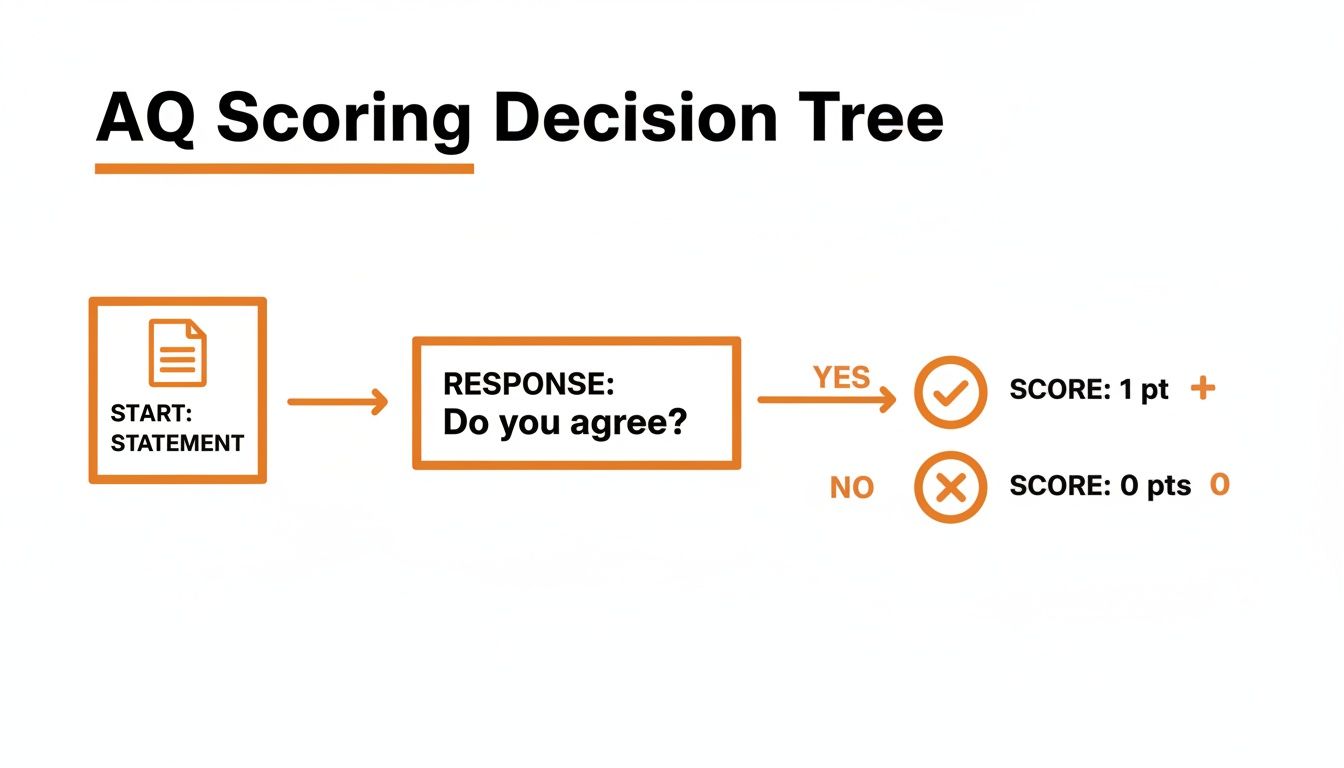
As you can see, the binary scoring awards one point for responses indicating an autistic trait and zero otherwise, keeping the calculation transparent.
AQ Score Ranges and General Interpretations
To give you a clearer idea, here’s a breakdown of what different score ranges might suggest. Remember, this is a general guide for screening purposes and not a substitute for professional evaluation. Use this as a practical tool to guide your clinical judgment.
Score Range | Common Interpretation | Recommended Next Step |
|---|---|---|
0-25 | Low indication of autistic traits. Generally falls within the neurotypical range. | No further action is typically indicated unless specific concerns persist. Monitor and reassure. |
26-31 | Borderline range. Suggests some autistic traits are present, but may not be clinically significant. | Discuss specific concerns raised by the questionnaire. Advise monitoring and a follow-up if challenges increase. |
32-50 | High indication of autistic traits. This score strongly suggests that a formal diagnostic assessment is warranted. | Actionable Insight: Immediately refer for a comprehensive evaluation from a qualified clinician specializing in autism. |
This table helps put the numbers into perspective, guiding whether the next step should be a conversation with a professional.
Context Is Crucial for Accurate Interpretation
A raw score from any screening tool is just one piece of a much larger puzzle. To interpret it responsibly, a clinician must place it within the broader context of a person’s life. This includes their personal history, current challenges, and even demographic factors that can influence both lived experience and diagnostic trends.
This holistic view is non-negotiable for an ethical and effective assessment.
For example, regional data can add important context. Research on county-level ASD prevalence in California revealed significant socioeconomic and racial disparities. The data showed Orange County led public school diagnoses at 1.5% (one in 63 children) in 2011, with prevalence increasing among specific demographic groups in later years. For clinicians serving diverse populations, this background information is vital when evaluating an AQ score.
An AQ score is a starting point, not a destination. Its true value is unlocked when a skilled clinician integrates it with other information, including clinical observation, developmental history, and the person's own narrative of their experiences and struggles.
Ultimately, the number itself is less important than the conversation it starts. It provides a structured framework to explore an individual’s strengths and challenges, paving the way for a more thorough and personalized evaluation. It's this blend of quantitative screening and qualitative clinical expertise that leads to accurate understanding and meaningful support.
How the AQ Is Used in Clinical and Research Settings
The Autism Spectrum Quotient is much more than an academic exercise. It's a genuinely practical tool for busy clinics and formal research studies alike. Its real value comes from its efficiency and its power to put a number on traits, giving professionals a clear starting point where they might not have had one before. By understanding where it shines—and where it falls short—clinicians and researchers can use the AQ effectively and ethically.
In a clinic, it’s helpful to think of the AQ as a screening tool. It’s an inexpensive, quick questionnaire that helps a professional make an educated guess about what to do next. This is especially important when resources are tight and waitlists for a full evaluation are dauntingly long.
The AQ as a Clinical Guidepost
Picture this common scenario: an adult comes into a clinic describing lifelong social struggles, anxiety in certain settings, or just a persistent feeling of being "different." They've likely done some digging online and are starting to wonder if they might be autistic. A clinician can hand them the AQ to gather structured, measurable information right away.
For example, a score of 38 would be a strong indicator that the individual's self-reported traits match up with a profile often seen in autistic adults. That score isn't a diagnosis, of course. But it gives the clinician a solid, evidence-based reason to recommend a complete diagnostic evaluation, which would likely involve in-depth tools like the ADOS-2 (Autism Diagnostic Observation Schedule, Second Edition). This gives you an actionable next step: refer the patient for comprehensive testing and use the AQ score to support the referral.
This screening role has never been more critical. Just look at the explosion in ASD caseloads in California's DDS system, which swelled from 38,000 in 2007 to nearly 133,000 by 2020. With autism now accounting for more than half of all eligible cases, the pressure on services is immense. The AQ helps manage this demand by flagging those who most likely need to be prioritized for a full workup. You can read a detailed public report on these trends in California's autism services.
Applications in Research Settings
In the research world, the AQ’s superpower is its ability to measure the broader autism phenotype. This term describes the presence of autistic-like traits in people who don't meet the full diagnostic criteria for autism but may share some characteristics with their autistic family members.
Researchers can give the AQ to large groups of people to:
Quantify Traits: See how autistic traits are spread across the general population.
Explore Genetics: Look into the heritability of these traits by comparing scores within families.
Find Correlations: Examine the links between autistic traits and other cognitive or behavioural patterns. For instance, a study might use the AQ to see if a high "attention to detail" score correlates with success in specific STEM fields.
This approach allows scientists to get past a simple "autistic vs. non-autistic" divide and really dig into the nuanced, dimensional nature of these traits.
The AQ is a valuable tool within the broader field of psychological testing, enabling researchers to gather large-scale data that deepens our understanding of the spectrum. Its application in both clinical and research settings is crucial for advancing the field.
Knowing the AQ's Limits
For all its uses, the AQ has real limitations. Any responsible practitioner needs to keep these front of mind to avoid misinterpreting the results and ensure they’re using the tool ethically. As a self-report questionnaire, its accuracy hinges entirely on a person's self-awareness and honesty.
Someone with little insight into their own social patterns might score lower than their observable traits would suggest. On the flip side, a person dealing with high anxiety might over-report certain traits. This subjectivity is a key reason why the AQ should never, ever be used alone to make a diagnosis.
Here are the key limitations to remember:
Subjectivity: It relies on personal insight, which can be highly variable.
Masking: It might not pick up on traits in people who have learned to suppress or hide them to fit in.
Cultural and Gender Bias: The questions may not be equally effective across different cultural backgrounds or gender identities.
Not a Diagnostic Tool: It absolutely cannot confirm autism on its own or be used to determine eligibility for services or accommodations.
At the end of the day, the Autism Spectrum Quotient is an excellent first step. It provides a structured, quantitative foundation to build on. For healthcare professionals looking to create a fuller picture, the key is to pair AQ results with other assessments. The AQ helps identify the "what," but further evaluation is needed to understand the "how" and "why."
Moving Beyond Screening With Objective Cognitive Data
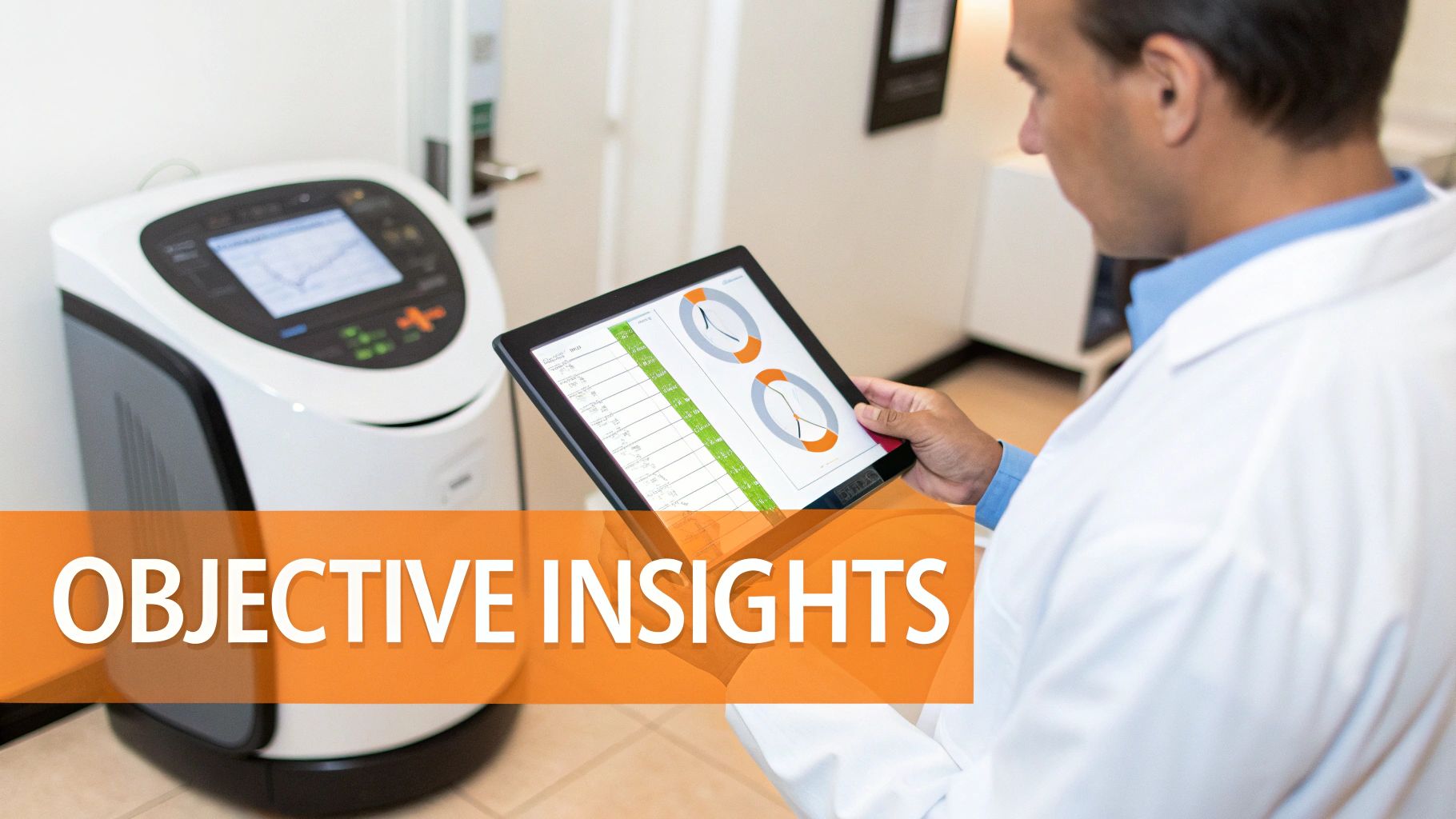
A high score on the Autism Spectrum Quotient (AQ) is a powerful starting point. It’s a clear signal that certain traits are present, telling you what an individual experiences based on their own self-perception.
But it doesn’t explain how these traits show up at a deeper, cognitive level. This is where the real journey begins—moving from a subjective screening to objective, measurable data. The AQ is an excellent bridge from initial concerns to a full diagnostic evaluation, but another layer of data is needed to build a truly comprehensive profile.
From Self-Reported Traits to Measurable Functions
The AQ questionnaire does a fantastic job of flagging potential challenges. For instance, several statements in the "attention switching" domain can point directly to difficulties in shifting focus. This is valuable information, no doubt.
But it stops short of quantifying the specific cognitive functions that are actually driving that challenge.
Is the difficulty with attention switching caused by slower processing speed? Or is it tied to a core deficit in executive function? The AQ simply can't tell you. And that’s the critical difference between identifying a trait and measuring the mechanics behind it. To create support plans that really work, clinicians need to get past the "what" and drill down into the "how."
An AQ score is like knowing a car has trouble accelerating. Our cognitive assessments are like running a diagnostic to see if it’s an issue with the engine, the fuel line, or the transmission. The first tells you there's a problem; the second tells you exactly where to look to fix it.
This is exactly where platforms like Orange Neurosciences provide that essential next layer of data. By delivering objective metrics on specific cognitive functions, we give clinicians a multi-dimensional view that perfectly complements the initial screening results.
Building a Multi-Dimensional Client Profile
Objective cognitive data doesn't replace the Autism Spectrum Quotient; it enriches it. When you combine the two, you can build a client profile that is far more detailed and actionable.
Imagine a client scores highly on the AQ, especially on items related to attention and detail. An objective cognitive assessment can then add specific, hard data on:
Processing Speed: Quantifying precisely how quickly they can process and react to visual or auditory information.
Executive Function: Measuring skills like cognitive flexibility, planning, and working memory.
Sustained Attention: Assessing their ability to maintain focus on a single task over time without getting sidetracked.
This combination creates a powerful synergy. You have the client’s self-reported experiences from the AQ, now backed by concrete data showing their exact cognitive strengths and weaknesses. This is a highly actionable insight: you can now build a care plan that targets specific, measured cognitive functions rather than vague, self-reported traits.
Creating Precise and Personalized Care Plans
Armed with this deeper, more granular information, you can shift from generalized support strategies to truly personalized interventions. It's a data-driven approach that empowers you to build care plans that are precise, effective, and tailored to an individual’s unique cognitive makeup.
For example, knowing a client has a specific deficit in working memory allows for targeted therapies and strategies that address that exact challenge. You're no longer just treating the trait of "difficulty with attention switching"; you are supporting the underlying cognitive function. A practical intervention could be introducing visual aids or checklists to reduce the cognitive load on their working memory during daily tasks.
This detailed data provides the foundation for more effective therapeutic interventions, educational accommodations, and workplace support systems. It lets you take a proactive and targeted approach to care that can dramatically improve outcomes.
Ready to see the full picture? Learning more about objective cognitive assessments shows how we complement screening tools with the precise data needed for modern clinical practice.
Frequently Asked Questions About the AQ Test
When you’re exploring neurodiversity assessments, a lot of questions can come up. The Autism Spectrum Quotient is a fantastic tool, but it's natural to have questions about its purpose, its limits, and how it’s actually used. Let's clear up some of the most common queries to help you understand its role with confidence.
Can the Autism Spectrum Quotient Diagnose Autism?
Absolutely not. The AQ test is strictly a screening tool—it cannot, and should not, be used to diagnose autism. Its job is to flag the presence and intensity of self-reported autistic traits. A high score is a strong signal that a full, formal evaluation with a qualified professional is a wise next step.
Think of the AQ as a smoke alarm. It’s designed to blare loudly when it detects smoke, alerting you to a potential fire. But the alarm can't tell you if it's a real fire, how big it is, or what started it. For that, you need a firefighter. The actionable insight here is to treat the AQ score as an urgent alert, not a final report.
A formal diagnosis is a deep-dive process involving clinical interviews, direct behavioural observations (like those in the ADOS-2), and a thorough look at a person’s developmental history. The AQ simply points clinicians in the right direction, letting them know it's time to investigate further.
Are There Different Versions of the AQ Test?
Yes, there are several. Since the original 50-item AQ was created for adults with average intelligence, researchers have adapted it for different age groups to make it more relevant and accurate.
You’ll find a few key versions:
The AQ-Adolescent: This version is tweaked for teenagers, using language and scenarios that reflect their life experiences.
The AQ-Child: This one is a questionnaire for a parent or guardian to fill out, reporting on their child’s behaviours and traits from an outside perspective.
The AQ-10: A super short, 10-item version perfect for quick screening in a doctor's office or for large research studies where the full 50-item test just isn’t practical.
It's critical to use the right, validated version for the person's age and situation to get results that actually mean something.
If My AQ Score Is Low, Can I Still Be Autistic?
Yes, it’s entirely possible. The AQ is a self-report questionnaire, which means the results are only as good as a person's self-awareness and how they interpret their own life experiences. Some autistic people might not even recognise certain traits in themselves because, to them, that’s just their "normal."
Then there's the powerful effect of masking or camouflaging. This is when someone learns—consciously or not—to hide or suppress their natural autistic traits to fit in with neurotypical social norms. After years of practice, these coping strategies can become so automatic that they skew how a person answers the questionnaire, leading to a score that doesn't capture their internal reality. A practical example: someone might disagree with "I find it difficult to read body language" because they have spent years intellectually memorizing what certain expressions mean, even though they have no intuitive understanding. A low score should never be the final word, especially if someone is still struggling.
How Should I Prepare for an AQ Test?
No prep is needed at all! The whole point is to answer the statements honestly and instinctively. You want to reflect on your lifelong patterns, not just how you feel on the day you take it.
Try not to overthink the questions or answer how you think you should. That just makes the results less reliable. The test is trying to get a genuine snapshot of your traits, so your most spontaneous answers are the most valuable.
What Should I Do After Getting a High AQ Score?
A high score—usually considered 32 or above—isn't a final answer; it's a prompt to take the next step. The best course of action is to schedule a comprehensive diagnostic assessment with a qualified professional who specializes in autism, like a clinical psychologist or neuropsychiatrist.
When you go to your appointment, bring your AQ score with you. It’s a great conversation starter, giving you and the clinician a structured way to talk about your experiences and the traits that led to the high score. This is an actionable step: use the score as a tool to open a productive dialogue with a healthcare provider. If you're curious about the complexities of diagnosis, our article on the differences between autism and sensory processing disorder-or-sensory-processing-disorder-(spd)-a-diagnostic-dilemma) might be a helpful read.
A high AQ score is an invitation for deeper exploration. It provides the data to start a meaningful conversation with a healthcare provider about your unique neurocognitive profile and determine the best path forward for support and understanding.
How Does the AQ Complement Objective Cognitive Tools?
The AQ and objective cognitive assessments are like two sides of the same coin—they work together to paint a much richer picture of an individual's neurobiology. The AQ gives you the subjective data: it tells you what a person is experiencing from their own perspective. Objective tools, on the other hand, measure the underlying cognitive machinery—they show how the brain is actually working.
For instance, someone might score high on the AQ's "attention to detail" questions. An objective cognitive test can then measure their visual processing speed or sustained attention with precision. This helps determine if that self-reported trait is a measurable cognitive strength or a processing challenge. By combining these two sources of data, clinicians get a robust, multi-layered understanding that helps them create truly personalized and effective support plans.
At Orange Neurosciences, we provide the objective cognitive data that bridges the gap between screening and diagnosis. Our platform delivers precise metrics that empower clinicians to move beyond self-reported traits and understand the core cognitive functions at play. Discover how our tools can enhance your clinical practice by visiting https://orangeneurosciences.ca. For a personalized demo or to speak with our clinical team, please contact us through our website or email us directly.
Orange Neurosciences' Cognitive Skills Assessments (CSA) are intended as an aid for assessing the cognitive well-being of an individual. In a clinical setting, the CSA results (when interpreted by a qualified healthcare provider) may be used as an aid in determining whether further cognitive evaluation is needed. Orange Neurosciences' brain training programs are designed to promote and encourage overall cognitive health. Orange Neurosciences does not offer any medical diagnosis or treatment of any medical disease or condition. Orange Neurosciences products may also be used for research purposes for any range of cognition-related assessments. If used for research purposes, all use of the product must comply with the appropriate human subjects' procedures as they exist within the researcher's institution and will be the researcher's responsibility. All such human subject protections shall be under the provisions of all applicable sections of the Code of Federal Regulations.


© 2026 by Orange Neurosciences Corporation