A Compassionate Guide to Understanding Autism
Nov 14, 2025
Autism is a neurodevelopmental difference. Put simply, this means the autistic brain is wired to process information, communicate, and experience the world in its own unique way.
It’s not an illness or something that needs a cure. It's a fundamental part of a person's identity—their core operating system.
What It Means to Be Autistic
To really get what autism is, we need to move past dry, clinical definitions.
Think of it this way: imagine you’re trying to run Windows software on a Mac. Both are powerful, highly capable computers, but they run on completely different operating systems. Neither one is "wrong" or "broken"; they just interact with the world using a different internal framework. That’s a pretty good way to start thinking about the autistic experience.
This neurological difference shows up in several key areas of life:
Social Communication: An autistic person might prefer direct, literal language and find it tough to pick up on things like sarcasm or unspoken social cues. For example, they may not understand why a coworker says "I'm fine" with a frustrated tone, taking the words at face value.
Sensory Processing: Everyday sights, sounds, or textures can feel intensely overwhelming. On the flip side, an individual might actively seek out powerful sensory input. A practical example is a child who needs noise-cancelling headphones in a supermarket or an adult who finds deep pressure from a weighted blanket calming.
Information Processing: Many autistic individuals have an incredible ability to focus deeply on topics that capture their interest, often developing amazing expertise and passion. This could look like a teenager who can name every part of a steam engine or a professional who excels at detailed data analysis.
Deconstructing the Autism Spectrum
The word "spectrum" often trips people up. It’s not a straight line from “less autistic” to “more autistic.”
A much better analogy is a colour wheel. Every person has their own unique blend of strengths and challenges. One individual might be a fantastic public speaker but find bright lights unbearable. Another might be non-speaking but possess an extraordinary memory for tiny details.
Autism is a diverse spectrum of experiences. Each person's journey is unique, shaped by their individual strengths, support needs, and environment. Embracing this neurodiversity is key to fostering understanding and acceptance.
Recognizing these varied profiles has led to much greater awareness. For example, the dramatic rise in autism prevalence in California is a direct result of this improved understanding. Recent estimates show 1 in 27 children are diagnosed there—a figure that points to better screening and recognition, not necessarily an actual increase in how common autism is.
This guide is here to help build a foundation of empathy, offering real, actionable insights for parents and individuals navigating this journey.
Recognizing Signs of Autism in Daily Life

To really understand autism, we have to look beyond clinical checklists and see the small, meaningful moments of everyday life. The signs aren't always big or dramatic. Often, they show up as subtle differences in how a person connects with the world and the people in it.
Spotting these traits isn't about finding a single, definitive sign. It's about noticing patterns. That's why having a good grasp of the typical stages of child development by age can be so helpful. It gives you a baseline for what to expect, making it easier to see variations that might point to an autistic neurotype.
Social and Communication Differences
For an autistic person, social interactions can feel like trying to follow a conversation in a language they’ve only half-learned. The unwritten social rules that most people just get aren't always so obvious.
This might look like:
Literal Interpretation: You might tell them to "break a leg," and they'll get genuinely concerned you want them to get hurt. Sarcasm or playful teasing can be confusing without someone spelling it out.
Direct Communication Style: They might come across as blunt, stating facts without the social "padding" that neurotypical people often expect. It isn't rudeness; it's clarity. For instance, they might tell you your new haircut isn't flattering, not to be mean, but because they are stating an observation honestly.
Different Social Energy: A child might play happily alongside their peers rather than directly with them (this is often called parallel play). An adult might find the unstructured chaos of a large party overwhelming but thrive in a deep, one-on-one conversation.
Sensory Experiences and Processing
The world can be an incredibly loud, bright, and intensely textured place. For many on the autism spectrum, it’s like the volume knob for sensory input is turned all the way up. This can lead to feeling completely overwhelmed or, on the flip side, seeking out more intense sensations to feel regulated.
Sensory sensitivities are not just preferences; they are neurological responses. A scratchy jumper can feel like sandpaper against the skin, and the low hum of fluorescent lights can be as distracting as a fire alarm.
It's important to distinguish these sensitivities from other conditions. If you're noticing sensory-related signs, it can be helpful to explore the differences between autism and sensory processing disorder in our detailed guide-or-sensory-processing-disorder-(spd)-a-diagnostic-dilemma).
Repetitive Behaviours and Deep Interests
Repetitive movements or a strong need for routine are often misunderstood from the outside. These behaviours, known as stimming (self-stimulatory behaviour), are actually powerful tools for self-regulation. Stimming helps an autistic person manage anxiety, block out overwhelming sensory input, or even just express pure joy.
A few examples in daily life include:
A child flapping their hands when they get excited.
An adult pacing back and forth while they think through a problem.
Needing to eat the same lunch every single day because it provides a sense of comfort and predictability.
Beyond this, many autistic individuals develop deep, passionate interests in specific topics. This isn't just a casual hobby; it's a profound level of engagement that brings immense expertise and joy. Whether it's memorizing every train schedule in the country, mastering a complex video game, or becoming an expert on ancient Egypt, these passions are a hallmark of the focused and dedicated autistic mind.
Common Signs of Autism Across Developmental Stages
Recognizing the signs of autism is not about checking boxes but about understanding a person's unique way of experiencing the world. The following table provides a general guide to what these signs might look like at different developmental stages, but remember that every autistic person is different.
Developmental Stage | Social Communication & Interaction | Repetitive Behaviours & Restricted Interests |
|---|---|---|
Infants & Toddlers | Limited or no eye contact, not responding to their name, not pointing at objects to show interest. | Repetitive movements like rocking or hand-flapping, intense reactions to minor changes in routine. |
Preschool & School-Age | Difficulty making friends, prefers to play alone, trouble understanding feelings or non-verbal cues. | Has deep, specific interests, needs strict routines to feel secure, repeats words or phrases (echolalia). |
Teenagers | Finds group conversations overwhelming, may have a very direct or literal communication style. | Develops highly focused, intense interests, adheres rigidly to routines, may engage in stimming to manage stress. |
Adults | May feel exhausted from "masking" in social situations, prefers deep one-on-one talks over small talk. | Strong need for predictable routines, deep expertise in specific subjects, uses stimming as a self-regulation tool. |
This table is a starting point. If you recognize these patterns in yourself or a loved one, it may be helpful to seek a professional opinion. Appreciating these traits for what they are allows us to better support the people behind them and honour the unique ways they experience joy and connection.
Navigating the Path to an Autism Diagnosis
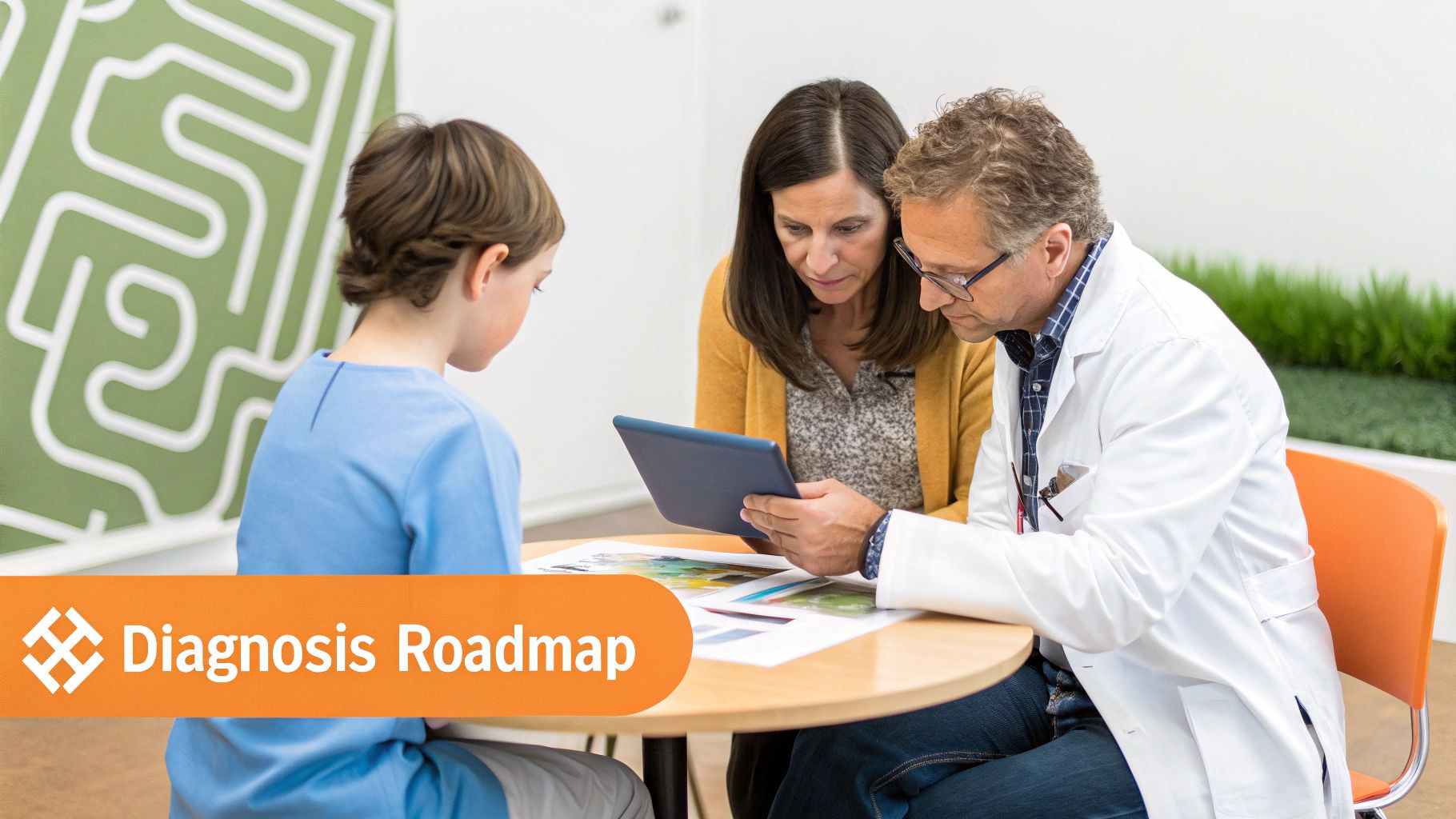
Starting the journey towards an autism diagnosis can feel a lot like being handed a map with no clear starting point. It's often overwhelming, but understanding the process is the first step toward advocating effectively for yourself or your child. It all begins with finding the right professionals and preparing for a detailed evaluation.
A formal diagnosis isn't something just any doctor can provide. It typically comes from a specialized team that might include a developmental paediatrician, a child psychologist, a neuropsychologist, or a psychiatrist. These experts are trained to see the whole person—their development, behaviours, and unique ways of communicating.
What to Expect From the Evaluation
A proper evaluation is far more than a quick check-up. Think of it as a deep dive into an individual's unique neurotype, designed to gather information from multiple angles.
While every assessment is personalized, you can generally expect a few key steps:
Parent/Caregiver Interviews: You’ll be asked detailed questions about your child’s entire developmental history, from their earliest milestones to how they interact with others today.
Direct Observation: The specialist will spend time with your child, often through play-based activities, to see their communication style, social skills, and behavioural patterns in a natural setting.
Standardized Assessments: These are specific, evidence-based tools and tests used to measure different aspects of development. Tools like the ADOS (Autism Diagnostic Observation Schedule) are widely used for this.
For adults pursuing a diagnosis, the process is a bit different. It relies more on in-depth interviews about their life experiences, challenges, and personal strengths, often supported by questionnaires for close family members who can offer another perspective. Getting a handle on what these evaluations involve is crucial, and you can learn more about cognitive assessment in our guide.
Preparing for Your Appointment
To get the most out of the evaluation, showing up prepared makes a world of difference. Taking the time to organize your thoughts and observations beforehand helps you paint a clear and thorough picture for the specialist.
The goal is to share a holistic view of the individual, including their strengths, passions, and challenges. Your firsthand knowledge is one of the most valuable tools in the diagnostic process.
Here are a few actionable steps you can take:
Document Examples: Keep a journal of specific behaviours, communication methods, and sensory sensitivities you've noticed. For example, note that your child lines up their toys instead of playing with them conventionally, or that they become distressed when the daily routine changes unexpectedly.
Gather Reports: Collect any relevant documents you have, like school reports, or even just notes from teachers or therapists.
List Your Questions: Write down every single question that comes to mind. Seriously, no question is too small or silly. An actionable tip is to bring a notebook with questions like, "What are the next steps after diagnosis?" or "What local resources do you recommend?"
Policy can also play a major role in getting a diagnosis. For example, California's Autism Insurance Mandate, which requires private insurers to cover key services, has led to a 22% increase in diagnoses since 2020 simply by making care more accessible. After a diagnosis, many individuals and families find that professional autism counselling services offer invaluable, tailored guidance for the road ahead.
How Technology is Transforming Autism Support
Technology is carving out incredible new paths for supporting autistic individuals, pushing us far beyond the old one-size-fits-all mindsets. Digital tools are giving us personalized, accessible, and genuinely engaging ways to build skills and foster real independence. They offer support that can adapt on the fly to a person's unique profile, making a tangible difference in their day-to-day life.
This shift is particularly powerful when it comes to assessment. Traditional methods often lean heavily on subjective observation, which has its limits. But digital cognitive assessments? They offer something different: precise, data-driven insights. By analyzing how someone performs on specific tasks, these tools can map out their cognitive strengths and challenges with stunning clarity.
Data-Driven Insights and Personalized Learning
Think of it like this: trying to understand a person’s learning style just by watching them is like admiring a car's exterior. You get a general idea, but you miss the details. Digital assessments are like popping the bonnet and seeing exactly how the engine processes information—from attention and memory to processing speed. This objective data is the key to creating support plans that are truly built for the individual.
This level of detail is a game-changer for providing effective support. For example, if an assessment reveals a child has a rock-solid visual memory but struggles with auditory processing, educators can immediately adapt. They might swap spoken directions for visual schedules or written instructions, setting that child up to succeed from the get-go. This is an actionable insight you can implement immediately.
Technology empowers us to move from guesswork to evidence-based support. By understanding the unique cognitive profile of each autistic individual, we can provide tools and strategies that align with how they learn best, fostering confidence and growth.
Practical Tools for Daily Life
The impact of this technology goes well beyond the initial assessment. It’s about putting practical, everyday tools into people’s hands that can enhance communication, build social skills, and even make learning more fun. These tools aren't meant to replace traditional therapies, but to complement them by offering consistent reinforcement right in a person's own environment.
Here are just a few examples of how technology is already making a difference:
Augmentative and Alternative Communication (AAC): For non-speaking or minimally speaking people, AAC apps on tablets or phones are absolutely life-changing. These apps let users tap icons or type words that are then spoken aloud, giving them a powerful voice to express their thoughts, needs, and feelings.
Gamified Social Skills Training: Let's face it, learning complex social rules can be tough. Gamified platforms transform this process into an interactive and enjoyable experience. Users can practice navigating tricky social situations in a safe, low-stakes virtual space, building confidence they can then take into their real-world interactions.
Visual Schedule and Routine Apps: Many autistic people find comfort and security in predictability. Apps that lay out the day with clear, visual schedules can significantly reduce anxiety around transitions. A simple checklist with images for "get dressed," "eat breakfast," and "catch the bus" provides a predictable structure that helps manage the entire day.
These digital tools are a key part of how Orange Neurosciences supports neurodiverse learners with its digital therapy platform, creating adaptive and engaging experiences. They offer a degree of personalization that was once incredibly difficult to achieve, making support more effective and accessible than ever. By integrating these solutions, we can better meet the diverse needs of the autism community, helping each person thrive on their own terms.
Understanding Autism Prevalence and Statistics
Headlines about rising autism rates often grab the spotlight, but they rarely tell the whole story. What looks like an epidemic is actually a reflection of something much more positive: a seismic shift in how we understand, recognise, and define autism.
This increase isn’t a cause for alarm. Instead, it’s a sign of real progress. We’re getting far better at identifying autism across all ages, genders, and backgrounds. As a result, more people are finally getting the validation, support, and understanding they need to truly thrive.
The infographic below highlights just how much technology is becoming a powerful ally in autism support, from new assessment tools to communication apps.
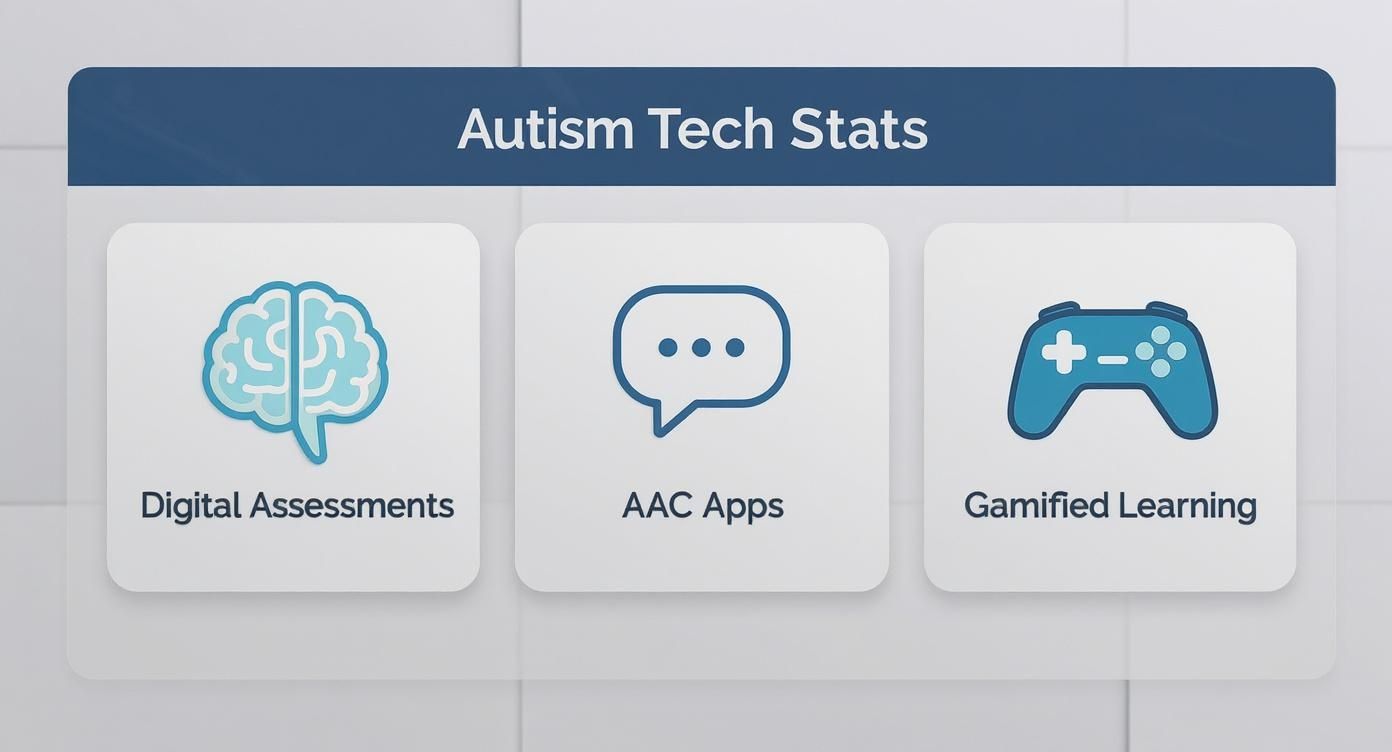
This really brings to life how modern tools are helping to forge more personalized and effective paths forward for the entire autism community.
A Closer Look at the Data
When you dig into the numbers, some fascinating patterns start to emerge. For decades, autism was diagnosed far more often in boys than in girls. We're now seeing that gap narrow as our understanding evolves. We've learned that autism can present very differently in girls, who are often more likely to "mask" or camouflage their traits to fit social expectations.
Geography tells an important story, too. The prevalence rates you see in a particular region are heavily influenced by the local access to quality healthcare and specialized diagnostic services. This is why some areas report higher numbers—not because there are more autistic people, but because they have better systems for identifying and supporting them.
A higher prevalence rate in a specific region often points to a stronger support infrastructure, including advanced diagnostic capabilities and greater community awareness, rather than a higher occurrence of autism itself.
California is a perfect example of this in action. It has become the state with the highest autism prevalence in the United States, with recent data showing a rate of 1 in 19 children at age 8. That's significantly higher than the national average.
Why? It's largely because of the state’s advanced healthcare infrastructure and its adoption of tech-driven diagnostic tools. These resources lead to more accurate, and much earlier, identification. For a deeper dive, you can read the full CDC report on these findings.
Ultimately, understanding these statistics is about remembering the people behind the numbers. Each data point represents an individual, a family, and a unique journey. Here at Orange Neurosciences, our mission is to support every one of those journeys with objective, data-driven cognitive assessments that bring clarity and direction.
If you have questions about cognitive profiling or want to see how our tools can help, we invite you to visit our website. Our team is ready to provide you with the clear insights you need.
Frequently Asked Questions About Autism
When you're first exploring the world of autism, it's natural to have a lot of questions. Getting clear, straightforward answers is the first step toward building real understanding and moving past common myths. We've gathered some of the most common questions to offer some practical insight for families, friends, and anyone looking to learn.
While these answers can provide some clarity, it's always important to remember that every autistic person's experience is completely their own.
Is There a Cure for Autism?
This is probably one of the most common questions, but it’s rooted in a bit of a misunderstanding of what autism actually is. There is no “cure” for autism because it isn't a disease or an illness that needs fixing. Think of it as a neurodevelopmental difference—the autistic brain is simply wired to process the world in its own unique way.
The goal of any support shouldn't be to change who a person is at their core. Instead, it’s about providing them with the tools and strategies to navigate a world that often wasn't built with their needs in mind.
Many autistic people see their autism as a fundamental part of who they are—a source of incredible strengths, deep passions, and unique perspectives. The focus of effective support is on improving quality of life, not on fundamentally changing the person.
This is why the type of support matters so much. To get a better sense of the different approaches, you can explore the distinctions between behavioural interventions vs the developmental perspective in our detailed article.
What Is the Difference Between Autism and Asperger's?
You might still hear people use the term "Asperger's syndrome," but it's no longer an official diagnosis. It was once used to describe people who had social challenges and very intense, specific interests but didn't have significant delays in their language or cognitive development.
Back in 2013, the main diagnostic manual clinicians use (the DSM-5) was updated. Asperger's syndrome was folded into the single, broader diagnosis of Autism Spectrum Disorder (ASD).
This change really reflects a more current understanding of autism as a vast and varied spectrum. Now, someone who might have been diagnosed with Asperger's in the past would simply receive an ASD diagnosis, often with a specifier like "Level 1" to describe their level of support needs.
How Can I Best Support a Friend or Family Member with Autism?
Real support starts with empathy, respect, and a genuine desire to listen and learn. Instead of guessing what they need, the most powerful thing you can do is just ask. Talk to your loved one about their needs, preferences, and boundaries.
Here are a few actionable ways you can offer meaningful support:
Practise Clear Communication: Try to be direct and avoid sarcasm or idioms that might be confusing. For instance, instead of saying, "Let's hit the road," say, "It's time for us to leave now." Clarity is kindness.
Respect Sensory Needs: Be mindful of the environment. If you're going out, ask if they'd prefer a quieter restaurant or if they need to bring headphones. Ask what makes them comfortable.
Honour Routines: Predictability can be a huge comfort and a great tool for reducing anxiety. If you know plans need to change, give as much advance notice as possible. For example: "Tomorrow, we need to leave for school 10 minutes earlier than usual."
Celebrate Their Passions: Show genuine interest in the things they love. Ask them to explain the complex plot of their favourite video game or the history of the dinosaur they're studying. These deep interests are often a source of immense joy, comfort, and expertise.
Create a Safe Space: Above all, offer a non-judgmental space where they can be their authentic selves without feeling pressured to "mask" or conform to social expectations. Let them know it's okay to stim or to step away from a social gathering if they feel overwhelmed.
Your acceptance and understanding can make all the difference in their world.
At Orange Neurosciences, we believe that understanding an individual's unique cognitive profile is the first step toward providing effective support. Our evidence-based assessment tools offer the clear, objective data needed to create personalized care plans that truly make a difference. Explore our solutions and contact us for more information by visiting our website at https://orangeneurosciences.ca.
Orange Neurosciences' Cognitive Skills Assessments (CSA) are intended as an aid for assessing the cognitive well-being of an individual. In a clinical setting, the CSA results (when interpreted by a qualified healthcare provider) may be used as an aid in determining whether further cognitive evaluation is needed. Orange Neurosciences' brain training programs are designed to promote and encourage overall cognitive health. Orange Neurosciences does not offer any medical diagnosis or treatment of any medical disease or condition. Orange Neurosciences products may also be used for research purposes for any range of cognition-related assessments. If used for research purposes, all use of the product must comply with the appropriate human subjects' procedures as they exist within the researcher's institution and will be the researcher's responsibility. All such human subject protections shall be under the provisions of all applicable sections of the Code of Federal Regulations.


© 2026 by Orange Neurosciences Corporation