Assessment of learning disability: A Practical Guide to Evaluation and Support
Feb 10, 2026
An assessment for a learning disability isn't just one test. Think of it as a thorough investigation into how a person's brain is wired for learning. The real goal here isn't just to find what's challenging, but to map out an individual's unique mix of cognitive strengths and weaknesses. It’s about creating a personalized blueprint for success.
This process is a multi-faceted evaluation, all designed to build an effective, truly supportive system for the individual.
Decoding the Blueprint of the Brain
Imagine the assessment process as a detective's deep dive into how someone's mind works. We're not looking for a single "problem" to label. Instead, it's a careful process of gathering clues from many different sources to build a complete, nuanced picture of a person’s cognitive abilities.
This investigation goes way beyond standard academic testing. A proper evaluation pieces together information from various domains—cognitive, academic, emotional—to understand the whole person, not just how they perform on one specific task. We're trying to solve the mystery of how they learn best, uncovering hidden talents along with their struggles.
More Than Just a Score
A quality assessment gives us the critical insights needed to provide support that actually works. It helps us figure out if we're looking at a true learning disability or something else that can look very similar, like anxiety or attention difficulties. Without that clarity, any attempts to help can miss the mark entirely.
Ultimately, the whole point is to create a detailed, personalized roadmap. This roadmap becomes an invaluable guide for parents, educators, and clinicians, helping everyone build a support system that fits. It provides actionable answers to crucial questions like:
Why does my child struggle with reading? For example, is it because they have trouble sounding out words (a phonological issue), or because they can't remember what they just read (a working memory issue)?
What specific cognitive gears are stuck? An assessment can show that a student's processing speed is slow, explaining why they take so long to finish tests even when they know the material.
What specific teaching strategies will work? The report might recommend multi-sensory teaching methods for a student with dyslexia, like using letter tiles or tracing letters in sand to connect the physical feeling with the sound.
An effective assessment doesn't just put a label on a deficit; it lights up a path forward. It turns confusion and frustration into a clear, actionable plan that empowers an individual to thrive by playing to their strengths while shoring up their weaknesses.
This comprehensive approach is the only way to create real, meaningful change. It makes sure that the help offered isn't just a generic solution, but is precisely targeted to what that individual actually needs. For a closer look at what goes into this kind of evaluation, you can learn more about what a neuropsychological assessment involves in our detailed guide.
This process is the foundation for every effective intervention that follows, turning diagnostic data into real-world success. It's the first—and most critical—step in helping someone unlock their full potential.
Navigating the Comprehensive Assessment Process
Figuring out if a child has a learning disability isn't a single event—it's more like a careful, methodical journey. To bring this to life, let’s imagine we're following the story of ‘Alex,’ a bright, creative kid who just can’t seem to get the hang of reading. This walkthrough will demystify each stage, showing it for what it is: a collaborative investigation to understand how a child truly learns.
The journey usually kicks off with a referral. This might come from a teacher who notices Alex stumbling over grade-level texts or from a parent who's worried about the nightly homework battles. This first step isn’t about jumping to conclusions. It’s simply about acknowledging that a persistent challenge exists and it's time to take a closer look.
The Foundation: Gathering Background Information
Before a single formal test is administered, the assessor's first job is to build a rich, detailed history. This means in-depth interviews with parents, teachers, and sometimes Alex, too. The goal is to paint a complete picture, exploring everything from developmental milestones and medical history to family background and early school experiences.
For instance, the assessor might ask Alex’s parents practical questions like, "When did Alex first start speaking in full sentences?" or "Did you notice any early trouble with rhyming games or learning the alphabet?" These aren't random questions; they provide crucial context. A history of early ear infections, for example, could hint at auditory processing challenges that might affect phonological awareness—a cornerstone of learning to read.
This image helps visualize the assessment journey, breaking it down into three core phases: gathering clues, building a detailed learner profile, and creating a solid plan for support.
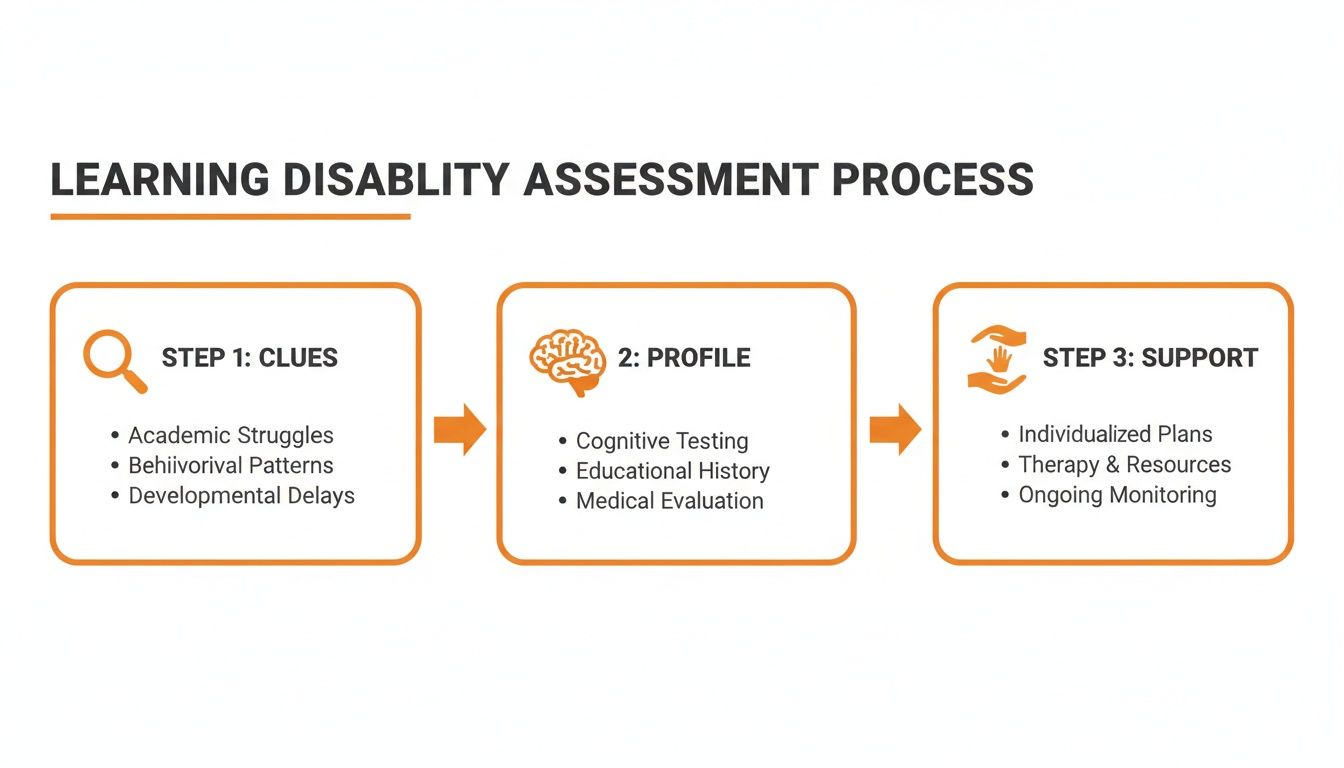
As you can see, a proper assessment is a logical progression. It moves from broad observations to a specific, actionable understanding of what a learner truly needs.
Key Stages in a Learning Disability Assessment
To give you a clearer picture of the workflow, the table below breaks down the typical stages of a comprehensive assessment. It outlines what happens at each step, from the first concern to the final report.
Stage | Primary Goal | Common Activities |
|---|---|---|
Referral & Intake | To understand the core concerns and decide if a full assessment is needed. | Initial parent/teacher interviews, review of school records and report cards. |
Information Gathering | To build a comprehensive history of the individual's development. | Detailed interviews, developmental questionnaires, medical history review. |
Observation | To see how challenges appear in a natural setting, like the classroom. | Observing student engagement, task initiation, and coping strategies. |
Direct Assessment | To objectively measure cognitive abilities and academic skills. | Administering standardized tests for IQ, memory, processing, reading, etc. |
Interpretation & Reporting | To synthesize all data into a coherent profile and written report. | Analyzing test scores, connecting findings to real-world struggles. |
Feedback & Planning | To communicate findings to the family and school and create a support plan. | Meeting with parents and educators, outlining recommendations and strategies. |
This structured process ensures that no stone is left unturned and that the final recommendations are grounded in solid evidence from multiple sources.
Observing in the Natural Environment
The next piece of the puzzle is often a classroom observation. This isn't about judging the teacher or catching Alex on a "bad day." It's about seeing how Alex's struggles actually play out in a real-world learning environment.
During an observation, an assessor might be looking for specific things:
Task Initiation: Does Alex jump into assignments right away, or does he look lost when given multi-step directions? For example, when the teacher says, "Take out your math book, turn to page 50, and do the odd-numbered problems," does Alex get started or just stare blankly?
Attention and Focus: How well does Alex handle distractions during silent reading compared to, say, a hands-on science experiment? Does a classmate's cough or a pencil dropping break his concentration completely?
Coping Strategies: When faced with a tough reading passage, does Alex resort to avoidance behaviours, like sharpening his pencil over and over or asking to go to the bathroom?
Watching Alex in his own classroom provides authentic data that a standardized test just can't capture. It reveals how cognitive difficulties intersect with social and environmental factors. When navigating this complex process, families often turn to the expertise of a clinical psychologist to conduct these thorough evaluations.
Piecing Together the Puzzle
With a rich background history and real-world observations in hand, the assessor is finally ready for direct testing. This involves administering a carefully chosen set of standardized tests to measure specific cognitive abilities and academic skills. Each test is a tool, selected to answer questions that came up during the initial information-gathering phase.
A comprehensive assessment is like putting together a complex jigsaw puzzle. Each piece—the parent interview, the teacher's report, the classroom observation, and the test scores—is essential. Only when all the pieces are connected does a clear and accurate picture of the learner emerge.
For Alex, this might mean a test of phonological processing reveals a specific weakness in identifying and manipulating the sounds in words. Another test, this one on working memory, might show he has a hard time holding and processing information at the same time. These aren't just scores on a page; they are the critical clues that explain why Alex finds reading so difficult. You can learn more about the specific terms used in reports in our guide on the language of assessment.
Finally, all this information comes together in a feedback session. Here, the assessor walks Alex's family and school team through the findings, connecting the dots between the test results and Alex’s everyday struggles. The process doesn’t end with a label, but with a clear, actionable plan to support Alex on his learning journey.
Exploring Core Cognitive and Academic Domains
Once we’ve gathered the initial history and observations, the assessment process digs into the real heart of the matter: examining specific cognitive and academic skills. Think of it like a mechanic running diagnostics on a car. It's not enough to know the car is sputtering; we need to pinpoint exactly which part—the transmission, the fuel injector, the electrical system—is causing the problem.
In the same way, an assessor systematically evaluates distinct cognitive functions to understand how a person’s brain actually processes information. These domains are the mental machinery we use for every learning task, from reading a sentence to solving a math problem. When one of these functions isn't working at full capacity, it can create major bottlenecks in learning.
The Brain’s Air Traffic Controller: Executive Functions
One of the most critical areas we look at is executive functions. Imagine an air traffic control tower at a bustling airport. The controllers have to manage incoming and outgoing flights, prioritize landings, handle unexpected weather, and keep everything running without a hitch. Executive functions do the same for our brain.
They're a set of mental skills that help us get things done, including:
Working Memory: This is the ability to hold information in your mind while you're actively using it. A practical example: A student with weak working memory might forget the beginning of a long sentence by the time they reach the end, making comprehension a real struggle.
Inhibition: This is the skill of tuning out distractions and controlling impulses. A practical example: This is what helps a student ignore classmates whispering so they can focus on the teacher's instructions.
Cognitive Flexibility: This is the ability to switch between different tasks or think about something in a new way. A practical example: A student uses this when they shift gears from a math problem to a writing assignment without getting "stuck."
When these "air traffic control" skills are weak, a student might have a tough time planning long-term projects, keeping their backpack organized, or even just starting their homework without constant reminders.
Assessing executive functions gives us a blueprint for understanding why a student might seem disorganized or unfocused. It's often not about laziness, but a genuine difficulty with the brain's core management system.
Processing Speed: How Fast the Brain Works
Another key domain is processing speed, which is basically the time it takes for a person to take in information, make sense of it, and then respond. This isn't about intelligence; it’s about how quickly they can perform simple, automatic mental tasks.
A slow processing speed can feel like trying to stream a high-definition movie on a very slow internet connection. All the information is there, but it arrives in a choppy, frustrating way that makes it hard to follow.
In the classroom, this can show up as:
Difficulty keeping up with note-taking during a lecture.
Struggling to finish tests within the time limit.
Taking a long time to answer questions, even when they know the answer.
Identifying a weakness here is so important because simple accommodations, like extended time on tests, can make a world of difference.
Pinpointing Specific Learning Challenges
Beyond these broad cognitive functions, a thorough assessment zooms in on skills that are directly tied to academic performance. This includes things like phonological processing (the ability to hear and work with sounds in language, which is crucial for reading), visual-spatial skills, and various language abilities.
The image below shows how modern tools can quickly screen for these different cognitive domains, giving a visual snapshot of a person's strengths and weaknesses.
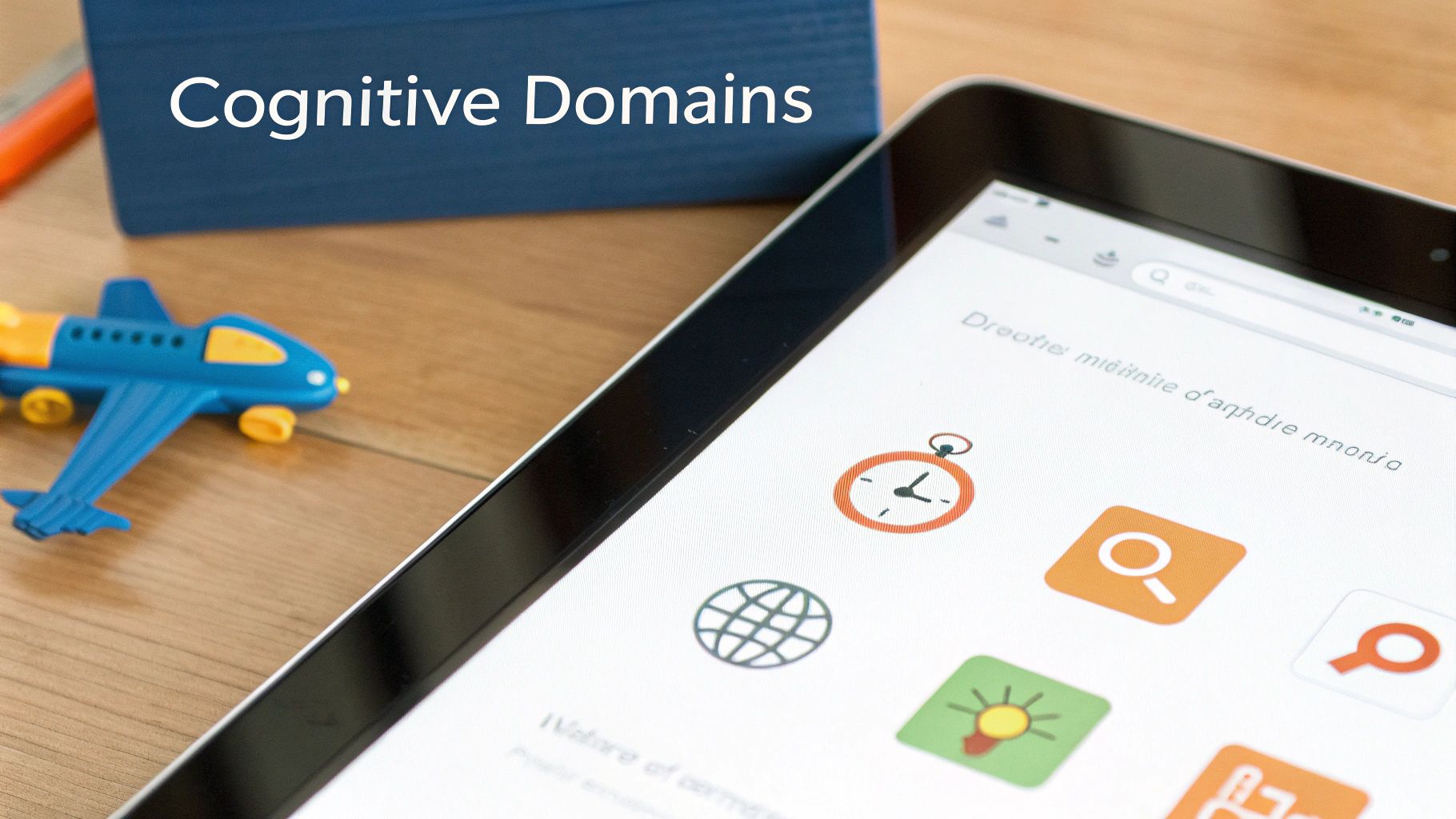
This kind of rapid screening helps clinicians efficiently spot areas, like processing speed or memory, that might need a more in-depth, traditional evaluation, which saves valuable time and resources.
The need for this kind of precise screening is especially clear when you look at the numbers. In California alone, around 12.5% of public school students—that's over 550,000 children—were identified with specific learning disabilities, making it the largest disability category. This highlights just how urgent the need is for accurate and efficient assessment tools to make sure every child gets the right support.
The Role of Modern Assessment Tools
Traditionally, assessing all these different domains has been a very long and involved process. Today, digital platforms are changing that reality.
Tools like those from Orange Neurosciences offer rapid, objective cognitive screening through engaging, game-like activities. They can measure functions like attention, memory, and processing speed in a fraction of the time it takes with traditional methods.
This allows clinicians and educators to quickly get a reliable baseline of a student's cognitive profile. It helps them efficiently pinpoint which areas need a deeper look, making the entire diagnostic process more focused and effective. For example, if a quick screener flags a weakness in reading comprehension, it tells the assessor exactly where to focus their more detailed investigation. You can learn more about this specific area in our guide on the Test of Reading Comprehension.
By understanding these specific cognitive and academic domains, an assessment can move beyond a simple label. It provides a truly personalized map of a learner's mind, creating a foundation for targeted interventions that build on their strengths and address the root causes of their challenges.
Interpreting Results and Making a Diagnosis
Once all the interviews, observations, and tests are done, the real work begins. This is where we fit all the puzzle pieces together to see the whole picture. Interpreting the results of a learning disability assessment is both a science and an art, involving a sharp eye for meaningful patterns of cognitive strengths and weaknesses, not just isolated test scores.
We’ve moved far beyond the old, simplistic models that just looked for a gap between a person's IQ and their academic achievement. Today, the focus is on building a comprehensive learning profile. This richer, more nuanced view helps us understand why a student is struggling, not just that they are.
Moving Beyond Simple Scores
A diagnosis should never, ever hang on a single piece of data. A skilled assessor synthesizes information from every source available—parent interviews, teacher reports, classroom observations, and standardized testing—to see how all the threads connect.
Actionable Insight: A low score on a reading fluency test is just a number on its own. But when you pair it with a parent’s story about nightly homework battles, a teacher’s note about the student avoiding reading out loud, and a cognitive test showing a weakness in phonological processing, a clear, consistent pattern pointing toward dyslexia starts to form. This holistic analysis is what gives a diagnosis its true power and accuracy.
The goal of interpretation isn't just to stick a label on a deficit. It's to understand the whole learner. It’s about creating a narrative that explains an individual's unique cognitive landscape—their high peaks of strength alongside their valleys of challenge.
The Critical Step of Differential Diagnosis
One of the most crucial parts of the assessment process is what we call differential diagnosis. This is the methodical work of distinguishing a specific learning disability from other conditions that can cause very similar symptoms. A lot of different issues can make school tough, and it's absolutely vital to pinpoint the correct root cause.
Conditions that often overlap or get confused with learning disabilities include:
Attention-Deficit/Hyperactivity Disorder (ADHD): This can wreak havoc on focus and follow-through, making it look a lot like a learning problem.
Anxiety or Depression: When a student is in emotional distress, their ability to concentrate and learn can take a massive hit.
Language Disorders: Difficulties with understanding or using language will naturally affect every single area of academics.
Getting this step wrong can lead to interventions that just don't work. For instance, putting a student through a phonics-based reading program won't solve the core problem if their reading struggles are actually due to inattention from ADHD. You can learn more about how academic skills are measured in our guide on the Wechsler Individual Achievement Test.
A Practical Example: Dyslexia vs. ADHD
Let's imagine two students, both finding it impossible to get through their history textbook.
Student A (with Dyslexia): During the assessment, cognitive testing flags a specific weakness in phonological processing and rapid naming, but her attention skills are solid. Her reading mistakes are often sound-based (like reading "ship" as "sip"). While she reads slowly, once she fights her way through the text, she can answer comprehension questions perfectly. The data points to a core difficulty with decoding printed words.
Student B (with ADHD): This student’s cognitive tests show strong phonological skills but reveal significant weaknesses in sustained attention and working memory. The assessor observes her constantly losing her place, skipping entire lines of text, and getting distracted by noises in the hallway. Her reading is choppy not because she can't decode, but because her attention keeps wandering off.
By carefully analyzing the entire pattern of data, the assessor can confidently tell the difference between a reading issue caused by dyslexia and one caused by ADHD. This leads to vastly different—and far more effective—support plans.
The history of assessment shows just how far we've come, but significant challenges remain. In California, for example, disparities persist, with African American students identified at a rate of 14.1% compared to 10.5% for white students, an echo of historical biases. More recently, a staggering 35% assessment backlog during the COVID-19 era delayed critical services for thousands of children, highlighting the urgent need for more efficient tools. You can discover more insights about these challenges in California's special education system.
This careful, methodical diagnostic process ensures that the final conclusion is accurate, defensible, and—most importantly—genuinely helpful for the individual. If you have concerns about your child's learning profile, contact us through our website to explore how our digital assessment tools can provide the clear, objective data needed to start this important conversation.
Translating Assessment into Actionable Support
A comprehensive assessment for a learning disability isn't the finish line; it’s the starting block. The true power of that diagnostic report is in its ability to become a practical roadmap for success, turning clinical findings into meaningful, real-world support. This is where the data comes off the page and the real potential for growth begins.
Think of the assessment report less as a collection of scores and technical terms, and more as a detailed user manual for a unique brain. Each finding is a critical clue, showing us exactly how an individual learns best and where they need specific support structures to thrive.
The next step is all about building a bridge between the 'what' (the diagnosis) and the 'how' (the support plan). This absolutely requires collaboration—a unified strategy built by the assessor, educators, parents, and the individual themself.
From Findings to Practical Strategies
The key is to draw a direct line from a specific cognitive challenge identified in the assessment to a concrete, actionable strategy. This is how we make sure every recommendation is targeted and evidence-based, not just a shot in the dark.
Here’s what this looks like in practice:
Finding: The assessment reveals a significant weakness in processing speed.
Actionable Support: Provide extended time (1.5x) on tests and assignments. Give them class notes ahead of time so they can focus on listening, not just scribbling. Break down big projects into smaller, more manageable chunks with their own due dates.
Finding: Testing shows a deficit in working memory.
Actionable Support: Teach the student to lean on checklists and graphic organizers. Supplement verbal instructions with written ones. Encourage memory aids like mnemonic devices or simple digital reminders on a phone.
Finding: A core challenge is spotted in phonological processing, a hallmark of dyslexia.
Actionable Support: Implement a structured, multi-sensory reading program (like Orton-Gillingham). Provide access to audiobooks and text-to-speech software to ease the cognitive load and help them access grade-level content without falling behind.
This translation process is fundamental. After an assessment, it's vital to implement effective reading strategies for struggling readers so students get the targeted, hands-on support that actually addresses the root of their difficulties.
Building a Collaborative Support Team
No one can go it alone here. A successful support plan depends on a strong, collaborative team that includes the student, parents, teachers, and specialists like speech-language pathologists. Regular, open communication is the glue that holds this team together.
A diagnostic report sitting in a file is just paper. An effective support plan is a living document, brought to life through consistent collaboration, open communication, and a shared commitment to the individual's progress.
This team works together to create and monitor an Individualized Education Program (IEP) or a similar support plan. The assessment data provides the solid foundation needed to set realistic, measurable goals.
Interventions vs. Accommodations
It’s crucial to understand the difference between interventions and accommodations. They’re both important, but they do very different jobs. Accommodations help students access the curriculum, while interventions work to build and remediate weaker skills.
This distinction is important, so let's break it down.
Common Accommodations vs. Interventions
Category | Accommodations (Examples) | Interventions (Examples) |
|---|---|---|
Purpose | To provide equal access to learning; removes barriers. | To teach new skills and improve underlying cognitive weaknesses. |
Example for Reading | Providing audiobooks or text-to-speech software for a history textbook. | Enrolling the student in a specialized, evidence-based reading program. |
Example for Writing | Allowing the use of a keyboard instead of handwriting for essays. | Providing targeted instruction in grammar, sentence structure, and essay organization. |
Example for Math | Permitting the use of a calculator for multi-step problems. | Using manipulatives and visual aids to teach number sense and mathematical concepts. |
A balanced plan needs both. For instance, a student with dysgraphia might get an accommodation to type assignments (removing the handwriting barrier) while also participating in an intervention like occupational therapy to improve fine motor skills.
Using Modern Tools for Ongoing Support
The journey doesn't stop once a plan is in place. We need to continuously monitor progress to make sure the strategies are working and adjust them as needs change. This is where modern digital tools can make a huge difference.
Platforms like Orange Neurosciences help bridge the gap between assessment and intervention. Our engaging, game-based cognitive training programs are designed to implement targeted support plans. For example, if an assessment points to weak executive functions, our tools offer specific exercises to strengthen skills like planning and attention. Our guide on how to improve executive function offers more insights into this critical area.
Even better, these platforms provide real-time data on progress, giving the support team objective information to track improvement and make informed decisions. This data-driven approach keeps the support plan dynamic and responsive, evolving right alongside the learner.
Ready to see how you can translate assessment data into effective, engaging intervention? Explore the tools on the Orange Neurosciences website and discover how our platform can help you build a bridge from diagnosis to lasting success.
Answering Your Questions About Learning Disability Assessments
When you’re trying to understand learning disabilities, a lot of questions come up. It's a complex world to step into. Whether you're a parent trying to find the right path for your child, an educator searching for better ways to support a student, or a clinician guiding a family through the process, getting clear, direct information is the first step.
This section tackles some of the most common questions we hear about learning disability assessments. Our goal is to give you the straightforward, actionable answers you need to move forward with confidence.
How Long Does a Learning Disability Assessment Take?
This is a big one. A full psycho-educational evaluation is a deep dive, not just a quick test. While the actual one-on-one testing might take anywhere from 6 to 12 hours—usually broken up over a few appointments—that's really just the tip of the iceberg.
The whole process involves much more. Think about the initial interviews, observing the child in their classroom, scoring all the measures, interpreting the results, writing a comprehensive report, and then sitting down for a feedback meeting. All in all, this journey can easily take several weeks, sometimes even a few months, depending on how complex the situation is and the assessor's availability.
For those just starting out and wondering if a full evaluation is even needed, quick screening tools can be a game-changer. For example, Orange Neurosciences' OrangeCheck gives you an objective snapshot of cognitive skills in less than 30 minutes. It helps clarify whether that bigger, longer assessment is the right next step, potentially saving families a lot of time and money.
What's the Difference Between a School Assessment and a Private Evaluation?
This is a really common point of confusion. Both school-based and private evaluations have their place, but they're designed for different reasons. Knowing the difference is crucial for making the right choice for your child.
Here’s a simple way to think about it:
School-Based Assessment: This is done by the school district's own team, which might include a school psychologist and special education teacher. Their primary job is to answer one question: Does this student qualify for special education services under the law? The focus is squarely on how a potential disability impacts their ability to learn at school.
Private Clinical Evaluation: This is done by a licensed psychologist or neuropsychologist outside of the school system. These evaluations tend to be much more thorough. They provide a specific medical diagnosis and can dig into other co-occurring conditions, like ADHD or anxiety, that a school assessment might not be designed to catch.
Actionable Insight: A private evaluation often gives you a richer, more complete picture of an individual’s entire learning profile. Families might choose this route to get a second opinion, bypass long waitlists at the school, or get detailed recommendations that can be used at home and in the classroom, not just for school services.
Can Adults Get Assessed for a Learning Disability?
Yes, absolutely. It's never too late to understand how your brain works. So many adults who struggled their way through school without any real answers decide to seek an assessment of learning disability later in life. They're often trying to figure out why they’re still hitting roadblocks in their careers or in higher education.
The assessment process for adults is pretty similar to a child's, but it's adapted for an adult's world. Instead of focusing on classroom performance, the evaluation looks at challenges in the workplace, university, or during high-stakes professional exams.
Getting a diagnosis as an adult can be life-changing. It often brings a huge sense of relief, finally putting a name to lifelong struggles. More than that, it's the key that unlocks legally protected accommodations that can level the playing field.
These can include practical supports like:
Extra time on exams for graduate school or professional certifications.
Workplace access to assistive technology, like text-to-speech software.
A quiet, separate space for taking important tests.
A diagnosis empowers adults to finally advocate for the tools and support they need to truly show what they're capable of.
Understanding the ins and outs of assessment is the first real step toward finding support that works. If you have more questions or want to see how modern tools can bring clarity to a learning profile, Orange Neurosciences is here to help.
Visit https://orangeneurosciences.ca to learn how our rapid cognitive assessment platform can provide the objective data you need to take the next step with confidence.
Orange Neurosciences' Cognitive Skills Assessments (CSA) are intended as an aid for assessing the cognitive well-being of an individual. In a clinical setting, the CSA results (when interpreted by a qualified healthcare provider) may be used as an aid in determining whether further cognitive evaluation is needed. Orange Neurosciences' brain training programs are designed to promote and encourage overall cognitive health. Orange Neurosciences does not offer any medical diagnosis or treatment of any medical disease or condition. Orange Neurosciences products may also be used for research purposes for any range of cognition-related assessments. If used for research purposes, all use of the product must comply with the appropriate human subjects' procedures as they exist within the researcher's institution and will be the researcher's responsibility. All such human subject protections shall be under the provisions of all applicable sections of the Code of Federal Regulations.


© 2026 by Orange Neurosciences Corporation