A Parent's Guide to Occupational Therapy with Autism in 2026
Mar 9, 2026
When people hear the term "occupational therapy," they often think it’s about jobs and careers. But for an autistic child or adult, it's about something much more fundamental: building the skills needed for the "occupations" of everyday life. It’s a hands-on, practical approach that helps bridge the gap between a person's potential and their ability to confidently engage with the world.
Unlocking Potential Through Occupational Therapy

Does the morning routine in your house feel more like a daily battle? Getting dressed becomes a fight against scratchy tags and tricky buttons. The sound and sensation of brushing teeth are completely overwhelming. The smell or texture of breakfast is enough to trigger a full-blown meltdown. If this chaos sounds all too familiar, you know firsthand the challenges many autistic children and their families navigate every single day.
These aren't just "quirks" or behavioural issues. They're often signs of real difficulty with the core "occupations" of being a kid. This is exactly where occupational therapy for autism comes in, reframing these struggles not as permanent roadblocks, but as skills that can be learned and developed.
What Is an "Occupation" in OT?
In the world of occupational therapy (OT), an "occupation" is any meaningful activity that "occupies" our time. It's everything we do that gives our life purpose and structure. For a child, these essential occupations are things like:
Playing with toys and making up games
Learning new things at school
Self-care, like getting dressed, eating, and bathing
Connecting with family and friends
When an autistic child has a tough time with these activities, it's often because their brain is wired differently for processing senses, planning movements, or reading social signals. OT provides the practical tools and strategies to help them navigate these areas with more ease and confidence.
Occupational therapy is about building a bridge between a child’s inner world and the demands of their environment. It equips them with practical skills to participate more fully in the occupations that matter most—from tying their shoes to making a friend.
The need for this kind of effective, tailored support is growing fast. In California alone, the number of individuals on the autism caseload jumped from 38,000 in 2007 to over 133,000 by 2020. This incredible increase highlights the urgent need for care that blends proven OT techniques with modern, data-driven tools to ensure every family gets support that is both effective and sustainable. You can read the full report on autism trends and service needs to see the data for yourself.
By zeroing in on tangible skills, OT helps create real, measurable progress. It’s not about just managing behaviours; it's about building true independence. Today's best practices now integrate objective data to make therapy more precise, allowing therapists to pinpoint the root cause of a challenge and track progress in a way that was never possible before. To see how these newer tools are empowering families, explore resources for parents and individuals on our website who are ready to help their child thrive.
The Core Goals of Occupational Therapy for Autism
A lot of parents think occupational therapy (OT) is meant to "fix" their child, but that’s not it at all. A good OT is more like a personal coach, someone who helps your child build the practical skills they need to navigate their day-to-day world with more confidence and independence. The real goal is to help them thrive by mastering the "occupations" of childhood—things like playing, learning, and self-care.
It’s about building a bridge between where your child is now and where they can be. This process zeroes in on a few key areas that we know are common challenges for autistic individuals. When you understand these goals, you can see exactly how OT works to unlock your child's potential.
This kind of targeted support is more critical than ever. In regions with excellent early screening, like California, the need is clear. The prevalence of autism spectrum disorder (ASD) there has hit a staggering 1 in 22 children, which is much higher than the national average. This isn't just a number; it reflects how aggressive screening is getting children into vital services like OT faster, addressing the very goals we're about to explore. You can discover more about California's rising autism rates and what it means for local services.
Improving Sensory Processing and Regulation
For many autistic children, the world is a sensory minefield. An OT essentially acts as a "traffic controller for the senses," helping the brain sort through the constant flood of information.
Some kids are over-responsive. This means everyday sights, sounds, and textures can feel completely overwhelming.
Practical Example: A child who covers their ears and gets deeply distressed in a busy grocery store is likely over-responsive to noise. In an OT session, a therapist might use a game where they listen to different sounds at varying volumes, helping the child's brain learn to process and filter the input in a controlled, playful setting.
On the other hand, some children are under-responsive. They might constantly seek out intense sensory input just to feel grounded in their own bodies. This is the child who might crash into furniture, spin in circles, or crave really strong flavours.
Actionable Insight: Create a "sensory corner" at home. Fill a small, quiet space with soft pillows, a weighted blanket, and a few fidget toys. This gives them a safe place to retreat when overwhelmed or a spot to get the intense sensory input they need to regulate.
Developing Fine and Gross Motor Skills
Motor skills are the building blocks for so many daily activities. In occupational therapy, we draw from various methods to meet a child where they are, often using hands-on, kinesthetic learning approaches that use movement to build new skills.
Fine motor skills are all about the small muscles in the hands and fingers.
Practical Example: To build the dexterity needed for writing and dressing, an OT might create a "treasure hunt" where the child has to use tweezers to pick up small "gems" (beads) and place them in a container. This fun activity directly strengthens hand muscles and improves precision.
Gross motor skills involve the large muscle groups we use for running, jumping, and balancing.
Practical Example: An OT could create a fun obstacle course that encourages crawling under tables, climbing over cushions, and balancing on a line of tape on the floor. This improves coordination, body awareness, and core strength all at once.
The Big Picture: The point isn't just to teach a child how to hold a pencil. It's about giving them the physical confidence to draw a picture, write their name, and jump into classroom activities right alongside their peers.
Building Independence in Daily Living Activities
Activities of Daily Living (or ADLs) are those essential self-care tasks we all have to do. An OT’s job is to make these routines less overwhelming by introducing structure and clever strategies.
Hygiene: Use a visual schedule with pictures to guide a child through each step of brushing their teeth. Actionable Tip: Stick the chart right on the bathroom mirror. It turns a chore into a predictable game and reduces verbal instructions.
Dressing: Practice with zippers and big buttons on a doll or a "busy board" first. This low-pressure practice builds motor skills and confidence before they try on their own clothes.
Feeding: Introduce a new food texture playfully, not at mealtime. Actionable Tip: Try "painting" with yogurt on a plate or using cookie cutters to make shapes out of a new fruit. This separates the sensory experience from the pressure to eat.
By breaking these big routines into small, manageable steps, OTs help build real competence and dial down the stress that so often takes over mornings and bedtimes.
Core OT Goals and Practical Home Activities
Goal Area | What It Looks Like in Daily Life | Actionable Home-Based Activity |
|---|---|---|
Sensory Regulation | A child calmly navigates a noisy playground or tolerates wearing different clothing textures. | Create a "sensory bin" with rice, beans, or water beads for tactile exploration. Start with just 5 minutes of play to build tolerance. |
Fine Motor Skills | A child can button their own shirt, hold a crayon to draw, or use scissors to cut paper. | Play with building blocks or LEGO to develop hand strength and precision. Challenge them to build a tower as tall as a specific book. |
Gross Motor Skills | A child can run, jump, and climb with coordination and confidence. | Play "animal walks" (like bear crawls or crab walks) to build core strength and body awareness. Make it a race across the living room! |
Activities of Daily Living (ADLs) | A child independently completes their morning routine, such as getting dressed and brushing their teeth. | Use a picture chart to show the steps for getting ready in the morning. Let your child put a sticker on each completed step. |
Social Participation | A child can take turns in a game, share toys, and engage in simple back-and-forth play with a friend. | Practice taking turns during a simple board game or while building a tower together. Use a verbal cue like, "My turn, then your turn." |
These examples are just the starting point. The true power of OT lies in its ability to create a personalized plan that grows with your child, helping them build the skills and confidence they need to participate fully in their world.
What to Expect in a Modern OT Session
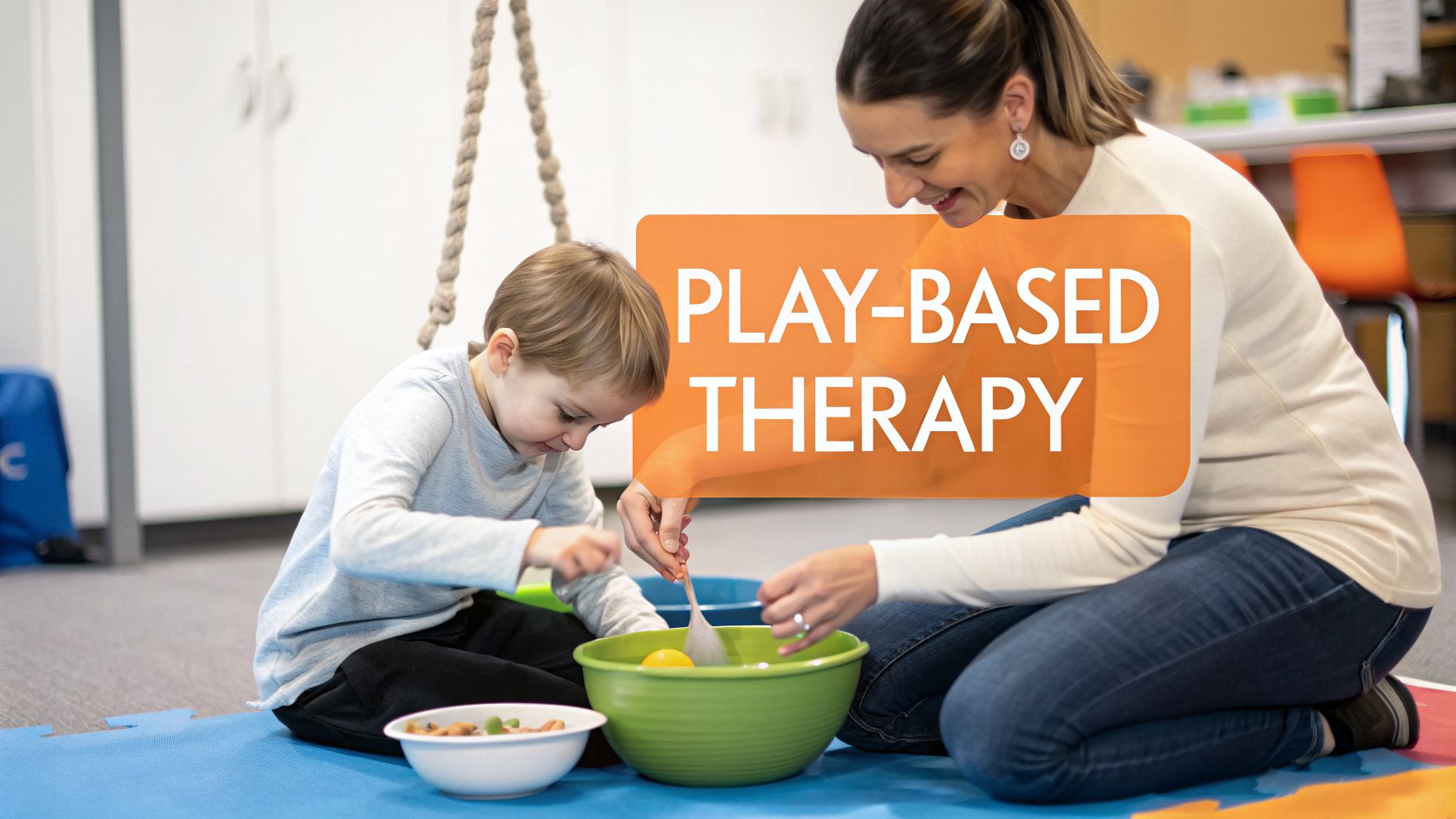
Walking into an OT session for the first time, it’s completely normal to wonder what actually goes on. You might be picturing clinical exercises, but what you’ll likely see looks a lot more like structured, purposeful play.
And that’s by design. A great OT session uses activities that are genuinely fun and motivating to build specific skills. While every child’s session is unique, they’re all built on a foundation of proven methods. Getting to know these approaches will help you feel confident, ask the right questions, and become an active partner in your child’s progress.
Sensory Integration a Core OT Approach
One of the most common—and often misunderstood—approaches in occupational therapy with autism is Sensory Integration (SI) Therapy. This isn't just about letting a child jump on a trampoline or mess around in a ball pit. It’s a highly strategic process.
Think of it like a sound engineer fine-tuning a radio to get a crystal-clear signal. An OT carefully selects sensory activities to help a child's brain better organize all the signals coming from their body and the world around them. The goal is to provide the "just-right" amount of sensory input—not too much, not too little—to help their nervous system calm down and focus.
Practical Example: For a child who is constantly on the move and seems to crash into everything, the therapist might set up an obstacle course. This isn't just random play; moving through it involves swinging, climbing, and landing on soft mats. This gives their body the intense input it's searching for, which paradoxically helps them feel more organized and ready to learn.
Activity-Based Interventions Building Life Skills
You’ll also see a lot of what we call activity-based interventions. Here, the therapist picks an activity the child is actually interested in—like baking cookies or building a LEGO car—and uses that single activity to work on several skills at once.
This is incredibly effective because the skills are being learned in a real, meaningful context. Instead of just practising isolated movements, the child is working toward a tangible goal they care about. It makes them an invested partner in their own therapy.
Practical Example: A simple cookie-baking activity can be a powerhouse for skill-building. The therapist might use it to help a child follow the recipe’s steps (sequencing), measure and pour the flour (fine motor control), and cooperate in a shared space (social participation). The delicious cookie at the end is just a bonus that makes the hard work feel like fun.
Focused Support for Specific Challenges
Beyond these broader strategies, OTs also pull from a toolbox of specific programs to tackle very distinct challenges. These structured approaches offer a clear roadmap for building a skill and make it much easier to see and measure progress over time.
A few common examples include:
Handwriting Programs: If forming letters is a struggle, an OT can introduce a specialized program that breaks down everything from pencil grasp and posture to the actual strokes needed for each letter.
Structured Play Therapy: To build social and emotional skills, a therapist might use a model like DIRFloortime. This approach guides parents and therapists to connect with children on their own developmental level, using play to build communication and emotional connection.
Executive Function Supports: For kids who have trouble with planning, staying organized, or managing time, an OT will introduce concrete tools. Things like visual schedules, picture checklists, and timers suddenly make abstract ideas like “getting ready for school” clear and achievable.
The most powerful therapy is often child-led and feels like play. When a child is having fun and is intrinsically motivated, their brain is primed for learning and building new neural pathways. Success builds on itself, creating a positive loop of engagement and growth.
When you understand these common methods, you can start to see the thoughtful strategy behind every "game." These are carefully chosen tools, each one designed to build a solid foundation for your child's independence. Seeing how these pieces fit together is a key part of the therapy puzzle. You can learn more about how a structured process leads to better outcomes by exploring the Orange Neurosciences approach.
Using Objective Data to Measure Real Progress
For years, figuring out if occupational therapy was truly working often came down to a gut feeling. A parent might say, “He seems to be paying better attention,” or a therapist would note, “She appears calmer during transitions now.” While that feedback is absolutely important, it doesn't paint the full picture. It’s a bit like trying to judge a car’s performance just by listening to the engine—you can tell it’s running, but you have no idea how efficiently.
Today’s OT practice is moving beyond guesswork by bringing objective data into the conversation. This shift gives therapists and families a clear, measurable way to see exactly where a child is starting from and just how far they've truly come.
Beyond Subjective Feedback to Cognitive Blueprints
The first step in this data-driven approach is a thorough cognitive assessment. Instead of only observing a child’s challenges on the surface, specialized tools can now precisely measure the core cognitive skills that affect their ability to function day-to-day. Think of these as the fundamental building blocks for learning and independence.
Key skills that can be objectively measured include:
Attention: The ability to lock onto a task and filter out distractions.
Processing Speed: How quickly the brain can take in information and respond.
Memory: This covers both working memory (holding information in mind for a moment) and long-term recall.
Eye-Hand Coordination: The brain’s capacity to guide the hands based on what the eyes see.
This information creates a "cognitive blueprint"—a detailed map of a child's unique strengths and areas needing support. A platform like Orange Neurosciences, for instance, can generate this kind of detailed profile in under 30 minutes.
This level of precision is a game-changer. Take a child who struggles with handwriting. Is it because their fine motor skills are still developing, or is it a deeper issue tied to visual processing? Objective data helps answer that question, allowing a therapist to design a highly targeted plan that gets to the root cause of the difficulty.
By quantifying cognitive functions, we move from "I think the problem is..." to "I know the problem is...". This clarity empowers therapists to design interventions that are not just helpful, but surgically precise.
This is especially critical in regions where there's a strong focus on early intervention. For example, some parts of the United States have seen a significant rise in diagnoses. A 2020 report from San Diego found that nearly 7% of 8-year-old boys were identified with ASD, a record-breaking figure driven by universal screening and quick referrals to OT. This approach is vital for addressing core deficits in perception, processing speed, and eye-hand coordination early on. You can learn more about the research behind these record-setting numbers.
Tracking Progress with Unmistakable Proof
The very same technology that provides the initial blueprint is also used to track progress over time. After a block of therapy, the child can be reassessed, providing clear, measurable proof of improvement.
The platform is designed to be engaging and fun for the user, while delivering serious, data-backed insights for clinicians and families.
Seeing a graph that shows a 20% improvement in processing speed or a significant jump in sustained attention is far more powerful than simply feeling like things are getting better. This data helps the entire therapy team:
Validate that the current therapy plan is working.
Identify areas where progress might be slowing down.
Adjust strategies in real-time to overcome new hurdles.
Motivate everyone—the child, their parents, and the therapist—with visible proof that their hard work is paying off.
This kind of objective evidence is also essential for demonstrating the value of occupational therapy to schools, healthcare providers, and insurance companies. When progress is measured with hard data, it becomes undeniable.
Actionable Step: Are you ready to see how data can shape your child's therapy journey? Learn more about how our objective cognitive assessments can give your therapy team the insights needed for truly personalized and effective care.
Bringing OT Skills Into Your Everyday World
The real magic of occupational therapy happens when the skills from a therapy session blend seamlessly into everyday life. Think of it as building a bridge from the clinic to your kitchen table and your child's classroom. When home and school environments support what's happening in therapy, you create a powerful, consistent loop that helps new abilities take root and grow.
This doesn't mean you need to turn your home into a therapy centre. Often, it's the small, thoughtful adjustments to your child's space and daily rhythms that make the biggest impact, boosting their confidence and making life smoother for everyone.
Here’s a look at some practical ways to weave OT strategies into your family’s daily life.
How to Create a Sensory-Smart Home
A "sensory-smart" home is simply a space that works with your child's sensory system, not against it. It’s about turning down the volume on things that feel overwhelming while providing the just-right input they need to feel calm and organized. These small changes can be game-changers, helping to prevent meltdowns and creating a more peaceful home.
Actionable Insight: Set up a calm-down corner. This isn’t a time-out spot, but a safe haven. Designate a quiet, cozy space your child can go to when they feel overwhelmed. Fill it with soft pillows, a weighted blanket, noise-cancelling headphones, or a few favourite comforting toys.
Actionable Insight: Adjust the atmosphere. Harsh fluorescent lights can be incredibly jarring. Try switching to warmer, dimmable LED bulbs and using blackout curtains to make bedrooms more sleep-friendly. To dampen noise, lay down rugs or carpets, and always have headphones available for noisy times like when the vacuum is running.
Actionable Insight: Build a "sensory diet." Just like a balanced food diet, a sensory diet is a curated schedule of activities that gives a child the specific sensory input their nervous system craves. Your OT can help you build one, but it might include 10 minutes of jumping on a mini-trampoline before homework or swinging in the backyard after a long school day.
This simple visual shows how assessment, therapy, and tracking all work together in a cycle to build and measure success.
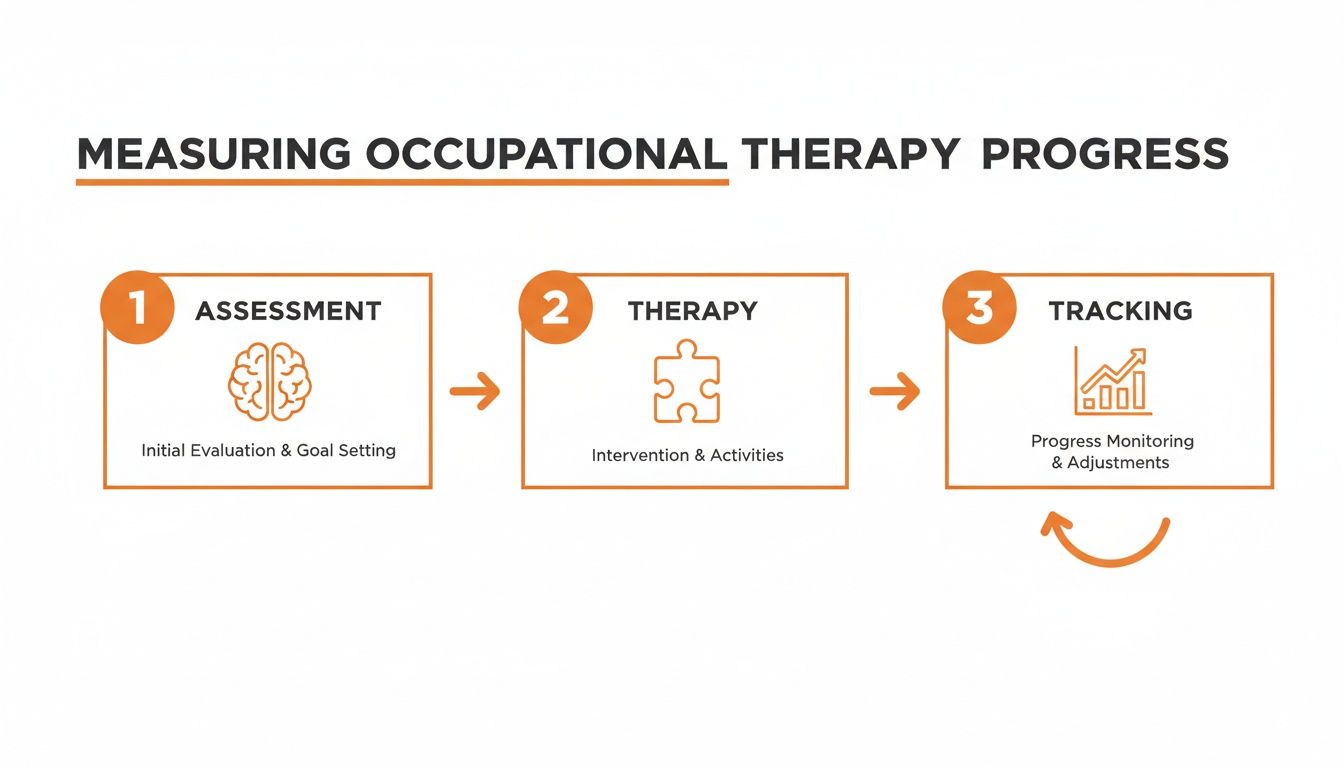
It all starts with a solid assessment, which guides the therapy, and ongoing tracking helps us see what’s working and what needs to be adjusted.
Weaving Executive Function Support Into Daily Routines
Executive functions are the project management skills of the brain—they help us plan, organize, and get things done. Many autistic children struggle in this area, but you can provide incredible support by making these skills visible and concrete within your daily routines.
Actionable Insight: A visual schedule is one of the most powerful tools for this. For a morning routine, a simple chart with pictures for "get dressed," "eat breakfast," and "brush teeth" removes the guesswork and lowers anxiety. For a bigger task like "clean your room," you can break it down into smaller, pictured steps: "put toys in bin," "put books on shelf," and "put clothes in hamper."
Actionable Insight: Timers are another fantastic resource. Setting a timer for 15 minutes of focused work followed by a 5-minute break helps a child manage their attention and makes big tasks feel less intimidating. It’s a tangible way to teach time management. By creating predictability, these tools also do wonders for emotional regulation, easing the stress that often bubbles up during unstructured time. For more ideas, our guide on managing anxiety in children is a great resource.
The goal is to make executive function support visible and concrete. Tools like checklists and timers externalize the 'what' and 'when' of a task, reducing the mental load on your child so they can focus on the 'how.'
Making the Classroom a Place to Thrive
True progress happens when everyone is on the same page. Working hand-in-hand with your child’s school is essential for bringing OT goals into the classroom. Many of the most effective strategies are simple accommodations that teachers can easily build into their day, helping your child access learning and connect with their peers.
The table below shows how some common OT strategies can be adapted for both home and school, creating that all-important consistency.
Challenge Area | Home Strategy Example | School Strategy Example |
|---|---|---|
Sensory Regulation | Using a weighted blanket during quiet time to provide calming deep pressure. | Allowing the child to wear noise-cancelling headphones during independent work or assemblies. |
Executive Function | A pictorial checklist for the after-school routine (e.g., unpack bag, have snack, do homework). | Providing a visual timer at the child's desk to help them manage time during a specific task. |
Fine Motor Skills | Playing with modelling clay or LEGO at home to build hand strength. | Offering a pencil grip or specially lined paper to make writing tasks more manageable. |
Movement Needs | Scheduling regular "movement breaks" for jumping on a trampoline or swinging. | Assigning active classroom jobs like handing out papers or taking a message to the office. |
These small but meaningful adjustments create a supportive web that helps a child feel capable and understood, no matter where they are.
By working together, parents, teachers, and therapists ensure that the hard work done in therapy sessions translates into meaningful, real-world independence.
Where Do We Go From Here?
The journey with occupational therapy is all about turning big hopes into small, everyday wins. It’s not about abstract goals; it’s about the real, practical skills that help your child navigate their world with more confidence. From learning to tie their shoes to joining a game on the playground, OT is built on celebrating each step toward independence.
We’ve walked through how proven methods like Sensory Integration therapy and activity-based approaches form the backbone of occupational therapy with autism. We’ve also touched on how these powerful strategies can be woven into your child’s life at home and school, creating a supportive net that catches them when they need it.
From Educated Guesses to Concrete Answers
For a long time, measuring progress in therapy relied heavily on what we could see and how everyone felt things were going. It was a good start, but now we can do so much better. We're in the middle of a major shift, moving from subjective feelings to objective facts.
The real goal here is to give you, your child, and your therapy team the power to create meaningful change. With the right support and a clear understanding of your child's unique cognitive profile, autistic children can experience incredible growth and live more independent, fulfilling lives.
Instead of just observing a challenge, precise cognitive assessments let therapists look under the hood. They can see exactly which cognitive skills—like how quickly the brain processes information or maintains focus—are causing a roadblock. This completely changes the game. Therapy stops being a process of educated guesswork and becomes a targeted plan aimed at the root of the issue, not just the symptoms.
This move toward data is especially crucial for therapists and clinicians who are dedicated to providing the absolute best care. You can discover more about our tools for healthcare providers and see how they’re helping to shape a new standard of practice.
Take the First Step Today
Getting a clear picture of your child’s unique cognitive wiring is the key to designing a therapy plan that actually works for them. An objective assessment gives your team the clear, usable information they need to build a program that delivers real, measurable progress.
We'd love for you to see how our AI-powered assessments can map out a detailed cognitive profile for your child in under 30 minutes. It’s the first step toward a more effective and truly personalized OT journey. Visit our website to learn more or contact our team directly.
For more practical tips and insights on supporting your child's development, don't forget to subscribe to our newsletter. Let’s build a brighter, more independent future together.
Frequently Asked Questions About OT for Autism
When you’re a parent trying to find the right support for your child, the world of therapy can feel overwhelming. It's natural to have a lot of questions. Getting straight, honest answers about occupational therapy with autism is the first step toward feeling confident about the path ahead for your family.
Let’s walk through some of the questions we hear most often.
How Do I Know if My Child Needs Occupational Therapy?
This is a big question for many parents. You might start thinking about an OT evaluation when you see your child struggling with the everyday "jobs" of being a kid. These aren't just behavioural quirks; they often point to deeper challenges in how your child processes the world around them and coordinates their actions.
Some of the things you might notice include:
Overwhelming Sensory Experiences: Does your child have extreme reactions to loud noises, bright lights, or the feeling of a tag on their shirt? Practical Example: They might refuse to wear jeans because the denim feels "scratchy" or have a meltdown every time the blender turns on.
Frustration with Daily Routines: Are tasks like getting dressed, using a fork, or brushing teeth a daily battle? If these struggles seem more intense than for other kids their age, it could be a sign.
Trouble with Motor Skills: This could be anything from the fine motor control needed to hold a pencil to the gross motor skills for balancing on the playground or catching a ball. Practical Example: They may have very messy handwriting despite trying hard, or they might seem more clumsy than their peers, often tripping or bumping into things.
Challenges with Play and Friendships: You might see difficulties with things like taking turns, understanding personal space, or joining in on imaginative games with other children.
What Is the Difference Between OT and Physical Therapy?
It's easy to get these two mixed up, but they have very different, though complementary, roles. Here’s a simple way to think about it: a physical therapist (PT) helps your child learn to move confidently through their environment, while an occupational therapist (OT) helps them meaningfully interact with all the things in that environment.
Physical Therapy (PT) zeroes in on big body movements. A PT works on building strength, balance, and coordination for things like walking, running, and climbing stairs safely and efficiently. Practical Example: A PT might help a child learn to go up and down a slide at the park.
Occupational Therapy (OT) takes a much broader view. It’s all about helping your child succeed in the "occupations" of daily life. This covers fine motor skills for writing and buttoning, sensory processing, self-care routines, and even the social give-and-take needed for school and play. Practical Example: An OT might help a child develop the fine motor skills to zip their own jacket and the social skills to ask a friend to play with them at the park.
How Long Will My Child Need OT?
There’s no magic number here. The length of time your child spends in occupational therapy is completely unique to them, their goals, and the progress they make. It could be a few months focused on mastering a specific skill, or it might continue for several years to support their development as they grow.
A good therapy plan is never set in stone. It should be a living thing, with goals that are regularly reviewed and updated as your child gains new skills. This is where using objective data to track cognitive functions like attention and processing speed can make a huge difference—it gives a much clearer picture of when a goal is truly met and what to work on next.
How Much Does Occupational Therapy Cost in 2026?
The cost of OT can really depend on where you live, the therapist's level of experience, and how often you have sessions. As of 2026, most private insurance plans in Canada do provide some coverage for occupational therapy, but how much they cover varies wildly. The best first step is always to call your provider and ask about your policy's limits and whether you need a doctor's referral.
Actionable Insight: Don't stop there. There are often provincial funding programs and non-profit grants specifically for families of autistic children. Your therapist or a local autism society can be incredible resources for helping you find and apply for these funding options. Ask them for a list of potential grants you can apply for.
At Orange Neurosciences, we see firsthand how clear, objective data can be the bedrock of great therapy. Our AI-powered assessments give your therapy team a detailed cognitive profile, helping them build a plan for your child that is truly personalized and measurable. Find out how we can bring clarity to your child’s needs and track their amazing progress by visiting https://orangeneurosciences.ca.

Orange Neurosciences' Cognitive Skills Assessments (CSA) are intended as an aid for assessing the cognitive well-being of an individual. In a clinical setting, the CSA results (when interpreted by a qualified healthcare provider) may be used as an aid in determining whether further cognitive evaluation is needed. Orange Neurosciences' brain training programs are designed to promote and encourage overall cognitive health. Orange Neurosciences does not offer any medical diagnosis or treatment of any medical disease or condition. Orange Neurosciences products may also be used for research purposes for any range of cognition-related assessments. If used for research purposes, all use of the product must comply with the appropriate human subjects' procedures as they exist within the researcher's institution and will be the researcher's responsibility. All such human subject protections shall be under the provisions of all applicable sections of the Code of Federal Regulations.


© 2026 by Orange Neurosciences Corporation