An Occupational Therapist for Autism Can Help Your Child Thrive
Mar 1, 2026
Ever felt like your child needs a personal coach for the game of daily life? That’s a great way to think about an occupational therapist for autism. They are skilled professionals dedicated to helping your child build real-world independence and confidence. They do this by tackling the specific challenges that can make everyday tasks feel overwhelming, from sensory overload to tricky motor skills.
Their goal is simple: to make daily life manageable, meaningful, and even fun. If you're looking for practical ways to support your child, understanding what an OT does is your first actionable step.
What an Occupational Therapist for Autism Really Does

Think of an occupational therapist (OT) as a personal architect for your child’s world. They don't just drill skills. Instead, they analyze your child's unique way of experiencing things. They then help redesign tasks and environments to be more accessible and less stressful.
Their work is all about "occupations"—the meaningful activities that fill our days. For a child, this includes everything from getting dressed and brushing their teeth to playing with friends and participating in class. For an autistic child, these everyday occupations can be packed with hidden hurdles. An OT’s job is to identify those hurdles and build a practical bridge over them.
A Strategist for Life Skills
An OT acts as a life-skill strategist, breaking down big, intimidating activities into small, achievable steps. For example, if tying shoelaces is overwhelming, an OT might start with a fun lacing board to build finger dexterity, then move to using two different colored laces to make the steps clearer, and finally practice on real shoes. This approach is essential for building a foundation of independence that will serve a person throughout their entire life.
In fact, some studies show that nearly 75% of children diagnosed with autism receive services from occupational therapists, physical therapists, and speech-language pathologists. These professionals are key players in addressing the core challenges of ASD.
An occupational therapist helps bridge the gap between a child's current abilities and the skills they need to participate fully in life. They focus on how a child can succeed, not just what they can't do.
Core Areas of Focus
While an OT's work is incredibly broad, it usually centres on a few critical areas for autistic children. The table below gives you an actionable snapshot of where they focus their expertise.
How an OT Supports Children with Autism
Area of Focus | What It Means for Your Child | Practical Example |
|---|---|---|
Sensory Processing & Integration | Helping your child make sense of and manage sensory input (sights, sounds, textures) to prevent overwhelm or under-stimulation. | Creating a "sensory diet" with scheduled activities like swinging for 10 minutes before homework, jumping on a trampoline, or using a weighted lap pad during story time to help them stay calm and focused. |
Activities of Daily Living (ADLs) | Teaching the practical, self-care skills needed every day, from personal hygiene to getting dressed and eating. | Using a visual schedule with pictures to guide them through their morning routine or introducing an adaptive tool like a button hook to make dressing themselves easier. |
Fine & Gross Motor Skills | Developing the muscle control and coordination needed for everything from handwriting to running and playing. | Using therapeutic putty to build hand strength for writing, or creating a living room obstacle course with pillows and cushions to improve balance and coordination for playground fun. |
Social & Play Skills | Guiding your child in learning how to interact with peers, understand social cues, and engage in cooperative play. | Role-playing a conversation about joining a game at recess or using a board game to practice taking turns, sharing, and handling winning or losing gracefully. |
By homing in on these key areas, an OT provides a service that makes a real difference far beyond the therapy room.
This guide gives you a solid overview of OT, but you can always dive deeper into the specifics of occupational therapy in Canada. For a look at how different countries approach support, this complete guide to UK care options for autism also offers some valuable perspective.
Core Strategies in Occupational Therapy for Autism
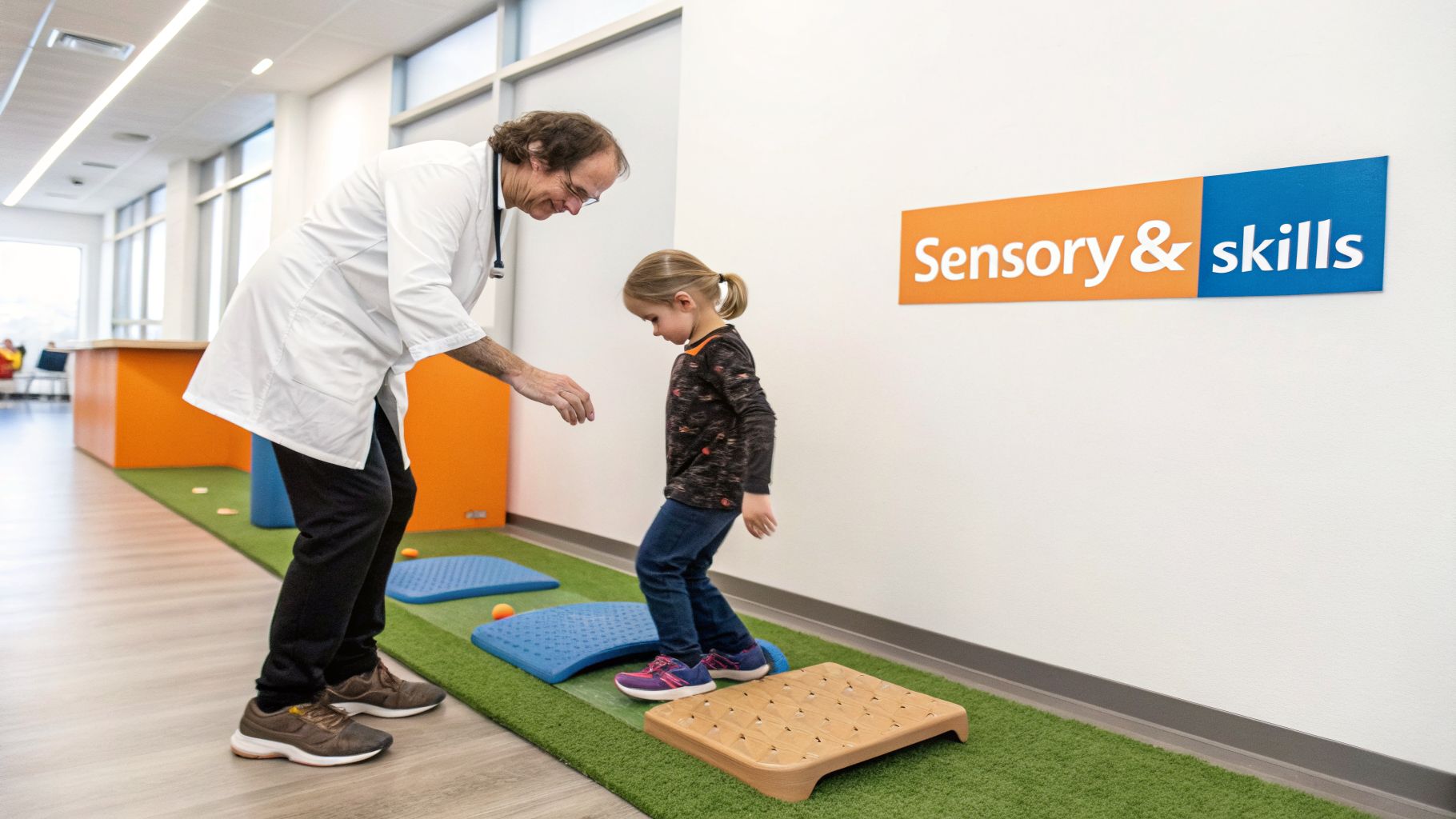
An occupational therapist (OT) uses proven, hands-on methods to help autistic children turn daily challenges into real achievements. These strategies aren't just about practising skills; they’re about rewiring how a child interacts with their environment. Here are actionable insights into the core methods OTs use to create meaningful, lasting progress.
The goal is to go beyond simple instructions to build real-world competence. By zeroing in on sensory needs, daily routines, and social interaction, an OT gives a child the tools they need to navigate their world with greater confidence and ease.
Taming the Senses with Sensory Integration
For many autistic children, the world can feel like a constant sensory assault. A ticking clock might sound like a drum, or the tag on a shirt can feel unbearably scratchy. Sensory Integration Therapy is designed specifically to address this, helping the brain better process and respond to all that incoming sensory information.
Think of the OT as a friendly traffic controller for the senses. They create structured, play-based activities that challenge the sensory system just enough to help it organize itself, preventing the sensory "traffic jams" that can lead to meltdowns or withdrawal.
A core principle of Sensory Integration Therapy is that through guided, playful activities, the brain can learn to process sensory input more effectively, leading to improved focus, better emotional regulation, and greater participation in daily tasks.
Practical Example: For a child who is hypersensitive to touch and hates messy hands, an OT might start by having them play with dry beans, then move to play-dough, and eventually to finger paint inside a sealed plastic bag. This gradual exposure helps the brain adapt without causing distress. Occupational therapists also often recommend specific tools and play, like sensory toys for autism, to support a child's unique sensory needs at home and school.
Mastering Activities of Daily Living
Activities of Daily Living, or ADLs, are those fundamental tasks we all do to care for ourselves. For an autistic child, mastering skills like tying shoelaces, using a fork and knife, or brushing teeth can be major hurdles that impact their self-esteem and independence.
An occupational therapist is an expert at breaking these complex tasks into small, manageable steps, creating a clear path to success. They use visual aids, adaptive tools, and plenty of repetition to build muscle memory and confidence. The focus is always on achieving practical independence.
Actionable Insight for Dressing: Create a simple, picture-based chart that shows the sequence of getting dressed. Lay out clothes in the order they need to be put on. An OT might also suggest adaptive clothing with magnetic closures instead of buttons, giving the child an immediate sense of accomplishment.
Actionable Insight for Mealtimes: For a child with motor planning difficulties, try using weighted utensils to provide more sensory feedback and control. Practice the steps of a family meal at a time when there is no pressure, like setting the table for dolls or action figures. These targeted interventions often improve a child's fine motor skills and can be supported at home with specific eye-hand coordination exercises.
Building Bridges Through Social and Play Skills
Play is how children learn to connect, share, and make sense of the social world. An occupational therapist acts as a guide, creating structured play scenarios that teach crucial social and pragmatic skills in a natural, fun way.
They might set up a game that requires turn-taking or guide a child in interpreting a playmate's facial expressions and tone of voice. This isn’t just about teaching rules; it's about building the intuitive social understanding that leads to genuine friendships. By creating successful peer interactions in a supportive setting, the OT helps the child build a positive foundation for socializing in all areas of their life.
Why a Great OT Is Worth Their Weight in Gold
If you’re a parent of an autistic child, you’ve probably felt it: the urgent need for skilled, effective support. The reality is, finding a great occupational therapist for autism has never been more crucial—or more challenging. As awareness of autism grows and diagnoses become more accurate, the number of children identified on the spectrum has risen steadily. This puts a real strain on specialized services.
This isn’t just a headline; it’s a reality families are living every day. Take California, for example, which has seen its autism caseload grow dramatically. It now has the highest prevalence of autism in the United States. This surge directly fuels the demand for highly trained therapists who can step in with practical, hands-on support.
The Frontline Impact of Rising Demand
With this rising need, OTs have become frontline experts for families navigating a new diagnosis. They're often one of the first and most consistent professionals you'll work with, and their skills in sensory integration, motor skills, and daily living activities hit right at the core challenges many autistic kids face.
Knowing this isn't meant to discourage you. It’s to empower you. Understanding that you’re looking for a highly sought-after professional helps validate why the search can feel so tough. It also reinforces just how important it is to find the right person for your child’s long-term success.
In this high-demand world, you are your child’s most powerful advocate. When you understand the true value of an OT's specialized expertise, you can navigate the system with more confidence and fight for the personalized, high-quality care your child deserves.
Why Specialization Is Everything
With so many families seeking help, you can’t just settle for any OT. Finding a truly qualified occupational therapist for autism is non-negotiable. While a generalist OT might have some helpful knowledge, a therapist with deep, specific experience in autism brings a completely different level of understanding to the table. They’re prepared for the unique sensory, behavioural, and social complexities that are part of the autism experience.
Actionable Insight: When you vet a potential therapist, ask them directly: "Can you give me an example of how you helped a child with sensory sensitivities similar to my child's?" A specialist's answer will be specific and strategic, not general. That specialized perspective changes everything. To get the best support for your child, it's essential to connect with a professional who has not only the right credentials but a proven track record of helping kids just like yours.
Ready to find the right support for your child's journey? Our team can show you how objective data can help shape and guide your child’s therapy. Contact us today via email to learn more about our approach.
Enhancing Therapy With Objective Cognitive Insights
An occupational therapist’s observations are the very bedrock of effective therapy. Their trained eye can spot incredibly subtle challenges in how a child moves, plays, and interacts with their world. But what if we could give them a tool to look inside the engine, instead of just listening to it run? That's exactly what modern tools now offer: a deeper view into a child’s cognitive wiring.
This is where objective cognitive assessments come into the picture. Think of it like a mechanic moving beyond a simple sound check to using a diagnostic computer that reads the engine's performance data directly. This shift provides precise, unbiased information that beautifully complements the therapist’s expert observations, painting a much more complete picture of a child's needs.
Looking Beyond the Obvious Symptoms
Sometimes, the root of a challenge isn't what it first appears to be. A child might be struggling with handwriting, and the immediate assumption is often a fine motor skill delay. The real issue, however, could be something deeper, like slower processing speed or a deficit in eye-hand coordination, making it tough to translate what they see into a fluid motor action.
Actionable Example: Traditional observation might lead to a plan focused on strengthening hand muscles with putty. But an objective assessment can reveal that the brain is actually struggling to process visual information quickly enough. This insight redirects the therapy plan from just motor drills to targeted cognitive training games that improve processing speed, addressing the true source of the difficulty.
Platforms like Orange Neurosciences use engaging, game-based activities to measure these core cognitive functions. By gathering this kind of hard data, an occupational therapist for autism can move from educated guesses to evidence-based conclusions.
The infographic below illustrates how the rising prevalence of autism and other conditions contributes to a high demand for specialized OT services, making precise, efficient therapy more critical than ever.

This connection between the growing need for support and the high demand for OTs really highlights the importance of using tools that make therapy more effective and efficient for everyone involved.
Creating Hyper-Personalized Therapy Plans
Armed with objective data, an OT can design a truly personalized intervention plan. Instead of a one-size-fits-all approach, they can pinpoint the exact areas of cognitive weakness and strength, tailoring every single activity to the child's unique profile.
For example, assessment data might reveal a child has:
Strong visual memory but struggles with auditory attention. The OT can then create visual schedules and minimize verbal instructions.
Excellent problem-solving skills but a lag in processing speed. Therapy can then focus on fun, low-pressure games that build cognitive quickness.
This level of detail empowers therapists to work smarter, not just harder. It ensures that every minute of a therapy session is focused on what will make the biggest impact for that specific child. You can explore the details of our objective cognitive assessments to see how these tools work in practice and what kind of data they provide.
By integrating these powerful insights, an OT can unlock more effective outcomes, track progress with concrete metrics, and give parents a much clearer understanding of their child's journey.
Your First Occupational Therapy Session Explained

Starting any new kind of therapy can bring up a lot of questions and maybe a little anxiety, for you and your child alike. Knowing what to expect when you first meet with an occupational therapist for autism can make all the difference, helping everyone feel more comfortable and ready to build a great partnership.
Think of this first appointment less as a therapy session and more as a discovery session. It’s a dedicated time for the therapist to truly get to know your child, your family’s dynamics, and what daily life looks like for you. It all starts with the evaluation.
What Happens During the Initial Evaluation
This first meeting is a comprehensive look at your child’s unique profile of strengths and challenges. The therapist isn’t looking for a label; they’re gathering a complete picture to ensure their approach is perfectly suited to your child's individual needs.
An OT evaluation is a multi-part process, designed to feel as natural and comfortable as possible. It usually includes three key parts:
Standardized Assessments: The OT might use specific, validated tests to get a baseline reading of skills like fine motor control, visual-perceptual abilities, or sensory processing. These tools provide concrete data to measure progress against later on.
Structured Observation: This is where the “play” really comes in. The therapist will engage your child in specific, purposeful activities to see how they move, interact, and problem-solve in a natural setting. Practical Example: They might ask your child to build a tower of blocks to assess motor planning and hand-eye coordination, or initiate a simple game of catch to observe social reciprocity.
Parent/Caregiver Interview: You are the true expert on your child. A significant part of the evaluation is the conversation the OT will have with you. Actionable Insight: Before your appointment, jot down 3-5 specific daily challenges you face (e.g., morning routines, mealtime struggles, playground anxiety). This will help you provide clear, concrete examples for the therapist.
Your insights are just as critical as the therapist’s clinical observations. To get a better sense of the specific tools involved, you can learn more about occupational therapy assessments and see how they create the roadmap for an effective therapy plan.
Setting Goals and What a Session Looks Like
After the evaluation, the OT will sit down with you to set meaningful, functional goals. These aren’t vague wishes. They are specific, measurable targets designed to make a real-world difference in your child's and your family's life.
Practical Example of a SMART Goal: "Within two months, Michael will independently zip his jacket before going outside for recess on 4 out of 5 days, using the 'zipper helper' tool provided by the OT."
A goal like this is powerful because it's clear, trackable, and directly connected to improving day-to-day independence.
So what does a typical session look like? For your child, it will probably feel a lot like structured play. Whether your child is on a swing (to help with sensory regulation), building with blocks (for motor planning), or squeezing therapeutic putty (to build hand strength), each activity is carefully chosen to build a specific skill. The therapist’s art is in creating that "just-right challenge" that pushes skills forward without causing frustration, making each session both productive and positive.
Ready to find the right OT to partner with your family? Reach out to our team by email to discover how our tools can help you and your therapist track progress toward your child’s goals.
How to Find the Right Occupational Therapist for Your Child
Choosing the right occupational therapist is one of the biggest decisions you'll make on your child's developmental journey. This person isn't just a therapist; they become a key partner for your entire family. This guide will walk you through what to look for and the right questions to ask to find a professional who is a perfect fit.
Your goal is to find an occupational therapist for autism who has more than just the right credentials. You need someone whose philosophy aligns with your family’s values and goals, and who sees you as a critical part of the therapy team.
What to Look for in a Therapist
Before you even make a call, have a mental checklist of what makes a therapist a great fit. This goes far beyond what's on paper; it’s about their real-world experience and their approach to therapy.
Here are actionable things to look for:
Credentials and Specialization: First, look for an OT with the OTR/L designation (Occupational Therapist Registered/Licensed). But don't stop there. Actionable Step: Ask them directly about their specific training in autism. Have they earned a Certified Autism Specialist (CAS) credential or completed advanced training in sensory integration?
A Family-Centred Approach: The best therapists know that parents are the real experts. They should be eager to teach you strategies you can use at home, genuinely listen to your concerns, and work with you to set goals that actually matter to your family's daily life.
Play-Based and Strengths-Based Philosophy: Great therapy should feel like play with a purpose. A fantastic OT will tap into your child's natural interests (like dinosaurs or trains) and build on their existing strengths to make every session engaging and motivating.
Key Questions to Ask During a Consultation
A consultation call is your chance to interview them. Don't be shy about asking direct questions—you're building your child's core support team.
Finding the right therapist is a bit like interviewing for a key role in your child's life. You need someone with the skills, the experience, and a personality that works well with your family's culture.
Here are targeted questions to ask:
"How do you measure success and track progress?" Look for a balanced answer that includes objective data (like standardized scores) but also emphasizes functional, real-world wins—like your child being able to join in at family meals or handle a noisy birthday party.
"Can you give me a practical example of how you partner with a child's family and school?" Their answer will reveal how collaborative they truly are.
"What is your approach to challenging behaviours or sensory overload?" This gives you a window into their therapeutic philosophy. An ideal answer will focus on understanding the root cause of the behavior (the "why") rather than just managing the symptom.
Finding a therapist is the first step. To see how objective insights can fuel your child's progress, explore our information for parents and individuals.
A Few Common Questions We Hear From Parents
We know you probably have a lot of questions. That's completely normal. Here are a couple of the most common ones we hear from families just starting their OT journey.
How Long Will My Child Need Occupational Therapy?
This is one of the first questions parents ask, and the honest answer is: it really depends on your child. There's no set timeline.
Some kids might just need a few months of focused support to master a specific skill, like getting dressed independently. Others benefit from longer-term therapy to work on more complex social or sensory goals. Your OT will work with you to set clear, achievable milestones and will constantly review your child's progress, adjusting the plan as they grow and change.
Is Occupational Therapy Covered by Insurance in Canada?
Navigating funding can be tricky. Coverage for occupational therapy really varies across the country and by provider.
Actionable Step: Your best first step is always to call your private insurance provider directly. Before you call, have your policy number ready and ask these specific questions:
"What is my annual coverage limit for occupational therapy services?"
"Do I need a doctor’s referral to be reimbursed?"
"Are services from a private OT clinic covered?"
This will give you a clear financial picture before you begin.
Ready to see how objective cognitive data can fine-tune your child's therapy? The Orange Neurosciences platform gives therapists the insights they need to build truly personalized and effective plans.
If you are ready to take the next step, you can reach our team by email at talktous@orangeneurosciences.com or discover how we can support your family's journey on our website.

Orange Neurosciences' Cognitive Skills Assessments (CSA) are intended as an aid for assessing the cognitive well-being of an individual. In a clinical setting, the CSA results (when interpreted by a qualified healthcare provider) may be used as an aid in determining whether further cognitive evaluation is needed. Orange Neurosciences' brain training programs are designed to promote and encourage overall cognitive health. Orange Neurosciences does not offer any medical diagnosis or treatment of any medical disease or condition. Orange Neurosciences products may also be used for research purposes for any range of cognition-related assessments. If used for research purposes, all use of the product must comply with the appropriate human subjects' procedures as they exist within the researcher's institution and will be the researcher's responsibility. All such human subject protections shall be under the provisions of all applicable sections of the Code of Federal Regulations.


© 2026 by Orange Neurosciences Corporation