A Complete Guide to Employee Assistance Program Benefits
Mar 3, 2026
Think of an Employee Assistance Program (EAP) as a confidential support system for your team, sponsored by you, the employer. It's a strategic resource that helps people navigate both personal and professional hurdles. By giving employees a proactive way to manage things like stress, financial worries, or work-life balance, companies directly boost focus, productivity, and the overall health of their organisation.
The Real-World Value of an EAP

Let's imagine an employee, 'Alex.' They're feeling crushed by mounting personal debts and a tight project deadline at work. Their focus is shot, and their productivity is starting to slip. Instead of letting that pressure snowball into a full-blown crisis, Alex makes a confidential call to their company’s EAP and gets immediate, free advice from a financial counsellor.
This isn't just a nice story; it's a perfect example of an EAP in action. It’s not a simple 'perk.' A modern EAP is a core business tool, a confidential, employer-sponsored resource designed to help people solve problems before they spiral and tank their performance and well-being.
More Than a Safety Net—A Proactive Lifeline
In today's world, the line between our personal lives and professional duties is blurrier than ever. A good EAP acknowledges this reality and provides a support system to address issues head-on. It's a cornerstone for anyone serious about building a thriving employee wellbeing program that looks after the whole person.
For employees, this means having a trusted, no-cost way to get help for anything—from mental health struggles and substance use support to finding childcare or getting legal advice. The magic is in the accessibility and confidentiality. Knowing that support is just a call or click away, without judgment, encourages people to get help early. This is huge for preventing burnout and building resilience.
For healthcare providers, understanding the EAP landscape can lead to better patient care. You can learn more about how these integrated systems empower clinicians on our page for healthcare providers.
And for employers? The benefits of an employee assistance program are just as powerful. When you invest in your team’s well-being, you see tangible returns in productivity, engagement, and loyalty.
Actionable Insight: As an employer, don't just offer an EAP—champion it. Regularly remind your team about the confidential services available during all-hands meetings and in company newsletters. Frame it as a strength to use the resources, not a sign of weakness.
The table below breaks down how EAPs deliver value to everyone involved.
EAP Benefits at a Glance
This table summarises the core advantages that Employee Assistance Programs offer to both employees and the organisation itself.
Benefit Category | For Employees | For Employers |
|---|---|---|
Well-being & Health | Provides immediate, confidential access to mental health counselling and crisis support at no personal cost. | Reduces absenteeism and presenteeism by addressing root causes of stress and distraction. |
Work-Life Balance | Offers practical resources for managing personal responsibilities like childcare, eldercare, and financial planning. | Boosts employee morale and loyalty, showing the company cares about its people as a whole. |
Performance & Growth | Delivers tools to manage workplace conflicts and improve professional skills, enhancing job satisfaction. | Increases overall productivity and focus as employees are less burdened by unresolved personal issues. |
Risk & Safety | Creates a safe channel to address issues like substance use or workplace harassment. | Mitigates litigation risks by resolving conflicts before they escalate into formal complaints. |
Ultimately, by supporting the individual, you strengthen the entire organisation. It's a clear win-win.
The Full Spectrum of Modern EAP Services
When most people hear “Employee Assistance Program,” they immediately think of counselling. And while that’s a huge piece of the puzzle, it’s really just the tip of the iceberg. A modern EAP is so much more.
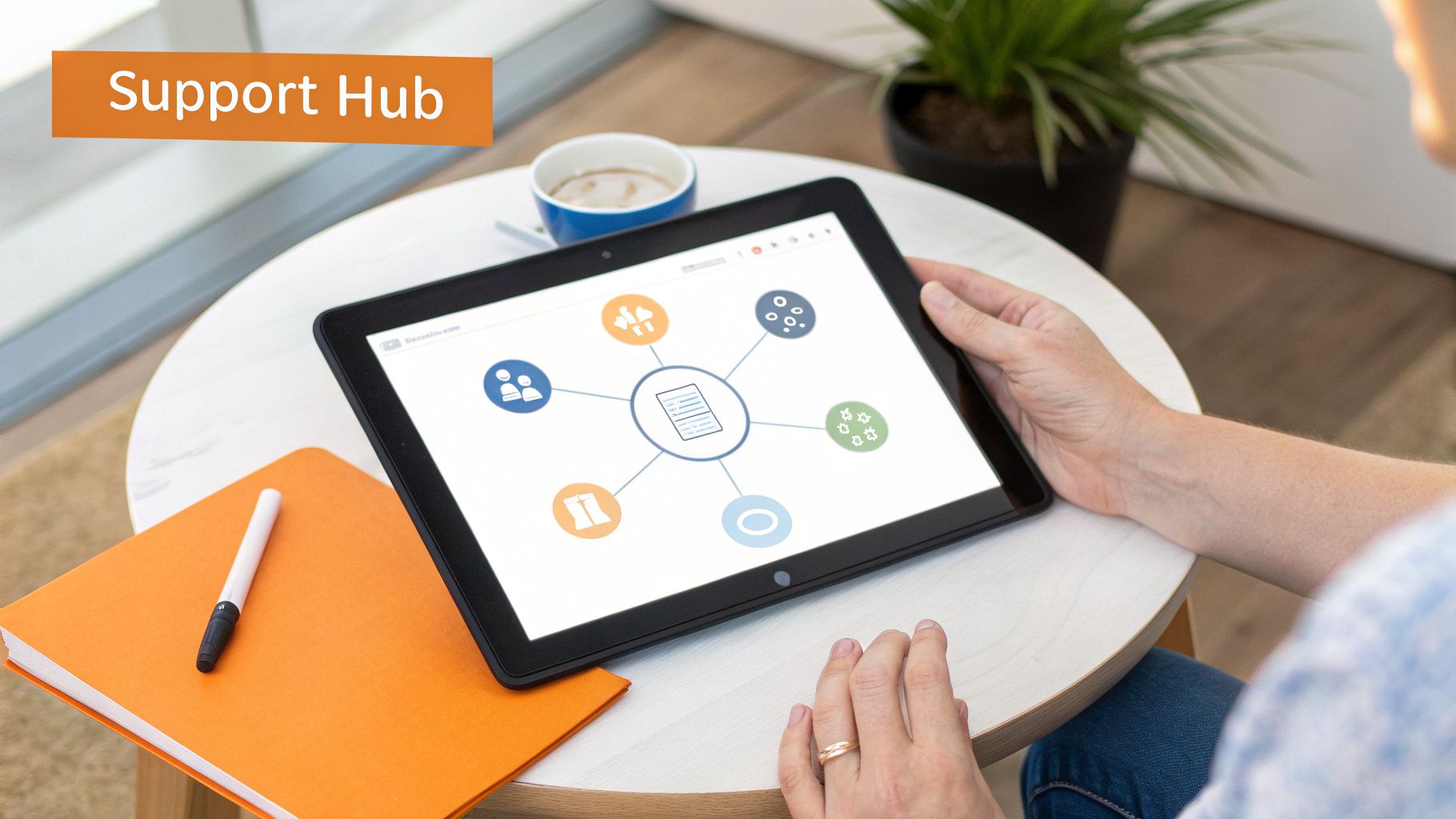
Think of it as a central 'support hub' for your team—a single, confidential place they can turn to for a whole network of specialized resources. This hub is built to help with just about any challenge life can throw their way, addressing the root causes of stress, not just the symptoms.
Let’s break down what that support actually looks like.
Mental Health and Crisis Support
This is the foundation of any good EAP. It provides short-term, solution-focused guidance for common struggles like anxiety, depression, and stress. It’s not meant to be a substitute for long-term therapy, but it acts as a critical first port of call for an employee who needs help right now.
Practical Example: An employee feeling crushed by a high-pressure project can connect with a counsellor to develop immediate coping strategies, like mindfulness exercises to use before big meetings. This proactive step helps them manage stress before it spirals into burnout, keeping them engaged and productive.
Crucially, this also includes 24/7 crisis intervention hotlines for any urgent situation that arises.
Actionable Insight for Employees: If you're feeling overwhelmed, don't wait for a crisis. Use your EAP to get early, solution-focused coaching. Think of it as preventative maintenance for your mental well-being. Save the EAP hotline number in your phone today so it's there when you need it.
Work-Life Solutions
Life doesn't just stop when an employee logs on for the day. EAPs get this, offering practical work-life services that help people manage the logistical demands waiting for them outside the office. These services are designed to reduce the mental load your team carries, freeing up their energy and focus for their work.
This support can cover a wide range of personal logistics:
Childcare and Eldercare Referrals: Helping employees find vetted, available care providers for their children or aging parents.
Relocation Assistance: Providing resources and information for employees moving to a new city for their job.
Convenience Services: Offering support for everyday tasks, like finding a reliable plumber or a trusted pet sitter.
Practical Example: An employee, Sarah, is struggling to find a suitable long-term care facility for her aging parent. The stress is affecting her sleep and her ability to concentrate at work. Through her EAP, a specialist gives her a list of vetted facilities, a guide on what to ask during tours, and information on financing options. This practical support drastically cuts down her stress, allowing her to be more present and effective in her role.
Financial and Legal Guidance
Money stress is easily one of the biggest sources of anxiety and distraction at work. At the same time, trying to navigate a legal issue can feel completely overwhelming and expensive. EAPs tackle these major life stressors head-on by offering confidential consultations with qualified professionals.
Financial Consultations: Employees can get expert advice on everything from debt management and budgeting to saving for retirement or understanding a mortgage.
Legal Guidance: This often includes a free initial consultation with a lawyer for issues like preparing a will, understanding tenant rights, or navigating family law.
Practical Example: A junior team member losing sleep over student loan debt connects with an EAP financial expert. Together, they create a realistic repayment plan and explore consolidation options. This simple, actionable step empowers them to regain control, which improves their overall sense of security and focus at work.
For more complex cognitive challenges that can arise from chronic stress, you can learn about targeted solutions by exploring our guide to modern cognitive therapies and how they complement broader wellness strategies.
Why EAPs Are a Lifeline in High-Cost Regions Like California
In a place like California, where the cost of living and healthcare can feel overwhelming, an Employee Assistance Program (EAP) stops being a simple "nice-to-have" perk. It becomes a critical lifeline for financial and mental well-being. The constant pressure from steep expenses means even well-paid employees can find themselves stretched thin, both emotionally and financially. An EAP steps in as that crucial first line of support, offering immediate, no-cost help that directly tackles these regional pressures.
This is especially true when you look at how healthcare works in the state. For a huge part of the population, employer-sponsored health plans are the main source of coverage. In fact, these plans cover over 17 million nonelderly Californians—that’s 55% of that demographic. Since EAPs are often bundled right into these benefit packages, they become one of the most direct and accessible routes to mental health support available. You can dive deeper into these trends in the California Health Benefits Survey 2025.
Bypassing the High Cost of Care
One of the biggest hurdles to getting help in California is the out-of-pocket cost. With average annual deductibles for a single person hitting $1,620, many people will put off using their insurance for mental health until a problem becomes a full-blown crisis. This is where the financial genius of an EAP really shines.
Practical Example: A software engineer in San Francisco is feeling buried by work stress and anxiety. Her health plan has a high deductible she hasn't come close to meeting. Instead of shelling out hundreds of dollars for a single therapy session, she uses her EAP to connect with a counsellor for several sessions at absolutely no cost. This gives her immediate tools to cope while she decides on a longer-term care plan.
Actionable Insight for Employers: In high-cost areas, emphasize the "no cost" benefit of your EAP during onboarding. Position it as "Day One Support" that bypasses deductibles and waiting periods, offering immediate financial and mental relief to new hires.
This immediate access is a complete game-changer. While a staggering 62% of California companies make new hires wait for their standard health benefits to kick in, EAPs are usually available from day one. For a new employee struggling with the stress of moving for a job, this means they can get support right when they need it, without having to wait weeks or even months for their main benefits to activate.
A Foundation for Better Clinical Outcomes
For healthcare providers, the EAP plays a foundational role. Clinicians who use advanced platforms like OrangeCheck for cognitive assessments know firsthand that a patient's mental state has a direct impact on their ability to even engage with treatment. Things like stress, anxiety, and depression can throw up major roadblocks to effective cognitive therapy and rehabilitation.
The EAP infrastructure helps clear away some of those initial hurdles. By first addressing the life stressors—whether it’s money worries, childcare issues, or relationship conflicts—the EAP helps create a patient who is more stable and ready to engage in their own care.
Here’s how this helps clinicians in a practical sense:
Reduced Patient Stress: An EAP counsellor can work with a patient to manage a major life event, allowing them to show up to a specialist appointment more focused and prepared for their cognitive assessment.
Improved Engagement: When those foundational needs are being met, patients have more capacity to follow through with complex treatment plans, like the game-based cognitive therapies we develop.
A Holistic Support System: The EAP becomes a true partner in care, providing wrap-around support that perfectly complements the specialized neurological or psychological treatment being delivered.
This symbiotic relationship is what ultimately leads to better outcomes. The EAP takes care of the immediate life stressors, which frees up clinicians to focus their expertise on targeted cognitive interventions.
Ready to see how this integrated approach can improve patient results? Explore how Orange Neurosciences partners with providers to deliver superior outcomes by visiting our website or contacting our team today.
Measuring the Real-World Value of Employee Assistance Programs
When you invest in your business, you want to see a return. It's that simple. For an Employee Assistance Program (EAP), that return isn't just a number on a spreadsheet; it shows up in the health of your entire organisation. Calculating the ROI of EAP benefits goes beyond just dollars and cents. It's about drawing a clear line from proactive employee support to tangible business results like better productivity, attendance, and loyalty.
Think about it: when someone on your team gets the help they need to manage a personal crisis or navigate a stressful life event, that positive change doesn't happen in a vacuum. A focused, less-burdened employee is a more productive one. This isn't just a feel-good idea—it translates directly into higher-quality work, fewer mistakes, and the mental space for innovation.
From Proactive Support to Bottom-Line Savings
One of the most straightforward ways to see an EAP’s impact is by looking at absenteeism. Let's be honest, many "sick days" aren't about a cold or flu. They're about mental exhaustion, burnout, or simply not being able to cope with a personal problem. An EAP provides an immediate, confidential place to turn, which can dramatically cut down on these unplanned absences.
Practical Example: An employee struggling to find eldercare for a parent might miss several days of work just trying to make phone calls and coordinate logistics. A good EAP connects them with a specialist who provides a curated list of resources in a single conversation. This saves the employee immense time and stress, keeping them present and focused at work. Industry data consistently shows that a well-used EAP can reduce absenteeism by as much as 27%.
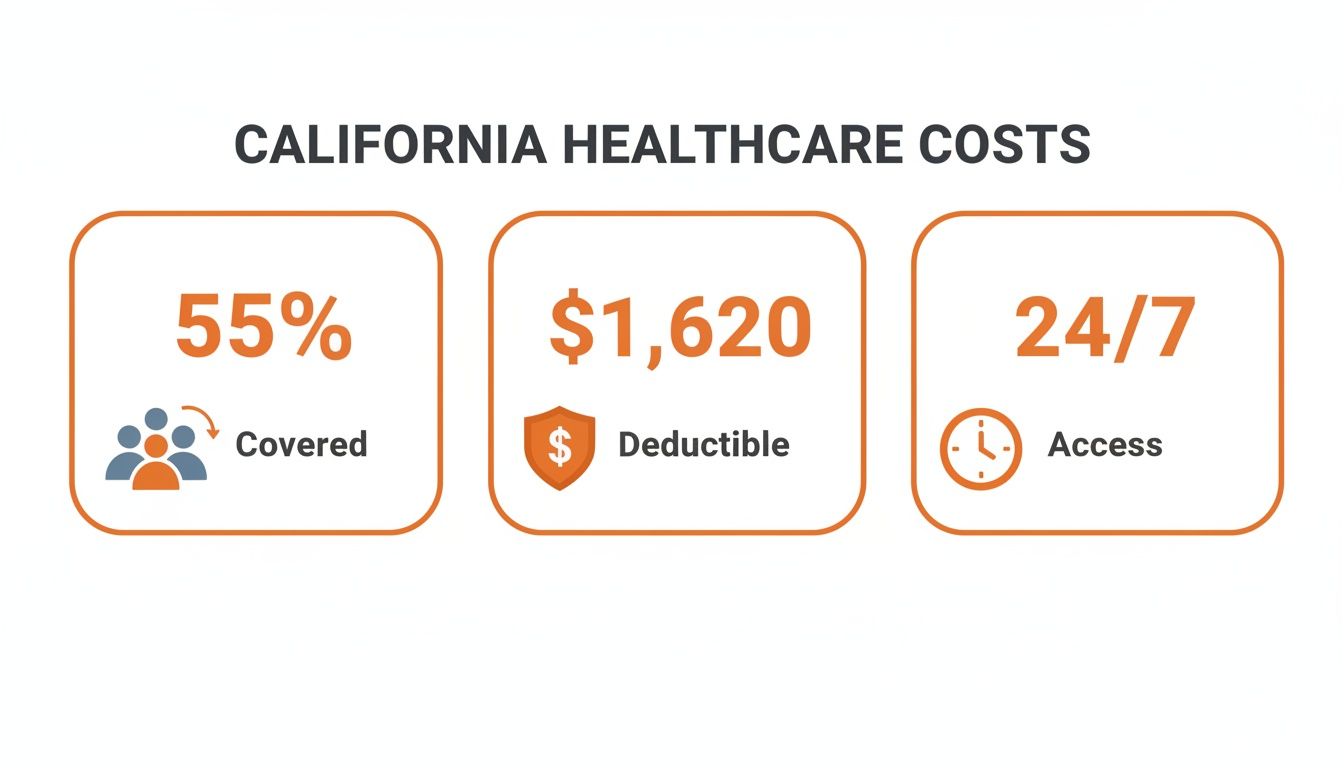
As you can see, even with coverage, employees often face high deductibles and long waits for care. A free, 24/7 EAP acts as a critical bridge, offering immediate support when it's needed most.
The table below demonstrates just how these improvements translate into a measurable return on investment for businesses that get their EAP implementation right.
ROI of a Well-Implemented EAP
This table outlines the measurable business impact of effective Employee Assistance Programs, based on a mix of industry data and best-practice examples.
Metric | Average Improvement | Source/Example |
|---|---|---|
Productivity | 22% increase in employee engagement | Gallup, "State of the Global Workplace" |
Absenteeism | 27% reduction in missed workdays | Society for Human Resource Management (SHRM) |
Retention | Up to 13% lower turnover rates | EAP and Workplace Solutions |
Healthcare Costs | $3 to $10 saved for every $1 invested | U.S. Department of Labor |
Litigation Risk | Significant reduction in formal complaints | Various case studies on early conflict resolution |
These numbers tell a powerful story: investing in your people's well-being isn't just the right thing to do; it's one of the smartest financial decisions a company can make.
Building a More Loyal and Resilient Team
Beyond the day-to-day numbers, EAP benefits are a cornerstone of long-term employee retention. In today's job market, where 63% of job seekers say a company's focus on well-being is a top priority, a strong EAP is a serious competitive advantage. It sends a clear message: we care about you as a whole person, not just an employee.
Actionable Insight for Leaders: To boost retention, make your EAP a visible part of your company culture. Share anonymized success stories (with permission) or highlight a specific EAP service in your monthly internal communications. This demonstrates a genuine commitment to well-being that builds powerful loyalty.
This support also acts as a vital risk management tool. By giving employees a safe, confidential avenue to address issues like workplace conflict, harassment, or substance use, you can solve problems before they spiral. Early, internal resolution dramatically reduces the chances of issues escalating into formal complaints or expensive, reputation-damaging litigation.
The real-world results speak for themselves. Winners of the 2025 Healthiest Employers of California award reported EAP utilisation rates three times higher than the norm, driven by leaders who championed the programs. One company saw 84% of EAP users report significant improvement or full recovery. Another completely revamped their program and saw usage jump from a mere 2% to 16%—a 600% increase—while cutting therapy wait times to under two days. This proves the undeniable link between accessibility and powerful outcomes.
Making the Cognitive Connection Clear
The ROI of an EAP becomes even more compelling when you connect it to cognitive function. We know that chronic stress—one of the main reasons people use an EAP—directly attacks our ability to focus, remember information, and make sound decisions.
By giving employees the tools to manage that stress, you're not just helping them feel better; you're building a mentally sharper, more capable workforce. This is where objective measurement becomes so important. For clinicians and employers alike, integrating tools like our rapid cognitive assessments can finally put hard numbers to these improvements. You can actually track the gains in an employee's cognitive health as they use their EAP support, creating a data-driven case for the incredible value of your well-being programs.
Taking EAPs to the Next Level with Digital Cognitive Health
Your Employee Assistance Program is often the first line of defence. When an employee is in distress, the EAP is a confidential, safe place to turn. They are brilliant at figuring out what the problem is—stress, money worries, a family crisis. But to get to the heart of the matter and offer help that truly sticks, we need to understand why the employee is struggling to cope.
This is where digital cognitive health tools become an EAP’s most powerful ally. While EAPs tackle the emotional and situational side of an employee's challenges, objective cognitive data shows us the functional impact that stress is having on their brain. It’s the difference between knowing your car is acting up and having a diagnostic report that tells you exactly which part needs fixing.
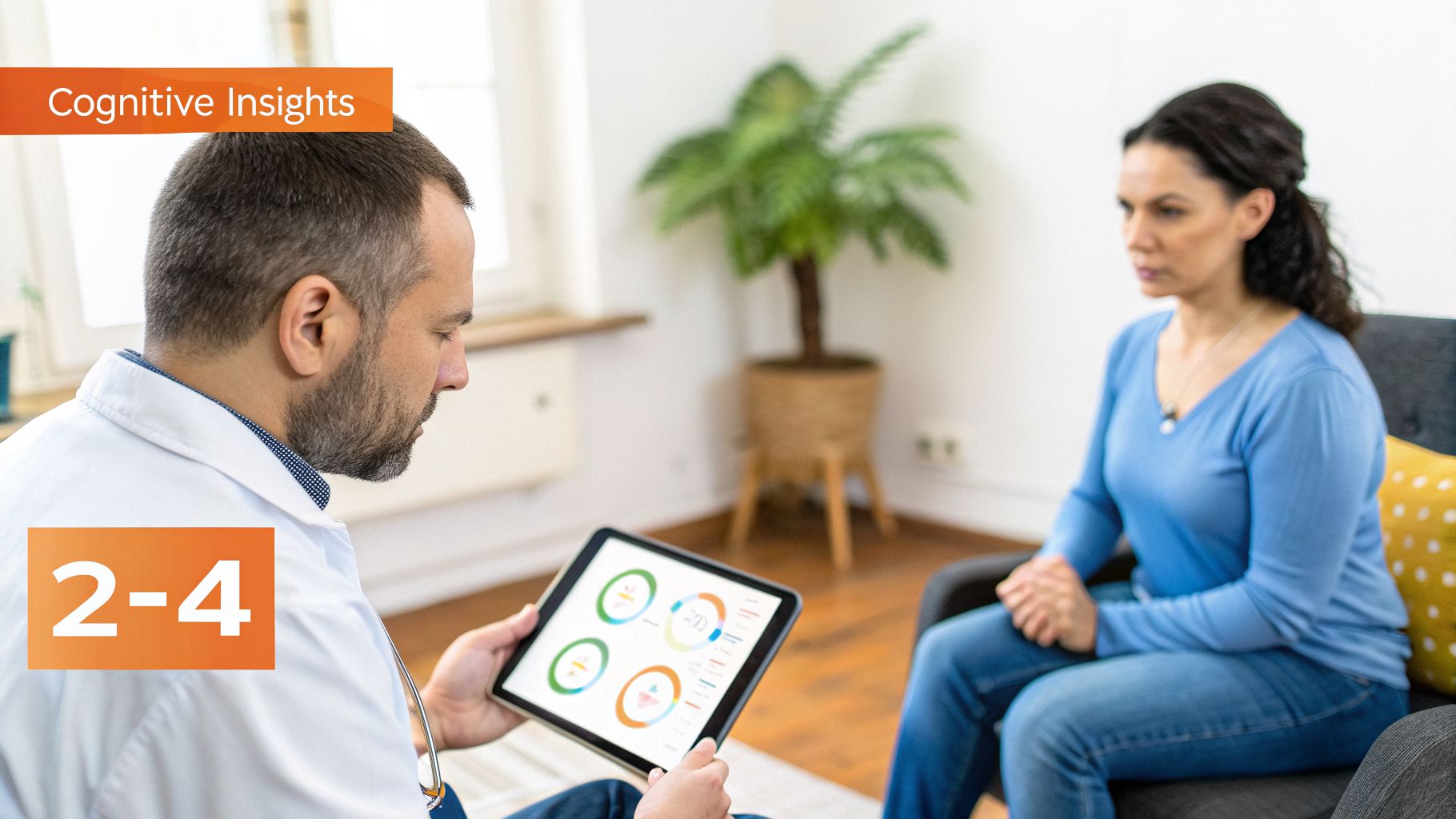
As you can see, objective cognitive data can be brought into a consultation quickly and easily, providing immediate, actionable insights. This simple step moves the conversation from a subjective report of feelings to a data-backed strategy for getting better.
From Vague Feelings to Pinpoint Solutions
Practical Example: An EAP counsellor gets a call from an employee who is completely overwhelmed by burnout. He says he feels "foggy," can't remember things, and his focus is shot. The EAP provides fantastic initial support with coping strategies. Then, the counsellor guides the employee to a quick, game-based cognitive assessment on a platform like OrangeCheck. In under 30 minutes, the report reveals a measurable dip in his sustained attention scores.
Actionable Insight: This hard data doesn't replace the EAP counsellor's expertise; it supercharges it. The counsellor can now build a targeted plan, saying, "We see a dip in your sustained attention, which is common with chronic stress. Let's work on specific exercises to rebuild that mental muscle."
This is a game-changer. It allows the clinician to build a highly targeted plan that gets right to the root of the cognitive weak points.
Creating a Proactive Wellness Ecosystem
When you weave digital tools into your EAP, it evolves from a reactive service into a proactive, data-driven wellness partner. The advantages of enhancing your employee assistance program this way are clear for everyone.
For Employees: They get a care plan that’s actually personalised to their brain’s needs. Instead of generic advice, they receive strategies and tools designed to strengthen the specific cognitive areas hit hardest by their stress.
For EAP Providers: They can finally show measurable results. Tracking cognitive scores over time gives them concrete proof that their interventions are working, powerfully demonstrating their value.
For Employers: They get a workforce that isn’t just being supported, but is actively regaining critical cognitive function. This leads to real, substantial improvements in productivity and a drop in presenteeism.
Closing the Loop with Engaging, Measurable Therapy
The process doesn't end with a report. The next step is giving employees accessible, even enjoyable, therapeutic tools that directly address the findings. This is where game-based digital therapies like ReadON come into the picture.
If the cognitive assessment flags an attention deficit, ReadON can be prescribed as part of the employee's recovery plan. It uses engaging, game-like exercises designed specifically to rebuild that cognitive muscle. Progress is tracked automatically, creating a constant feedback loop for both the employee and their EAP counsellor.
This builds a complete cycle of care:
Identify: The employee reaches out to the EAP with a problem.
Assess: A tool like OrangeCheck provides an objective cognitive baseline.
Intervene: A targeted plan is built using both counselling and data.
Train: Engaging digital therapies help rebuild cognitive function.
Measure: Progress is tracked, proving ROI and guiding the next steps.
By bridging the gap between identifying a problem and precisely understanding its cognitive toll, we unlock a whole new level of employee assistance program benefits. This data-informed approach ensures that support is not just immediate but also intelligent, targeted, and measurably effective.
Curious to see what this looks like in practice? Learn more about how Orange Neurosciences' complete brain health solution can partner with your EAP to deliver these superior outcomes.
Your EAP Questions Answered
It's completely normal to have questions when you're thinking about using an Employee Assistance Program, especially since the issues involved are so personal. Let’s walk through some of the most common questions people have, so you can feel confident getting the support you need.
Is My Use of the EAP Genuinely Confidential?
Yes. Without a doubt. Confidentiality is the absolute foundation of any good EAP. While your employer is the one paying for the program, they are never told who uses it or what they use it for.
Think of it like a visit to your doctor. Your EAP provider is bound by the same strict privacy laws. Your personal details and everything you discuss are kept completely private. The only thing your employer sees is high-level, anonymous data—for example, a report might say, "15% of total EAP usage this quarter was for financial guidance." This helps them understand the general needs of their team without ever singling anyone out.
What Happens If I Need Long-Term Support?
EAPs are set up to provide short-term, focused support. You can think of it as expert first aid for life's challenges, usually with a set number of free sessions available for each specific issue you're facing. But what if your situation needs more than just first aid?
That's when your EAP counsellor steps in as your personal navigator. For a great deep-dive on how these programs are structured, check out The Ultimate Guide to Employee Assistance Programs (EAPs).
Actionable Insight for Employees: The goal of an EAP is to make sure you get to the right support system. Your counsellor will provide a "warm referral," personally connecting you with a qualified, in-network professional who is covered by your main health insurance plan. This ensures you have a smooth and supported transition to ongoing care, taking the guesswork out of finding the right therapist.
Can My Family Members Use the EAP?
More often than not, the answer is a big yes. This is one of the most valuable aspects of modern EAP benefits. Smart employers know that your well-being at work is deeply connected to your family's well-being at home. Because of this, EAP services are frequently extended to your entire household, which can include your spouse, domestic partner, and dependent children.
Practical Example: If your teenager is overwhelmed by exam stress, they can connect with an EAP counsellor for support.
Practical Example: If you and your partner need help getting your finances organized, you can use the EAP’s financial planning services together.
This family-wide approach helps reduce stress at home, which in turn allows you to be more focused and present when you're at work. It's always a good idea to check your specific plan details, but broad family access is a very common and powerful feature. For more ideas on building a supportive environment, feel free to explore other articles on our blog.
Here at Orange Neurosciences, we believe in supporting the whole person. Our tools are designed to help clinicians and EAP providers gain objective insights into cognitive health, turning effective support into measurable recovery. Take the first step towards a smarter wellness strategy by visiting us at https://orangeneurosciences.ca or emailing our team today.
Orange Neurosciences' Cognitive Skills Assessments (CSA) are intended as an aid for assessing the cognitive well-being of an individual. In a clinical setting, the CSA results (when interpreted by a qualified healthcare provider) may be used as an aid in determining whether further cognitive evaluation is needed. Orange Neurosciences' brain training programs are designed to promote and encourage overall cognitive health. Orange Neurosciences does not offer any medical diagnosis or treatment of any medical disease or condition. Orange Neurosciences products may also be used for research purposes for any range of cognition-related assessments. If used for research purposes, all use of the product must comply with the appropriate human subjects' procedures as they exist within the researcher's institution and will be the researcher's responsibility. All such human subject protections shall be under the provisions of all applicable sections of the Code of Federal Regulations.


© 2026 by Orange Neurosciences Corporation