Cognitive Behavioral Therapy Vancouver: Your 2026 CBT Guide
Mar 4, 2026
Making the decision to seek out mental health support is a huge first step, but it can feel like a daunting one. Cognitive Behavioural Therapy, often called CBT, offers a down-to-earth, hands-on way to navigate life's hurdles, especially the kind of pressures that come with living in a city like Vancouver. Think of it less as a mysterious clinical process and more like learning to build your own toolkit for mental well-being.
Your Path to Wellness with CBT in Vancouver

It helps to think of CBT as something you do, not something that happens to you. It’s a partnership with your therapist, working together to uncover the powerful links between what you think, how you feel, and what you do. The fundamental idea is that by learning to identify and shift unhelpful thought patterns, you can directly influence your emotions and actions.
Unlike some therapies that might spend years delving into your past, CBT is structured and focused on the here-and-now. For example, if you're struggling with social anxiety, your sessions will focus on the specific thoughts that arise before a social event and the practical steps you can take to manage them, rather than an open-ended discussion of your childhood. This makes it a really empowering, proactive style of therapy.
A Proven and Practical Approach
There's a reason CBT is so widely recommended—it’s one of the most thoroughly researched psychological treatments out there. In fact, a huge 2023 meta-analysis that looked at 375 separate clinical trials reinforced what we already knew: CBT is the most studied therapy for anxiety and depression. This has cemented its place as a first-line treatment in Canada and around the globe. That mountain of evidence means that looking for effective cognitive behavioural therapy in Vancouver is a solid, reliable move for your mental health. Our partners at VanTherapy have more details on the research backing CBT as a leading therapy choice.
Because it’s so well-supported by evidence, you can feel confident that you’re putting your time and energy into a method that genuinely works. The skills you develop aren’t just quick fixes; they are tools for life that you can pull out to handle new challenges long after you’ve finished your sessions.
CBT equips you to become your own therapist. The goal is to provide you with the understanding and techniques to manage your mental health independently, fostering resilience and long-term well-being.
To give you a clearer picture, here's a quick summary of what makes CBT stand out.
Quick Guide to Understanding CBT
Aspect | Description |
|---|---|
Focus | On the present. It addresses current problems and thoughts rather than deep-diving into the past. |
Structure | Sessions are goal-oriented. You'll set an agenda and work on specific skills each time. |
Collaboration | You and your therapist are a team. You work together to understand and solve problems. |
Skill-Building | The core of CBT is learning practical, lifelong skills to manage thoughts and emotions. |
Evidence-Based | It's backed by decades of scientific research, proving its effectiveness for many conditions. |
This practical, skills-based approach is what helps so many people find real, lasting change.
Whether it’s the daily grind of work stress, the anxiety of social situations, or just a persistent inner critic getting you down, this guide is here to help. We’ll walk you through what CBT is, how it works, and how you can find the right support right here in Vancouver. To see how our cognitive assessment tools can complement your CBT journey, get in touch with our team by email.
How Cognitive Behavioral Therapy Actually Works

So, what really happens behind the closed doors of a CBT session? Let’s pull back the curtain. At its heart, CBT works with a simple but powerful idea: our thoughts, feelings, and behaviours are all tangled up together.
Picture them as a triangle. When you tug on one corner—say, a single thought—it sends a ripple effect across the other two, influencing how you feel and what you do. CBT is all about learning to guide those ripples yourself, instead of being swept away by them.
Let's use a common example. You’ve just landed a big job interview with a company in downtown Vancouver. An unhelpful thought flashes through your mind: "I'm going to completely bomb this interview." While it's just a thought, it feels like a fact, and a wave of anxiety (your emotion) washes over you. This feeling might lead you to procrastinate on your prep, or even think about cancelling altogether (your behaviour).
This is where a therapist trained in cognitive behavioural therapy in Vancouver steps in. They teach you to become a detective for your own mind, helping you press pause on that initial thought, look at it objectively, and question if it's really telling you the whole story.
Challenging Your Automatic Thoughts
The point isn’t to plaster over your worries with forced "positive thinking." It’s about cultivating a more balanced, realistic viewpoint. This whole process is known as cognitive restructuring, and it’s more practical than it sounds. It’s simply about asking good questions to check the facts.
Here’s a practical example of how you can do this yourself:
The Automatic Thought: "I'll have nothing interesting to say, and they'll think I'm a fraud."
The Actionable Insight (The Challenge): Ask yourself, "What is the evidence for and against this thought?" For example: "Evidence for: I'm nervous. Evidence against: I successfully led a project last quarter; my resume got me this interview; I prepared three talking points."
The Balanced Thought: "Okay, I'm nervous, and that's normal. But I'm also qualified and prepared. I can speak to my project management experience and ask them smart questions about the team."
See the difference? That subtle shift is powerful. It can transform paralyzing anxiety into manageable nerves, nudging your behaviour from avoidance toward proactive action.
A core principle of CBT is recognizing that while you can't always control the first thought that enters your mind, you can control the one that comes next. This is where your power lies.
Building Your Practical Skillset
CBT is an active, hands-on therapy. You won’t just be talking about your problems; you’ll be building a concrete toolkit to actually solve them. For a deeper look into the structured approach, it’s helpful to explore understanding Cognitive Behavioral Therapy and its methods.
Your therapist acts as a guide, walking you through different techniques and often giving you "homework" to try between sessions. For instance, if you're working on social anxiety, your therapist might suggest a 'behavioural experiment' like making small talk with a barista—a small, manageable step to test your fear that you'll be awkward. It’s this consistent, hands-on work that helps new, healthier mental habits take root. You can find more on the different approaches within this field by learning about the various cognitive therapies and their applications.
By being an active participant, you slowly learn to become your own therapist. You’ll leave therapy with the skills needed to navigate challenges long after your final session.
Finding the Right CBT Therapist in Vancouver
The single most important part of your success with CBT isn't the technique itself—it’s the connection you have with your therapist. Finding the right person is less about checking boxes and more about finding a real partner for your mental health journey.
So, where do you even start? Your best bet is to begin with trusted online directories. Websites like Psychology Today or the BC Association of Clinical Counsellors (BCACC) are fantastic resources. They let you filter therapists by location, specialty, and, most importantly, their therapeutic approach, so you can zero in on professionals who specialize in cognitive behavioural therapy in Vancouver.
While you're searching, you might also find general private counselling services that offer similar kinds of support. The real goal is to find a person whose methods and personality click with you.
Understanding Credentials in BC
As you start looking at profiles, you'll see a jumble of letters after therapists' names. It's helpful to know what they mean so you can choose with confidence. In British Columbia, these are two of the most common credentials you’ll run into:
Registered Clinical Counsellor (RCC): This tells you the therapist is registered with the BCACC. They’ve earned a master's degree in a field like counselling psychology and have gone through rigorous clinical training and supervision.
Canadian Certified Counsellor (CCC): This is a national designation from the Canadian Counselling and Psychotherapy Association (CCPA). Like an RCC, a CCC has a master's level education and commits to high national standards of practice.
Both the RCC and CCC designations mean a therapist is qualified, experienced, and accountable to a professional body. While psychologists (who have a PhD and can provide formal diagnoses) also offer CBT, you can feel completely confident working with an RCC or CCC. They are highly skilled at delivering this therapy.
Questions to Ask During a Consultation
Most therapists will offer a free 15-minute consultation call. This is your opportunity to interview them and get a feel for whether you’d work well together. Don't be timid—this conversation is a vital first step.
Think of this consultation not as a test, but as a conversation to gauge connection and expertise. You are assessing whether this person is the right guide for your journey. Your comfort and confidence in their ability are paramount.
Here are some actionable questions to ask to get the conversation started:
Experience: "Could you give me an example of how you've used CBT to help someone with [your specific concern, e.g., social anxiety, panic attacks]?"
Approach: "What does a typical CBT session with you look like? Can you walk me through the structure?"
Progress: "How will we track my progress? Do you use specific tools or feedback methods to see if we are on the right track?"
Action Plan: "What kind of 'homework' or practical exercises do you usually assign? For instance, what might I be asked to do between our first and second session?"
Their answers will give you a much clearer picture of their style and level of expertise. Finding someone whose responses feel right to you is the key to building that strong therapeutic relationship.
To get a better idea of how objective data can support this process, you can see how our platform helps therapists and counsellors track progress. If you need more guidance, feel free to reach out to our team by email at info@orangeneurosciences.ca.
How to Afford CBT in Metro Vancouver
Finding the right support for your mental health is a huge step, and the last thing you need is for cost to be a roadblock. The financial side of therapy can definitely feel overwhelming, but a little bit of know-how can help you map out a clear path to accessing cognitive behavioural therapy right here in Vancouver.
For many, the first stop is their workplace benefits. Most extended health plans in British Columbia do offer some coverage for psychological services, but the devil is always in the details.
Maximizing Your Extended Health Benefits
Before you start booking sessions, it’s worth taking a good, close look at your benefits package. You’ll want to hunt down the section for “psychological services” or “mental health support.”
Here’s your actionable checklist:
Find Your Coverage Amount: Look for the maximum dollar amount covered per year (e.g., $750, $1,500).
Check Practitioner Type: Confirm which credentials are covered. Does your plan only cover a Registered Psychologist (PhD), or does it also include a Registered Clinical Counsellor (RCC) or Canadian Certified Counsellor (CCC)? This is crucial for reimbursement.
Note the Per-Session Limit: Some plans cap how much they’ll pay for a single visit (e.g., $150 per session). If your therapist charges more, you’ll have to cover the difference.
Getting these numbers straight helps you plan. For example, a $1,000 annual limit could cover five sessions with a therapist who charges $200 each. Understanding how to make that investment work for you is key, and you can see more about how our process at Orange Neurosciences works to complement your therapy journey.
Finding Low-Cost and Sliding-Scale Options
What if you don’t have benefits, or your coverage is quite limited? Don’t lose hope. Vancouver has some excellent, more affordable alternatives for CBT. Many clinics and non-profit organizations offer what’s known as sliding-scale fees.
A sliding scale is a flexible fee structure where the cost of a therapy session is adjusted based on your annual income. It’s a model designed to make mental healthcare more accessible to everyone, no matter their financial situation.
With private therapy rates for counsellors in Canada often sitting between $100 to $200 per session, finding affordable CBT in Vancouver has become a real priority. Groups like the Vancouver Therapy Collective, for instance, are stepping up with sliding-scale programs that offer much lower fees. This is so important because provincial health plans like MSP provide very limited therapy coverage. You can get a broader view by reading about affordable CBT options across Canada.
To track down these options, a simple search for "sliding scale counselling Vancouver" is a great start. You can also check the websites of local non-profits or university counselling clinics. When you reach out, don't be shy—just ask if they offer a sliding scale. Taking that one small step can transform financial stress into a clear plan, getting you the quality care you deserve.
The Benefits of Online CBT in British Columbia
Good therapy isn't defined by your postal code anymore. For so many people across British Columbia, virtual Cognitive Behavioural Therapy has become a genuinely powerful and effective way to get help, completely changing how mental health care is delivered and received.
The most obvious win is convenience. Just think about all the time you'd save not having to commute to a downtown Vancouver office. You can reclaim those hours and put them toward your actual well-being instead. Online CBT cuts out the travel, making it so much easier to squeeze sessions into a packed schedule, whether you’re in a remote community or just juggling a busy work week.
Access to Specialized Care
Another massive advantage is the sheer access you get to specialized therapists. The perfect therapist for you—someone who has deep experience with the specific challenges you’re navigating—might not have an office anywhere near your neighbourhood. Virtual therapy completely removes that geographic hurdle.
This means you can connect with the absolute best provider for your needs, no matter where in BC you both happen to be.
For a structured, skills-based therapy like CBT, this online format is remarkably effective. The entire focus is on learning and putting practical techniques into action, which translates perfectly to a virtual setting. You get the same collaborative, goal-focused support that makes CBT so successful, but with a lot more flexibility.
Online therapy isn't a second-best option. It's a smart, accessible way to get expert support on your own terms, from a space where you already feel safe and comfortable.
The move toward virtual care has been a major shift across Canada, and the feedback has been overwhelmingly positive. A recent survey found that 82% of Canadians using virtual mental health services were either very or somewhat satisfied.
What's more, about three-quarters of primary care physicians in 2022 agreed that virtual platforms allowed them to effectively assess their patients' mental health needs, confirming its value in a clinical setting. You can dive into more findings on virtual care satisfaction in Canada.
To get the most out of your online sessions, here’s an actionable tip: create a "therapy zone." Set up a private, quiet space where you won’t be interrupted. Use a good pair of headphones to tune everything else out, and maybe even light a candle or have a cup of tea. This ritual helps your brain switch into therapy mode, making the experience feel just as personal and connected as an in-person meeting.
As digital tools become more woven into our healthcare system, you can learn more about how they're shaping the future by reading about the expansion of digital brain health across Canada. If you have any questions about how online CBT can work alongside our tools, please send us a message via email.
Measuring Your Progress with Cognitive Assessments
Traditionally, the success of Cognitive Behavioural Therapy has been measured by feel—how you’re doing from one week to the next. While your feelings are a huge part of the story, what if you could add objective data to that picture?
Think of it like starting a new fitness plan. You absolutely track how you feel, but you also measure tangible progress in strength, speed, and endurance. Adding objective cognitive assessments to your therapy journey does the same thing for your brain.
These assessments give you and your therapist a clear baseline of core brain functions like memory, attention, and problem-solving. This data-driven approach takes some of the guesswork out of the process, helping you both see real, measurable improvements. It can turn progress from a feeling into a fact.
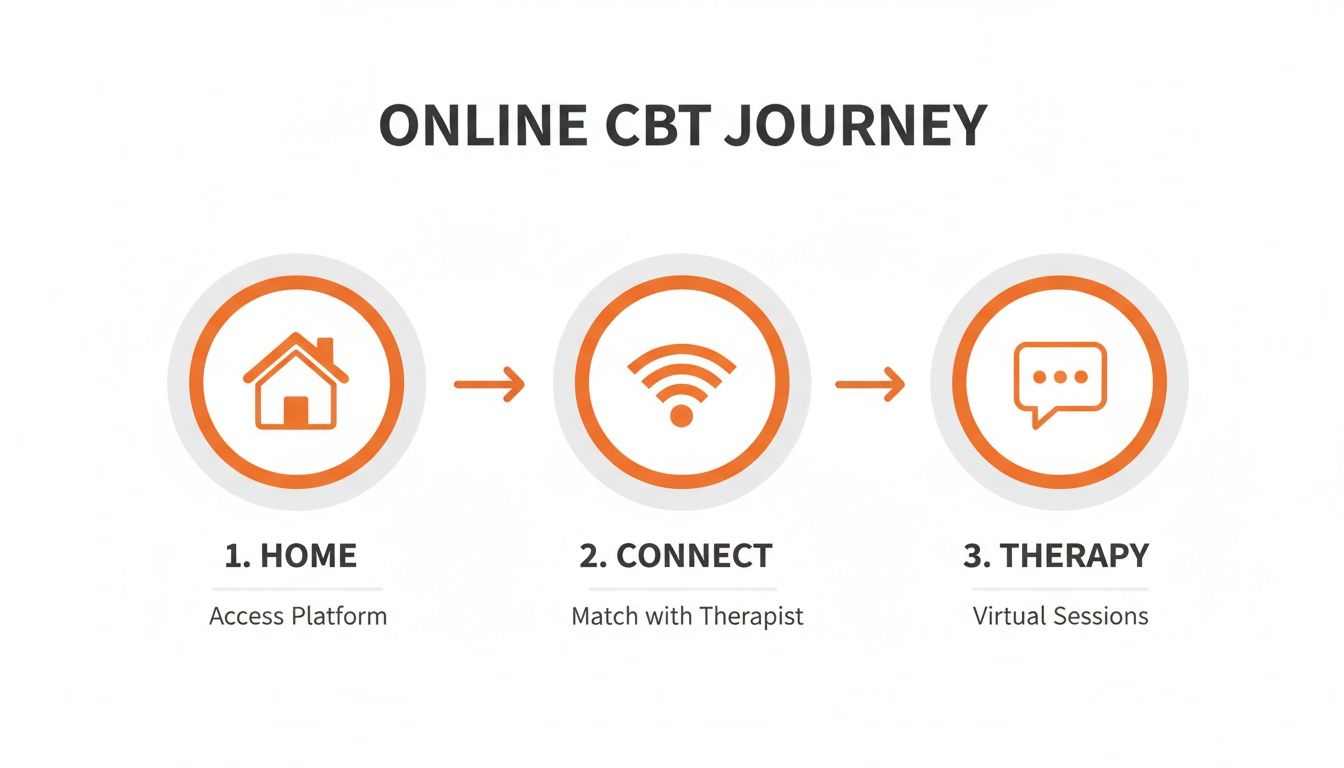
Modern therapy often integrates these tools right into the process, making it simpler than ever to get started from home and connect with the right support.
Personalizing Your CBT Plan with Data
This is where digital tools can make a huge difference in your cognitive behavioural therapy in Vancouver. Platforms like those from Orange Neurosciences provide therapists with the precise data needed to personalize your CBT plan right from the start. It’s not about replacing the vital human connection in therapy, but strengthening it with clear insights.
For instance, imagine your initial assessment shows a specific challenge with sustained attention. Armed with that knowledge, your therapist can do more than just talk about focus. They can build specific, targeted exercises right into your CBT sessions, like mindfulness techniques proven to strengthen attention or practical experiments designed to help you manage real-world distractions.
Objective data helps your therapist shift from a generalized approach to a highly personalized strategy. It’s the difference between using a standard map and having a GPS that pinpoints your exact location and the best route forward.
Tracking Real, Measurable Improvement
One of the most powerful aspects of using assessments is seeing your progress over time. Instead of relying solely on your memory of how you felt a month ago, you can compare your cognitive performance before, during, and after a block of therapy.
Here's an actionable way to use this data:
Establish a Baseline: An initial assessment creates a snapshot of your cognitive functions before you even start CBT.
Monitor Changes: Follow-up assessments can reveal improvements in areas like your processing speed or executive function as you put new skills into practice.
Validate Progress: Seeing your scores improve is incredibly motivating. It provides concrete proof that the hard work you're putting in is truly paying off.
This process gives both you and your therapist concrete evidence of change. It helps validate your efforts and provides a clear picture of how the skills you’re learning are strengthening your cognitive resilience.
This data-informed approach helps fine-tune your therapy, making sure you’re always working on the skills that will make the most impact. To see how these tools can support your therapeutic journey, visit our website to learn more about our cognitive assessments for individuals and therapists. If you have any questions, our team is here to help at info@orangeneurosciences.ca.
Common Questions About CBT in Vancouver
It’s completely normal to have questions before starting something new, especially therapy. To help you feel more prepared for the journey ahead, we’ve put together answers to some of the most common things people ask about starting cognitive behavioural therapy in Vancouver.
How Long Does CBT Take to Work?
One of the great things about CBT is that it’s built to be a short-term, focused approach. While everyone’s path is different, many people start to feel a real shift and see positive changes within just 8 to 12 sessions.
Right from your first appointment, you’ll work with your therapist to outline clear, manageable goals. For example, a goal might be "to be able to attend a work social event for one hour without leaving" or "to reduce the number of panic attacks from three a week to one." This isn't just talk; it's about creating a roadmap so you can both see and measure your progress.
What Is a Typical CBT Session Like?
Forget the idea of lying on a couch and talking aimlessly. A CBT session is more like an active, collaborative workshop for your mind. It’s structured, and it’s productive.
Each session is a partnership. You're actively learning by doing, with your therapist acting as your expert guide. The focus is on building real-world skills you can apply immediately.
Here’s a practical breakdown of a typical session:
Action: You'll set an agenda together at the start to keep things on track. (e.g., "Today, let's focus on the anxiety I feel when driving over the Lions Gate Bridge.")
Action: You'll review your progress and discuss how the skills or "homework" from the previous week went. (e.g., "How did the breathing exercise work when you felt anxious?")
Action: You'll then work together on the main challenge, practicing a new skill. (e.g., Identifying and challenging the thought "What if I lose control of the car?")
Action: Before you leave, you’ll agree on a new practical exercise to try before your next meeting. (e.g., "This week, drive over the bridge once during off-peak hours and use the thought-challenging technique we just practiced.")
Is CBT Only for Anxiety and Depression?
While CBT is famous for its incredible success in treating anxiety and depression, its toolkit is far more versatile than many people realize. It’s proven to be highly effective for a wide range of other challenges.
Because CBT gets to the root of unhelpful thought patterns that cause distress, the skills you develop can be applied to many different parts of your life. For example, the same techniques used to challenge anxious thoughts can be used to manage the catastrophic thinking associated with chronic pain, or the rigid rules of behaviour seen in OCD. This includes helping you manage everything from panic attacks, phobias, and OCD to PTSD and even chronic pain.
Ready to take the next step and see how objective data can enhance your therapeutic journey? Orange Neurosciences provides evidence-based cognitive assessment tools that give you and your therapist a clearer picture of your progress.
Explore our solutions at https://orangeneurosciences.ca or contact our team directly by email at info@orangeneurosciences.ca to learn more.

Orange Neurosciences' Cognitive Skills Assessments (CSA) are intended as an aid for assessing the cognitive well-being of an individual. In a clinical setting, the CSA results (when interpreted by a qualified healthcare provider) may be used as an aid in determining whether further cognitive evaluation is needed. Orange Neurosciences' brain training programs are designed to promote and encourage overall cognitive health. Orange Neurosciences does not offer any medical diagnosis or treatment of any medical disease or condition. Orange Neurosciences products may also be used for research purposes for any range of cognition-related assessments. If used for research purposes, all use of the product must comply with the appropriate human subjects' procedures as they exist within the researcher's institution and will be the researcher's responsibility. All such human subject protections shall be under the provisions of all applicable sections of the Code of Federal Regulations.


© 2026 by Orange Neurosciences Corporation